THE NIBBLE BLOG: Products, Recipes & Trends In Specialty Foods


Also visit our main website, TheNibble.com.

BOOK REVIEW: Life, On The Line


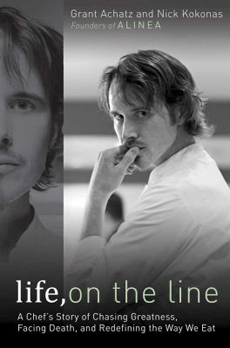
Life, On The Line, has a double meaning. Photo courtesy Gotham Books.
 

Uber-foodies know the name Grant Achatz (pronounced AK-its), the wunderkind chef whose brilliant career, laden with the top honors and awards,* almost came to a tragic end.

In 2007, the year after his Chicago restaurant, Alinea, was named the best in the country by Gourmet magazine, Achatz was diagnosed with Stage IV squamous cell carcinoma cancer of the tongue (there is no Stage V). The protocol to save his life was to remove his tongue and part of his jaw, which would have ended his ability to taste and to speak. He was 33 years old, one of the world’s great young chefs.

Fortunately for Achatz and his many friends and fans, his business partner, Nick Kokonas, found a clinical trial at the University of Chicago, which used chemotherapy and radiation instead of surgery. Treatment was gruesome but successful; the chef’s sense of taste, obliterated by the treatment, ultimately returned. The food-loving universe sends a million thanks to Kokonas and the doctors involved.

In October 2008, Achatz and Kokonas published Alinea, a hardcover coffee table book featuring more than 100 of the restaurant’s recipes (exquisite, but not for the beginner!).


In March 2011, the team’s second book, Life, on the Line: A Chef’s Story of Chasing Greatness, Facing Death, and Redefining the Way We Eat, was published. It is now available in paperback and Kindle editions.

Life, On The Line

We received a review copy earlier this year, but it got fused into a pile of books waiting to be read (the pile is 44 inches high). Finally, with a rare day of free time (Independence Day, like most national holidays, is one of our book catch up days), we cracked it. We started reading in the morning, headed to a friend’s house, plopped onto a chaise longue and breezed through all 390 pages before we went to sleep—taking an hour or so to watch the fireworks and interact with other house guests.

Beautifully written (the voices of Achatz and Kokonas are virtually identical, leading us to guess that a professional writer iced the cake, as it were), we eagerly devoured chapter after chapter.

*Food & Wine’s “Best New Chefs,” 2002; James Beard Foundation”s “Rising Star Chef Of The Year,” 2003; Gourmet magazine’s “Best Restaurant in America,” 2006; James Beard Foundation’s “Outstanding Chef,” 2007; Restaurant magazine’s “#1 Restaurant in North America” and “#7 Restaurant In The Word,” 2010.


Life, On The Line has a double meaning, detailing Achatz’s life as a chef on the kitchen line and his almost miraculous survival, when the cancer put his life on the line. Like many top chefs, he has a passion, energy and work ethic that seem almost unbelievable. There are many people who work ridiculously long hours, but few of those jobs require the combination of constant creativity, staff supervision and training, and pressure to produce perfection for five or six hours at the end of a long day—not to mention standing on your feet in a hot kitchen.

Young Grant, who grew up in the small town of St. Clair, Michigan, began his culinary career peeling vegetables and cracking eggs in his grandmother’s café—a family affair that included his mother and aunts. He notes, “I never got an Easy Bake oven or a play kitchen. I played every day at the Achatz Café….”

His parents then started their own successful restaurant, and by high school he had assumed weekly shifts at Achatz Depot—alongside his parents, uncles and cousins.

 
Grant Achatz receiving a 2009 James Beard Award, one of several different Beard Awards, for his Alinea cookbook. Photo courtesy James Beard Foundation.
 

From Student To Star

After high school, Achatz headed to the prestigious Culinary Institute of America. He began a restaurant externship at Grand Rapids’ finest restaurant, starting at the lowest level: peeling vegetables and prepping ingredients for the meals, making soups and salad dressings. In a mere month, he was moved to the roast/grill station on the hot line—a fast-track promotion for the 19-year-old culinary student.

To fast-forward: Achatz then began as a commis, or prep cook (from the French word for assistant), at the celebrated French Laundry in Napa Valley. (Do you know the different positions in a professional kitchen?
Here they are, from top (chef de cuisine or executive chef) to bottom (kitchen assistant).

French Laundry was then regarded as the best restaurant in America (and remains a contender for top honors, depending on who’s creating the list). Achatz rose to sous-chef under mentor Thomas Keller before taking over the kitchen at Trio, outside of Chicago. One of his best customers was Nick Kokonas, who three years later bankrolled his next move: chef/co-owner of Alinea. Far more than serving as financier, Kokonas became the all-around business partner most entrepreneurs can only hope for.

The heart and soul of the book is Achatz’s journey from culinary school to top of the world at a very young age. No prima donna, he is Everychef. His path was similar to that of many gifted chefs, most of whom work fourteen hour, backbreaking days to create beautiful cuisine. Not every chef wins the accolades Achatz has and/or ends up owning a renowned restaurant, but most of them merit an A for effort. If you enjoy a great restaurant meal, Life, On The Line will give you a far greater appreciation of it.

Once Achatz and Kokonas begin to discuss a partnership, Achatz’s chapters alternate with those penned by Kokonas, who provides a perspective on restaurant development and management (not easy—another reason to more deeply appreciate that delicious meal).

The book comprises behind-the-scenes insights—general management and front of the house views from Kokonas, back of the house perspectives from Achatz. It’s a serious book, with one amusing section early on (amusing to us, frustrating to Chef Achatz):

The young culinary school graduate decides to leave his unhappy job at Charlie Trotter’s after eight weeks (read the Chapter 5 and you’ll see that writing well is the best revenge). Using his savings (“There aren’t a whole lot of ways to spend money in St. Clair or Grand Rapids….”), he embarks on what he believes will be an inspirational three-star restaurant tour of Europe, booking dinners at Les Crayères (average meal, condescending service), Georges Blanc (grey, overcooked squab and indifferent/insulting response from the chef and maitre ‘d) and Enoteca Pincchiori in Florence (good but not celestial). His best meal was at an unnamed family restaurant with superb home cooking, that happened to be on a bike route he took.

He returned to the U.S. and found his inspiration in California, with Chef Thomas Keller at The French Laundry. To get the tryout, he wrote a letter a day for fourteen days, telling Chef Keller why he wanted the job. The rest is culinary history.

If you’ve never had Achatz’s food, by the middle of the book you’ll feel as if you had. It’s a delicious gastronomic experience.

Alinea: A New Train Of Thought

Alinea is an editor’s mark denoting the beginning of a new train of thought, exemplified by a new paragraph. It is more commonly known as the paragraph mark, less commonly as the pilcrow. The literal translation from Latin, a linea, means “off the line.”

There’s a double meaning: Alinea represents a new train of thought about food, and as a restaurant, the food comes “off the line.” The line is the section of the kitchen where the food is cooked.

You have to know, or know of, Achatz’s food to be in love with this book. Then, you can see, smell and taste every dish he describes.

We were fortunate enough to dine twice at Trio during his tenure, and then at Alinea. We love the total experience he creates: innovative, intellectual, breathtaking and exquisitely delicious food, presented in new ways, down to the custom-made serving pieces designed to showcase a particular dish. Why serve a slice of seared foie gras with rhubarb purée, when you can purée the foie gras, mold it into a thin, hollow cylinder and fill it with rhubarb foam?

The presentation comprises small tastes of many different courses (maybe 18, maybe 40), that push the envelope and create a memorable evening.

Molecular Gastronomy

We are cautioned by Kokonas not to refer to the cuisine as molecular gastronomy, which is perceived of by some of its finest practitioners as having overtones of gimickry and mad-scientist cooking. The U.K.’s Heston Blumenthal dislikes the term, believing it makes the cuisine sound “complicated” (it is!) and “elitist” (it is!).

Ferran Adrià, the Catalan chef, has referred to his cooking as deconstructivist (not exactly tasty-sounding!). Deconstruction is a method in which the elements of a classic dish appear in a different shape or form.† Hervé This, the “father of molecular gastronomy,” reintroduced the concept in 2004 as “culinary constructivism.”

According to Blumenthal, whose restaurant, The Fat Duck, has been named the best restaurant in the world more than once (for the past three years, the honor has gone to Noma in Copenhagen, helmed by chef/co-owner, René Redzepi, an El Bulli alumnus):

“The fashionable term ‘molecular gastronomy’ was introduced relatively recently, in 1992, to name a particular academic workshop for scientists and chefs on the basic food chemistry of traditional dishes. That workshop did not influence our approach, and the term ‘molecular gastronomy’ does not describe our cooking, or indeed any style of cooking….

“We may use modern thickeners, sugar substitutes, enzymes, liquid nitrogen, sous-vide, dehydration, and other nontraditional means, but these do not define our cooking. They are a few of the many tools that we are fortunate to have available as we strive to make delicious and stimulating dishes” (see the entire statement).

Some chefs prefer the term “culinary physics” and “experimental cuisine.” Anything is fine with us: Just tell us what it is!

Otherwise, we nominate “innovation cuisine,” given that this decade’s innovation can become the next decade’s mainstream. To decide for yourself, check out some of the techniques here. There are emulification, fragrant foams, vapors, gelification, spherification, reverse spherification, other reshaped liquids, fatty liquids transformed into powders and other concepts from food science.

Here’s a history of molecular gastronomy. You can also pick up a copy of Hervé This’s book, Molecular Gastronomy: Exploring the Science of Flavor.

As Kokonas wrote in an online article: “A trip to El Bulli restaurant in Roses, Spain under the direction of chef Ferran Adrià let Grant know that you could take classical technique, apply equal measures of whimsy, intelligence, creativity and technology, and transform the dining experience.”

Some of Achatz’s dishes (from Trio and Alinea):

  • Essence of Pizza, ultra-thin potato starch paper imbued with flavors of garlic powder, tomato powder, paprika and fennel pollen, along with congealed mozzarella fat, the size of a stamp.
  • Cumin Candied Corn, a losenge of savory corn panna cotta wrapped in cumin-flavored sugar film.
  • Wild Turbot With Hyacinth Vapor, the fish in a small bowl set in a larger one filled with fresh hyacinth flowers, over which boiling water is poured to create an aromatic environment (other dishes had environments created from burning cinnamon sticks or oak leaves).
  • Stock set up to resemble a sponge, imbued with flavors of the sea.
  • A micro-sandwich of passionfruit sponge between layers of dehydrated prosciutto.
  • If you’re inspired by this menu, book a trip to Alinea. It’s not an easy reservation to get, but the book tells us that January is the slow month.

    January is not Chicago’s kindest month, but the experience will be worth it. Try to rea the book first.

    †In a simple example, think of Eggplant Parmesan, deconstructed. Instead of the fried eggplant slices baked with mozzarella and tomato sauce, the eggplant is sautéed in olive oil and topped with ricotta and sauce. Instead of breaded slices, bread crumbs are used as a garnish.


    Comments off

    TIP OF THE DAY: Make Olive Oil Ice Cream


    Olive oil ice cream (photo © Funkybg | Dreamstime).

      Ice cream is our favorite food, so we look for special ways to celebrate in July, National Ice Cream Month. A delicious olive oil ice cream recipe (you heard that right!) is below.

    But first, we treated ourselves to three pints of Jeni’s Splendid Ice Creams, at $12.99 per pint. We found them in a specialty food market in New York City: Columbus, Ohio-based Jeni’s has begun distribution to specialty stores nationwide (see the store locator on the Jeni’s website). Jeni’s sells pints for $12.00, but the extra 99¢ was far better than the alternative of paying $65.00 in overnight shipping to get them from Columbus.

    Jeni’s Splended Ice Creams are indeed splendid. Flavors such as Goat Cheese With Cherries and Sweet Corn are burned into our memory as the best ice cream we’ve ever had. The high price reflects the quality of the ingredients—it’s impossible to use better ones. You can taste the distinctive flavor of the local, grass-fed milk and cream.

    But budget is a consideration for us, so for less than half the price, we’ll stick to Talenti Gelato. Both were NIBBLE Top Picks Of The Week (here are our reviews of Jeni’s and Talenti). But to our palate, Talenti Gelato is the best price-value ice cream out there: superpremium ice cream without the superpremium price.

     
    For ice cream devotées, Jeni’s is a must-try. If there’s no Jeni’s near you, pick up a copy of Jeni’s ice cream cookbook.

    Next, in honor of National Ice Cream Month and some very fruity Olave olive oil from Chile, we made our own ice cream: olive oil ice cream. (Fruity is just one of the flavor profiles of olive oil. See the others).

    Olive oil ice cream?

    If that sounds unusual to you, it was a new concept to us as well, when we first tried it in 2004. The occasion was the opening of Mario Batali’s pizzeria, Otto, in New York City. There was much to explore on the menu.

    After a selection of appetizers and a pizza with lardo, we were handed the dessert menu and saw a collection of homemade gelato made by pastry chef Meredith Kutzman. We ordered the olive oil gelato—and liked the extra-creamy elegance so much that we had another dish! (Here’s the difference between ice cream and gelato.)


    OLIVE OIL ICE CREAM RECIPE

    In a basic custard base, olive oil substitutes for some of the heavy cream. There are as many recipes as there are recipe tweakers. Emeril Lagasse, for example, uses fewer egg yolks but amps up the fat by using half and half instead of milk. He also adds a teaspoon of vanilla extract. You can do your own tweaking to find your ideal recipe.

    The key is great-tasting olive oil. You should be able to drink it from the spoon and say, “Delicious!”

    Ingredients

  • 1-1/3 cups whole milk
  • 1/2 cup sugar
  • Pinch of salt
  • 1-1/2 cups heavy cream
  • 6 large egg yolks
  • 2/3 cup fruity Chilean extra virgin olive oil
  • Garnish: a drizzle of olive oil and a sprinkle of Himalayan or Maldon salt
  •  
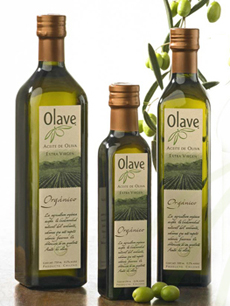
    Olave is a fruity-style olive oil from Chile. You can buy it online (photo © Olave Olive Oil).
    _________________

    *We used fruity organic olive oil from Olave. You don’t want to use a peppery or grassy olive oil. See the different olive oil flavor profiles.

    Preparation

    1. WARM the milk, sugar, and salt in a medium saucepan.

    2. WHISK the egg yolks in a separate medium bowls. Slowly pour the warm mixture into the egg yolks, whisking constantly. Then scrape the warmed egg yolks into the saucepan.

    3. STIR the mixture constantly over medium heat with a heatproof spatula, scraping the bottom as you stir, until the mixture thickens and coats the spatula. Turn off the heat when the custard just slightly thickens.

    4. POUR the cream into a large bowl and set a mesh strainer on top. Pour the custard through the strainer and stir it into the cream.

    5. WHISK the olive oil into the custard and cream mixture until it’s well blended; then stir until cool over an ice bath.

    6. CHILL the mixture thoroughly in the refrigerator, then freeze it in your ice cream maker according to the manufacturer’s instructions. Yield: 1 quart.
     
     
    THE NEXT BEST THING

    If you don’t want to make olive oil ice cream from scratch, use fine olive oil as a topping for vanilla ice cream.

  • DRIZZLE olive oil over the top, as you would a syrup.
  • GARNISH with a pinch of coarse sea salt (for a salty counterpoint plus crunch). Pink Himalayan sea salt is especially lovely, as is the pyramid-shaped Maldon salt, which is also available in a wonderful smoked version.
  •  


    Comments off

    TIP OF THE DAY: 10 Uses For Bananas & Banana “Ice Cream” Recipe


    We didn’t buy quite this many, but it sure
    seemed like it! Photo by Alessandro Paiva |
    SXC.
      We were overly enthusiastic when we purchased a very large bunch of bananas at an excellent price. But of course, it’s no bargain if half of them spoil.

    There were far more bananas than we could eat. It’s been too hot to turn on the oven to bake banana bread. And our overstuffed freezer precluded making banana ice cream (one of our favorites!).

    Fortunately, we received our weekly email from Care2.com—one of our favorite e-newsletters—promising 15 ways to use bananas.

    Written by Katie Waldeck, we repeat most of them here in edited form. Here’s the original article.

    We haven’t tried them (except for the banana soft serve), so let us know what you think.

     
    10 USED FOR BANANAS

    Beauty

    1. Condition Your Hair. Use Dr. Oz’s banana hair treatment.

    2. Whiten Your Teeth. Don’t throw away the peel: Rub the inner side on your teeth for about two minutes before brushing. The magnesium, manganese and potassium in the peel will help to whiten your teeth naturally.

    3. Make A Facial Mask. An anti-aging mask made from mashed bananas, heavy cream, honey and oat flour? Sounds like banana pudding! Here’s the recipe. Don’t let the dog get too close.

    4. Make A Sugar Scrub. Whip up a scrub to exfoliate your skin. Here’s a recipe. Make a double batch and bring some to a friend (keep it in the fridge until ready to use, and use it within a few days).


    Health

    5. Insect Bite. If you don’t have any cortisone cream or other medication, rub the inner banana peel on the bite to alleviate the itch.

    6. Splinter. Press the inside of the banana peel onto the splinter. The fruit’s natural enzymes are said to raise the splinter so you can remove it more easily.

    House & Garden

    7. Polish Leather & Silver. Rub the banana peel on the item and buff with a cloth. Hmm…test it on older shoes before trying it with the Louboutins.

    8. Fertilize Plants. Instead of tossing the banana peels, dry them and grind them into an excellent mulch for seedlings and young plants. Some say that the peels can also fight off aphids. But as one member of a gardening forum added to the conversation thread, “About the only way a banana peel would eliminate aphids would be if you placed the aphids on a flat surface and beat them with it.”


    Bananas growing on the tree. Photo by Sergio Roberto | SXC.


    In The Kitchen

    9. Dog Treat. Bananas are a perfectly safe, and perfectly healthy, treat for your beloved pooch!

    10. Make “Soft Serve.” Turn those extra bananas into a healthful and lower calorie approximation of soft serve ice cream. Make as much as you plan to eat at one time.

  • PEEL the bananas and cut into small pieces.
  • FREEZE for 2 hours and toss into a food processor.
  • BLEND in a food processor, scraping down the bowl as necessary, until the frozen chunks turn into “soft serve.”
  •  
    BANANA TRIVIA

    The banana “tree” is actually a jumbo perennial herb with huge leaves. The word “banana” is derived from the Arab word for finger, “banan,” referring to the fact that the bananas in a bunch look like fingers.

    Enjoy more banana trivia and the history of bananas.
      

    Comments off

    Nitrite-Free Fearless Franks From Niman Ranch


    Trade up to better franks. Photo courtesy Niman Ranch.
      Yesterday when we put the dogs on the barbie, they were uncured Fearless Franks from Niman Ranch.

    Not all hot dogs are created equal. Many supermarket brands are full of fat instead of meat and make up for the lower-quality meat by over-spicing.

    Bite into a Fearless Frank and you taste superior quality meat plus a delightful smokiness. The texture is firm and toothsome. The franks are fearless because the meat is free of antibiotics, added hormones, and nitrites, and is fully traceable.

    The all-beef franks are naturally cured with a proprietary blend of celery juice and spices. They give peace of mind to those who prefer nitrate-free preparations.

    Fearless Franks are more expensive but well worth it. The mantra: Eat better meat; if cost is an issue, eat less meat.

    You can buy Fearless Franks at Whole Foods Markets and other fine retailers, as well as online from Niman Ranch.

    > The history of hot dogs.

    > A brief history of meat preservation is below.


    THE DIFFERENCE BETWEEN CURED & UNCURED MEATS

    Cured meats (bacon, ham, contain the chemical preservatives sodium nitrite and (or) sodium nitrate. Sodium nitrate is added to preserve and enhance a meat’s flavors and shelf life.

    When nitrates break down through cooking, digestion, or other means, they form nitrites, which are potential carcinogens.

    Manufacturers and the USDA claim that the level of nitrates/nitrites is too low to cause problems. But there is enough of a controversy that it makes some people wary of ingesting nitrates and nitrates. They’ve given up hot dogs and other cured meats.

    Instead, look for uncured hot dogs, like Fearless Franks.


    Why Are Nitrates Used?

    Nitrates and nitrites are chemicals that occur naturally in all plant foods and some animal products.

    Both substances are extraordinarily useful to processed meat manufacturers. They provide cured meats with their characteristic flavor and pink color. These chemicals are also very important in food preservation; they’re especially good at inhibiting the growth of microorganisms, including those that cause botulism. They’ve been used for these purposes since the late 1800s.

    The chemical reactions leading to the creation of carcinogens are not subject to speculation, nor are the formations of the carcinogens themselves. Both are well-documented. Although carcinogens have been demonstrated to cause cancer in laboratory animals, and some research has suggested that individuals with heavy consumption of cured meats have higher risks of colon and pancreatic cancers, no research has shown definitively that they also cause cancer in humans.

     
    Uncured franks are made without nitrites. Photo courtesy Niman Ranch.
     
    This is why to many people, nitrates and nitrites are a non-issue.
     
     
    A BRIEF HISTORY OF MEAT PRESERVATION

    Ancient man preserved meat by cooking it until most of the moisture (which allows bacteria to grow) was removed. The result: jerky.

    Later, man searched for a less chewy solution, and found it in salt and saltpeter (the natural form of potassium nitrate).

    During modern times, a product called pink salt contains a standardized amount of sodium nitrite (it’s not the same product as the gourmet pink Himalayan sea salt) has become the preferred medium for curing and preserving meats.

    The use of nitrites and nitrates in the production of cured meats is now carefully regulated, with a concentration not to exceed 200 parts per million in finished products. Thus, The amount of nitrates and nitrites you ingest when eating cured products is considered to be negligible and, according to the USDA, does not pose any health risk.


    CHECK OUT WHAT’S HAPPENING ON OUR HOME PAGE, THENIBBLE.COM.


    Comments off

    COOKING VIDEO: Vegetarian Italian Sausage


    Since this week’s Top Pick is the Veggie Patch vegetarian line, our weekly video recipe follows suit.

    These delicious vegetarian sausages are billed as vegetarian in the video, but they’re actually vegan—no animal-based ingredients are used. Even the special flavoring, Bill’s Best Chik’Nish Seasoning, is vegan.

    The meatless sausages are made with a base of gluten flour and garbanzo bean flour, plus all of the traditional Italian sausage seasonings: garlic, onion, chili flakes, fennel seeds, oregano, pepper and paprika.

    You don’t have to stuff sausage casings, either. Because the flours act as bonding agents, the ingredients form a dough that is hand-rolled into sausage shapes, then steamed.

    Make them for yourself, or as a gift for a vegetarian or vegan friend.


    Comments off

    The Nibble Webzine Of Food Adventures
    RSS
    Follow by Email


    © Copyright 2005-2026 Lifestyle Direct, Inc. All rights reserved. All images are copyrighted to their respective owners.