THE NIBBLE BLOG: Products, Recipes & Trends In Specialty Foods


Also visit our main website, TheNibble.com.

TIP OF THE DAY: S’mores DIY Dessert Party Bar


Above: Just one of the options for a s’mores party bar. Image courtesy McCormick.
 

Since the Girl Scouts popularized s’mores (the first published recipe is in their 1927 handbook), they have been a happy tradition around the campfire. Two marshmallows toasted on a stick, a square of chocolate and two graham crackers make a delicious chocolate marshmallow sandwich.

The heat from the toasted marshmallow melts the chocolate a bit to add more lusciousness. The name of the sweet sandwich snack comes from its addictive quality: You’ll always ask for “some more.”

These days, the grill most often replaces a campfire, but the treat is just as sweet. And the original concept has given way to different riffs on s’mores.

This set of s’mores-inspired recipes, from McCormick, doesn’t even need a grill. It uses marshmallow creme, and sets up a build-your-own s’mores bar that offers different cookies in additional to graham crackers.

Want more than a cookie sandwich? Make “ice cream s’mores” by crumbling the cookies and piling the ingredients atop a scoop of vanilla.

Of course, you can use your own favorites instead of these ideas. Brainstorm with family and friends to come up with winning combinations:

  • Banana Split S’mores: vanilla wafers + vanilla marshmallow creme + chocolate sauce + chopped grilled bananas and strawberries
  • Chocolate Pretzel S’mores: graham crackers + mini chocolate covered pretzels + vanilla marshmallow creme + caramel sauce
  • Peach Melba S’mores: shortbread cookies + vanilla marshmallow creme + raspberry jam + chopped grilled peaches
  • Peanut Brittle S’mores: peanut butter cookies + vanilla marshmallow creme + caramel sauce + toffee bits and chopped peanuts
  • Raspberry Lemon Bar S’mores: sugar cookies + vanilla marshmallow creme + lemon curd + halved raspberries
  •  

    MORE S’MORES RECIPES

    We love the combination of chocolate, marshmallow and graham crackers in any combination. You can:

  • Make s’mores on a stick by dipping plain (not toasted) marshmallows in chocolate and rolling them in graham cracker crumbs.
  • Make s’mores pie by filling a graham cracker crust with marshmallow ice cream (see below) and topping with chocolate sauce.
  • Make a s’mores sundae or parfait with marshmallow ice cream (see below), chocolate sauce and crushed graham crackers.
  • Here are variations on the classic s’mores recipe:

  • Cinnamon S’mores & Cappuccino Cocktail
  • Classic S’mores Recipes
  • Grilled Banana S’mores
  • Ice Cream S’mores Recipes
  • S’mores On The Grill
  •  
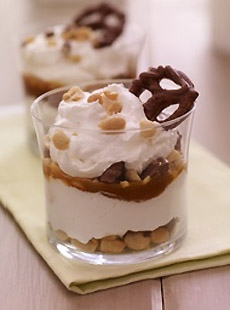
    S’mores sundae: crumble the cookies on top. Photo courtesy McCormick.com.
     
    MARSHMALLOW ICE CREAM

    If you can’t find marshmallow ice cream in the store, here are two ways to create it:

    Vanilla Ice Cream + Marshmallows: Soften a container of vanilla ice cream enough to be pliable, mix in halved mini marshmallows and return to freezer.

    Toasted Marshmallow Ice Cream: For even more flavor, toast the marshmallows first. Here’s a recipe for toasted marshmallow ice cream.


    Comments off

    RECIPE: Tomato & Watermelon Salad With Ricotta Salata


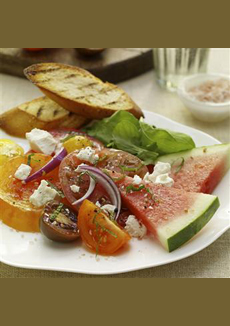
    Tomato and watermelon salad: delicious! (photo © McCormick).

    [2] Ricotta salata, a good “salad cheese.” There’s more about ricotta salata below(photo © Good Eggs).
     

    It‘s not red, white and blue, but we can’t wait to serve this salad over July 4th weekend. It’s a riot of different flavors, accented with ricotta salata, a firm Italian cheese with a mildly salty flavor. (If you can’t find it, substitute feta.)

    The summer salad recipe is courtesy McCormick.com, which has many yummy recipes.
     
     
    HEIRLOOM TOMATO & WATERMELON SALAD
    WITH RICOTTA SALATA

    Ingredients

  • 1/4 cup extra virgin olive oil
  • 2 tablespoons raspberry vinegar
  • 1/4 teaspoon sea salt
  • 1/4 teaspoon black pepper, coarsely ground
  • 2 tablespoons julienne-cut fresh basil
  • 2 tablespoons julienne-cut fresh mint
  • 2 to 3 cups loosely packed arugula leaves
  • 4 large heirloom tomatoes, assorted varieties, cut into 1/4-inch thick slices (about 3 pounds)
  • 16 wedge-shaped slices ricotta salata, 1/4-inch thick (about 6 ounces)
  • 16 wedge-shaped slices seedless watermelon, 1/4-inch thick
  • 1/4 cup thinly sliced red onion
  • 8 diagonally sliced French bread slices, 1/2-inch thick, grilled (optional)
  •  
    Preparation

    1. MIX oil, vinegar, sea salt and pepper in small bowl until well blended. Mix basil and mint in small bowl. Set aside.

    2. ARRANGE 1/4 cup loosely packed arugula leaves on each of 8 plates. Divide tomato slices, ricotta salata and watermelon among plates. Arrange decoratively as desired.

    3. SPRINKLE basil-mint mixture and red onion evenly over each salad. Drizzle with dressing. Sprinkle with additional sea salt and pepper, if desired. Serve with grilled bread slice, if desired.


    ABOUT RICOTTA SALATA

    Most people are familiar with the fresh, soft form of ricotta. As a fresh cheese, it has a limited shelf life.

    To extend its life, long ago the ricotta was salted, baked and smoked. Today the pressed, salted, dried and aged version of ricotta is known as ricotta salata (salted ricotta).

    The cheese, made in wheels, is milky-white and firm. It is used for grating or shaving. In addition to salads, grate it over potatoes, rice, soups and grilled vegetables.


    Comments off

    TIP OF THE DAY: Your Own Signature French Fries

    While the Belgians may or may not have invented what we call French fries (see the history below), they do consume the most French fries per capita of any country in Europe. And we would have thought that Americans took that prize!

    Call them French fries or simply fries in America, chips in the U.K. or American fries in many parts of the non-European world: It’s hard to find anyone who doesn’t like julienned, fried potatoes and the other shapes that evolved from them: crinkle fries, curly fries, shoestring fries, steak fries, waffle fries, wedges, etc.

    And then, there are French fry toppings that create new dishes, from chili cheese fries to the beloved Canadian dish, poutine: brown gravy and cheese curds atop fries.


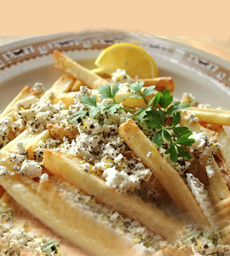
    Fries Greek-style, with crumbled feta and oregano. Photo courtesy Stix Mediterranean Grill | New York City.

     
    So your culinary challenge of the week is to come up with your own own signature topping for fries. Here are some categories to choose from and some examples in each:

  • Cheese: blue, cheddar, feta, goat, parmesan, truffle cheese
  • Condiments: aïoli (garlic mayonnaise) or other flavored mayo (curry, dill, horseradish, parsley, etc.), barbecue sauce, chutney, Dijon or honey mustard, flavored ketchup, hot sauce, seasoned salt, sour cream, tartar sauce
  • Fresh herbs & spices: capers, chili flakes, cracked pepper, curry, dill, oregano, parsley, scallions or other favorite
  • Proteins: bacon, chili, cooked chopped beef with onions, fried/poached egg, pulled chicken or pork
  • Sauces & oils: flavored olive oil (we love truffle oil), gravy, malt vinegar or vinaigrette, salad dressing (blue cheese, ranch, thousand island), salsa, tomato sauce, yogurt sauce (like this tzatziki recipe)
  •  
    The photo above shows the Greek fries from Stix Mediterranean Grill in New York City: crumbled feta cheese and oregano. Flex Mussels, one of our favorite specialty restaurants, serves truffle fries with grated parmesan and truffle oil. It’s worth the $11! (Check out the 20 different flavors of steamed mussels.)

    THE HISTORY OF FRENCH FRIES

    French fries are not French in origin, experts agree. Credit may go to the Belgians. But let’s start in the beginning.

    The potato is a New World food which grew wild in Peru. It was cultivated and spread to other parts of Latin America.

    In 1537, Gonzalo Jiménez de Quesada, a Spanish explorer and conquistador, was exploring a village in Colombia. He and his troops found the locals eating potatoes, which were small and bitter. Initially, the Spaniards called them “truffles” because they grew underground. Samples were brought back to Europe and bred into larger, less bitter versions. But they were used as animal feed: Along with tomatoes, they were thought to be poisonous to humans.

    We don’t know exactly when the first human ate a batch of sliced, fried potatoes. Historical accounts indicate that the Belgians might have been frying up thin strips of spuds in the late 17th century, as a substitute for fried fish when the rivers were iced over.


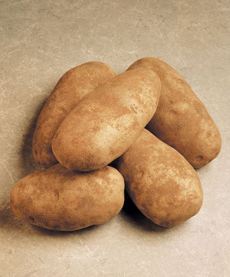
    Burbank, Idaho and russet potatoes are
    best for fries. Photo courtesy Idaho Potato
    Commission.
     

    What was happening in France? Like other Europeans, the French were growing potatoes for hog feed. In fact, convinced that potatoes caused leprosy, the French Parliament banned cultivation of potatoes in 1748.

    Potatoes as human food had one champion, a French army medical officer named Antoine-Augustine Parmentier. While a prisoner of war, he was forced to eat potatoes and found the “poison” theory simply wasn’t true. In 1772, the Paris Faculty of Medicine finally proclaimed that potatoes were edible for humans, though it took a famine in 1785 for the French to start eating them in earnest.

    In 1802, Thomas Jefferson’s White House chef, Honoré Julien, a Frenchman, served “potatoes served in the French manner” at a state dinner. The potatoes were “deep-fried while raw, in small cuttings.” This is one of the earliest references to “French” fries. You can read the details here.

     
    FRENCH FRY TRIVIA

  • What’s in a name? The word “potato” comes from the Haitian word “batata,” which is their name for the sweet potato. It entered Spanish as “patata” and eventually into English as “potato.”
  • Why a spud? The slang term for potato, “spud,” comes from a spade-like tool used to harvest potatoes in earlier times.
  • Condiments. In the U.S., ketchup is typically the condiment of choice. In the U.K., it’s malt vinegar. In much of Europe, it’s mayonnaise. But the French typically enjoy their fries without condiments.
  • Belgian-style fries. In Belgium, a raw egg is sometimes cracked over French fries hot from the fryer. The heat cooks the egg, leaving a runny the yoke as a dip for the fries.
  •  
    WHY DO ONLY SOME TYPES OF POTATOES MAKE GOOD FRIES?

    You need a floury/starchy potato variety, which is lower in moisture (drier). Examples include Idaho, russet and russet Burbank. Check out the different types of potatoes.


    Comments off

    PRODUCT: Megaload, Chocolate Candy With Double The Pleasure

    Megaload isn’t the name we’d have given to this candy line. It’s more like “double the fun.”

    Created by someone who obviously couldn’t decided among different treats, Megaload offers peanut butter cups and caramel cups topped with other favorite sweet snacks:

  • Almond buttercrunch
  • A chocolate chip cookie
  • A chocolate-covered pretzel
  • A chocolate sandwich cookie (think Oreo)
  • Candy coated chocolate pieces (think M&Ms)
  • Peanut buttercrunch
  •  
    Hmm…where to start? Photo courtesy Megaload.
     

    Packages of three cups include:

  • “Sweet and Salty,” peanut butter cups topped with different chocolate-covered pretzels
  • “Caramel Crunch,” caramel cups topped with buttercrunch or candy coated chocolate pieces
  • “Original,” peanut butter cups topped with chocolate chip cookie, “Oreo” and “M&Ms”
  • This is fun “kids’ candy,” not gourmet chocolate. But adults who enjoy PB cups and caramel cups will like them just as much.

    Right now they’re available at Amazon.com, and soon will be coming to a Walmart near you.
      

    Comments off

    Boozy Milkshake Recipe For National Vanilla Milkshake Day


    [1] Celebrate with a vanilla milkshake (photo © Inga Nielsen | iStock Photo).

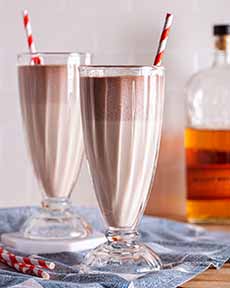
    Two Chocolate Milkshakes In Tall Milkshake Glasses
    [2] The original milkshakes were alcoholic. You can add a shot of Irish cream liqueur or even rum or whiskey to your shake (photo © Gelson’s Markets).

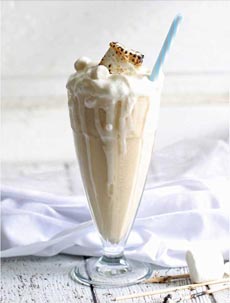
    Toasted Marshmallow Garnish on  Peanut Butter Milkshake
    [3] A peanut butter milkshake with a toasted marshmallow garnish. Here’s the recipe (photo © The Thirsty Feast | Honey And Birch).


    June 20th is National Vanilla Milkshake Day, and we’ve got some delicious recipes.

    A milkshake is a simple combination of ice cream, milk, and syrup, combined in a blender and optionally garnished with whipped cream, a maraschino cherry, or sprinkles (you can be more daring with chocolate-covered coffee beans, mini chips, etc.).

    Adults can add a shot of whiskey or liqueur.

    You can also substitute another flavor of ice cream.

    > The history of the milkshake is below.

    > Also below is the difference between a milkshake, float, malt, and thick shake.

    > Plus, more milkshake recipes below.

    Elsewhere on The Nibble:

    > The year’s 8 ice cream drink holidays.
     
     
    RECIPE: CLASSIC VANILLA MILKSHAKE

    Ingredients For 6 Half-Cup Servings

  • 1 pint vanilla ice cream
  • 1 cup milk
  • Optional: 2 tablespoons to 1 shot of spirits: bourbon, whiskey, liqueur/schnapps (try butterscotch, chocolate, coffee, or vanilla), cream liqueur
  • 1 tablespoon vanilla syrup or pure vanilla extract
  • Optional garnish: cherry, sprinkles, whipped cream
  •  
    Preparation

    1. PLACE ice cream, milk, alcohol, and syrup/vanilla in a blender. Cover and blend on high speed until smooth.

    2. POUR into glasses. Garnish as desired and serve immediately.

    More ice cream in the mix makes a thicker shake.
     
     
    MORE MILKSHAKE RECIPES

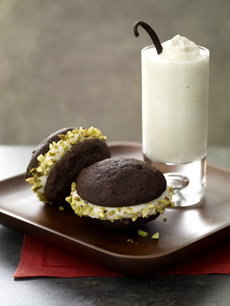
    If you like cardamom, try this delicious vanilla cardamom milkshake shooter.

    How about a milkshake with gin? The original milkshakes were alcoholic!

  • Boozy Mojito Milkshake
  • Classic Chocolate Milkshake
  • Easter Milkshake (Change The Colors For Other Holidays)
  • Frappe, A New England-Style Milkshake
  • Gin Martini Milkshake
  • Orange Mezcal Milkshake
  • Patriotic Milkshake
  • Pumpkin Milkshake With Bourbon
  • Salted Caramel Milkshake With Guinness & Spiced Rum
  • Salted Watermelon Milkshake
  • Vanilla & Pear Milkshake With Beer & Vodka
  •  
    The history of the milkshake follows.


    MILKSHAKE HISTORY

    Most people know a “milkshake” as a cold beverage made from milk, ice cream, and often, syrup, served in a tall, fluted glass with a straw (the classic milkshake glass is known as a Y glass).

    The Random House Dictionary describes a milkshake as an American creation, “a frothy drink made of cold milk, flavoring, and usually ice cream, shaken together or blended in a mixer.” And it states that the word dates to 1885.

    That’s when the word “milkshake” is first found in print. But that original milkshake was not suitable for children or teetotalers. It was an alcoholic drink, a “…sturdy, healthful eggnog type of drink, with eggs, whiskey, etc., served as a tonic as well as a treat.”*

    By 1900, the whiskey and eggs were out, and the term “milkshake” referred to “wholesome drinks made with chocolate, strawberry, or vanilla syrups.”*

    Yet, the milkshake still contained no ice cream.


    THE MODERN MILKSHAKE

    The modern milkshake was born in 1922, when an employee at a Chicago Walgreens, Ivar “Pop” Coulson, was inspired to add two scoops of ice cream to malted milk. Malted milk was a drink made by blending milk, chocolate syrup, and malt (malt was invented in 1887—as a nutritional supplement for infants).

    The malted milkshake shot to stardom nationwide. By the 1930s, soda fountains were known as “malt shops.” In 1937 two milkshake-worthy events occurred: A superior blender was invented by Fred Waring, and the flexible straw was invented by Joseph Friedman.

    But not all milkshakes were malted milkshakes. Many people preferred their milkshakes malt-free.

    By the late 1930s, the term “frosted” was being used to describe maltless milkshakes that blended ice cream and milk into one smooth drink, while a “float” had scoops of ice cream “floating” in milk.

    Soda fountain owners also came up with their own names. In New England, milkshakes were variously called frappes (Massachusetts), velvets, frosteds, and cabinets (Rhode Island, referring to the freezer cabinet from which the ice cream was scooped).

     
    [4] Vanilla cardamom milkshake shooter with a whoopie pie. Here’s the recipe (photo © McCormick).
     
    Someone in a drive-through restaurant in St. Louis invented the concrete, a milkshake so thick that it was handed out the order window upside down for a wow factor. (We’ve had a few, and would argue that the concrete is not really a milkshake, but ice cream that’s been blended with just enough milk to turn it into a malleable form. It needs to be eaten with a spoon: It’s so thick it can’t be drunk through a straw).
    ___________________

    *Source: Stuart Berg Flexner, Listening to America (New York: Simon & Schuster, 1982) p. 178.
    ___________________
     
     
    FOOD TRIVIA

    In the 1950s, a milkshake machine salesman named Ray Kroc became the exclusive distributor of a speedier milkshake machine, the Multimixer. He inadvertently invented modern fast food with his vision of franchising a McDonald’s hamburger stand in San Bernardino, California—in order to sell several Multimixers to each location.
     
     
    FLOAT, MALTED, MILKSHAKE: THE DIFFERENCE

    A float, also known as an ice cream soda, is a carbonated soft drink—cola, root beer, etc.—with one or more scoops of ice cream “floating” in it.

    A milkshake, “shake” for short, is a blend of ice cream, milk, and flavoring. The scoop of ice cream is blended into the milk; you can’t see the ice cream.

    A thick shake has multiple scoops of ice cream, which thicken the drink—“So thick,” advertised one soda fountain, “that the straw stands up straight.”

    A malt, short for malted milk, is a milkshake with added malted milk powder. The powder is made from a mixture of malted barley, wheat flour, and evaporated whole milk. It was originally developed, in 1897, by a pharmacist, James Horlick. He intended it as a gruel—a nutritional supplement—for infants.

    Soon enough, parents discovered how tasty it was…and the rest is history.


    CHECK OUT WHAT’S HAPPENING ON OUR HOME PAGE, THENIBBLE.COM.


    Comments off

    The Nibble Webzine Of Food Adventures


    © Copyright 2005-2026 Lifestyle Direct, Inc. All rights reserved. All images are copyrighted to their respective owners.