|
Updated August 2026
Depending on where you reside, you may never have heard of a Cuban Sandwich, called a Cubano in Cuban restaurants. But August 23rd is National Cuban Sandwich Day, honoring a pressed hero-type sandwich that originated in Tampa and traveled to Miami and points beyond.
In fact, there’s a rivalry between the two cities over small details (check out this article on NPR.org).
Here’s a recipe. You can make it in a panini press, or with two skillets.
National Cuban Sandwich Day even has its own Facebook page, with many more photos and videos.
The annual Cuban Sandwich Festival in Ybor City attracts competitors from around the United States and beyond
In 2015, participating restaurants joined forces to make a 105-foot-long Cuban Sandwich, the world’s longest. Alas, we could find no photo.
Below:
> What’s a Cuban sandwich, a.k.a. Cubano?
> The history of the Cuban sandwich.
> Tampa vs. Miami.
> Medianoche, a sister sandwich.
Elsewhere on The Nibble:
> The history of the sandwich.
> The different types of sandwiches.
> The year’s 27 sandwich holidays.
> The year’s 20 bread holidays.
WHAT’S A CUBAN SANDWICH?
A Cuban sandwich (or cubano) is a traditional grilled ham and cheese sandwich that originated in Cuban immigrant communities in Florida, most notably in Tampa and Miami.
The original Cuban sandwich from the Ybor City district of Tampa, Florida is a type of hero sandwich.
The classic sandwich is built on a specific style of Cuban bread and features a distinct combination of layered ingredients:
Roast pork: Typically a slow-roasted, mojo-marinated pork shoulder, shredded.
Glazed or smoked ham: Thinly sliced ham layered alongside the pork.
Swiss cheese: Melted to bind the layers together.
Pickles: Dill pickle spears or chips to add a sharp, briny crunch.
Mustard: Yellow mustard spread generously on the bread.
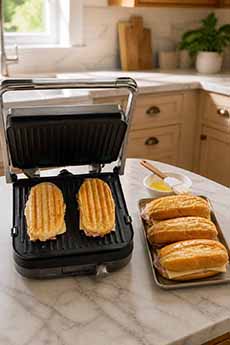
Traditionally, the assembled sandwich is brushed with butter or lard on the outside (photo #2) and pressed in a heavy, ribbed grill press (called a plancha) until the bread is golden-brown and crisp, and the cheese is fully melted.
The first commercial offering of Cuban bread itself (photo #4) was in 1896. The baker, Francisco Ferlity, had emmigrated from Sicilty and established at La Joven Francesca bakery in Ybor City. (The bakery closed in 1973 and is now part of a museum.)
A staple of Cuban cuisine, Cuban bread is a simple, white yeast bread: flour, water, yeast, salt, and a small amount of lard or shortening.
Typically baked into long, flute-like loaves like a baguette, it delivers a flaky crust with a soft, fluffy, and slightly airy interior crumb.
While Ferlita popularized this commercial baking style in Florida, the broader recipe blends deep Cuban, Spanish, and Italian cultural traditions.
THE HISTORY OF THE CUBAN SANDWICH
The Beginning
The late 1800s. The Cuban sandwich we know today originated in Tampa, Florida in the late 1800s, in the now historic cigar-producing neighborhood of Ybor City. The neighborhood was populated by many Cuban immigrants, who came to work in the cigar industry, as well as German cigar workers and Italian laborers.
The early 1900s. The sandwich achieved popularity among workers in the district’s many cigar factories. One popular eatery, Columbia Restaurant in Ybor City, has been around since 1905. (It’s now an elegant restaurant, with a dolphin fountain in the courtyard.)
Ingredients
While it’s called “Cuban,” the sandwich has influences from other immigrant groups, particularly the German cigar workers and Italian bricklayers in the area.
Genoa salami was added by Italians, who found that placing a hot brick on top of the sandwich for a few minutes pressed it flat and made it taste better—warm and crusty. This led to the use of a cast iron grill press, still used today. At home, you can use a George Foreman grill or panini press (both are electric grill presses, with flat and ridged plates).
Mustard was a condiment preferred by the Germans. It also didn’t spoil in the Florida heat as mayonnaise could. Refrigeration was scarce in the early 20th century.
TAMPA VERSUS MIAMI
Tampa and Miami have an ongoing rivalry over the correct ingredients for a Cuban sandwich.
Miami avows that salami should never be used. Plus, Miami-style Cuban sandwiches can be spread with butter!
But there’s no doubt about the original ingredients.
In 2012, the Tampa City Council passed a resolution designating the “Historic Tampa Cuban Sandwich” as the “signature sandwich of the city of Tampa.”
The Council proclaimed that a traditional Tampa Cuban is to include Cuban bread, ham, mojo-spiced pork, Genoa salami, mustard, Swiss cheese, and three pickle chips.
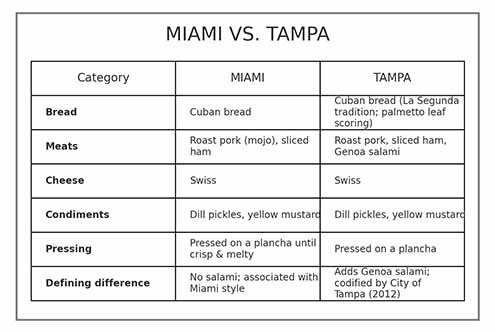
[8] Are you Team Tampa or Team Miami? (Abacus chart)
The Holiday Is Invented
National Cuban Sandwich Day was started by Christopher Spata, a Tampa Bay Times staff writer, as a hoax. On August 23, 2016 he declared “National Cuban Sandwich Day” as a tongue-in-cheek experiment to show how easily “national food days” can be fabricated.
He wrote a piece for the paper explaining that he picked August 23rd because it was already National Sponge Cake Day, drafted a press release, launched social pages and a hashtag, and submitted the “holiday” to calendar sites.
He proved that with “$12 and three hours” anyone could establish a holiday. (Editor’s Note: The holiday sites now charge significantly more.)
Worldwide Demand
By the 1970s, the Cuban Sandwich had spread to menus around the United States.
In 2015, the Cuban Sandwich Factory opened in Belfast, Ireland.
In 2016, the Tampa Cuban Sandwich Bar opened in Seoul, Korea.
In fact, London’s Jama Cubana restaurant won first place in The World’s Best Cuban Sandwich category at the 2016 Annual Cuban Sandwich Festival (held in Tampa on March 5th). It too is a newcomer, opened in 2015.
Continued below photo.
|
|

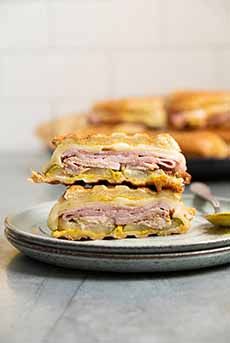
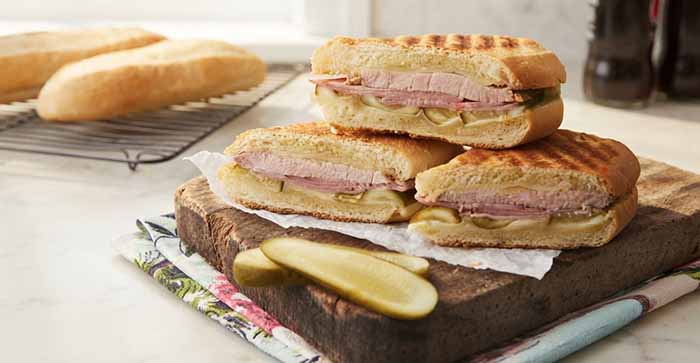
[1] The Cuban sandwich or Cubano. Here’s the recipe (photo © Taste Of Home).
[2] The sandwiches are pressed under hot irons in restaurant settings, but you can use your George Foreman grill or a panini press (photo © The Nibble)
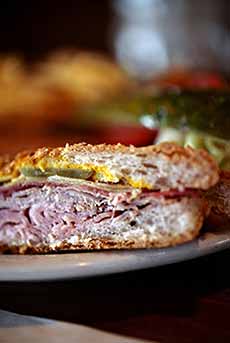
[3] The crust is now crunchy and the sandwich is ready to enjoy with a cold beer (photo © Columbia Restaurant | Ybor City).
[4] Cuban bread is a long loaf like a baguette but is doughier and without the crustiness of a French or Italian loaf. Here’s the recipe to bake it at home, from The Stay At Home Chef (photo © The Stay At Home Chef).
[5] Add a side of corn slaw/ corn salad): sweet corn kernels mixed with shredded cabbage, diced red onion, and a light vinaigrette.
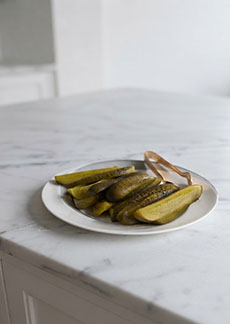
[6] Dill pickles add a bit of tartness and crunch to the sandwich (photo © The Nibble).
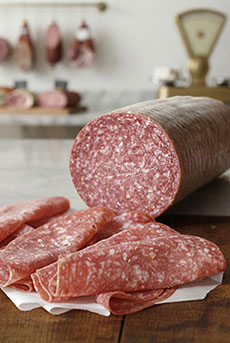
[7] Tampanians add Genoa salami to their Cubanos.
|
[9] Lunch is waiting (photo © The Nibble)!
MEDIANOCHE, THE CUBAN SANDWICH SIBLING
Very similar to the Cuban Sandwich is the Medianoche (“midnight”), which originated in Cuba.
As the name suggests, this sandwich is popular late-night fare, served in Havana’s nightclubs. It contains the same ingredients as the Cuban Sandwich—ham, roast pork, Swiss cheese, mustard, and dill pickles.
However, it is smaller and uses a different bread: slightly sweet rolls made from an egg dough with a bit of sugar (similar to challah but a different shape).
Like the Cuban sandwich, the medianoche is typically warmed in a press.
So warm up the press: Wherever you live, today’s the day to enjoy a Cuban Sandwich.
And while you’re at it, there’s pan con lechón: Cuban roast pork with mojo*, pickles, and mustard, no ham or cheese.
Outside of Cuba, its closest relative is the Italian muffuletta sandwich, pressed Italian cold cuts and cheese on a sesame loaf. Different flavors, similar stacked/pressed sandwich preparation.
Both the Cubano and the muffuletta fall into that great category, the hero sandwich (also grinder, hoagie, submarine, etc.).
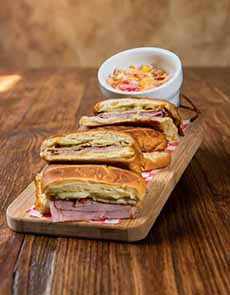
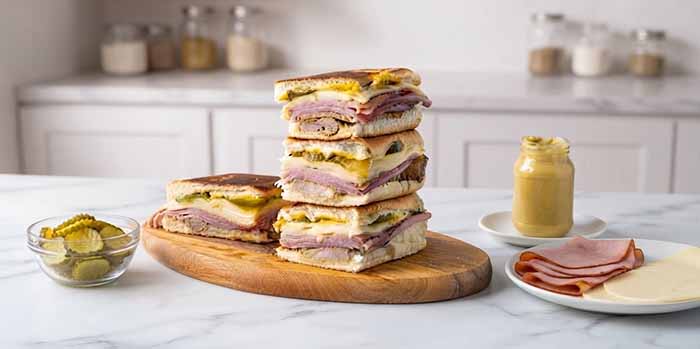
[10] The medianoche is a smaller version of the Cubano, created as late-night (medianoche is Spanish for midnight) club fare (photo © The Nibble).
________________
*Cuban mojo (mojo criollo) is a garlicky citrus-based marinade/sauce, great for marinating pork (lechón asado) and chicken. It’s also used as a hot garlic-oil pour-over for vegetables or yuca con mojo (boiled cassava, often with sautéed onions). You’ll also see yuca frita (boiled then fried cassava sticks) and yuca con mojo served alongside lechón asado.
The marinade is made with sour orange juice (naranja agria), garlic, oregano, ground cumin, salt and pepper, and oil. Onion and bay leaf are options. Some cooks add a splash of vinegar.
Mojo recipe: If you want to make it but can’t access sour orange juice, add 1 part lime juice (e.g. 1/4 cup) to 2 parts orange juice (e.g. 1/2 cup). Then, warm 1/4 cup oil with 6 cloves minced garlic until just fragrant. Remove from the heat and add the sour orange juice or equivalent plus 1 teaspoon oregano, ½ teaspoon cumin, 1 teaspoon salt, and ½ teaspoon pepper.
Marinate pork, chicken for 2–4 hours, fish for 20–30 minutes. As a dressing, just heat and pour over hot vegetables or yuca with sautéed onions.
CHECK OUT WHAT’S HAPPENING ON OUR HOME PAGE, THENIBBLE.COM.
|