|
Niçoise (nee-SWAHZ) refers to something from the city of Nice, on the French Riviera in the region of Provence.
You can find the following popular Niçoise dishes in restaurants around the U.S., and they’re easy to make at home (except for the truffle omelet, which is easy to make if you can afford the truffles):
Aïoli, a garlic mayonnaise used as a spread, dip, and condiment with potatoes, shellfish, and vegetables (aïoli recipe).
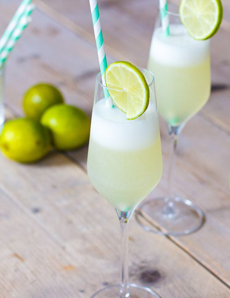
Alcohol: The local favorites are pastis, an anise liqueur and apéritif; and rosé wine.
Bouillabaisse, the signature dish of Marseille. It’s a fish stew with vegetables, garnished with croutons and rouille*).
Daube, beef stew braised in red wine and served with polenta or gnocchi (influences from neighbor Italy).
Fromage de chèvre, goat cheese, fresh and aged.
Nougat, the chewy white confection made from egg whites and almonds.
Omelette aux truffes, made with black truffles harvested in Provence from November through March.
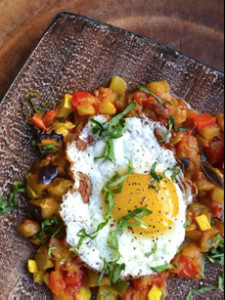
Ratatouille, a casserole of tomatoes, onions, eggplant, zucchini, peppers, garlic, and herbs.
Tapenade, a spread made from anchovies, capers, and black olives.
And then, there’s Salade Niçoise (Niçoise Salad in English).
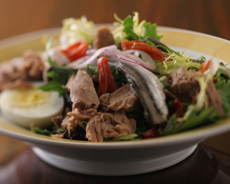
The classic Salade Niçoise recipe is a composed salad (i.e., not tossed, but placed) of tomatoes, tuna (cooked or canned), hard-boiled eggs, Niçoise olives and in season, young haricots verts (French green beans). It is served with a Dijon vinaigrette and can be served with or without a bed of salad greens. It is an entrée salad.
Each cook can customize the salad to his or her taste. We’ve included optional extra ingredients below.
RECIPE: SALADE NIÇOISE
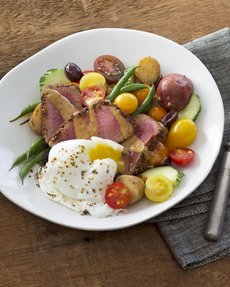
This take on the classic Niçoise salad from McCormick uses two twists: a poached egg and a zesty seasoning blend (the recipe is in the footnote below).
Ingredients For 6 Servings
For The Dijon Vinaigrette
1/4 cup extra virgin olive oil
1/4 cup white wine vinegar
2 teaspoons Dijon mustard
1/2 teaspoon sea salt
1 tablespoon seasoning blend†
For The Tuna
1 rectangular piece (6 ounces) sashimi-grade ahi tuna loin
1/2 teaspoon sea salt
1/4 teaspoon black pepper, coarse grind
4 teaspoons seasoning blend†
2 tablespoons vegetable oil
For The Tuna & Salad
6 each baby yellow, red, and purple new potatoes
1/2 pound fresh French green beans (haricot verts), trimmed
1 tablespoon white wine vinegar
6 large eggs
1/2 cup assorted grape/teardrop tomatoes, halved
1/2 cup thinly sliced baby cucumbers
|
|

[1] A classic Salade Niçoise from French chef François Payard (photo © Payard).
[2] McCormick’s version substitutes a poached egg for the traditional hard-boiled (photo © McCormick).
[3] Trending in America: Kale Niçoise (photo © Williams Sonoma).
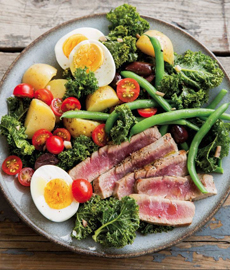
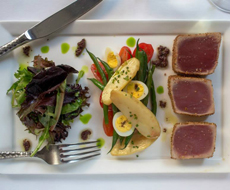
[4] Deconstructed Niçoise at the Seafire Grill (photo © Seafire Grill).
|
|
1/4 cup pitted Niçoise olives, halved (substitute picholine, kalamata, or another flavorful black olive)
Serve With…
Plain sliced baguette with olive oil for dipping (add herbs to the oil)
Garlic bread
________________
*Rouille (roo-EE, the word for rust in French) is a sauce made from olive oil with breadcrumbs, garlic, saffron, and red chiles, which give it the rusty orange color. It is served as a garnish with fish and fish soup and is essential with bouillabaisse, the signature fish stew dish of Marseille.
†McCormick’s spice blend recipe is 1 tablespoon chia seeds, 2 teaspoons grated lime peel, 2 teaspoons chili powder, 1 teaspoon garlic powder, 1/4 teaspoon ground chipotle powder. Blend and store tightly capped in the fridge. Makes 2-1/2 tablespoons. Substitute another spice blend or some lemon zest.
|
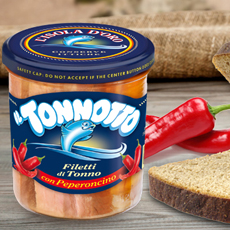
[5] Tonnatto brand tuna from L’isolo D’Oro, a fine Mediterranean tuna used in the best salads in Nice. Tonnatto refers to refined tuna fillets, whole, and, tender and selected for their quality (photo © L’isolo D’Oro).
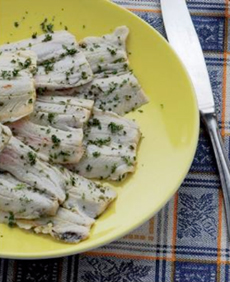
[6] Anchovy lovers: layer them on (photo © Flavor Your Life).
|
|
Preparation
1. MAKE the vinaigrette. Place the oil, vinegar, mustard, and sea salt in a blender container; cover. Blend on high speed until smooth. Pour into a small bowl. Stir in the seasoning blend. Cover and refrigerate until ready to use.
2. SEASON the tuna with salt and pepper. Coat with the seasoning blend, pressing firmly so the mixture adheres to the tuna. Grill or sear: Heat the oil in a large skillet on medium-high heat. Add the tuna and sear 1-1/2 to 2 minutes on all sides. Remove the tuna to a plate; set aside to cool slightly. Cover and refrigerate until ready to serve.
3. COOK the potatoes. Add them to a large saucepan with simmering salted water to cover. Cook for 15 to 20 minutes or until fork tender. Drain and rinse with cold water; drain on paper towels to remove the water. Meanwhile…
4. COOK the green beans in a large saucepan of simmering salted water to cover, 3 to 5 minutes or until tender-crisp (don’t overcook). Drain and rinse with cold water; drain well on paper towels. Place in a large bowl with green beans. Add 1/4 cup of the vinaigrette; toss to coat. Season with salt to taste. Set aside.
5. CUT the potatoes in half or quarters, depending on size. Add to a bowl with the green beans.
6. POACH the eggs. Fill a large, deep saucepan with 2 inches of water and 1 tablespoon vinegar. Bring to a boil and reduce the heat to medium. Break 1 egg into a small dish and carefully slide it into the simmering water (bubbles should begin to break the surface of the water). Repeat with the remaining eggs. Poach the eggs for 3 to 5 minutes or until the whites are completely set and the yolks begin to thicken. Carefully remove eggs with a slotted spoon. Drain on paper towels.
7. SERVE: Slice the tuna into thin slices. Divide the potato mixture, tomatoes, cucumbers, and olives among 6 plates (aim for an attractive presentation). Top each with tuna slices and a poached egg. Drizzle the remaining vinaigrette over the tuna slices. Sprinkle the egg with some additional seasoning blend.
|
OPTIONAL INGREDIENTS FOR A NIÇOISE SALAD
Make it your own with added ingredients or substitutes. Just keep the five basics: tuna, tomato, egg, green beans, and olives, plus the vinaigrette.
Cooked vegetables: broccoli florets, broccolini or broccoli rabe.
Greens: arugula, bell pepper, carrots, celery, cress, cucumber, fennel, fresh herbs (basil, cilantro, dill, mint, parsley), frisée, kale, radicchio, radishes.
Tomatoes: Substitute halved cherry or quartered larger tomatoes (in the off-season, substitute sundried tomatoes in olive oil or roasted red pepper).
Onions: green (scallions), grilled onions, red, shallot, sweet onions.
Proteins: anchovies, bacon, beans or lentils, canned or grilled salmon or other grilled fish, sardines.
CHECK OUT WHAT’S HAPPENING ON OUR HOME PAGE, THENIBBLE.COM.
|
|