THE NIBBLE BLOG: Products, Recipes & Trends In Specialty Foods


Also visit our main website, TheNibble.com.

JULY 4th: Spicy Hot Lemonade Recipe (Also Limeade & Orangeade)

red-hot-lemonade-fresno-melissas-230
Jalapeño lemonade becomes red, white and
blue with the addition of some blueberries.
Photo courtesy Melissas.com.
 

It’s easy to make a special July 4th drink. Just “heat up” a pitcher of cold lemonade with bright red jalapeño slices. Toss in a few blueberries and you’ve got a red, white and blue theme.

For less heat, remove the seeds and the white connective tissue.

Don’t want any heat? Replace the jalapeño with bright red cherries.

Start with a can of frozen lemonade, or make your own with fresh lemons (there’s a link to the recipe below).

  • For a different type of heat, substitute slices of fresh ginger for the jalapeño.
  • For a zero-calorie drink, use non-caloric sweetener.
  • For a low-glycemic drink, use agave nectar instead of sugar.
  • A shot of vodka or gin turns lemonade into a splendid cocktail.
  • You can also use this recipe to make fresh limeade, orangeade or grapefruitade.
  • After July 4th, varying the garnishes makes the recipe “new” each time.
  •  
    MORE LEMONADE IDEAS

    Try this homemade lemonade recipe. It’s so much better than store-bought.

    Or, take advantage of peach season to make this yummy peach lemonade recipe.


    Comments off

    PRODUCT: Shelf Stable Pacific Organic Hummus

    Way back in 2006, we received samples of shelf-stable hummus in jars. From a brother and sister-led company called Salt & Vinegar, we felt the manufacturers had nailed a need in the rapidly growing hummus market: hummus that didn’t require refrigeration.

    The fledgling company didn’t make it; and since then, the hummus category has exploded even more. You can find hummus in dozens of flavors, mixed with other Middle Eastern specialties like babaganoush, tabouleh and yogurt.

    The only thing missing: shelf-stable hummus. Hummus that you can keep in your locker or desk drawer, in your glove compartment, in your gym bag, for a protein-packed, better-for-you snack or light lunch.

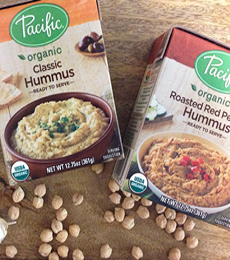
    Pacific Foods has risen to meet the need, with three flavorful varieties of shelf stable—Classic, Roasted Garlic and Roasted Red Pepper. They are made from the highest quality organic ingredients, including chickpeas, lemon juice, tahini, a touch of garlic and a pinch of sea salt.

    How does shelf stable hummus compare to refrigerated or freshly made hummus?

       
    pacific-organic-hummus-trio-230r

    Two of the three flavors of shelf-stable hummus (no refrigeration required). Photo courtesy Pacific Foods.


    pacific-hummus-bowl-230
    No refrigerator required. Photo courtesy
    Pacific Foods.
     

    In our own office test, our favorite refrigerated varieties (including Tribe) won out, but Pacific was deemed more than worthy, with bonus points for convenience.

    And according to the manufacturer, Pacific’s Classic Hummus has “one-third fewer calories and 40% less fat than the refrigerated hummus category leader.”

    Look for them where you’d find the shelf stable salsas, in the chip aisle. They’re rolling out at Whole Foods Markets, and at other stores that carry the Pacific brand of organic products.

    Priced at $3.39 to $4.29 (based on the individual retailer)per 12.75-ounce container, these convenient little boxes are begging to accompany you wherever you go.

    Don’t forget a plastic spoon plus optional chips and veggies.


    Comments off

    TIP OF THE DAY: Caramelized Onion Dip

    We grew up making Lipton’s California Dip: a package of Lipton Onion Soup Mix combined with a pint of sour cream. It was simple and soul-satisfying, a party standard with potato chips and pretzels (and later, crudités, pita chips and other chips).

    The recipe appeared in 1954, two years after the Lipton soup mix hit the market. The recipe “spread through Los Angeles faster than a canyon fire.” (Source: American Century Cook Book, Jean Anderson [Clarkson Potter:New York] 1997,p. 24.)

    Newspapers printed the recipe and onion soup mix sales soared. Beginning in 1958, Lipton printed the recipe on every box of the soup mix.

    As with the creator of German Chocolate Cake, a recipe that spread like wildfire throughout Texas, the identity of the original recipe developer has never been established. So if your grandmother or great-grandmother lived in L.A. in 1954 and claimed to have invented Lipton California Dip, it could be so.

    Over the years, from-scratch onion dip recipes have taken turns with chives, leeks and scallions. Caramelized onions also have their fans.

       
    heluva-good-dip-beauty-kalviste-230

    Chips and caramelized onion dip. Photo by Elvira Kalviste | THE NIBBLE.

     
    In fact, this summer, you can pick up Heluva Good! Limited Edition Roasted Garlic & Caramelized Onion Dip. Caramelized onions have more sophisticated flavor than the dried onion chips in the Lipton mix, from the sweetness of the caramelized onions and the roasted garlic layered in.

    Heluva Good is a specialty producer of sour cream and sour cream-based dips. Find out more, and see the other dip flavors, at HeluvaGood.com.

    You also can make your own caramelized onion dip. The recipe below takes just 10 minutes, plus chilling time.


    caramelized-onions-pompeianFB-230
    Caramelized onions are delicious with any
    savory foods. Photo courtesy Pompeian | FB.

      RECIPE: CARAMELIZED ONION DIP

    Ingredients For 2 Cups

  • 1 tablespoon vegetable oil
  • 2 cups thinly sliced onion
  • 2 teaspoons chopped fresh sage leaves
  • 3/4 cup mayonnaise
  • 3/4 cup sour cream
  • 1 teaspoon salt
  • 1 teaspoon ground black pepper
  • Chips, crudités, pretzels or other dippers
  •  

    Preparation

    1. HEAT oil in medium saucepan or frying pan over medium-low heat. Add the onions and sage. Cover and cook until onions are deep golden brown, about 20 minutes, stirring occasionally. Remove from heat and let cool.

    2. WHISK together mayonnaise and sour cream in a medium bowl to blend. Stir in the cooled caramelized onions, salt, and pepper. Cover and refrigerate until flavors blend, about 2 hours.


    MORE WAYS TO USE CARAMELIZED ONIONS

    We consume them as quickly as we make them!

    Often, we eat them right from the pan or as they’re cooling. But check out these uses for caramelized onions.


    Comments off

    RECIPE: Crudité Flag, A July 4th Snack

    We launch this year’s series of red, white and blue July 4th foods with a crudité flag.

  • The red and white flag stripes are cauliflower florets, red cherry tomatoes and red bell pepper strips. (Remove the stems from the tomatoes—the green color doesn’t belong on the flag.)
  • The blue field with white stars is represented by blue tortilla chips.
  • The white stars are represented by the dip, served on the side.
  •  
    The flag was made by Heluva Good, which served the flag with its own sour cream-based dips.

    But we think a blue cheese dip does the best job of Here’s a recipe.

      crudite-flag-heluvagood-230
    Old Glory as chips and dip. Photo courtesy HeluvaGood.com.
     
    Variations: You can use other “white” vegetables, including jicama or peeled cucumber and/or summer squash.
     
    MORE

    Check out this bacon pizza American flag.


    Comments off

    Pork Belly Lettuce Wraps Recipe For National Pork Belly Day

    kuromitsu-glazed-pork-belly-sushisamba-230
    [1] Pork belly lettuce wraps: a real treat (photo © Sushi Samba).

    A Slab Of Uncooked Pork Belly
    [2] A slab of uncooked pork belly (phoco © The Country Victualler).

    Whole Hearts Of Palm
    [3] Hearts of palm, a.k.a. palmito (photo © Trikaya).

    A Head Of Butterhead Lettuce
    [4] Butterhead lettuce, a category that includes Bibb and Boston. Here are the different types of Butterhead lettuce (photo © Good Eggs).

    Japanese Kuromitsu, Brown Sugar Syrup a.k.a. Black Syrup
    [5] You can purchase kuromitsu at Asian markets or online (photo © Locca | Amazon).


    In honor of the World Cup Games in Brazil, Brazilian-Japanese fusion restaurant Sushisamba will be serving a signature dish from Chef Pedro Duarte: Kuromitsu Pork Belly Lettuce Wraps.

    Kuromitsu is a Japanese sugar syrup, similar to but milder than molasses. We could eat an entire tray of these sweetly glazed pork belly treats. Consider them as a first course for Father’s Day dinner…or make all four and keep them for yourself.

    > November 10th is National Pork Belly Day.

    > The year’s 24 pork holidays.

    > The year’s 27+ sandwich holidays.

    > The different cuts of pork.

    > The history of lettuce wraps is below.
     
     
    The recipe follows. But first, we introduce you to kuromitsu, the Japanese glaze used in the recipe. It’s easy to make, and the recipe is below.
     
     
    WHAT IS KUROMITSU?

    Kuromitsu is a Japanese sugar syrup, typically made from unrefined Okinawan kurozato (black sugar). The term means “black honey”; it is similar to molasses but thinner and milder.

    It is also called brown sugar syrup.

    It is used to add sweetness to sweet Japanese dishes. It is one of the ingredients used in making wagashi, and it serves well with kuzumochi, fruits, ice cream, and cakes. Drizzle it on your choice of Japanese sweets, such as anmitsu, shiratama dango, kudzu mochi, warabi mochi, or kinako on toast. Or on western-style pancakes.

    The syrup is also used in bubble tea recipes.

    You can find premade kuromitsu in Asian products stores, but here’s a recipe below.
     
     
    RECIPE #1: KUROMITSU GLAZED PORK BELLY LETTUCE WRAPS

    Prepare the pork belly a day in advance in advance (6 hours marinating plus 4 hours cooking).

    Ingredients For The Pork Belly Confit

    Yield: four five-ounce servings.

  • 1.25 pounds pork belly
  • 1 ounce salt
  • 1 ounce sugar
  • 1 liter canola oil
  • 1 bouquet garni (thyme, garlic, bay leaf, black pepper)
  •  
    The recipes for the lettuce wraps and kuromitsu follow.
     
    Preparation

    1. RUB the pork belly with the sugar/salt mixture and allow to marinate for 6 hours.

    2. RINSE, pat dry, and submerge in a hotel pan (also called a steam table pan—a deep roasting pan will do) with the canola oil and bouquet garnish. Cover with tin foil and cook in the oven for 4 hours at 325°F.

    3. REMOVE from the oil when the pork belly is soft and allow it to cool in the refrigerator with some weight on top. You can reuse the oil for another cooking process. When ready to serve…

    4. MIX the lemon zest, palmito, and frisée to create the garnish. To plate, place 1 piece of pork belly on 1 piece of bibb lettuce. Brush the pork belly with kuromitsu glaze. Top with the fresh palmito-frisée salad. It’s delicious!


    RECIPE #2: LETTUCE WRAPS

    Ingredients Per Serving

  • 4.5 ounces pork belly confit (recipe above)
  • 1 ounce kuromitsu glaze (recipe below)
  • Lemon zest, to taste
  • 1 ounce hearts of palm (palmito), julienned
  • 1 ounce frisée
  • 1 bibb lettuce leaf
  •  
    Preparation

    1. PREPARE the pork belly a day in advance in advance (6 hours marinating plus 4 hours cooking). To assemble:

    2. MIX lemon zest, palmito, and frisée to create garnish. To plate, place 1 piece of pork belly on 1 piece of bibb lettuce. Brush pork belly with kuromitsu glaze. Top with the fresh palmito-frisée salad. It’s delicious!


    RECIPE #3: HOMEMADE KUROMITSU

    Ingredients For 1 Cup

    Thanks to Taste Of Zen for the recipe.

  • 2/3 cup dark muscovado or other unrefined brown cane sugar (the different types of brown sugar)
  • 2 tablespoons light muscovado sugar
  • 1/2 cup white table sugar
  • 1/2 cup hot or boiling water
  •  
    Preparation

    1. PLACE the sugars and water in a nonstick pot and heat over medium heat. Once the sugars start to melt, shake the pot extensively while gently stirring with a wooden spoon. Do not over-stir or lumps can form. While stirring, add hot water a little at a time. The syrup may bubble and spurt; wear protective clothing to avoid burns. When the sugar is completely melted…

    2. REDUCE the heat and simmer over low heat for about 30 minutes, stirring occasionally. The syrup will thicken and a caramel-like aroma will emanate. If the syrup starts to lump or stick to the bottom of the pot, lower the heat.

    3. REMOVE from heat and let cool. Store any extra syrup in an airtight glass jar at room temperature or in the fridge. It should keep for 2 to 3 months. Bring refrigerated syrup to room temperature before using (you can heat it for 10 seconds in the microwave).
     
     
    THE BEST LETTUCE & VEGETABLE LEAVES FOR WRAP SANDWICHES

    While the recipe above uses Bibb lettuce, we’re taking a moment to show you all the options for wrap sandwiches.

  • Butter or Bibb Lettuce (Boston lettuce): Soft, flexible, and best for small wraps or low-carb “tacos.” Tip: Layer two leaves for extra strength.
  • Romaine: Best for hand-held wraps like boats, chicken strips, tacos, and veggies. The elongated shape fits larger items and the crunchy ribs add texture. Tip: Trim the thick bottom rib if it’s too rigid to fold.
  • Iceberg Lettuce: Best for crisp lettuce cups (they form natural bowls). Tip: Peel the whole outer leaves from the head carefully.
  • Green or Red Leaf Lettuce: Best for medium wraps with softer fillings (tuna salad, e.g.). The leaves are flexible yet strong, but overlap multiple leaves for larger wraps.
  •  
    Beyond lettuce:

  • Cabbage Leaves (green, savoy, or napa): Best for heartier, warm fillings. Thicker and sturdier than lettuce, it doesn’t wilt quickly. Blanch briefly (10–15 seconds) to soften for easy rolling.
  • Swiss Chard: Best for grain or veggie wraps thanks to its large surface area with earthy flavor. You can use them raw or lightly steamed. Remove the tough stem for easier rolling; both work.
  • Collard Greens: Best for large, burrito-style wraps. The leaves are very sturdy; slightly bitter flavor complements rich fillings. Blanch and trim the spine for more flexibility.
  •  
    Collard Wraps
    [6] Collard wraps (photo © David Venable | QVC).
     
     
    THE HISTORY OF LETTUCE WRAPS

    While Americans may think that lettuce wraps appeared out of nowhere in the 1990s, using leaves as edible wrappers is an ancient practice. Long before flatbreads* were common, people in many regions used large leaves (grape, cabbage, lettuce) to bundle fillings.

    The best-known ancestor of today’s wraps is the Cantonese san choy bao (also spelled sang choy bow)—stir‑fried minced meat, mushrooms, water chestnuts, and aromatics spooned into crisp lettuce cups.

    It likely emerged from southern Chinese banquet cuisine where. Variations appear in regional Chinese cooking with different lettuces and fillings (chicken, pork, seafood, tofu).

    The concept of lettuce- and herb-wrapping expanded across Southeast Asia and became integral to dining.

  • Korea: “Ssam” (wrap) culture pairs grilled meats (like samgyeopsal) with lettuce or perilla leaves (shiso), rice, kimchi, and sauces (ssamjang), a long-standing practice in Korean cuisine.
  • Thailand/Laos: Larb and grilled meats are commonly eaten with lettuce or cabbage leaves to wrap meat, rice, and herbs; miang kham is a related bite-size leaf wrap tradition.
  • Vietnam: Fresh herb–packed rolls and DIY wraps at the table (with lettuce, perilla, mint) accompany grilled meats, bún (noodle) dishes, or bánh hỏi.
  •  
    Western Adoption

    Lettuce wraps appeared in Chinese restaurants in North America in the late 20th century, then went mainstream in the 1990s. Chains such as P.F. Chang’s popularized chicken lettuce wraps in 1993, introducing the format to a broad audience.

    From the 2000s onward, lettuce wraps have been embraced for their fresh, lighter alternative to bread and fitting in to low‑carb/gluten‑free eating trends (paleo, keto).

    Chefs now use diverse fillings—tuna tartare, pulled pork, tofu, or grains—and a range of leaves (butter, romaine hearts, little gems, even cabbage) for texture and durability.

    It’s so easy to make wraps at home.

    Source: Abacus A.I.

    Lettuce Wraps With Canned Salmon
    [7] Lettuce wrap with canned salmon (photo © Chicken Of The Sea).
     
    _______________

    *Evidence dating to 12,400–14,500 years ago shows that hunter‑gatherers in northeastern Jordan made an unleavened flatbread from wild cereals—millennia before the start of farming. By the early agricultural era in the Fertile Crescent, 9,000–10,000 years ago, domesticated grains (emmer, einkorn, barley) were routinely ground and baked into flatbreads on hot stones, hearths, or tandir/tabun ovens.


    CHECK OUT WHAT’S HAPPENING ON OUR HOME PAGE, THENIBBLE.COM.


    Comments off

    The Nibble Webzine Of Food Adventures
    RSS
    Follow by Email


    © Copyright 2005-2026 Lifestyle Direct, Inc. All rights reserved. All images are copyrighted to their respective owners.