|
The Jewish new year, Rosh Hashanah, begins tonight, and we’re having latkes.
Potato latkes are a Chanukah/Hanukkah tradition*, but they are enjoyed year-round. One taste and you’ll know why.
> The recipe for latkes is below. But first:
THE HISTORY OF LATKES
The popular potato latkes of European Jewish cuisine descend from Sicilian ricotta pancakes that appeared in the Middle Ages. They traveled north to Rome, where the Jewry called them cassola.
Here’s a recipe for ricotta latkes. Traditionally sweetened, you can make a savory version with herbs instead of sugar.
Potato latkes (meaning “fried cakes,” i.e. pancakes, in Yiddish) are an Ashkenazi invention that gained popularity in Eastern Europe during the mid 1800s. The Hebrew word, leviva, is found in the Book of Samuel.
While the ricotta pancakes, a cousin to cheese blintzes are delicious, our bet is that more people would rather have fried potatoes!
Here’s a longer history of latkes.
MODERN LATKES
For centuries, potato latkes were the rule. Toward the end of the 20th century, cooks went so far as to make sweet potato latkes.
Then, anything was possible: latkes from beets, carrots, celery root, parsnips…. If it’s a root vegetable, it can be turned into latke. You can also use non-root vegetables, like summer and winter squash.
Food trivia: Potatoes themselves are not root vegetables, but stem vegetables. They grow on underground stems, called stolons.
Potato tubers are actually thickened stems: They have buds that sprout stems and leaves; roots don’t. Here’s more about it.
HOW TO ENJOY LATKES
You can use sweet potatoes or purple potatoes—anything you can grate.
You can turn latkes into a main course with the addition of a protein: from sliced steak to fried chicken (the Jewish chicken and waffles) to pickled herring or smoked fish.
You can serve it as a salad course, atop a plate of mesclun.
You can provide three or four different toppings.
You can serve mini-latkes with a beer or glass of wine.
Latkes don’t have to be round or oval. If you have pancake or egg molds, make whatever shape you have: diamonds, flowers, hearts, stars, etc.
Don’t use anything with detail (Mickey Mouse ears, animals, etc.), since the latke batter is chunky, not smooth like pancakes or an egg.
Most importantly, you can make latkes any day of the year. Think of them as you would hashed browns.
LATKE GARNISHES
You can serve more than one topping or garnish. Our mom always served sour cream and her homemade applesauce, as did her mom. (For Rosh Hashanah, the latkes accompanied roast chicken; for Chanukah, a brisket.)
We improved on her toppings, by adding a hit of nutmeg to the applesauce and minced chives, and separately, horseradish, to the sour cream.
While applesauce and sour cream are perfect latke partner, this is a new century. Try fusion seasonings, go crazy (within reason) with toppings like cardamom applesauce, curried Greek yogurt or 3-herb sour cream.
Some ideas:
|
|
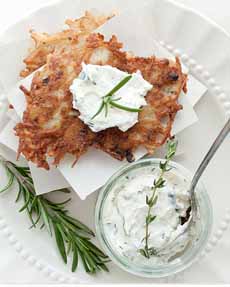
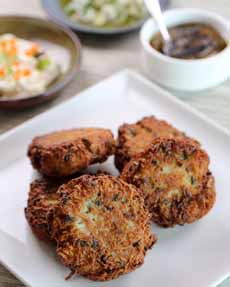
[1] Classic potato latkes with sour cream, enhanced with dill. Here’s the recipe from Najwa Kronfel of Delicious Shots.

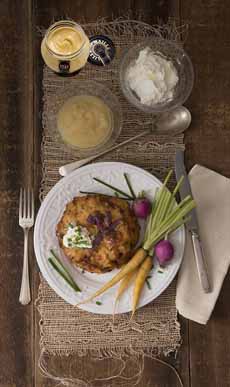
[2] Latkes, modernized with Dijon mustard (photo courtesy Maille).
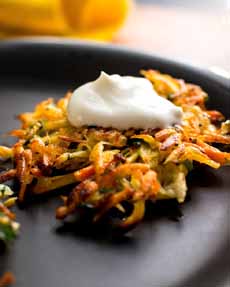
[3] Latkes made with scallions instead of conventional yellow onions (photo courtesy Shaya | New Orleans). |
|
Dairy: crème fraîche, herbed goat cheese or ricotta, Greek yogurt, sour cream with chives, dill or scallions
Fish and seafood: caviar/roe, herring in cream sauce, salmon pastrami, smoked salmon, smoked sturgeon, smoked whitefish
Fruit sauce: chutney, cranberry sauce, flavored applesauce
Gourmet: smoked salmon and salmon caviar (or other roe) with crème fraîche or dilled sour cream
Poached egg: for a main or first course
Salsa: corn, corn and bean, peach or mango, pesto, roasted tomato)
More: Dijon mustard, kimchi, pickled beets, pickled onions and other pickled vegetables, pomegranate arils
Plus
Chopped fresh herbs: basil, cilantro, dill, thyme
Slaw: Asian slaw (no mayo), purple cabbage cole slaw, root vegetable slaw.
Vegetables: grilled or roasted, ratatouille or other vegetable medley
Our personal favorite latke garnish is gourmet-traditional: creme fraiche with dill, smoked salmon and caviar.
We would gladly accept a latke trio: three different preparations, as in photo #6.
|
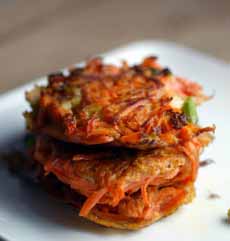
[4] Carrot and scallion latkes (photo courtesy Elana’s Pantry).
[5] Celery root and parsnip latkes. You can make beet latkes or potato latkes, too.
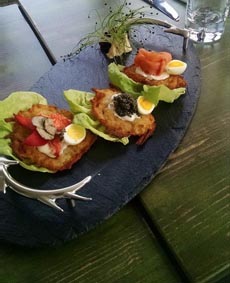
[6] Gourmet latke trio: lobster and white truffles, caviar and crème fraîche, smoked salmon and crème fraîche, all with a quail egg garnish (photo courtesy Duet Brasserie).
|
|
RECIPE: GRANDMA BERTHA’S LATKES
This recipe for quick, light and crisp latkes is from Andrea Watman, Creative Director at New York City’s legendary Zabar’s. The recipe is Andrea’s grandmother’s
This simple adaptation uses a food processor instead of hand grating, and potatoes that are not peeled. It should only take minutes to prepare.
The latke recipes of Grandma Bertha’s time required labor-intensive peeling of the potatoes, then grating them on a four-sided metal grater—which invariably ended up scraping one’s knuckles as well.
The hand grating took so long that the potatoes would start to discolor. Only the enjoyment of the delicious finished latkes made one forget the travail of making them.
Andrea improved upon the recipe by tossing the potatoes, peel and all, into the food processor. She also uses a coffee scoop to measure the batter. She finds that it makes latkes that are “just the right size.”
If you don’t have a coffee scoop, you can use a 1/4 cup measure, which makes larger latkes.
Latkes freeze really well and can be reheated in the microwave; but they are best when eaten right after cooking.
Ingredients For About 30 Latkes
4 Idaho potatoes, washed but not peeled
1 large yellow onion
3 large eggs
1-2 cups all-purpose flour
1 tablespoon coarse salt
½ tablespoon fresh-ground pepper
Oil for frying (Andrea uses half olive oil, half corn oil)
Garnishes of choice
Preparation
1. CUT the potatoes and onion into quarters. Place in the bowl of food processor, using the “S” blade or knife blade. Grind until finely ground; pulse if necessary.
2. ADD the eggs, salt and pepper. Grind until mixed. Remove bowl from food processor and stir in the flour. The mixture should be the consistency of thick oatmeal.
3. HEAT 1″ of oil in a deep frying pan. Be patient and wait until it heats fully or the latkes won’t get golden brown. (Andrea uses an electric frying pan set at high heat because she finds it provides a more consistent heat than the stovetop.)
4. SCOOP the batter into the frying pan using a coffee scoop. You should be able to fry 6-8 latkes at a time. The latkes will begin to bubble, just like regular batter pancakes.
5. TURN them when brown. Try not to turn them more them once. The less you turn them the crisper they will be. Remove all the pancakes that have been cooking before adding new batter. In this way, way you can control the temperature of the oil and keep track of cooking time.
6. PLACE the cooked latkes on paper towels to drain.
|
MORE LATKE RECIPES
Butternut Squash Latkes With Harissa & Tahini Crème Fraîche
Potato, Onion & Cauliflower Latkes
Vegetable Latkes: carrots, leeks, parsnips, potatoes, white onion
________________
*Latkes are traditionally eaten by Ashkenazi Jews during the Chanukah. The oil in which the latkes are fried is another tribute to the miracle of Chanukah. The history, in brief: In ancient Judea, the Syrian king Antiochus ordered the Jewish people to abandon their religion and worship the Greek gods. Judah, leader of the band that called themselves the Maccabees (Hebrew for hammer), drove the Syrians from Israel and reclaimed the Second Temple in Jerusalem, removing the Greek statues. They finished their work on the 25th day of the month of Kislev, and wanted to light the eternal light (N’er Tamid), present in every Jewish house of worship, to rededicate the temple. Once lit, the light should never be extinguished. But there was only a tiny jug of lamp oil—enough for a single day. A miracle occurred: the light burned for eight days. This is the origin of Chanukah, the Festival of Lights, which is celebrated for eight days. The word Chanukah means “rededication.”
CHECK OUT WHAT’S HAPPENING ON OUR HOME PAGE, THENIBBLE.COM.
|
|