Preparation
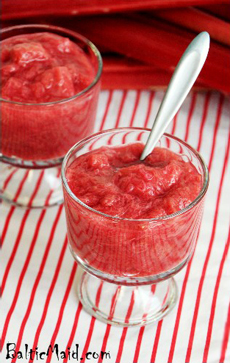
1. TRIM, wash and dice the rhubarb. Combine in a saucepan with the water, sugar, lemon juice and optional sliced berries.
2. BRING the water to a boil and then simmer over medium-low heat, stirring occasionally until the sugar dissolves and the mixture is slightly thickened and the rhubarb is is in threads (stringy), about 15 minutes.
3. COOL and chill or serve warm.
ABOUT RHUBARB
Technically, rhubarb is a vegetable, a member of the sorrel family (the difference between fruits and vegetables). Native to Asia, rhubarb has long been used in Chinese medicine.
Fruits carry their seeds inside; vegetable seeds scatter in the wind. You see seeds in an apple, avocado, cucumber and tomato, but not in broccoli, carrots or lettuce. Lacking sweetness doesn’t make it a vegetable.
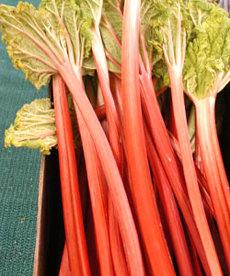
Rhubarb, Rheum rhabarbarum, is a vegetable in the family Polygonaceae. The leaf stalks (petioles) are crisp like celery with a strong, tart taste. Rhubarb looks like rosy-pink celery, but is no relation (celery is a member of the Apiaceae family).
Fruit Vs. Vegetable
While rhubarb is botanically considered a vegetable, a New York court decided in 1947 that since it was used in the United States as a fruit, it counted as a fruit for the purposes of regulations and duties. A side effect was a reduction on imported rhubarb tariffs, as tariffs were higher for vegetables than fruits. [Source: Wikipedia]
And that’s only one example. Science notwithstanding, on May 10, 1893, tomatoes, a red fruit/berry of the Nightshade family, were declared a vegetable by the United States Supreme Court.
At the time, there were import tariffs on vegetables but not fruits, yet tomatoes were still being subjected to the tax. In 1887, an importing company had sued the tax collector of the Port of New York to recover back duties collected on their tomatoes, which they claimed had been wrongfully classified as vegetables.
The Court decided that the tariff act should be based “in common language of people,” not botanists, so tomatoes should be taxed like potatoes, carrots, parsnips, turnips, beets etc.
More proof that justice is blind.
|