THE NIBBLE BLOG: Products, Recipes & Trends In Specialty Foods


Also visit our main website, TheNibble.com.

FOOD 101: Mahlepi or Mahleb, A Middle Eastern Spice

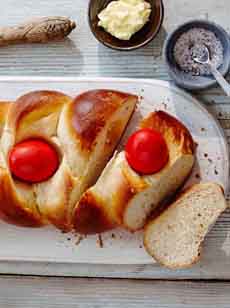
We would never have heard of mahlepi or mahleb*, a Middle Eastern spice, were it not for Greek tsoureki (photo #1), one of our favorite Easter breads.

Tsoureki, a soft, sweet and buttery braided yeast loaf, is famous for its embedded Easter eggs.

We’ve never made it because it’s a two-day process, and we never have enough room in the fridge to let the loaf rise overnight. But if you’re game, here’s a recipe from King Arthur Flour.

The traditional flavoring for tsoureki is a spice called mahlepi/mahleb. Most American bakers substitute vanilla, but for a deliciously authentic flavor, buy the real deal online.

Mahleb adds a unique cherry-bitter almond, sweet-nutty flavor that will delight lovers of marzipan.

You may like it so much, you’ll start adding mahlepi to butter cookies, muffins, pound cakes, scones and other baked goods and yeast breads.
 
 
WHAT IS MAHLEPI, MAHLEB, OR HOWEVER YOU SPELL IT*?

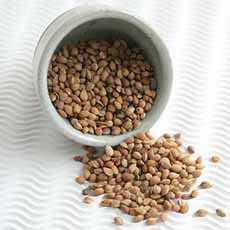
Mahleb is an aromatic spice that has been used for centuries† in the Middle East. It is made from the seeds of a particular species of cherry tree called the Mahaleb or St. Lucie cherry (Prunus mahaleb).

The cherry stones are cracked to extract the seed kernel, which is ground to a powder.

In addition to baked goods and other sweet foods, mahleb is in tresse cheese (jibneh mshallaleh, a string cheese from Syria.

scones. In Egypt, powdered mahlab is made into a paste with honey, sesame seeds and nuts, eaten as a dessert or a snack with bread.

In Greek cooking, beyond Easter bread it is used to flavor Christmas cake and pastries and eggy yeast cakes and cookies for the New Year, such as vasilopita (which contains a hidden coin or trinket that gives good luck to the recipient, like the Western king cake).

In Egypt, mahlab is made into a paste with honey, sesame seeds and nuts, and eaten as a dessert or a snack with bread.

  Tsoureki Greek Easter Bread
[1] Greek tsoureki bread, flavored with mahleb spice (photo courtesy King Arthur Flour).

Mahlepi Seeds Mahleb
[2] Whole mahleb seeds are ground into a spice (photo courtesy Migdisian | Amazon).

 
For other recipes, mahleb pairs well when mixed with anise, black cumin (Nigella sativa) or caraway.

Look for it in Greek or Middle Eastern markets, or online.
________________

*The spelling in English varies based on transliteration: mahlab, mahalab, mahlep, mahaleb, etc. In Greece, it is mahlepi.

†Recipes for a seed that may be mahleb have been found in records from ancient Sumer.


Comments off

FOOD FUN: Easter Deviled Eggs On Wheatgrass

Wheatgrass Planter
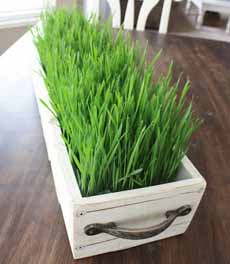
[1] Set deviled eggs or Easter eggs in a planter of wheatgrass. Here’s how to grow wheatgrass from Country Girl Home.

Easter Deviled Eggs
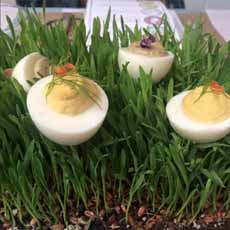
[2] Deviled eggs in wheatgrass, at Essex Street Market | NYC.

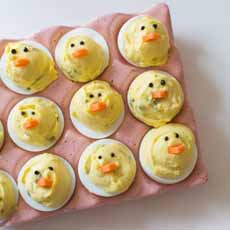
Deviled Egg Chicks
[3] Turn your deviled eggs into chicks, with this idea from Julie Blanner Entertaining & Design.


It doesn’t have to be Easter to love this deviled egg idea (photo #2), spotted at Essex Street Market in New York City.

It’s so simple that we wonder why we haven’t seen it before.

While much fresh wheatgrass is sold in plastic trays, to be juiced at home, florists took notice of the graceful shoots and potted them in planters.

Get one, and nestle deviled eggs—or colored Easter eggs, or chocolate eggs—in the grass.

Afterwards, the planter of wheatgrass is an attractive home accent. It’s also a catnip alternative.

You also can do what many health enthusiasts do: Juice the wheatgrass and drink it for its vitamins and minerals. The straight juice has a powerful grassy taste, so many people enjoy it in smoothies.

Don’t add it to a salad, as logical as that may seem:

The grass itself is difficult to digest raw, and cooking diminishes its nutritional value.
 
 
WHAT IS WHEATGRASS?

Wheatgrass is the young grass of the wheat plant, Triticum aestivum. It grows into the tall stalks from which wheat is harvested.

Wheatgrass grows in temperate regions and can be an indoor or outdoor plant.

It grows very quickly, so if you start today, you can germinate wheat seeds and create your own planter.

We, on the other hand, are headed to the florist.
 
 
EASTER DEVILED EGGS

Tint the egg whites pink or green, and mix and match the garnishes. Here’s how.


CHECK OUT WHAT’S HAPPENING ON OUR HOME PAGE, THENIBBLE.COM.


Comments off

Wafels & Dinges Belgian Waffles

March 25th is International Waffle Day. Fortunately, we live in New York City, where it is easy to get authentic Brussels and Liège waffles*, thanks to Wafels & Dinges.

The company operates food trucks and kiosks. If you’re hesitant to take on the carbs, give yourself a treat: They’re worth it.

In fact, the plain waffles are so good, we don’t even need any dinges (“things,” i.e., toppings, plus beverages).

According to the company, in 2007, Albert II, then King of Belgium, mandated that the Belgian Ministry of Culinary Affairs bring authentic Liege and Brussels wafels to New York City. What passed as “Belgian waffles” in the U.S. needed a serious upgrade.

Wafels & Dinges was born, and we thank King Albert.

The dinges include bananas, dessert sauces (caramel, chocolate, speculoos/spekuloos), ice cream, maple syrup (a nod to American preferences), Nutella, pearl sugar, powdered sugar and whipped cream.

Recently, the company introduced Tofu Boost waffles, using House Foods’ excellent tofu. You can’t taste the tofu, just a delicious, crisp waffle. But if you need an excuse, call it an excuse to eat protein.

Locations of the Wafels and Dinges trucks vary, but you can call 866-429-7329 or check on Wafelsanddinges.com.

They are hand-delivered in New York City and shipped everywhere. Take a look.
 
 
> CHECK OUT THE DIFFERENT TYPES OF WAFFLES
 
 
ABOUT WAFFLE DAY(S)

Waffle Day began in Sweden, known as Våffeldagen. It was actually the result of pronunciation: “Our Lady’s Day,” Feast of the Annunciation, called Vårfrudagen in Swedish.

Vårfrudagen, celebrated on March 25th, sounds very similar to Våffeldagen (Waffle Day) in vernacular Swedish [source].

No one wanted to give up an occasion to eat waffles, so the new holiday, Våffeldagen, was designated to mark the beginning of spring.

A different Waffle Day was established in the U.S. on August 24th. It celebrates the anniversary of the patenting of the first waffle iron in the U.S.

The two holidays are now known in the U.S., respectively, as International Waffle Day (March 25th) and National Waffle Day (August 24th).
 
 
WAFFLE IRON HISTORY

The earliest waffle irons originated in The Netherlands around the 14th century. The waffles were baked over the fire in the hearth.

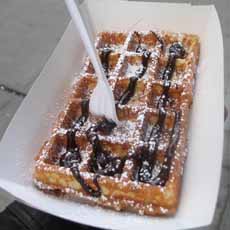
  Brussels Waffle
[1] Brussels waffle with chocolate fudge sauce and powdered sugar (photo © BillyBoy | Forums.Roadfood.com).

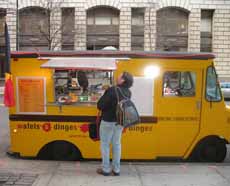
Wafels & Dinges Food Truck
[2] Wafles & Dinges truck (photo © BillyBoy | Forums.Roadfood.com).

Liege Waffles
[3] Liège waffles, made with pearl sugar (photo © Visit Belgium).

 
The waffle irons were constructed of two hinged iron plates connected to two long wood handles (photo). Many were crafted to imprint design patterns on the waffle: coats of arms, religious symbols, landscapes, etc. (and finally, the honeycomb pattern of today’s waffle irons).

In the 19th century, the design was adapted to be used atop the kitchen stove. In 1869, Cornelius Swartwout of Troy, New York patented a waffle iron for stove top use, consisting of cast-iron plates joined by a hinge that swiveled in a cast-iron collar (here are photos of it).

In 1891 John Kleimbach, a German immigrant in Shamokin, Pennsylvania, created a waffle iron for the Mansion House Hotel and became a traveling salesman, spreading the joy of waffles [source].

Fast forward: In 1971, Oregon track coach Bill Bowerman used the family waffle iron to experiment with the idea of a new sole for track footwear that would grip but be lightweight. He became co-founder of Nike, which helped to revolutionize athletic shoes.

________________

*Brussels wafels/waffles are what America generally calls “Belgian waffles,” although Belgians don’t appreciate that nomenclature. Authentic Belgian waffles are not made with pancake batter, but with a yeast-leavened dough that produces a lighter, crisper texture.

Liège wafels/waffles are made with pearl sugar, a beet sugar. The pearls burst and caramelize when the dough hits the waffle iron, resulting in a dense, sugary waffle. Liège waffles are Belgian street food; Belgians eat them plain, without toppings.


Comments off


© Copyright 2005-2026 Lifestyle Direct, Inc. All rights reserved. All images are copyrighted to their respective owners.