THE NIBBLE BLOG: Products, Recipes & Trends In Specialty Foods


Also visit our main website, TheNibble.com.

TIP OF THE DAY: Savory French Toast

Saturday was always “French Toast for breakfast day” in our family. It was always sweet, with real maple syrup and fresh fruit.

So when we came across this recipe for savory French Toast from Castello Cheese (which used its Aged Havarti in the recipe), we picked the following Saturday (yesterday) to give it a try.

The result: a nifty breakfast option for those who don’t particularly like syrup or other sweet toppings, and a change of pace for those who do. It evokes a breakfast grilled cheese sandwich on a soft, eggy base of pan-fried bread, rather than on crisp toasted bread.

It’s a nice change of pace. Just as you can vary the toppings on French Toast, you can use different savory toppings.

For those of you who remember Creamed Chipped Beef On Toast, you can make a French Toast version. Use leftover beef or jerky to replace the tomato and cheese in the recipe below. No beef? Check the fridge: You can adapt just about any savory leftovers.


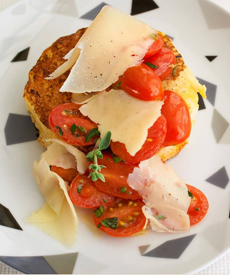
savory-french-toast-castello-230

Savory French Toast with cheese and tomatoes. Photo courtesy Castello Cheese.

 
Test out the recipe now: It may be just what you’re looking for for Father’s Day.

Prep time is 40 minutes. For prettier color, look for heirloom cherry tomatoes or a mix of red, orange and yellow varieties.

As you can see in the photo, the Castello chef used a three-inch round cookie cutter to cut the bread in circles after it comes out of the pan. We’re not so elegant; and besides, we don’t want to give up that cut-away French toast.
 
RECIPE: SAVORY FRENCH TOAST

Ingredients For 6 Servings
 
For The Tomato Topping

  • 3 cups cherry tomatoes, cut in half
  • 2 tablespoons olive oil
  • 1 teaspoon chopped fresh oregano
  • 1 teaspoon balsamic vinegar
  • Salt and pepper to taste
  •  
    For The French Toast

  • 2 cups milk
  • 2 eggs
  • ¼ cup grated Parmesan cheese (substitute Asiago or Pecorino Romano)
  • Salt and pepper to taste
  • 6 1½-inch thick slices brioche, egg bread or jalapeño Italian bread
  • 2 ounces aged Havarti, shaved (substitute Jack, aged Gouda, Tilsit or other shaveable cheese)
  •  

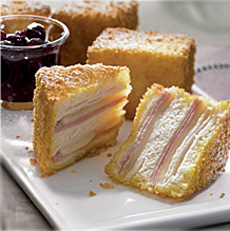
    monte-cristo-kikkoman-panko230
    A Monte Cristo sandwich is ham and Gruyère on French Toast. Photo courtesy Kikkoman.
     

    Variations

  • Blue cheese and sliced apples
  • Feta and kalamata olives with dill or oregano
  • Smoked salmon, caviar and crème fraîche
  •  
    Preparation

    1. PREPARE the tomatoes: Sauté the tomatoes in the olive oil over medium high heat. Add the oregano and vinegar and cook until softened, about 3 minutes. Season the mixture with salt and pepper and set aside, keeping warm until ready to serve.

    2. MAKE the French Toast: Whisk the milk, egg, Parmesan, salt and pepper in a shallow pan. Dip the bread into the milk mixture and pan fry it in a hot non-stick pan for 3 minutes per side.

    3. TRANSFER the bread onto serving plates and top with the tomato mixture. Shave the cheese over the tomatoes. Serve immediately.


    THE HISTORY OF FRENCH TOAST

    The dish known in America as French toast has roots at least as far back as ancient Rome, where it was a sweet dish. In fact, pain perdu (lost bread), the current French name for the dish, was once called pain à la romaine, or Roman bread.

    While the story evolved that French Toast was a food of the poor, trying to scrape together a meal from stale bread, recipes from ancient and medieval times denote that it was fare for wealthy people.

  • Recipes used white bread, a luxury, with the crusts cut off. Poor people ate brown bread, much cheaper because the wheat endosperm did not have to be milled and painstakingly hand-sifted through screens to create white flour.
  • Costly ingredients such as spices (cinnamon, cloves, mace and nutmeg), sugar and almond milk are found in numerous recipes.
  • The cooked bread was topped with costly honey or sugar.
  • And cookbooks themselves were the province of the privileged: Only wealthy people and clergy learned to read.
  •  
    THE MONTE CRISTO SANDWICH

    More recently, French toast has evolved into a savory sandwich, the Monte Cristo. It is an evolution of the croque-monsieur, a crustless sandwich of ham and Gruyère cheese, buttered and lightly browned on both sides in a skillet or under a broiler.

    The croque-monsieur was invented in Paris in 1910. A variation with a baked egg on top is called a croque-madame. Neither sandwich was battered, like French toast.

    The Monte Cristo sandwich, a triple-decker sandwich, battered and pan-fried, was invented at the Hotel del Coronado in San Diego. According to the L.A. Times, the first recipe in print is in the Brown Derby Cookbook, published in 1949.

    Here’s the recipe so you can try it for lunch—although probably not on the same day you have French Toast for breakfast.


    Comments off

    TIP OF THE DAY: “Leftovers” Antipasto Plate

    We can’t wait to get to Seattle to eat at Chef Ethan Stowell’s restaurants. Until then, we visit the websites and drool over the food photos.

    And we get ideas. After spotting this asparagus antipasto plate, we thought of different approaches to antipasto.

    Antipasto means “before the meal” in Italian—meaning before the main meal. It’s the traditional first course of multicourse Italian dinner.

    Most of us have had one along the way. The contents vary greatly by region, but Italian restaurants in the U.S. often have cured meats, marinated artichoke hearts, mozzarella or provolone, olives, peperoncini and pickled vegetables (giardiniera).

    Our mother’s typical antipasto consisted of artichoke hearts, fresh mozzarella, Genoa salami, giardiniera, a slice of cantaloupe in season wrapped with prosciutto, olives and our childhood favorite, BQ brand sesame breadsticks.

    But back to Ethan Stowell and his team of chefs:

       
    asparagus-antipasto-ethanstowell-230

    An asparagus-based “antipasto.” Photo courtesy Ethan Stowell Restaurants.

     
    His asparagus plate inspired us to create a “whatever” antipasto with foods we had on hand—which happened to include leftover steamed asparagus. We tossed them in a vinaigrette, and placed them on individual plates with:

  • Cheese (we had truffle cheese)
  • Croutons (thin slices of toasted baguette)
  • Dried figs (wish we’d had fresh figs!)
  • Mixed olives
  • Pâté (two varieties, thanks to a sample shipment from Les Trois Petits Cochons)
  • Pickled red onions (made in an hour with this recipe)
  • Sweet gherkins
  •  
    The tasty result seemed like a lot of thought and effort went into it. But really, we just went through the fridge and added a dab or this and that. Don’t hesitate to combine anything with anything else.


    greek-mezze-murrays-230
    Assorted Greek mezze. Photo courtesy Murray’s Cheese.
      AMUSE-BOUCHE, ANTIPASTO, HORS D’OEUVRE, MEZZE &
    TAPAS: THE DIFFERENCES

    Different but similar: Here’s the scoop on these popular foods:.

  • Amuse-bouche (pronounced ah-MEEZ boosh) is French for “amusing the mouth.” It’s an hors d’oeuvre-size portion plated in a tiny dish, sent as a gift from the chef after the order has been placed but before the food arrives. It is brought after the wine is poured. It is just one bite: A larger portion would constitute an appetizer. Amuses-bouches tend to be complex in both flavors and garniture, and enable the chef to show creativity.
  • Antipasto is a first course of assorted foods, served at the table (some restaurants have antipasto buffets).
  • Appetizer, a first course lately referred to as a starter in fashionable venues, is small serving of food served as a first course. It can be the same type of food that could be served as an entrée or a side dish, but in a smaller portion (e.g., a half-size portion of gnocchi). Or it could be something not served as a main dish, such as smoked salmon with capers.
  • Hors d’oeuvre (pronounced or-DERV) are one- or two-bite tidbits served with cocktails. They can be placed on a table for self-service, or passed on trays by the host or a server. Canapés are the original hors d’oeuvre; they’ve been joined in modern times by hot options such as cheese puffs, mini quiches, skewers, baby lamb chops and many other options. Technically, the term refers to small, individual food items that have been prepared by a cook. Thus, a cheese plate is not an hors d’oeuvre, nor is a crudité tray with dip, even though someone has cut the vegetables and made the dip. The term means “[dishes] outside the work [the main meal].” Several pieces can be plated to serve as an appetizer (first course). Martinets note: In French, the term “hors d’oeuvre” is used to indicate both the singular and plural forms; Americans incorrectly write and speak it as “hors d’oeuvres.”
  • Mezze or meze (pronounced MEH-zay) is an assortment of small dishes served to accompany alcoholic drinks or as an appetizer plate before the main dish. In Greece, expect mezedes of feta, Kalamata olives, pepperoncini, assorted raw vegetables and dips like taramasalata and tzatziki. Many other options include anchovies and sardines, saganaki (grilled or fried cheese) and roasted red peppers. In the Middle East, you’ll typically find dips (babaganoush, hummus), olives, pickles, tabouleh and other items, from raw vegetables to falafel and sambousek, small meat turnovers. Don’t forget the pita wedges!
  • Tapas (pronounced TOP-us) are appetizers or snacks that comprise a wide variety of popular foods in Spanish cuisine. They may be cold or hot, from cheese and olives to chorizo to a tortilla, meatballs, or fried squid. While originally traditional foods, some tapas bars now serve very sophisticated plates. You can order one or more tapas with a glass of wine, or order a series of plates to create a full meal.
  •   

    Comments off

    TIP OF THE DAY: Brown Rice Pudding Recipe For Breakfast

    Yesterday we popped into our local Le Pain Quotidien to meet a colleague for coffee. On the breakfast menu was brown rice pudding, topped with mixed nuts and raisins.

    We love rice pudding, so of course, we ordered it: our first “breakfast” rice pudding. It had much less sugar than dessert rice pudding, and, though served at room temperature, was not far removed from other porridge, like Cream Of Rice or oatmeal.

    We went online and found a breakfast rice pudding recipe from Tiffany at LiveLearnLoveEat.com.

    We also found the recipe below from the folks at Lundberg, the California-based premium rice producer, which uses just 1/2 cup of brown sugar in the entire recipe.

    Both recipes are made with cooked rice and are a great way to use leftover rice. Add nuts for protein!

    RECIPE: RICE PUDDING WITH BROWN RICE

    Ingredients

  • 1½ cups cooked short grain brown rice
  • 3 eggs
  • ½ cup brown sugar
  •    
    livelearnloveeat.com-230
    You can justify brown rice pudding: It’s a whole grain! Photo courtesy LiveLearnLoveEat.com.
  • Optional mix-ins: ½ cup raisins, chopped dates, or other dried fruit—blueberries, cherries, cranberries
  • ¼ teaspoon salt
  • ½ teaspoon vanilla extract
  • 3 cups whole milk
  • Nutmeg
  • Optional garnish: nuts (try a mix), shredded coconut
  • Optional: half and half, heavy cream, whipped cream
  •  
    Preparation

    1. BEAT the eggs; add the sugar and beat until smooth. Add the milk, salt, and vanilla and blend.

    2. ADD the rice and the raisins or other dried fruit. Pour into a greased shallow baking dish and sprinkle with nutmeg.

    3. SET the baking dish in a pan of hot water and bake at 350°F. After baking for approximately 30 minutes, gently stir the custard to suspend the rice. Continue baking for 60 minutes or until the custard is set (a total of 90 minutes).

    4. SERVE warm or cold, with cream as desired. To serve as dessert, you can use whipped cream.


    shrimp-miso-grits-silkroadtavern-230
    Shrimp and grits. Grits, ground from corn, are also porridge. Photo courtesy Silk Road Tavern.
     

    WHAT IS PORRIDGE?

    Porridge is a dish made by boiling ground, crushed or chopped cereal in water, milk, or a combination of both. It is usually served hot, often sweetened, and sometimes savory (the beloved cheese grits are porridge).

    Any cereal grain can be made into porridge. Some of the most common in the U.S.:

  • Buckwheat: kasha
  • Corn: cornmeal mush, grits, Indian pudding, polenta
  • Oats: oatmeal
  • Rice: congee, Cream of Rice
  • Wheat: Cream of Wheat, farina, Wheatena
  •  
    Other cereals—flax, millet, quinoa, rye, sorghum, and spelt, for example—are also made into porridge; as are non-cereals like legumes and potatoes. Pease porridge, from the old English nursery rhyme, is made from dried peas.

     
    WHAT IS GRUEL?

    Gruel is a thinner version of porridge—so thin that it can be drunk, rather than spooned. Historically, gruel has been a staple of the Western peasant diet.

    Gruel is often made from barley, hemp and millet. In hard times, chestnuts and even the less tannic acorns of some oaks were ground into flour and made into gruel.

    Gruel was a cheap way for officials to feed the poor—most famously described by Charles Dickens’s Oliver Twist, a ward of the parish, who couldn’t even get a second helping of it in the orphanage.


    CHECK OUT WHAT’S HAPPENING ON OUR HOME PAGE, THENIBBLE.COM.


    Comments off

    GIFT: Premium Spirits For Father’s Day

    For Father’s Day, here are some spirits that will light up Father’s Day for that special Dad who loves tequila or vodka.

    Casa Herradura has two superior expressions for the tequila lover:

    HERRADURA SELECCIÓN SUPREMA, EXTRA-AÑEJO

    Herradura Selección Suprema is the highest grade tequila from Casa Herradura. Aged for more than 49 months in American oak barrels, it has a very dark copper hue, paired with an intense aroma of brown spice and floral notes.

    This is an enormously complex, world-class sipping tequila for the connoisseur. The suggested retail price is $350 for a 750ml bottle. Pricey, yes; but for tequila lovers, it should be a memorable experience.

    At a more affordable price is Herradura’s limited edition Colección de la Casa, Reserva 2014 – Scotch Cask Finish Reposado.

       
    CASA HERRADURA SELECCION SUPREMA TEQUILA

    The greatest tequila in the world? Photo courtesy Casa Herradura.


    It undergoes a double maturation process after resting in two different types of oak casks: American oak and single malt Scotch casks. This creates a totally new flavor profile for fine tequila. The suggested retail price is $89.99.

    For more information visit Herradura.com.


    titos-handmade-vodka-bottle-230
    A different vodka experience. Photo courtesy Tito’s.
     

    TITO’S HANDMADE VODKA

    Tito’s Handmade Vodka is one of the fastest-growing craft spirits, and it’s gluten-free (made from 100% corn mash). Wine Enthusiast magazine scored it higher than Belvedere, Grey Goose and Ketel One.

    It’s made in small batches (microdistilled) in an old fashioned pot still by Tito Beveridge (that’s his actual name), a geologist who first made it for Christmas gifts. Friends encouraged him to go commercial.

    His boot-strapped brew won the double gold medal at the World Spirits Competition and put Tito’s on the map.

    We found it online for prices ranging from $17.99 to $32.99. Here’s a store locator on the company website.


    Comments off

    FOOD FUN: Pie Crust Cutters

    Surrounded by luscious spring and summer fruits, it’s hard not to want to bake a pie—or to learn how to bake one, if you’ve never dipped a toe in the oven.

    Two pie gadgets from Williams-Sonoma make even a novice seem like a sophisticated pie baker.

    LATTICE PIE CRUST CUTTER

    Like lattice crusts but lack the time or patience to make them?

    Williams-Sonoma offers this solution: a lattice pie crust cutter. It quickly and easily cuts a lattice-like crust from rolled-out dough.

    You simply place the lattice insert in the bottom of the gadget’s frame, then lay a sheet of rolled dough on top. To create the pattern, use a rolling pin to press the cutter into the dough. Lift off the insert and invert the latticed dough onto the pie.

    It’s not as dramatic as a hand-woven lattice, but it’s certainly more interesting than a solid top crust!

       
    lattice-pie-crutter-230sq-WS

    Press a lattice-style pie crust in 1-2-3. Photo courtesy Williams-Sonoma.


    Get yours at Williams-Sonoma.com, $19.95.


    american-flag-pie-cutter-WS-230
    A patriotic pie, indeed! Photo courtesy Williams-Sonoma.com.
     

    AMERICAN FLAG PIE CRUST CUTTER

    What we really love is this American flag pie crust cutter, also from Williams-Sonoma and also $19.95.

    While we try to avoid bringing single-use gadgets into our small kitchen, we made an exception for this one. Now, a patriotic pie will be our annual contribution to July 4th festivities.

    Get yours at Williams-Sonoma.com.

    Both inserts are designed for use with a 12″ diameter pastry crust.


    Comments off

    The Nibble Webzine Of Food Adventures
    RSS
    Follow by Email


    © Copyright 2005-2026 Lifestyle Direct, Inc. All rights reserved. All images are copyrighted to their respective owners.