Editor’s Note: National Italian Food Day is February 13th, and we’ve updated this 2015 article to reflect the 2026 Top 10 list. “Italian food” is a broad category, so:
> Check out the year’s 58 Italian food holidays.
And yes, Italian food is still America’s favorite international cuisine. However, many beloved Italian dishes are actually Italian-American creations rather than authentic Italian cuisine.
Spaghetti and Meatballs, Chicken Parmesan, and Baked Ziti became household favorites in America but aren’t traditional Italian. They were created by Italian immigrants adapting their recipes to American ingredients and tastes.
Also note that pizza would be number one on the fist two lists if it had been included in their rankings.
> The 2026 list is below.
2015: AN INFORMAL LIST
Nation’s Restaurant News (NRA) reports something that may not even be news: Italian food remains America’s favorite “international” restaurant cuisine. No other cuisine comes close, although Mexican and Chinese round out the “big three.”
Sixty-one percent of the 1,000 people surveyed said they eat Italian food at restaurants at least once a month. By comparison, Mexican cuisine was eaten at least once a month by 50%, and Chinese cuisine by 36%.
We couldn’t find an official survey of the most popular Italian dishes, but one informal survey we found nominated the following as the Top 10 favorite Italian restaurant entrées in the U.S. (excluding pizza, the majority of which is consumed at pizzerias* rather than conventional Italian restaurants):
- Chicken Parmigiana
- Fettuccine
- Lasagna
- Linguine With Clam Sauce
- Veal Marsala
- Chicken Saltimbocca
- Pasta Primavera
- Shrimp Fra Diavolo
- Penne Alla Vodka
- Spaghetti Marinara (with tomato sauce)
Our own Top 10 list would be different, but we wouldn’t turn any of these down! And we’d add our own Top 10 Italian Desserts list: cannoli, panna cotta, zabaglione, tiramisu, berries with mascarpone, riccota cheesecake, biscotti, gelato/semifreddo/spumoni/tortoni, sorbetto/granita and bomboloni.
The NRA defines “ethnic” cuisine broadly as any cuisine originating in a different country or within a specific region of the United States. We prefer the term “international cuisine” (it’s hard to think of French and Italian food as “ethnic”), but that doesn’t always work. American cuisnes—think Cajun and Creole—are ethnic but not international, as are California, Hawaiian, New England, Southern and Southwestern cuisines, among others.
Choose the term you like better and read the full article at NRN.com.
2024: THE YOUGOV LIST (INACCURATE!)
A YouGov survey data from 2024-2025, claims that these are the top 10 favorite Italian dishes in the United States. However, three of their Top 10 aren’t even Italian! And Pasta With Chicken And Garlic Sauce? Is that a “Top 10” thing now? What happened to Chicken Parm?
In order of popularity, YouGov’s methodology has produced:
- Spaghetti with Meatballs: 84%
- Ravioli: 80%
- Pasta with Tomato Sauce: 80%
- Macaroni and Cheese: 80% (NOT ITALIAN!*)
- Lasagna: 78%
- Caesar Salad: 74% (NOT ITALIAN!*)
- Pasta with Chicken and Garlic Sauce: 73%
- Fettuccine Alfredo: 73%
- Taco Salad: 72% popularity (NOT ITALIAN!*)
- Baked Ziti: 68% popularity
*Caesar Salad was created by an an Italian immigrant restaurateur Caesar Cardini, in Tijuana, Mexico in the 1920s (the history of Caesar Salad).
*Taco Salad? Definitely Tex-Mex, developed by the inventor of Fritos for Disneyland in 1955 (the history of Taco Salad).
*Mac and cheese was invented by Thomas Jefferson (or his cook—the history of macaroni and cheese).
So let’s get on with a better list.
2026: THE ABACUS LIST
We asked one of our favorite A.I. “consultants,” Abacus, for its take. It advised, of course, that there is no one official list. “But based on U.S. restaurant menus, sales, and general popularity, these are the 10 Italian (or Italian‑American) dishes that are consistently the biggest hits in the U.S.:”
- Pizza (especially pepperoni & Margherita)
- Spaghetti With Meatballs (or Bolognese, meat sauce)
- Lasagna
- Fettuccine Alfredo
- Chicken Parmigiana
- Garlic Bread
- Ravioli
- Baked Ziti and other baked pasta casseroles
- Tiramisu
- Cannoli
We vote with Abacus!
|
|
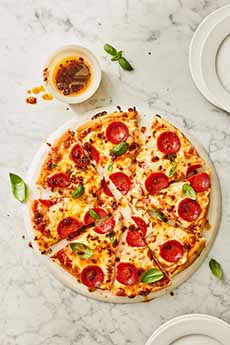
[1] Pizza is number one, especially pepperoni and Margherita (photos #1, #2, #3 © DeLallo).
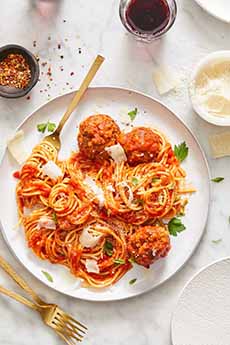
[2] Spaghetti and Meatballs.
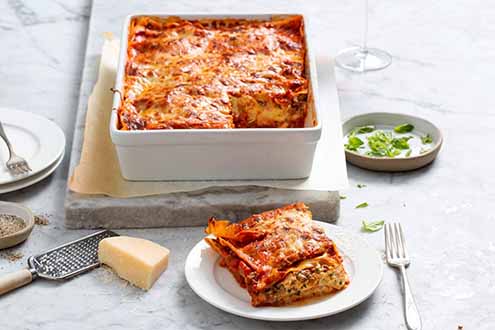
[3] Lasagna.
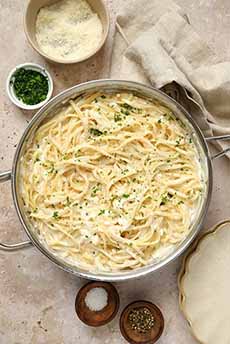
[4] Fettuccine Alfredo. Our favorite variation adds green peas and pancetta (photos #4 and #5 © Taste Of Home).
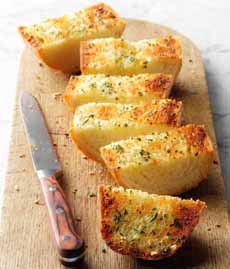
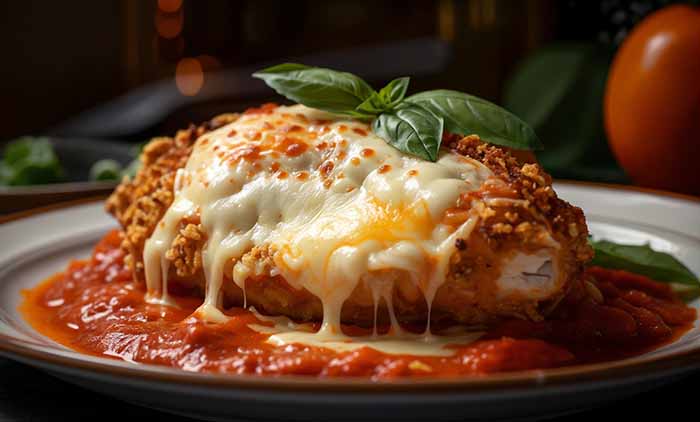
[6] Garlic Bread. The photo for Number 5, Chicken Parm, is below.
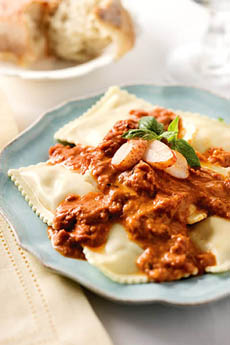
[7] Ravioli (photo © Chesapeake Bay).
|