THE NIBBLE BLOG: Products, Recipes & Trends In Specialty Foods


Also visit our main website, TheNibble.com.

RECIPE: Pumpkin Flan & The Difference Between Caramel Custard & Creme Caramel

October 3rd is National Caramel Custard Day.

Caramel custard is one of the numerous different types of custard. Crème caramel, also called flan, is another.

Because there is no official National Flan Day (Walmart declared one in 2012 as a product promotion), and because it’s pumpkin season, we’re sharing a Pumpkin Flan recipe from Seviche restaurant in Kentucky.

But first, let’s end the confusion between caramel custard and crème caramel/flan.

It’s easy to confuse the two by name (but not by sight—details follow). In fact, when we looked at caramel custard recipes and images online, almost all of them were crème caramel/flan.

Both use caramelized sugar (white sugar heated until it becomes a light brown liquid), but in different ways. Here’s how to distinguish them:

  • Caramel custard, a British recipe, mixes caramelized sugar into the custard prior to baking. It is typically baked in ramekins. The top is smooth, like conventional baked custard, but a deep tan color from the caramelized sugar (photo #3).
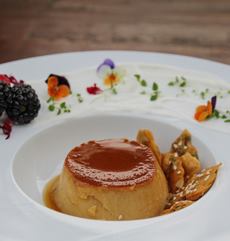
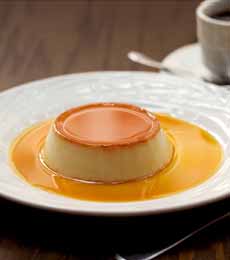
  • Crème caramel or flan, known as flan in Spanish (photos #1 and #2), has a distinctive layer of moist caramelized sugar on top. This is made by adding the caramelized sugar to the bottom of the mold. When the flan is unmolded, upside-down, there’s a brown layer of caramel top that runs down the sides, creating a sauce-like effect.
  • A quick visual: If it doesn’t have a separate, runny top layer, it isn’t crème caramel/flan. If it does have the runny top, it is flan/crème caramel.
  • While both are most often made in individual portions, they can also be made in a multi-portion size (photo #4).
  • Pastry flan: In the pastry world, flan is a term used for a sweet or savory multiportion tart filled with some kind of custard. Both are typically made in a fluted tart or flan ring, a short pan with a removable bottom.
  •  
    > With a sweet flan, the tart is filled with pastry cream (crème pâtissière, a type of custard) and topped with fruit.

    > Quiche is the best known of the savory tarts. Another term for spinach quiche is spinach flan; leek and bacon quiche is leek and bacon flan, etc.
     
     
    RECIPE: PUMPKIN FLAN

    This recipe uses a particular brand of pumpkin-infused syrup. If you can’t find it locally and don’t want to order it online, you should be able to find others, such as Monin and Torani. It’s the same syrup used to make pumpkin spice lattes.

    If you don’t know the details, here’s the difference between evaporated milk and condensed milk.

    Ingredients For 10 Four-Once Servings

  • ¾ cup sugar
  • 1 cup water
  • 1 can (14 ounces) evaporated milk
  • 1 can (14 ounces) condensed milk
  • 10 egg yolks
  • 1 teaspoon vanilla extract
  • 8 ounces Pumpkin Reál Infused Syrup (available at local Liquor Barn locations)
  • 1 cup pumpkin purée
  •  
    Preparation

    1. MIX the sugar and water in a saucepan. Bring to a boil for a few minutes until the sugar caramelizes.

    2. POUR the caramelized sugar into aluminum molds; you can use any shape: oval, round or square. Spread the caramel on the bottom of the molds. Set aside at room temperature until hardened.

    3. PREHEAT the oven to 350°F. Mix well the evaporated milk, condensed milk, egg yolks, pumpkin and vanilla by hand or blender. Pour through a fine mesh sieve. Gently pour the mixture on top of the caramel in the aluminum molds.

      Pumpkin Flan

    [1] Pumpkin flan at Seviche restaurant in Louisville, Kentucky (recipe below).

    Flan
    [2] Classic flan at Fogo de Chão.

    Caramel Custard
    [3] Caramel custard has a smooth, dry top: no runny caramelized sugar. That sugar is in the mix—it’s what gives the custard its brown color, instead of conventional, pale yellow, baked custard. Here’s the recipe from Bon Appetit.

    Caramel Custard
    [4] A multiportion caramel custard made in a removable-bottom pan. Here’s the recipe from Hummingbird High.

     
    4. FILL the molds to about 1 to 1-1/4 inch of the top. Cover the molds individually with aluminum foil. Before baking the flan, place the molds on a larger baking pan and add hot water to this pan until half way up the molds. Bake for about 45 minutes. Let cool then refrigerate for at least 4 hours.

    5. TO SERVE: Run a thin knife around the edges of the mold to loosen the flan. Place a plate on top of the mold and quickly turn upside down to position the golden brown caramel on top.
     
     
    DON’T GO AWAY WITHOUT CHECKING OUT

    THE HISTORY OF CUSTARD


    Comments off

    Prosecco Cocktail Recipes & The History Of Prosecco

    Mionetto Prosecco
    [1] Ready for Halloween drinking or gifting. This is the traditional bottle shape for all Proseccos (photos #1 and #2 courtesy Mionetto).

    Smoking Cranberry Mimosa
    [2] Dry ice chips create a smoking Cranberry Mimosa for Halloween or anytime. Here’s the recipe (photo: The Nibble).

    Prosecco Flutes
    [3] Toast to Halloween (photo © BLT Prime | NYC).


    Updated June 2026

    Are you planning a Halloween party?

    Will you be a guest at one?

    Are you staying home to greet the trick-or-treaters (or hide from them)?

    In any case, you deserve your own treat: Mionetto prosecco.

    Its black-and-orange colors are holiday-themed, and the sparkling wine inside is delicious for drinking straight or turning into cocktails:

  • Bellini (with peach purée or nectar)
  • Mimosa (with orange juice)
  • Smoking Blood Orange Mimosa For Halloween
  • Grapefruit Mimosa
  •  
    Below:

    > What is Prosecco?

    > The history of Prosecco.

    Elsewhere on The Nibble:

    > 20 Champagne cocktail recipes, including a Caramel Apple Mimosa.

    > The history of Halloween.

    > Prosecco ice pops recipe.

    > The different types of sparkling wine.

    > Why you should have a Champagne re-corker.

    > The year’s 100+ cocktail and spirit holidays.

    > The year’s 9+ Champagne and other sparkling wine holidays.

    > The history of individual cocktails, spirits, and other foods.
     
     
    WHAT IS PROSECCO?

    Prosecco is a very affordable bubbly that often takes the place of Champagne at the table—or the party.

    Prosecco (pro-SEK-o) is the name of a village in northeast Italy’s Veneto region. It is located in the hills of the province of Treviso, between the towns of Conegliano and Valdobbiadene.

    It’s the of home Prosecco sparkling wines. In Europe, wines are named after the place where the grapes are grown and the wine is made. The wine is often labeled Prosecco di Conegliano Valdobbiadene, after its appellation*.

    The Prosecco grape—now known as the Glera grape—originated there. While most of the wines are largely Glera, by law other local white grape varieties, such as Bianchetta Trevigiana, can be included in the blend.

  • Prosecco can be frizzante (frizz-ON-tay)—just slightly fizzy. These wines are sometimes bottled with a regular cork to be opened with a corkscrew.
  • Or, prosecco can be spumante (spoo-MON-tay)—very fizzy and bottled with the Champagne’s mushroom-style cork and cage (or something similar).
  •  
    Prosecco is made by the Tank Method, also known as the Charmat process (named for its inventor), the bulk method, cuve close (French for sealed tank), granvas (Spanish) or autoclave (Italian).

    The second fermentation† takes place in a stainless steel tank and the resulting wine is bottled under pressure. This is a much less expensive way to do the job, and wines made by this method are less expensive than traditional method bubblies that follow the Champagne style.


    THE HISTORY OF PROSECCO

    The history of Prosecco is not well documented. Until recently, there were different theories about its origin.

    Now, it is believed that the first Prosecco was created in 1868 by Antonio Carpene, who subjected still white wine of the area to a second fermentation, which produced the bubbles.

    In general, the wine of Prosecco has been linked to a wine made at the time of Roman Empire, in a town called Pucino.

    It, like Prosecco, was located in the hills that surround the Gulf of Trieste [source]. (The town no longer exists, but the surname Pucino, indicating a person from Pucino, is still going strong.)

    Using grape DNA and archaeological evidence, it was more recently established that the grape called Prosecco was very similar to the older grape from the Pucino area, Glera. The grape called Prosecco is now called Glera.
     
    ________________

    *An appellation is a legally defined and protected geographical indication, used to identify where the grapes for a wine were grown. Restrictions other than geographical boundaries, such as what grapes may be grown, maximum grape yields, alcohol level, and other quality factors, may also apply before an appellation name may legally appear on a wine bottle label.

    The rules that govern appellations are dependent on the country in which the wine was produced, and a legal designation appears on the label. A.O.C., Appellation d’Origine Contrôlée (the appellation of origin is controlled by law) is one of these.

    The tradition of wine appellation is ancient: References are found in the Bible, where the wines of Carmel, Samaria, Helbon and Jezreel are mentioned. The tradition of appellation continued throughout antiquity and the Middle Ages, though without any of the legally sanctioned rules as exist in modern times (see paragraph above).

    Historically, the world’s first exclusive (protected) vineyard zone was introduced in Chianti, Italy in 1716; and the first wine classification system in Tokaj-Hegyalja, Hungary, in 1730 [source].

    Other types of food often have appellations as well. Products from certain highly-regarded apples to cheeses to figs to walnuts are A.O.C. designations (here’s more). A.O.C. guarantees quality and authenticity to the consumer.

    Sparkling wines undergo two fermentations. The second fermentation creates the bubbles.
     

    CHECK OUT WHAT’S HAPPENING ON OUR HOME PAGE, THENIBBLE.COM.


    Comments off

    FOOD FUN: Sashimi Bites Appetizer Or Cocktail Nibble

    Sashimi lovers: This one’s for you.

    Low in calories, high in protein, nice to look at: Why not make sashimi bites.

    We spotted these on the Facebook page of Chef Eric Ripert. While known worldwide for Le Bernardin in New York City, these are at his restaurant Blue, at the Ritz Carlton in Grand Cayman.

    Chef Ripert’s caption says that he marinated local wahoo in a sour orange juice marinade. The result is full of protein with just a few calories.
     
     
    OUR COPYCAT RECIPE: SASHIMI BITES

    We’ve never been to Grand Cayman, but re-created a version of the recipe with a yuzu marinade (we always have a bottle of yuzu juice on hand). The biggest problem was finding a substitute for the wahoo fish, also known as ono.

    Wahoo is a mild white fish with a firm texture (“muscular”, and the fillets are thick enough to slice bites of 1″ high or more. We settled on Alaskan Halibut, which is also white and mild. Your fishmonger may have other ideas.

    Customize your marinade like a tiradito sauce: olive oil and citrus juice (lemon, lime, yuzu), salt and pepper, and whatever other seasonings you like: grated ginger or garlic, a bit of cayenne or other dried chile.

    You can also use a favorite fish marinade recipe, or a Dijon vinaigrette.

    Note that photo #1 shows the bites with fingerling potato chips. While homemade at the restaurant, you may be able to find them at specialty stores—or make your own potato chips.

    Also, we don’t know what the menu calls these morsels, but we call them “sashimi bites”
     
    Ingredients

  • Fish fillet
  • Marinade/vinaigrette
  • Carrots (regular or specialty color), narrow or medium diameter
  • Red onion slivers and sprig of microgreens or an herb like chive or tarragon leaf (no stem)
  •  
    Preparation

    1. RINSE and pat dry the fish. Cut into 1″ cubes (larger if you like) and marinate, turning occasionally.

    2. STEAM the carrots until they are tender but not falling apart. Set aside to cool, then slice into 1/4-inch pieces.

    3. REMOVE the cubes from the marinade and shake off the excess. Assemble on a plate: cube, carrot, herb. If you want to serve as a tiradito, make extra marinade to spoon onto the bottom of the plate.
     
     
    We don’t know about you, but we could eat an entire tray.

      Sashimi Appetizer Bites
    [1] We don’t know what the menu calls them, but we call them “sashimi bites” (photo courtesy Chef Eric Ripert).

    Wah
    [2] Wahoo’s flesh is thick and meaty (photo courtesy Giovanni’s Fish Market).


    [3] Wahoo, which can grow to 8 feet, are a favorite for sports fishing (photo courtesy Sport Fishing Magazine).


    WHAT IS WAHOO

    Wahoo (Acanthocybium solandri) is originally from Hawaii, where it is caught wild. It is also known as ono, a Hawaiian word that means “good to eat”.

    It is also fished in the Gulf Of Mexico. It favors tropical and subtropical waters.

    Wahoo is a member of the same fish family (Scombridae) as bonito, mackerel and tuna. It is closely related to king mackerel.

    Its colors are radiant: The back of the fish is iridescent blue, while the sides are silvery with a pattern of blue and silver stripes (photo #3).

    The fish can grow quite large, up to eight feet in length and weighing up to 183 pounds. They are some of the fastest fish in the sea, clocked at 60 mph [source]. It is a favorite for sports fishing.

    Most important for eating, wahoo is a delicious fish: It has a firm texture like swordfish (photo #2) and a mild, sweet, rich taste.

    The firm flesh is can be grilled easily.


    Comments off


    © Copyright 2005-2026 Lifestyle Direct, Inc. All rights reserved. All images are copyrighted to their respective owners.