|

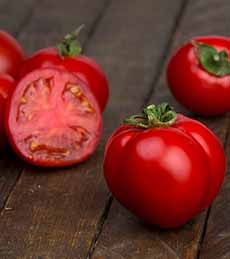
[1] Luscious, aren’t they! But what do you do during the long span of months when vine-ripened tomatoes are out of season (photo © Baldor Specialty Food).
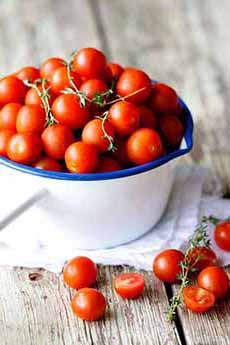
[2] Cherry tomatoes: Not the same thing, but a fair substitute (photo © Casa Barilla).
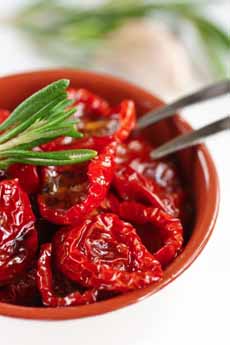
[3] Sundried tomatoes should look like this: bright red and moist. If you don’t use them quickly enough and they start to dry out and turn brownish, place them in a container topped with olive oil (photo © Bella Sun Luci).
[4] Oven-roasted red peppers. Here’s how to make them from Alexandra Cooks (photo © Alexandra Cooks).
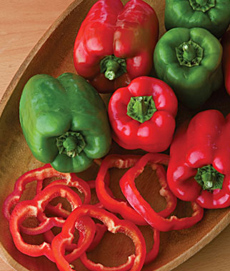
[5] Slice the peppers horizontally and put them in this pickling brine for an hour or more (photo © Burpee).
[6] Pimentos in jars are soft, pliant and ready for a sandwich or burger (photo © Goya). |
|
Even though it’s spring, it will be a few months before vine-ripened tomatoes are available.
There’s nothing worse than paying good money for “slicking tomatoes,” the term our supermarkets give to tasteless tomatoes, sometimes mealy, that never ripen to a soft texture.
If they’re hard, that means they’re good for slicing? That’s one angle; but those tomatoes are not good for eating.
So: What should you do if you want something approximating tomato flavor plus bright color on your sandwich or in your salad?
Here’s what we use.
OFF-SEASON TOMATO SUBSTITUTES
Cherry Tomatoes: Available year-round. They have good texture, bright color and depending on the crop, flavor approximating their larger relatives [photo #2].
Canned Whole Tomatoes: Drain and halve them and press out the juice in a sieve. Save the juice and substitute it for water in a recipe. We also toss it into a Bloody Mary.
Fried Green Tomatoes: You can buy hard tomatoes that are artificially reddened, and give them the Fried Green Tomatoes treatment. Here’s a recipe.
Pimentos/Pimientos: They’re available in jars, whole or sliced. A form of bell pepper, marinating in the jar makes them soft and pliant [photo #6].
Red Bell Peppers: Thinly sliced, marinated or pickled (you can pickle in one hour), oven roasted. Bell peppers are tomatoes’ cousins in the Nightshade Family* [photo #4].
Sundried Tomatoes: Marinated in oil and drained, or turned into pesto [photo #3].
Sweet Potatoes: Refrigerate whole baked sweet potatoes. Slice and use on a sandwich..
UNCONVENTIONAL SUBSTITUTES
These two fruits may raise your eyebrows, but to paraphrase: “Try it, you may like it!”
Mango (Unripened): A slice of unripe mango can replace a slice of tomato. The texture is similar, it’s not very sweet and the texture is similar.
Persimmon: Their juicy, meaty texture and natural sweetness are an excellent substitution.
HOW TO IMPROVE THE FLAVOR OF THE TOMATOES YOU’VE ALREADY PURCHASED
We have recommendations for that, too. Here they are.
THE HISTORY OF THE TOMATO
In all of its forms—fresh, tomato sauce. paste, juice, etc.)—the tomato is the second most widely consumed vegetable in the U.S., after the potato.
The tomato is native to Mesoamerica: It was cultivated by the Aztecs and Incas.
In 1519, Cortez found it growing in Montezuma’s gardens, and it became part of the culinary bounty brought back to Spain by the 16th-century conquistadors (along with cacao, chiles, potatoes, turkey and much more).
Some Europeans embraced them, but many believed them to be poisonous (it’s a member of the Nightshade family, which includes some poisonous plants: and the leaves of some of the edible plants are poisonous if consumed in large quantity).
French botanist Joseph Pitton de Tournefort bestowed the Latin botanical name Lycopersicon esculentum on the tomato. This translates to “wolf-peach,” a reference to the third century writings of Galen concerning a poison in a palatable package which was used to destroy wolves.
The English word tomato comes from the word brought back from the New World by the Spanish, the Aztec/Nahuatl word tomatl, pronounced toe-MAH-tay. This became the Spanish word tomate: same pronunciation, different spelling.
The original tomatoes were small, like cherry tomatoes, and most likely yellow rather than red. In Spain and Italy, they were known as pomi d’oro, golden apples.
The original cherry tomato versions were deemed inedible and used only as decorative plants for 200 years, until famine in Italy caused starving peasants to eat them.
After five centuries of breeding, there are thousands of varieties of tomatoes in a vast array of shapes, colors and sizes.
The most common shapes in the U.S. are round (beefsteak and globe), pear-shaped (roma and plum) and the miniature (cherry and grape).
THE TOMATO: FRUIT OR VEGETABLE?
Is the tomato a fruit or a vegetable? It is the fruit of the tomato plant.
Botanically speaking, it is developed from the dry ripened ovary in the base of a flower, and contains the seed(s) of the plant (although cultivated tomatoes may be seedless).
It can be further classified as a berry since it’s pulpy and has edible seeds.
Apples, blueberries, oranges, pears, and raspberries are true fruits.† Many kinds of nuts are also true fruits, as are the avocado, tomato and—more surprisingly—the bean pod, bell pepper, hot chile pepper and zucchini.
Science notwithstanding, on May 10, 1893, tomatoes were declared a vegetable by the United States Supreme Court.
At the time, there were import tariffs on vegetables but not fruits, yet tomatoes were still being subjected to the tax.
In 1887, an importing company had sued the tax collector of the port of New York to recover back duties collected on their tomatoes, which they claimed had been wrongfully classified as vegetables.
The Court decided that the tariff act should be based “in common language of people,” not botanists, so tomatoes should be taxed like beets, carrots, parsnips, potatoes, turnips, etc. You can read the case summary here.
A good rule of thumb to determine if something is a fruit is not whether it is sweet, but if it has internal seeds.
That means that:
Acorns, almonds, cucumbers, green beans, squash, walnuts and zucchini are botanical fruits.
Asparagus, broccoli, carrots, celery, lettuce, onions and potatoes are vegetables.
It’s O.K. if you want to call cucumbers, zucchini etc. vegetables. We just want to set the record straight.
|