|
In our area of New York City, the health department issued a heat alert today: Don’t go out until after 6 p.m. this evening.
It’s expected to hold for the next week. Whew!
If you’re living amid high heat and must be outside (or inside heat), hydrate extensively.
You can hydrate with plain or flavored water, still (flat) or carbonated water—mineral water, club soda and seltzer (here’s the difference).
Some people love to drink water, and have no problem drinking lots of it.
If you’re not one of them, you can hydrate yourself by picking water-filled foods.
FOODS WITH THE HIGHEST WATER CONTENT
Bonus: In addition to being high in water, they’re low in calories; and most can be served at all three meals.
Most of these can be toted in a snack bag (to carry with you, cherry tomatoes are the best tomato option).
In order of percentage of water:
Apple: 86% water
Cantaloupe and honeydew: 90% water
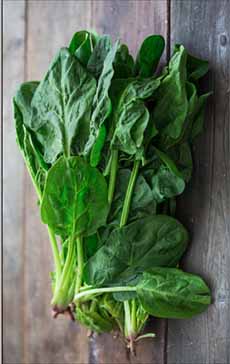
Spinach: 91% water
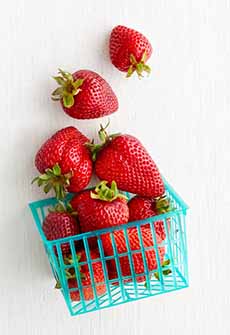
Strawberry: 91% water
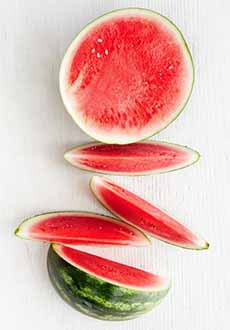
Watermelon: 91% water
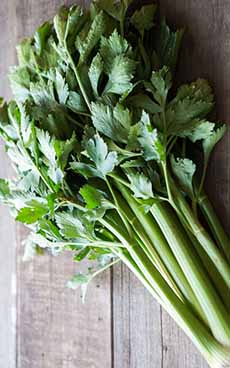
Celery: 95% water
Tomato: 95% water
Zucchini: 95% water
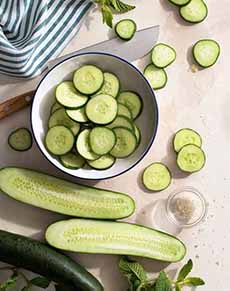
Cucumber: 97% water
Thanks to United Healthcare for this information.
Some easy “hydration” meals:
Mixed fruit salad with cottage cheese or yogurt.
Mixed green salad with celery, cucumber, tomato, zucchini, with lettuce and other ingredients of choice—plus optional grilled chicken or fish.
Greek-style salad with anchovies, feta, grape cheese, kalamata olives, pepperoncini and romaine or spinach—plus optional grilled chicken or fish.
Poached eggs atop steamed spinach.
Roasted vegetable plate with steamed spinach.
Spinach salad with cucumbers, tomato, hard-boiled eggs, bacon, plus optional grilled chicken or fish.
Dessert: melon, sorbet, strawberries—or sorbet topped with melon and strawberries!
ANOTHER WAY TO HYDRATE: NIBBLE ON CRUSHED ICE
When dehydrated and at home, you can nibble on ice chips or crushed ice if you don’t want to keep drinking water.
Before we got a home water filter and didn’t enjoyed the taste of our tap water, we crunched on ice chips or ate spoonfuls of crushed ice (think of it as a snow cone without the syrup).
HOW TO CRUSH ICE WITHOUT AN ICE CRUSHER
The best way is to have a refrigerator that supplies cubes and crushed ice.
There are also electric countertop ice crushers and ice shavers (have a snow cone machine?).
But most of us have to rely on other techniques.
There are at least five ways to crush ice. Note that if you’re crushing ice for drinks, you’ll need more crushed ice to fill up a glass, because there’s more air space between the ice cubes.
Also note that the smaller the piece of ice, the faster it melts.
Blender Or Food Processor
Place the ice cubes in the machine. With the top on firmly, pulse to the desired size.
Toss the crushed ice into a strainer to drain out the melted water on the bottom.
If you make a large amount, you can re-freeze the crushed ice and re-pulse it the next time you need crushed ice (the frozen pieces will have stuck together).
Lewis Bag Or A Freezer Bag & Mallet
A Lewis bag is a heavy canvas bag that that was originally used by banks to transport coins.
In the 19th century, before electric devices easily created crushed ice whenever it was needed, some clever bartender came up with the idea of repurposing a Lewis bag to crush ice cubes with a mallet.
The heavy canvas bag is not only durable, but it absorbs the water given off by crushing the ice.
You can buy one, including the mallet, for less than $20 on Amazon and elsewhere.
The downside: Since the bag isn’t see-through, you end up with uneven pieces.
Try substituting a plastic freezer bag. If your mallet cuts through the plastic, double-bag the ice cubes and try again.
Ice Tapper Or Spoon
Some of the early ice boxes—cooled by large blocks of ice—had a place for an ice cube tray. If not, they could chip larger, irregular pieces off the block of ice with an ice pick.
They then used the back of a spoon to tap the piece of ice (or ice cube) until it splintered.
In 1949, Frank W. Ernest, tired of the limitations of the spoon and ice pick, patented a device he called the Ice Disintegrating Utensil, today known as an ice tapper.
A mining engineer, Ernest employed his scientific knowledge to create a tool that could break ice cleanly and evenly.
Originally marketed as the Tap-Icer, the ice tapper lets you crack cubes, one at a time.
You can get it at Amazon and elsewhere, including many hardware stores.
We still have our grandmother’s, from the 1950s.
Manual Ice Crusher
For nostalgic value, we offer the Manual Ice Crusher, used by our great-grandmother and still made today in Germany.
Bear down on hinged metal plates with a handle to crush an ice cube placed between them.
You can get an upper arm workout crushing the ice!
> CHECK OUT THE DIFFERENT TYPES OF WATER
|