“…balls of sweetened dough, fried in hog’s fat, and called doughnuts, or olykoeks*.”
Because the center of the cake did not cook as quickly as the outside, the softer centers were sometimes stuffed with fruit, nuts, or other fillings that did not require cooking (think of the chopped onions in the center of a bialy).
What about the hole?
Per Smithsonian, a New England ship captain’s mother made a notably delicious, deep-fried doughnut that used her son’s spice cargo of nutmeg and cinnamon, along with lemon rind. She filled the center with hazelnuts or walnuts.
As the story goes, in 1847, 16-year-old sailor Hanson Crockett Gregory created the hole in the center of the doughnut. He used the top of a round tin pepper container to punch the holes, so the dough would cook evenly.
He recounted the story in an interview with the Boston Post at the turn of the century, 50 years later.
He effectively eliminated the need to fill the less-cooked center, and provided an inner cut-out that enabled the dough to be evenly cooked.
This was a breakthrough not just for donut holes, but for the donut in general. Previously, it had been cooked as a solid piece (no hole), so the sides were always crisper than the center. In fact, toppings were often put on the soggy center to cover up the flaw.
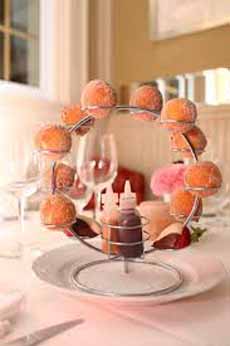
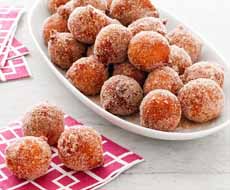
After the creation of the doughnut hole, donut makers also fried the dough “holes.”
It took more than a century and a mass marketer to popularize donut holes in America.
While the forerunner of Dunkin’ Donuts began in 1948 (here’s the history of Dunkin’ Donuts), Munchkins “donut hole treats” were not introduced until 1972. Tim Hortons followed with Timbits in 1976.
WHO CHANGED THE SPELLING FROM DOUGHNUT TO DONUT?
The first known printed record of the shortened word “donut” appears (likely an inadvertent misspelling) in “Peck’s Bad Boy And His Pa,” a story by George W. Peck published in 1900.
The spelling did not immediately catch on. That impetus goes to Dunkin’ Donuts, which decided on the truncated spelling when it started its business in 1950.
Later, as the brand expanded nationwide, it introduced America to the alternative spelling.
Donut is a easier to write, but we prefer the old-fashioned elegance of doughnut. Take your choice.
Doughnuts didn’t become a mainstream American food until after World War I. American doughboys at the front were served doughnuts by Salvation Army volunteers. When the doughboys returned, they brought their taste for doughnuts with them [source].
The name doughboy wasn’t related to the doughnuts, by the way. In the Civil War, the cavalry unchivalrously derided foot soldiers as doughboys.
According to one explanation, the term dates earlier, to the Mexican War of 1846-1848. American infantrymen made long treks over dusty terrain, giving them the appearance of being covered in flour, or dough.
One variation of this account explains that the soldiers were coated in the dust of adobe soil and were nicknamed “adobes,” which evolved into “dobies” and, eventually, “doughboys.”
We could not find exactly how U.S. service members in World War I (1914-18) came to be nicknamed doughboys, but as the granddaughter of a doughboy, we can relay that it was a positive term.
The nickname was still in use as of the early 1940s in popular culture, including the 1942 song “Johnny Doughboy Found a Rose in Ireland,” the 1942 musical film “Johnny Doughboy,” and the character “Johnny Doughboy” in Military Comics. The term was gradually replaced during World War II by G.I. (General Infantry) [source].
________________
*Olykoeks, meaning oil cakes, is the Dutch word for doughnuts. The Dutch, early settlers of Manhattan, brought doughnuts to the New World.
CHECK OUT WHAT’S HAPPENING ON OUR HOME PAGE, THENIBBLE.COM.
|