THE NIBBLE BLOG: Products, Recipes & Trends In Specialty Foods


Also visit our main website, TheNibble.com.

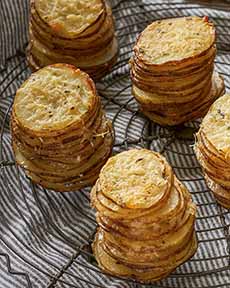
FOOD FUN: Potato Stacks With Romano Cheese

Have some fun with potatoes this weekend: Make potato stacks in your muffin cups.

The potato slices have crisp edges, and can be eaten like a stack of pancakes, in single slices, or whatever way creativity guides you.

(We picked them up and ate them like chips.)

The recipe, from Wisconsin Cheese, uses romano cheese for its tangy flavor to dishes.

Romano is similar in texture to parmesan, but has a sharper, more assertive taste. There’s more about it below.
 
 
RECIPE: CRISPY POTATO STACKS

Ingredients

  • 5 medium russet potatoes (2-inch diameter), cut into 1/8-inch slices
  • 6 tablespoons butter, melted
  • 2 teaspoons minced fresh rosemary
  • Salt and pepper
  • 3 ounces Romano cheese, grated (1 cup)
  •  
    Preparation

    1. HEAT the oven to 400°F.

    2. COMBINE the potatoes, butter and rosemary in a large bowl. Season with salt and pepper. Sprinkle with Romano; toss to coat.

    3. EVENLY STACK the potatoes in six lightly greased muffin cups. (The stacks will be taller than the muffin cups.)

    4. COVER the pan with aluminum foil. Bake for 35 minutes. Uncover; bake for 20-25 minutes longer or until the potatoes are golden and crispy around the edges.

    5. RUN a knife around edges to loosen the potato stacks; plate.
     

    ABOUT PECORINO ROMANO & ROMANO CHEESES

    History

    Few cheeses in the world have such ancient origins as Pecorino Romano.

    For more than 2,000 years, flocks of sheep that graze freely in the countryside of Lazio, the region of which Rome is the capital. These sheep produced the milk from which the cheese is made.

    In fact, it was made in Roman countryside until 1884, when a city council ruling over cheese salting in shops caused producers to move to the island of Sardinia.

    Pecorino Romano was a favorite of the ancient Romans, from royalty to soldiers and everyday citizens.

  • In the imperial palaces, it was prized at banquets.
  • It was a staple ration for the Roman Legionaries (along with bread and farro soup).
  •  
    The processing of sheep’s milk for cheese was described by Homer (c. 800 to c. 701 B.C.E.).

    Columella (4 to c. 70 C.E.), a prominent Roman writer on agriculture, gives a detailed description of pecorino production in his “De re rustica” [source].

    The method of production of the cheese was also described by Pliny the Elder (c. 23/24 C.E. to 79 C.E. [he died during the Pompeii eruption]).

    Today’s Pecorino Romano is made from the same recipe, albeit with pasteurized milk.

    A hard grating cheese, “pecorino” refers to sheep’s milk cheese (pecore means sheep in Italian). Romano indicates that the cheese is of Roman provenance.

    While Parmigiano Reggiano and Grana Pedano are the favorite grating cheeses of Northern Italy, Pecorino Romano is the choice in the southern portion of the country.

    It’s a bit drier and saltier than northern Italian grana (grainy) cheeses.
     
     
    Authenticity

    When you see the word “genuino” (genuine) on the label, you know that it’s a Romano made in Lazio.

    Genuino Pecorino Romano has a grainy, crumbly texture that is much more flavorful than other Romanos.

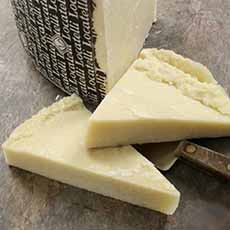
    With the expansion of Rome and the value of real estate, some of the herd was moved to the expansive meadows of Sardinia. Today, just one producer, Locatelli (photo #3) makes the cheese in Lazio.

    Today, most Pecorino Romano is made in Sardinia or Tuscany. These regions have very similar pastures and breeds of sheep to Lazio, ensuring a consistent flavor and quality.

    Pecorino Romano is typically aged for one year.
     
     
    D.O.C. Cheese

    Pecorino Romano is a D.O.C. cheese (Denominazione di Origine Controllata, which translates to Controlled Designation of Origin).

    This means that the name protected by law.

    Other regions and countries can make this type of cheese, but it must be called, simply, Romano.

    There are numerous Pecorinos made throughout Italy, but only one is Pecorino Romano.

    The D.O.C. cheese production is overseen by the Consorzio per la Tulela del Formaggio Pecorino Romano, which ensures quality standards are met.

    The label guarantees authentic production techniques and a distinct flavor.
     
     
    How To Enjoy Romano Cheese

    Enjoy it grated into soups, salads, pastas and gratin casseroles. Sprinkle it over grains and vegetables, particularly potatoes and tomatoes

    For dessert, serve chunks drizzled with honey, along with sliced pears.

    And while it isn’t an eating cheese, you can cut a piece to enjoy with a glass of hearty red wine.

    For the best flavor, don’t buy grated Romano.

    Instead, buy a wedge and “grate as you go” (photo #4). Keep the wedge tightly wrapped in the fridge.

    Perhaps the best-known brand for Pecorino Romano in the U.S. is Locatelli (photo #3): a D.O.P. cheese, hard and dense, strong and sharp in flavor, pale yellow in color.
     
     
    > THE DIFFERENT TYPES OF CHEESE
     
    > THE HISTORY OF CHEESE


    [1] Yummy potato stacks with melted Romano cheese and fresh rosemary (photo © Wisconsin Cheese).

    Fresh Rosemary
    [2] Fresh rosemary is a “must” (photo © Burpee).


    [3] Pecorino Romano cheese D.O.P. from Locatelli (photo © iGourmet).


    [4] Don’t buy grated cheese. Instead, buy a wedge and grate it as you need it (photo © iGourmet).


    [5] Cacio e Pepe, a famous spaghetti dish with grated romano and cracked pepper. Here’s a recipe (photo © Eataly).


    [6] Roasted broccoli with grated romano cheese. Here’s the recipe (photo © Kalyn’s Kitchen).


    [7] Tuscan bean soup with shaved Romano cheese (photo courtesy Lewis & Neal [now closed]).


    Comments off

    RECIPE: Café Au Lait For National Café Au Lait Day


    [1] Cafe au lait (photo © Krups).


    [2] In France, cafe au lait is also served in bowls. This is an older tradition, from days long ago, before potters knew how to add handles to vessels. These bowls are available from La Poterie du Chalet | Etsy (photo © La Poterie du Chalet.


    [3] Caffe latte, the Italian version, is the same recipe but served in a kitchen glass (photo © Williams Sonoma).


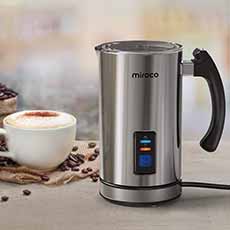
    [4] Look for a milk frother that also steams (photo © Miroco).


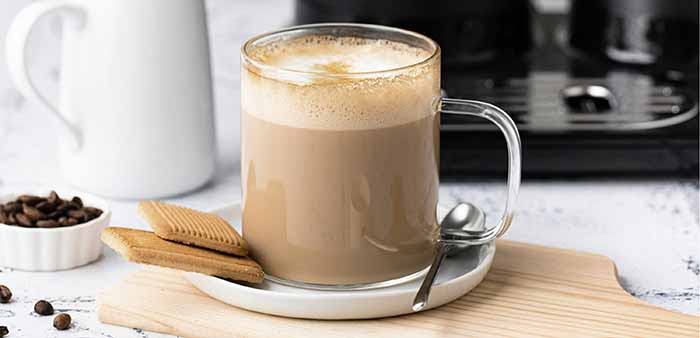
    February 17th is National Café au Lait Day, a French term for coffee with steamed milk (photo #1).

    Brewed French roast or Italian roast coffee is mixed in a 1:1 ratio with steamed milk (frankly, at home we often just heat the milk in the microwave—a “rustic” version).

    Café au lait is different from a latte, which is made with espresso and steamed milk.

    In cafés, the milk is steamed with the steaming arm of an espresso machine. For less than $50, you can buy a device that both steams and froths milk.

    In France, café au lait is served in cups, but also in bowls (photo #2)

    > The recipe for café au lait is below.

    > Coffee terms and the different types of coffee drinks: a photo glossary.

    > Espresso terms and the different types of espresso drinks: a photo glossary.

    > The history of coffee.

    > The history of espresso.

    > The year’s 25 coffee holidays.
     
     
    CAFÉ AU LAIT VS. CAFFÈ LATTE

    The drinks are the same: espresso with steamed milk. But the terms indicate the way coffee is served.

  • Café au lait, the French drink, is served in a white porcelain cup (photo #1).
  • Caffè latte, the Italian version is served in a kitchen glass (photo #3).
  •  
    “Coffee with milk” is the American translation, but in the U.S. the milk isn’t steamed.
     
     
    STEAMED MILK VS. FROTHED MILK

    Steamed milk is more widely used to make coffee and espresso drinks because the milk is easily steamed with the steam wand on an espresso machine.

    The steam makes the milk very hot and slightly aerated. These very small air bubbles create a finer and more delicate foam called microfoam.

    That’s the same foam that’s used to make latte art.

    So what separates steamed milk from frothed milk?

    Frothed milk is more highly aerated, giving it more volume and significant amounts of foam. Aeration—the addition of air bubbles—is what makes the froth (foam).

    Frothed milk lends itself specifically to foam-filled beverages like cappuccino, where it adds a creamy, airy topping.
     

    RECIPE: CAFÉ AU LAIT AT HOME

    Simply pour half a cup of extra-strong coffee and finish filling the cup with steamed milk.

    If you have a frother: Foam isn’t traditionally found atop a café au ait, but no one will report you if you use it.

    Ingredients For 2 Cups

  • 1 cup strong coffee
  • 1 cup steamed or otherwise heated milk
  •  
    Preparation

    1. HEAT the milk in a saucepan over medium-low heat, whisking until the milk is steaming and slightly foamy.

    2. FILL two large coffee cups halfway with the coffee. Divide the milk between them and stir.
     
     
    HOW TO STEAM MILK AT HOME

    If you don’t have a steaming wand, you can froth the milk instead.

  • POUR the milk into a jar, filled no more than halfway.
  • SCREW the lid on tightly. Shake the jar as hard as you can for 30 to 60 seconds, until the milk is frothy and has roughly doubled in volume.
  • MICROWAVE the milk to heat it. Remove the lid from the jar and microwave, uncovered for 30-60 seconds.
  •  
    Quite frankly, often at home, we cheat by heating milk in the microwave.

     
    Cafe Au Lait With Cookies
    [5] Café au lait, French for “coffee with milk”—but unlike the U.S. version, the milk is steamed (photo © Mr. Coffee).
     

    CHECK OUT WHAT’S HAPPENING ON OUR HOME PAGE, THENIBBLE.COM.


    Comments off

    FOOD 101: Bread Bag Clips

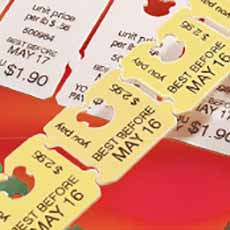
    How about those flat plastic closures that close loaves of bread?

    People all over the world get with their packaged bread—and they’re so much easier to use than wire twist-ties.

    After the bread is gone, we keep them to use as closures for other plastic bags, like the produce bags at the market.

    We even know parents who make art projects from them.

    Who makes them?

    The majority are made by a family-owned company in Yakima, Washington.

    Kwik-Lok has been manufacturing the closures since 1954.

    Founder Floyd Paxton, an engineer, saw that packaging technologies post-World War II were changing.

    At the time, his company made machines to nail-close produce boxes and labeling machines, largely for the Washington State apple industry.

    When apple distributors moved from boxes to bagging, they didn’t like the wire and tape closures in use at the time, and asked Floyd for help.

    As the story goes, the flat clip came to Paxton in 1952, during a flight.

    While he was on the plane, nibbling on a package of complimentary nuts, he realized he didn’t have a way to close them in order to save some for later.

    He took out a pen knife and hand-carved the first flat closure from a credit card (in some tellings, it was an expired credit card [source]).

    The Kwik-Lok closure prototype was born.

    In its first year of production, the flat tab quickly became the preferred method for closing bags of apples.

    It was not long before it was adopted by manufacturers who used polyethylene bags, like bread producers.

    Today, Kwik-Lok is an international company that closes billions of bags a year [source].

    So the next time you’re thinking of cutting up an expired credit card…think of what you can cut from it!
     
     
    > THE DIFFERENT TYPES OF BREAD
     
     
    > THE HISTORY OF BREAD


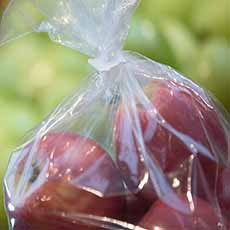
    [1] Is there anyone not familiar with these (photos #1 and #2 © Kwik-Lok)?


    [2] They were invented to close bags of apples.


    [3] Most Americans know them first and foremost, from the bread aisle (photo © Squid Ink).


    Comments off


    © Copyright 2005-2026 Lifestyle Direct, Inc. All rights reserved. All images are copyrighted to their respective owners.