THE NIBBLE BLOG: Products, Recipes & Trends In Specialty Foods


Also visit our main website, TheNibble.com.

TOP PICK OF THE WEEK: Oregon Chai

The chai craze began sweeping across America some 15 years ago. It leaped to the mainstream from Indian restaurants and tea parlors,

The formal name of the tea in Hindi is masala (spiced) chai (tea*, from the Mandarin cha). It originated on the Indian subcontinent.

Americans shortened the term, and chai (CHY) it is. Its spices have been ported to sweets: bonbons, bread pudding, cake and cheesecake, cookies, fudge, marshmallows, muffins; in cocktails; in glazes for chicken and ham; and as a liquid for cooking oatmeal and rice pudding (check out these recipes).
 
 
WHAT IS CHAI?

Chai is black tea flavored with aromatic spices and herbs. The recipe is not fixed: Each vendor or home cook picks a proportion and ingredients to taste.

The “givens” are black tea, ginger, green cardamom pods, milk and sugar.

  • Other popular spice additions include allspice, black peppercorns, cinnamon sticks, cloves, nutmeg, even vanilla and star anise.
  • While the conventional base is black tea, there are green tea versions.
  • You can also brew your own chai from scratch, with this recipe.
  • Chai contains the caffeine of its black tea; a cup typically has one-third the caffeine of coffee.
  •  
     
    OREGON CHAI

    There are numerous chai options on store shelves: tea bags, loose leaf tea, instant powdered mixtures and syrups.

    Our current favorite is the concentrate from Oregon Chai because of its flexibility. The concentrate has no milk, allowing choice of fat percentage, lactose-free and plant-based milks. There are sugar-free and caffeine-free options.

    As someone who likes calorie-free sweeteners and lactose-free milk, we needed to look no farther…although we’d love an slightly sweet Sugar Free version with less sucralose.

    The hack is to change the proportions from 1:1 concentrate to milk to 1/3 concentrate and 2/3 milk.

    Oregon Chai’s concentrates include Original plus:

  • Caffeine Free Concentrate
  • Salted Caramel Concentrate
  • Slightly Sweet Concentrate
  • Spiced Concentrate (a greater level of spice)
  • Sugar Free Concentrate
  • Vanilla Concentrate
  •  
    There are also powdered mixes:

  • The Original Powdered Mix
  • Vanilla Powdered Mix
  • Original Packets
  • Vanilla Packets
  •  
    The line is Non-GMO Verified, USDA Certified Organic and Certified Kosher by OU.

    The products are shelf-stable, to be refrigerated after opening.
     
     
    THE EASIEST CUP OF CHAI

    Simply open the container and mix equal parts of concentrate and milk. Then, heat it in the microwave or pour it over ice.

    For more information visit OregonChai.com.


    Hot Chai
    [1] Invite friends over for a chai tea party (photo courtesy Charles Chocolates).


    [2] With Oregon Chai, it’s a snap. Just mix the concentrate with your milk of choice and heat in the microwave (photo courtesy Oregon Chai).

    Iced Chai Recipe
    [3] Iced chai (photo courtesy Oregon Chai).

    Chai Tea Spices
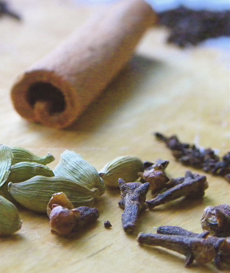
    [4] Some of the chai tea spices: cinnamon, black peppercorns, cloves and green cardamom (photo courtesy 30 Minute Dinner Party).

    THE HISTORY OF CHAI

    Today’s masala chai is a relatively recent creation. The original masala chai is very different from the contemporary recipe.

    That first version was an ancient Indian ayurvedic beverage—a cleansing spice tonic that did not include any tea (Camellia sinensis).

    When the British began to establish tea plantations in Assam, in 1835, they added milk and sugar to their tea, as they did at home. At the time, tea was too expensive for most Indians and was largely grown for export (this is unfortunately true of other third-world crops, including coffee).

    In the early 1900s, the British-owned Indian Tea Association began to promote tea consumption to Indian consumers. Because black tea was still an expensive ingredient, vendors used milk, sugar and spices—the ingredients of today’s masala chai—to create a flavorful drink while keeping costs down.

    The drink’s popularity spread throughout India and became even more popular in the 1960s, when mechanized tea production made black tea affordable for the common man.
     
     
    TEA TRIVIA

    After water, tea is the most widely consumed beverage in the world. Coffee takes third place.
    ________________

    *The English word, tea, though, comes from the Hokkien Chinese tê.


    Comments off

    Build Up Your Pastrami Sandwich With These Pastrami Sandwich Variations

    Pastrami Sandwich - PJ Bernstein
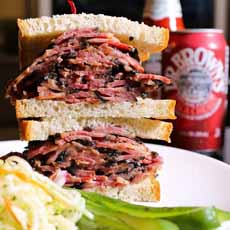
    [1] The classic pastrami sandwich: piled high on rye with bickles, cole slaw and Dr. Brown soda (photo courtesy P J Bernstein Deli | NYC).

    Pastrami On A Roll
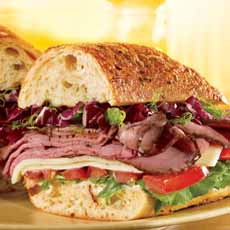
    [2] Pastrami on a roll with Swiss cheese, lettuce and tomato and red cabbage, watercress and mayonnaise (photo courtesy Dietz & Watson).

    Pastrami On A Roll
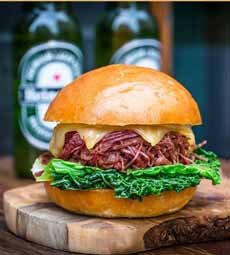
    [3] With melted cheddar on a brioche roll (photo courtesy Gordon Ramsay Group).

    Pastrami Sandwich On Baguette
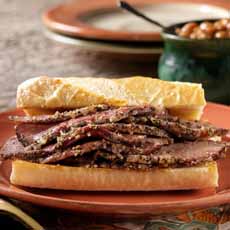
    [4] Thick-sliced on a baguette (photo courtesy Double R Ranch).


    [5] What’s a pastrami sandwich without pickles? (photo © Natasha Breen | iStock Photo).


    [6] Don’t forget the coleslaw! (photo LaCheryl CC-BY-NC-SA-2.0-license).

    A Jar Of Gold's Deli Mustard
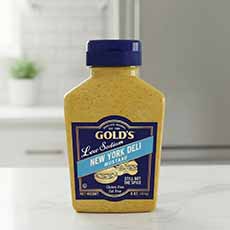
    [7] Deli mustard (Abacus Photo).


    January 14th is National Hot Pastrami Sandwich Day. The classic Jewish deli pastrami sandwich came to New York City with Romanian-Jewish immigrants in the latter half of the 19th century.

    Below you’ll find:

    > The history of pastrami.

    > Trending pastrami sandwich variations.

    Elsewhere on The Nibble:

    > The year’s 27+ sandwich holidays.

    > The year’s 25+ beef holidays.

    > The different types of sandwiches: a photo glossary.

    > The different cuts of beef: a photo glossary.

    > The Reuben sandwich and its variations.
     
     
    HOW IS PASTRAMI MADE?

    Pastrami is spicy cured brisket of beef. The brisket is salt-brined, seasoned with herbs and spices, and hot smoked.

    The typical pastrami spice-and-seasoning blend includes coriander seeds, dark brown sugar, granulated garlic, ground black pepper, ground cloves, kosher salt, smoked paprika and yellow mustard seeds.

    The spiced, smoked pastrami is then chilled and steamed (it is often kept warm on a steam table). In New York, it is thinly sliced (sometimes medium, but never thick) and served warm on caraway-seeded rye bread with a pot of brown deli mustard, accompanied by dill pickles and coleslaw.

    Deli mustard (photo #7), by the way, is an American name for a variety of coarsely ground mustard, i.e., a whole grain mustard. Some recipes add a hint of horseradish (yes!). The combination is the perfect accent to fatty pastrami and corned beef—and is delicious on ham, roast beef, turkey and everything else.

    In New York, the drink of choice is a can of Dr. Brown’s Black Cherry, Cel-Ray or Cream Soda, regular or diet (we wouldn’t turn down a good beer).

    That’s a New York pastrami experience.
     
     
    PASTRAMI HISTORY

    The name pastrami comes from Romanian pastramă, a derivation of a word that means to conserve food.

    Pastrami came to the U.S. with a wave of Jewish immigration from Bessarabia and Romania, in the second half of the 19th century. The word modification “pastrami” likely occurred then.

    In the Old Country, Jewish Romanians commonly used goose breasts were to make into pastrami; they were inexpensive.

    But in the U.S., beef navel was cheaper than goose, so the Romanian Jewish immigrants adapted their recipe and began to make beef pastrami.

    New York’s Sussman Volk is generally credited with creating the first pastrami sandwich, in 1887.

    Volk, a kosher butcher and immigrant from Lithuania, claimed he got the recipe from a Romanian friend in exchange for storing the friend’s luggage.

    According to his descendant, Patricia Volk, he sold the pastrami on sandwiches at his butcher shop.

    The sandwich was so popular that Volk converted the butcher shop into a restaurant to sell pastrami sandwiches [source].
     
     
    PASTRAMI TRAVELS WEST…NORTH…AND SOUTH

    As pastrami traveled to different cities, it was “adapted”—to the horror of a New York deli purist—to include Italian rolls, soft rolls giardiniera, even (gasp!) marinara sauce and mayonnaise. The Kansas-style brisket with barbecue sauce was added to the list.

    These versions are what Jewish New Yorkers call goyishem, meaning “in the manner or style of a non-Jewish person.”

    For the sake of our mother, grandmother, and every other cook in our line, we offer some modern yiddishe enhancements, “in the manner or style of Jewish foodies.”
     
     
    MODERN PASTRAMI SANDWICH VARIATIONS

    You can get creative with a pastrami sandwich without violating any Geneva Food Convention. You can add or substitute without abusing the New York pastrami tradition.

    We mean, you can modernize it. We’re not talking wasabi mustard, pickled jalapeños, or pesto, just some logical extensions, some borrowed from the Reuben sandwich.

    Our favorite: pastrami on rye or pumpernickel with melted Gruyère and caramelized onions. Plus the deli mustard and sides of pickles and coleslaw.
     
    Toppings

  • Gruyère/Swiss cheese, melted (we use packaged cheese fondue from Emmi or Swiss Knight, which have a pinch of white wine and Kirsch)
  • Caramelized onions
  • Lettuce and tomato
  • Roasted red pepper (pimento) and arugula or watercress
  • Sautéed/grilled peppers and onions
  •  
    Condiments

  • Russian/Thousand Island Dressing
  • Sweet gherkins or butter pickles
  • Dijon mustard
  •  
    Bread

    Alas, our taste buds can’t go so far as pastrami on a baguette or any crunchy or flavored roll. Not even brioche.

    Although some day soon, we’ll try it in a pita pocket.

     
    ________________

    *Russian Dressing vs. Thousand Island Dressing: The main difference between the two is that Thousand Island dressing has pickle relish (the “thousand islands”), giving it more sweetness and texture. It is made with mayonnaise and ketchup. Russian Dressing is made from mayonnaise and chili sauce, and is more piquant. Some people add a bit of prepared horseradish for more spice.


    CHECK OUT WHAT’S HAPPENING ON OUR HOME PAGE, THENIBBLE.COM.


    Comments off

    FOOD FUN: Go Bananas

    These healthful snacks—bananas, peanut butter and a second fruit—have so much pizzazz that we think they can go right to the dessert plate.

    You can use any flavor of peanut butter (check out these flavors from PB & Co.—dark or white chocolate, honey, pumpkin spice).

    If you’re not a PB or other nut butter fan, turn your sights to another sauce or spread:

  • Dessert sauce: caramel, chocolate, etc.
  • Berry or other fruit (finely diced, mashed or puréed)
  • Honey
  • Nutella
  •  
    For garnishes, consider:

  • Berries
  • Breakfast cereal: Cheerios, Fruit Loops, granola
  • Chopped or grated chocolate
  • Chopped nuts
  • Cookie crumbs
  • Crushed toffee
  • Diced fruits (apple, kiwi, etc.)
  • Dried fruits: blueberries, cherries, cranberries, raisins
  • Seeds
  • Sprinkles
  •  
    For a DIY experience, put all the toppings on the table and let everyone create his/her own.


    Banana Toppings

    Banana Toppings

    [1] & [2] Decorate bananas for snacking and dessert (photos courtesy Crazy Richard’s Peanut Butter).


  • For something more filling, adds a side of Greek yogurt or ricotta cheese. We sweeten our ricotta with a bit of Splenda, to emulate cannoli cream. Sour cream is another great pairing.
  • For a fancier dessert, add ice cream/frozen yogurt/sorbet and a dab of whipped cream.
  •  
     
    HERE’S MORE BANANA FUN & THE HISTORY OF BANANAS.
     

    Comments off

    Celebrate The First National Tea Day With These Tea Facts

    Tea Plantation
    [1] A tea estate in China. While China is the world’s largest tea-producing nation, it keeps most of what it grows for its own consumption (photo © The Meaning Of Tea).

    Two Leaves & A Bud
    [2] The top three leaves of the bush, called “two leaves and a bud,” are the only leaves used in premium tea (photo © Tea USA).

    Glasses Of Black Tea
    [3] Depending on where it’s grown, the same Camellia sinensis plant yields teas with different flavors, aromas, and colors (photo © National Honey Board).


    January 12th is the first-ever National Hot Tea Day, declared by the Tea Council of the USA, a trade association.

    Tea is the second most-consumed beverage in the world, after water. So have a cup as you read this:
     
     
    THE FLAVOR OF TEA VARIES DEPENDING ON WHERE THE TEA IS GROWN

    Black, green, or white, all tea comes from the Camellia sinensis plant (photos #1 and #2), a warm-weather evergreen. There’s one slight exception and one larger one:

  • In the Assam region of northeast India, the local variation, Camellia assamica was found to produce a finer leaf tea in that environment.
  • Herbal teas, discussed in the fifth bullet below.
  •  
    Whether tea is black, oolong, green, or white depends on how the fresh leaves of the tea plant are processed after they are plucked and; most importantly, their level of contact with oxygen.

    During oxidation, the tea leaves undergo natural chemical reactions that result in distinctive color and taste characteristics.

  • Black tea is allowed to oxidize for two to four hours.
  • Green tea is not oxidized at all—the leaves are steamed, rolled, and dried.
  • Oolong tea falls somewhere between green and black teas, in that the leaves are only partially oxidized.
  • White tea is not oxidized at all, and in fact, is plucked in the spring before the leaf buds even unfurl.
  • Herbal teas do not come from the tea plant Camellia sinensis but are an infusion of various leaves, roots, bark, seeds, or flowers of other plants. While they lack the caffeine of tea, they also are not associated with any of the potential health benefits of traditional teas.
  •  
    Tea is grown in thousands of tea gardens or estates around the world.
     
     
    THE FLAVOR VARIES DEPENDING ON WHERE THE TEA IS GROWN

    Along with wine grapes, coffee, cacao beans, and other agricultural products, local soil and climate result in corresponding flavor, aroma, and color variations (photo #3).

    As with coffee, each tea takes its name from the area in which it’s grown, and the areas in turn are known for their distinctive and uniquely flavored teas.

    Tea is also divided by grades, determined by leaf size. Smaller-sized leaves are used in tea bags while the larger-sized leaves can be found in packaged loose tea.

    While China is the world’s largest tea-producing nation, it keeps most of what it grows for its own consumption.

    The second largest consuming nation, India, is the largest exporter, followed by Sri Lanka, Kenya, Indonesia, Japan, and Taiwan.

    The largest importing nations are the United Kingdom, Australia, Canada, Russia, the United States, and The Netherlands.

     
    As with all foods, you can buy the average, the sublime, or something in-between. If you love a good cup of tea—or a tall frosty glass of iced tea—you’ll appreciate the difference between fine, “gourmet” tea made from top-quality whole leaves and mass-marketed tea bags produced from bits and pieces.

    A tip: When you buy higher-priced teas, first taste them plain, without milk or sweetener. The finest teas should be drunk black (plain) to appreciate their nuanced flavors and aromas.

    FINAL TIP: Don’t toss the leftover tea in the pot—pour it into ice cube trays. Tea ice cubes won’t dilute your iced tea. (Our favorite ice cube tray is the ISI Orka Ice Cube Tray—read our review to see why.)
     
     
    MORE ABOUT TEA

  • A Year Of Tea Party Ideas
  • Brewing The Perfect Cup Of Tea
  • The History Of Tea
  • How To Avoid Cloudy Iced Tea
  • How To Brew Iced Tea
  • How To Plan An Iced Tea Party
  • Pairing Tea With Food
  • Tea Facts
  • Tea Glossary: Tea Types & Terminology
  •  
     

    CHECK OUT WHAT’S HAPPENING ON OUR HOME PAGE, THENIBBLE.COM.


    Comments off

    RESTAURANT OF THE YEAR: Water In The East Village, New York City

    No matter how many great restaurants we eat at this year, we’re willing to state, at the beginning of January, that Water is our “restaurant of the year.”

    Unless you can’t imagine dinner without some kind of flesh, Water should be on your list for culinary excitement. It’s Japanese vegan cuisine.

    Created by restaurateur and bar impresario Ravi DeRossi, who specializes in vegetarian and vegan cuisine, along with the masterful Chef Steve Pereyda, Fire & Water has hung its sign at 111 East 7th Street. It’s just one door down from another DeRossi restaurant, Ladybird.

    Fire & Water is a dual concept. Fire is a vegan dim sum restaurant, Water is vegan Japanese (Fire is opening soon, and we hope to be the first in line).

    There is one tasting menu with two seatings nightly, Tuesday through Sunday, at 6:30 and 8:30. The menu is $65, with wine and saké available. We had a sake-and-wine pairing with each course and recommend it.
     
     
    WHAT YOU’LL EAT

    What’s on the menu? It doesn’t matter: Every bite is memorably exquisite. We hadn’t even left the table when we hungered to return for more.

    No matter how innocuous a dish sounds—seaweed salad, tempura pumpkin—each bite is sublime. Familiar foods like soba noodles and tofu are the best you can imagine, handmade by Chef Pereyda.

    The dishes are so packed with vibrant flavor and texture, that you can’t possibly miss fish and meat.

    Our eight-course tasting menu (photo #1), enjoyed over two hours:

  • Seaweed Salad with Salt Roasted Beets, Clementine, Wasabi Dressing
  • Celery Root with Yuba, Black Garlic, Mitsuba
  • Fresh Chilled Tofu with Brussels Sprouts, Hazelnuts, Fig Ponzu
  • Soba Noodles with Shishito, Yuzu, Shiso
  • Clear Ginger Broth with Salsify, Fried Tofu
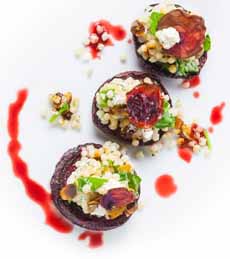
  • Mushroom Chirashi with Leeks, Shio Kombu, Fresh Wasabi (photo #2)
  • Tempura Pumpkin with Sweet Sesame, Broccoli Rabe
  • Ginger chocolate Cake, Sesame Ice Cream, Miso Caramel
  •  

    Omakase Fire & Water NYC
    [1] The first seven courses (dessert comes later).

    Mushroom Chirashi
    [2] If we had to pick a favorite—and it’s tough—it would be the Mushroom Chirashi, a revelation (both photos courtesy Fire & Water).

     
    There is an extensive saké list created by sommelier David Yi-Hsian Dong, and wines that also pair well with the cuisine.

    This is an intimate dining experience. The space is small; dinner is served at an L-shaped bar of seven seats, where you get to watch Chef Pereyda gracefully preparing your food.

    There’s a table tucked into the front window that can accommodate four people, but you don’t get to see the food prep—an enjoyable part of the dinner.

    The decor is thoughtful and lovely. The bar is a slab of a beautiful tree, its natural crevices looking like water flowing through the wood. We wanted to take home the wallpapers in both the dining room and the restroom.

    The only downside: After this restaurant is “on the map,” we’ll have to wait months for a seat.

    Reserve online at FireAndWaterNYC.com, or call 646.767.0476


    Comments off

    The Nibble Webzine Of Food Adventures
    RSS
    Follow by Email


    © Copyright 2005-2026 Lifestyle Direct, Inc. All rights reserved. All images are copyrighted to their respective owners.