|
Summer is the time to eat a homemade dessert without turning on the oven.
That means fruit salad, ice cream or no-bake cookies such as this recipe of cocoa, peanut butter and oats.
Ice box cakes have long been popular, too: a layering of chocolate or vanilla “wafer” cookies with whipped cream. The recipe was popularized on boxes of Nabisco Famous Chocolate Wafer Cookies, which were first produced in the 1930s.
When we think of wafer cookies, we are just as likely to think of the rectangular, finger-sized sandwich cookies with a waffle pattern.
Our colleague, Hannah Kaminsky, was “inspired by the brilliant fresh flavor of real berries baked into Voortman Bakery Raspberry Wafers. Paired with fresh raspberries, those sweet wafer cookie sticks become the building blocks of even greater tastes.
“Stacking bright, vibrant layers of flavor with the greatest of ease, anyone can assemble this masterpiece in minutes.”
However, those who prefer the liqueur can enjoy a glass or small snifter of it with the cake, followed by a cup of tea or coffee.
Served immediately or within a couple of hours, the cookies will be crunchy for a resoundingly satisfying bite. After a day or overnight, they’ll become softer, like the ladyfingers in tiramisu.
RECIPE: RASPBERRY ICE BOX CAKE
forkful from top to bottom, easy to slice, serve, and fully embrace with an open mouth. Go ahead, prep well in advance, so you can be ready whenever your party springs to life.
Prep time is just 10 minutes, plus 2-4 hours chilling time.
Ingredients
2 8-ounce packages cream cheese, softened
1/2 cup confectioner’s sugar
1 tablespoon potato starch
1/4 cup framboise (raspberry liqueur) or orange liqueur, divided (substitute orange or grape juice0
1 teaspoon orange zest
1 package (10.6 ounces) Voortman Raspberry Wafers, divided
1 6-ounce container fresh raspberries, divided
1 tablespoon freeze-dried raspberries, ground to a fine powder—or—
Grated chocolate
Preparation
|
|
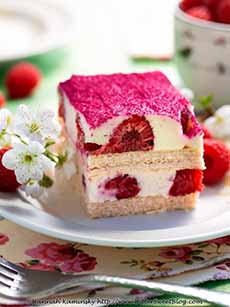
[1] This no-bake ice box cake is made without turning on the stove or oven (both photos © Hannah Kaminsky | Bittersweet Blog).

[2] Don’t like raspberry? Voortman makes wafer cookies filled with banana or blueberry, as well as chocolate, chocolate and caramel, chocolate and raspberry, cinnamon, coconut, cookies and cream, key lime, lemon, maple, peanut butter, s’mores, strawberry and banana, strawberry, and vanilla. There are also chocolate-coated and sugar-free varieties.
|
1. LINE Line an 8×8-inch baking dish with aluminum foil or parchment paper, with a piece hanging over two opposite edges to act as a lift for easy removal later.
2. PLACE the cream cheese with in the bowl of a stand mixer and beat briefly to soften. Add in the sugar, potato starch, 2 tablespoons of the liqueur, and orange zest, mixing thoroughly to combine. Pause to scrape down the sides of the bowl with a spatula to ensure that everything is smoothly incorporated.
3. ARRANGE half of of the wafer cookies in an even layer on the bottom of the pan. Brush the cookies with 1 tablespoon of the liqueur and top with half of the raspberries, distributing them as equally as possible across the exposed surface.
4. SPOON half of the cream cheese mixture on top, carefully spreading it over the berries. Top with the remaining wafer cookies and press down firmly to make sure the layers are flush. You may crush some of the berries below, but it’s a small sacrifice to make for all the flavor they add.
5. BRUSH the cookies with the remaining tablespoon of liqueur, top with the final half of the raspberries, and finish with the last of the cream cheese mixture. Smooth out the cream and top with a light sprinkle of the freeze dried raspberry powder all over.
6. CHILL for at least 4 hours for the best, most sliceable results, but feel free to dig in sooner if you don’t mind dishing out messier but crunchier layers. Covered with plastic wrap and refrigerated, the cake will keep for up to 5 days, but will grow softer and more tiramisu-like.
CLASSIC ICE BOX CAKE RECIPES
Ice Box Cake With Homemade Chocolate Wafers
Classic Chocolate Wafer Ice Box Cake & Ice Box Cake History
|