THE NIBBLE BLOG: Products, Recipes & Trends In Specialty Foods


Also visit our main website, TheNibble.com.

Cheese Ice Cream Recipes Plus Kraft Mac & Cheese Ice Cream


[1] The ice cream sensation of the summer: Van Leeuwen’s Kraft Macaroni & Cheese Ice Cream (photos #1 and #2 © Kraft).


[2] The sweet ice cream is flavored with Kraft Mac & Cheese powder.


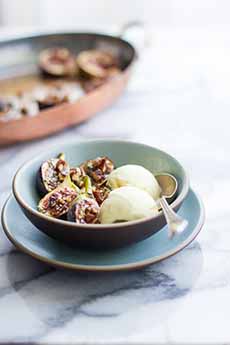
[3] Charlie Trotter’s goat cheese ice cream with roasted figs and tuiles*. Here’s the recipe (photo © Charlie Trotter).

Cheddar Ice Cream
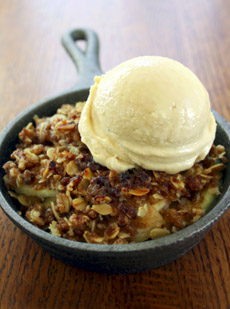
[4] Cheddar ice cream on an apple crisp. Here’s the recipe (photo © Hannah Kaminsky | Bittersweet Blog).

Goat Cheese Ice Cream
[5] Goat cheese ice cream with optional roasted figs. Here’s the recipe (photo © Bonjon Gourmet).


We’re celebrating unusual ice cream flavors today, starting with a food gift for that special person who wants to snack out on a limb.

This year, we were invited to try “Everything Bagel” ice cream and then, in July, Kraft Mac & Cheese ice cream. We didn’t try either, but we followed the comments of those who did.

The Mac & Cheese ice cream from Van Leeuwven was made with the same cheese powder as Kraft’s blue box wonder.

There are no bits of macaroni, likely because even when cooked, the frozen elbows would have become as hard as in their uncooked state.

The flavor sold out within an hour of going on sale online—the equivalent of 6,000 scoops in pints.

Fans commented on how the cheesy powder paired nicely with Van Leeuwen’s standard ice cream base of milk, cream, and sugar.

That’s no surprise to us: We’ve been making cheese ice cream for years (recipes below).

Disappointed you didn’t get to try it? Well, it’s b-a-a-a-a-c-k.

As of 7 o’clock this morning, it was on sale at VanLeeuwenIceCream.com, $12/pint “while supplies last.”

Or, make your own using fine aged Cheddar, with our Cheddar ice cream recipe.

But wait, there’s more! Check out the cheese-flavored ice cream recipes below. We promise, they’re delicious.

Elsewhere on The Nibble:

> The year’s 50+ ice cream holidays

> The different types of frozen desserts: a photo glossary.

> The history of ice cream.

> The different types of cheese: a photo glossary.

> The history of macaroni and cheese.
 
Cream Cheese Ice Cream With Baked Apples
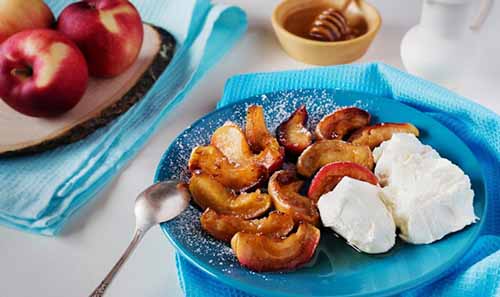
[6] Cream cheese ice cream accompanies honey-baked apples (photo © Elena Leya | Unsplash).
 
 
CHEESE ICE CREAM RECIPES

Here are six of our go-to cheese ice cream recipes—using cheeses more elegant than powdered cheddar.

While Van Leeuwen’s version is sweet, as our most of our lineup.

We have two savory recipes, both made with Parmigiano-Reggiano (Parmesan). The one from the brilliant chef Ferran Adrià is such a favorite of ours, that a friend makes it for us every year on our birthday.

Savory cheese ice cream is not a cutting-edge culinary concept. You can find Formaggio Gelato or Formaggio di Parmigiano in older Italian cookbooks.

The cheese ice cream replaced the cheese course at the end of summer lunches. It was also made in a loaf pan, cut in slices and served as a starter with ham and hard-boiled eggs.

We love Ferran Adria’s recipe for savory Parmigiano Reggiano Ice Cream Sandwiches.

You can update the recipe without the tuiles, to a first parfait with prosciutto and melon.

Or, go for a savory cheese course trio of Parmesan, Cheddar and Stilton gelati!

Take your pick: savory and sweet recipes:

  • Buttermilk Blue Ice Cream In Tuile Cups (savory)
  • Charlie Trotter’s Cheese Ice Cream Recipe With Whole Roasted Figs
  • Cheddar Ice Cream Recipe (sweet)
  • Cream Cheese Ice Cream Recipe (sweet)
  • Ferran Adrià’s Parmesan Ice Cream Sandwich Recipe (savory)
  • Point Reyes Farmstead’s Quick Blue Cheese Ice Cream Recipe (sweet)
  • Stilton Ice Cream Recipe (sweet)
  • Quick Parmesan Ice Cream Balls Recipe (savory)
  •  
    Enjoy them!

    Here’s a concept for a memorable cheese “ice cream social”:

    Get together a group of people who own ice cream machines, and have each one make a different flavor.

  • Accompaniments… digestive biscuits, Parmesan crisps, Maria cookies, and shortbread; candied nuts and spiced nuts; roasted pumpkin seeds (pepitas, unshelled); 70% cacao shaved dark chocolate (works with both sweet and savory) and diced membrillo (quince paste).
  • Wine pairings: dessert wines (late harvest Riesling, Moscato, Sauternes); Pedro Ximénez sherry (for goat cheese); vin santo or Madeira (for Parmesan); Port (especially for the blue cheese); crisp, dry hard cider (pairs famously with Cheddar).
  •  
    A Dish Of Parmesan Ice Cream
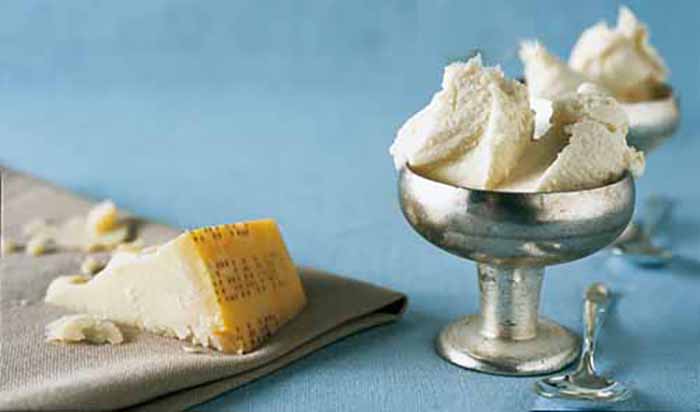
    [7] This savory Parmesan ice cream has just two ingredients: heavy cream and grated Parmigiano-Reggiano cheese. Here’s the recipe (photo © Vorrei).
     
    ________________

    *A tuile (TWEEL) is a thin, crisp French wafer, often baked in the shape of an arc. It can be savory or sweet. Tuile is the French word for tile, after the shape of arc-shaped roof tiles that the wafer most often resembles. Almond tuiles are a popular dessert cookie, can be made in dough; You can see a flat tuile in photo #3.


    Comments off

    All About Cabernet Sauvignon On National Cabernet Sauvignon Day

    Updated August 2026

    Red wine lovers, rejoice! National/International Cabernet Sauvignon Day is held on August 30th**, celebrating the wine made from the world’s most widely planted red wine grape variety. It’s known by wine people as “The King Of The Reds” or simply, “King Cab.”

    “Cab,” for short, is grown in nearly every major wine-producing country. In fact, adaptable to various climates and soils, it can be grown on every continent except Antarctica.

    It’s the principal grape in most Bordeaux wines, where it is typically blended with up to five other grapes.

    Every year on National Cabernet Sauvignon Day, we try a new vineyard about which we’ve heard good things. This year it’s Ehlers Estate in Napa Valley. Its 100% Cabernet wines do not disappoint (photo #3).

    Below:

    > What is Cabernet Sauvignon?

    > The flavors of Cabernet Sauvignon.

    > The red wine grapes of Bordeaux.

    > The history of Cabernet Sauvignon.

    > Classic food pairings.

    Elsewhere on The Nibble:

    > The year’s 25 red wine holidays.
     
     
    1. WHAT IS CABERNET SAUVIGNON?

    Despite its prominence as the most cultivated wine grape in the world, Cabernet Sauvignon is a relatively new variety (more about this in the history of the grape, below).

    One reason for its popularity—beyond its deliciousness—is its ease of cultivation. Cab is grown and produced along a diverse spectrum of climates from Australia and British Columbia, from Texas to Lebanon’s Beqaa Valley.

    The grapes have thick skins. The vines are hardy and naturally low-yielding, which means fewer grapes per cluster and more concentrated juice.

    And it’s able to age well due to its high tannins.

    The grapes bud late, which avoids remnant frost from the winter; and they are resistant to viticultural hazards such as rot and insects that plague other grape varietals.

    Regardless of where it is grown, the wines have a consistent presentation of structure and flavors that immediately signal the typicity of Cabernet Sauvignon (i.e., you know it’s a Cab).

    There is one major negative:

    Cab’s widespread popularity and expansion across the world’s wine regions have made it a “colonizer.” It can take over wine regions at the expense of indigenous grape varieties, which are pulled up to plant Cabernet Sauvignon.
     
     
    2. THE FLAVORS OF CABERNET SAUVIGNON

    Classic Cabernet Sauvignons are full-bodied wines with high tannins and good acidity, both of which contribute to the wine’s aging potential.

    In cooler climates, Cab tends to produce wines with blackcurrant notes that can be accompanied by notes of cedar, green bell pepper, and mint. The nuances become more pronounced as the wine ages.

    In moderate climates, the black currant notes are often combined with flavors of black cherry and black olive.

    In hot climates, the currant flavors can become over-ripe and “jammy.” In the Coonawarra wine region of South Australia, Cabernet Sauvignon, Cabernet Sauvignon wines tend to have characteristic eucalyptus or menthol notes.

    Before we focus on the history of Cabernet Sauvignon, let’s start with the other grapes from the area that made Cab famous: the Bordeaux region of southwestern France.
     
    Cabernet Sauvignon Grapes In Vineyard
    [10] A vineyard of Cabernet Sauvignon grapes in Bordeaux, France (photo © Pierre Ducher | Unsplash).
     
    3. THE RED WINE GRAPES OF BORDEAUX

    There’s great variation in any type of wine, based on the terroir†† in which the grapes are grown. In Bordeaux, Cabernet Sauvignon is the principal grape in Left Bank blends (such as the Médoc and Graves), while Merlot typically leads on the Right Bank (such as Saint-Émilion and Pomerol).

    By law, up to five other red grapes can be blended with Cabernet Sauvignon to create the classic “Bordeaux Blend.” What will be blended with Cabernet Sauvignon, and in what percentage, depends on the grapes in any particular year, as well as the winery’s classic style.

    • Cabernet Sauvignon has a robust body, an herbal character, and great mid-palate texture (tannin), typically with a long finish. As noted above, National Cabernet Sauvignon Day is August 30th.
    • Merlot has a softer body and cherry fruit flavors. Its milder tannins offset the herbal nature of the Cabernet. National Merlot Day is November 7th.
    • Cabernet Franc is leaner in body, with more savory (peppery) and red fruit flavors than Cabernet. It has an equally long finish. National Cabernet Franc Day is December 4th.
    • Malbec has black fruit flavors and a smooth body. It’s used to add creamy, plummy, fruit flavors. World Malbec Day is April 17th.
    • Petit Verdot adds both floral notes and tannin, as well as an opaque purple-red color.
    • Carménère, sometimes called the “lost grape of Bordeaux,” is the naturally occurring cross of Cabernet Franc and Gros Cabernet. It fell out of favor in the mid- to late 1800s, since the late-ripening grape needs warmth, which Bordeaux’s climate doesn’t provide consistently. National Carménère Day is November 24th. Here’s more about it.


    4. THE HISTORY OF CABERNET SAUVIGNON

    Until very recently, the origin of Cabernet Sauvignon was not understood.

    • Wild? The word “Sauvignon” was believed to be derived from the French sauvage, wild. It was thought by some to be a wild Vitis vinifera vine, native to France. But was it?
    • Ancient? Others thought it might be the Biturica wine grape, cultivated by the ancient Romans and referenced by Pliny the Elder.
    • Corrupted? In the 18th century, the grape was also known as Petite Vidure or Bidure—apparently a corruption of Biturica.
    • Wood? There was also the belief that Vidure was a reference to the wood portion of the vine, known as vigne dure.
    • Carménère? Some theorized a possible relationship to the Carménère grape, which was once known as Grand Vidure.
    • Spanish? Yet another theory was that the grape originated in the Rioja region of Spain [source].

     
    Finally: In the 18th century in the Médoc region of Bordeaux, records indicate that the grape previously called Petite Vidure became more popularly known as Cabernet Sauvignon.

    The first estates known to have actively grown grapes they called Cabernet Sauvignon (and likely supplied the vines to other estates) were Château Mouton and Château d’Armailhac, both in Pauillac, a commune (municipality) in the Haut-Médoc.

    But it wasn’t until 1996 that the grape’s real origins were discovered via DNA typing‡.

    At the University of California’s U.C. Davis Department of Viticulture and Enology, testing determined that Cabernet Sauvignon was the offspring of the red Cabernet Franc and the white Sauvignon Blanc.

    It was most likely a chance natural crossing that occurred in the 17th century.

    In 2016, the scientists at U.C. Davis announced they had sequenced a draft of the whole genome of the grape. Cabernet Sauvignon was the first genome of a commercial wine-producing grape to be sequenced [source].

    Back to the 18th century. From France, the grape spread across Europe and to the New World and Oceania, and today is planted in significant amounts in:

    • Australia’s Margaret River, McLaren Vale and Coonawarra regions.
    • Chile’s Maipo Valley and Colchagua regions.
    • California’s Santa Cruz Mountains, Paso Robles, Napa Valley and Sonoma Valley.
    • New Zealand’s Hawkes Bay.
    • South Africa’s Stellenbosch region.

     
    For most of the 20th century, Cabernet Sauvignon was the world’s most widely planted premium red wine grape; it was surpassed by Merlot in the 1990s.

    However, it regained the crown in 2015: Cabernet Sauvignon had once again become the most widely planted red wine grape worldwide.
     
     
    5. CLASSIC FOOD PAIRINGS WITH CABERNET SAUVIGNON

    The intense, bold flavors of Cabernet Sauvignon pair best with heartier and richer foods. That’s why steak and lamb are the two foods most often mentioned. But here’s a lengthier lineup.

    • Appetizers: bacon-wrapped dates stuffed with blue cheese, mini meatballs, mushroom tart.
    • Meats: beef short ribs and other braised beef dishes, brisket, burgers, game, lamb, steak, venison.
    • Poultry: roast duck, pheasant.
    • Salad: sliced steak salad with arugula, radicchio and shaved Parmigiano-Reggiano cheese.
    • Vegetarian: grilled portabello mushrooms; wild mushroom sauté; medley of eggplant and bell peppers in tomato sauce; lentil and bean burgers.
    • Cheeses: aged semi-hard and hard Cheddar, Gorgonzola, Roquefort and other blues, Gouda.
    • Dessert: dark chocolate, bittersweet chocolate cake or pie. How about a Cabernet Sauvignon Bundt cake?
     

    Pouring a glass of red wine.
    [1] The intense color of Cabernet Sauvignon ranges from deep ruby to dark purple. The hue comes from the small, black-blue grapes whose thick skins enable a high extraction of color during winemaking (photo © Tribella).


    [2] Cabernet Sauvignon grapes ripening on the vine (photo © Jeremy Lwanga | Unsplash).

    Bottles Of Ehlers Cabernet Sauvignon
    [3] Celebrate National Cabernet Sauvignon Day by trying something new. We tried the 2018 Cabernet Sauvignon from Ehlers Estate in Napa Valley, along with a second Ehlers Cabernet. Enjoyable now, this Cab will age well for 15-20 more years (photo © Ehlers Estate).

    Red Wine & Chocolate
    [4] Cab is a lovely pairing with dark chocolate, whether a solid bar, bonbon, cake, or tart (photo © Taza Chocolate).

    Filet Mignon, Shoestring Fries, Red Wine
    [5] Grilled beef and Cab are a perfect pairing. Most connoisseurs choose ribeye, but we prefer the tenderness of filet mignon (photo © Ruth’s Chris Steakhouse).

    Rack Of Lamb With Pesto & Red Wine
    [6] A roast leg of lamb or lamb chops are another match made in Cabernet Sauvignon heaven (photo © DeLallo).

    Red Wine, Blue Cheese, Figs, Grapes, Nuts
    [7] Enjoy your favorite blue with a glass of Cab. Add some figs, grapes and walnuts (photo © Alex 9500 | Panther Media).

    Linguine, Burrata, Red Wine
    [8] Pasta and pizza are a popular pairing with Cabernet Sauvignon (photo © Brooke Lark | Unsplash).

    Screaming Eagle Cabernet Sauvignon
    [9] In 2000, this bottle of 1992 Cabernet Sauvignon from California’s Screaming Eagle sold for $500,000 at auction, the result of great ratings and limited production. But you can get a California Cab rated 90 points and above for as little as $25 (photo © Christie’s).

     
    A FINAL NOTE
     
    A California Cabernet Sauvignon put American wines on the world map of great wines. Wine connoisseurs had largely looked to France for their red wines.

    At The Judgment of Paris of 1976 in blind tasting, a Napa Cabernet Sauvignon, 1973 Stag’s Leap Wine Cellars, bested the top Bordeaux wines, proving that world-class wines could be made in California.
     
    ________________

    *The world’s largest planted wine grapes, including red and white, are Cabernet Sauvignon, 840,000 acres (340,000 hectares); Merlot, 657,300 acres (266,000 hectares); Tempranillo, 570,800 acres (231,000 hectares); Airén, 538 700 acres (218 000 hectares); Chardonnay, 518,900 acres (211,000 hectares); Syrah, 470 000 acres (190,000 hectares); Grenache Noir, 402,780 acres (163,000 hectares); Sauvignon Blanc, 299 000 acres (121,000 hectares); Pinot Noir, 285,000 acres (115,000 hectares); Trebbiano Toscano / Ugni Blanc, 274,300 acres (111,000 hectares). Airén is a white grape that is very popular in Spain, often for unpretentious wines [source]. Cab is also planted in Italy, and there are nine distinct regions in China, accounting for roughly 70% of China’s wine-producing vines [source].

    **An alternate date: In some places it is celebrated on the Thursday before Labor Day. Take your choice, or celebrate both!

    The five principal red grapes of Bordeaux are Cabernet Sauvignon plus Cabernet Franc, Malbec, Merlot, and Petit Verdot; a sixth, Carmenère, is also used. Each grape has a different purpose in the blend. Cabernet Franc and Merlot are the two largest “blenders” in a Cab blend, with smaller amounts of Carmenère, Malbec, and Petit Verdot. The Bordeaux red blend is celebrated for producing majestic wines, capable of aging for 20 to 30 years. These wines tend to be full-bodied, with tart black currant and violet notes from the grape, and cedar and cigar box notes from French oak aging. They provide fine examples of how an Old World Cabernet Sauvignon should smell and taste [source].

    ††Terroir, pronounced tur-WAH, is a French agricultural term referring to the unique set of environmental factors in a specific habitat that affects a crop’s qualities. It includes climate, elevation, proximity to a body of water, slant of the land, soil type, and amount of sun. These environmental characteristics give a fruit or vegetable its unique character.

    Prior to the discovery with DNA, earlier in the 20th century, this relationship had been suspected based on the similarity of the grapes’ names and the fact that Cabernet Sauvignon shares similar aromas with both grapes (the blackcurrant and pencil box aromas of Cabernet Franc and the grassiness of Sauvignon Blanc).


    CHECK OUT WHAT’S HAPPENING ON OUR HOME PAGE, THENIBBLE.COM.


    Comments off

    Cookies & Cream Skillet Brownies Recipe For Brownies At Brunch Month


    [1] If you don’t have a skillet, you can use a 10″ cake pan (photo © Wisconsin Cheese).

    Oreo Cookies Stack With Pitcher Of Milk
    [2] Oreos are the largest brand of chocolate sandwich cookies (photo © Tijtan Adrndarski | Unsplash).

    Vermont Creamery Mascarpone Container
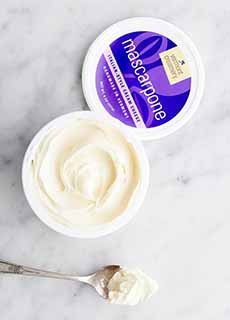
    [3] Mascarpone originated during the Middle Ages in Lombardy, a region in northern Italy. It has a looser, more velvety texture and a richer mouthfeel than cream cheese. Cream cheese was created in the U.S. in 1872: a happy accident (photo © Vermont Creamery).


    [] King Arthur Fudge Brownie Mix is available in traditional and gluten free (photo © King Arthur Baking).


    August is National Brownies At Brunch Month. As August comes to a close, we made two different recipes this past weekend: for Saturday brunch and Sunday brunch, of course! The Cookies & Cream Skillet Brownies. While they’re called skillet brownies, they’re made in the oven. The reference likely comes from times past: Before all kitchens had cake pans, they still had skillets.

    You can use a box of brownie mix, or make your own recipe from scratch. Two of the boxed mixes we like are:

  • Ghirardelli Dark Chocolate Brownie Mix
  • King Arthur Baking Company Brownie Mix
  •  
    A combination of cream cheese and mascarpone makes this recipe delightfully rich.

    But to gild the lily, use the brownies as a base for a hot fudge sundae. Top a slice with hot fudge, whipped cream and sliced strawberries.

    Thanks to Wisconsin Cheese for the recipe. Wisconsin is America’s second-largest cheese producing state, after California.

    > Check out more brownie recipes below.

    > The history of brownies.

    > All the brownie holidays.
     
     
    RECIPE: COOKIES & CREAM SKILLET BROWNIES
     
    Ingredients

  • 1 box (18.3 ounces) fudge brownie mix (+ egg(s) + milk and melted butter substituted for the water and oil)
  • 1 container (8 ounces) mascarpone cheese
  • 1/2 package (4 ounces) cream cheese, softened
  • 1/3 cup sugar
  • 1 large egg (in addition to the egg used with the box mix)
  • 16 chocolate sandwich cookies, divided
  • Optional toppings: whipped cream, vanilla ice cream
  •  
    Preparation

    1. HEAT the oven to 350°F. Prepare the brownie mix according to package directions; add the egg(s) to the brownie mix and substitute milk for water and melted butter for the oil.

    2. BEAT the mascarpone, cream cheese, sugar and egg in a large bowl until blended. Crush 10 cookies into crumbs; fold into the mascarpone mixture.

    3. POUR two-thirds of the brownie batter into a greased 10-inch ovenproof or cast-iron skillet; dot with the mascarpone mixture. Spread the remaining batter over top.

    4. BAKE for 25 minutes. Meanwhile, cut the remaining cookies into pieces; sprinkle over top. Bake for 10-15 minutes longer or until center is just set. (Take care not to over-bake.) Cool in the skillet or pan on a wire rack for 15 minutes before serving. Garnish with toppings as desired.
     
     
    MORE BROWNIE RECIPES

  • Almond Top Brownie Flowers
  • Brownie Ice Cream Sandwiches
  • Brownie Eyeballs For Halloween
  • Brownie Ice Cream Sundae With Whiskey
  • Candy Cane Fudge Brownies
  • Cherry Brownies With Dried Cherries
  • Chocolate Peanut Butter Brownies
  • Chocolate Waffle “Brownies”
  • Cream Cheese Brownies
  • Double Almond Brownies (substitute chopped almonds for the pecans)
  • Irish Cream Swirl Brownies
  • Peanut Butter Brownie Ice Cream Sandwiches
  • Peanut Butter Pretzel Brownies
  • Pumpkin Spice Brownies
  • Rocky Road Brownies
  • Salted Caramel Pretzel Brownies
  • S’mores Brownies
  • Spider Web Brownies For Halloween
  • Turtle Brownies
  •  
     
    > THE HISTORY OF BROWNIES
     
     
    WHY USE A SKILLET FOR BAKING?

  • More control. Especially with an apple crisp, you can sauté the apples to your liking before adding the crumbled topping and baking in the oven.
  • Chewier edges. For brownies, cornbread and giant chocolate chip cookies, get the pan hot on the stove top, then pour in the batter and bake. The result: crisper edges.
  • Even heat. Cast iron’s ability to retain heat ensures the upside-down cake you’re baking will be tender and evenly cooked without burning the sugary glaze.
  •  


    Comments off


    © Copyright 2005-2026 Lifestyle Direct, Inc. All rights reserved. All images are copyrighted to their respective owners.