THE NIBBLE BLOG: Products, Recipes & Trends In Specialty Foods


Also visit our main website, TheNibble.com.

Tahini Coffee Recipe: A Middle Eastern Twist On Espresso Or Coffee

September 29th is National Coffee Day, one of the year’s 25 coffee holidays.

We wanted to share this recipe for tahini coffee in advance, so that you might enjoy a cup of the latest trending coffee: tahini coffee (or espresso, or latte, or whatever form you prefer).

— By Karen Hochman
— Also see Einspanner Coffee


THE HISTORY OF TAHINI COFFEE

Tahini coffee was popularized by a New York City bakery-cafe this spring, Maman. Their Salted Tahini Honeycomb Latte went viral and inspired many copycat recipes. Here’s one of them (photo #3).

There’s a different take over in Brooklyn at the Iced Café at Edith’s (photo #). It’s a slushie of tahini, oat milk, and cold brew (photo #4). And no doubt, many more variations as the trend spread.

At Maman, the drink—hot or cold—combines espresso with a house-made tahini-honey blend and fleur de sel and topped with sweet-and-salty sesame crumbs (photo #1).

The result: a Middle Eastern-inspired coffee that’s creamy, nutty, and slightly sweet with complex flavors from the sesame paste.

Why tahini?

Tahini has been key in Middle Eastern cuisine for thousands of years, and coffee culture is deeply rooted in that region as well.

It’s a key ingredient in the ever-popular hummus, that took America by storm in 1986 with the founding of the Sabra brand by entrepreneur Zohar Norman. The explosion in popularity due to taste and nutrition created the new, mainstream hummus category**.

Yet, the specific pairing of two seems to have happened in New York City, from whence it went viral on Tik-Tok.

It’s not just trendy: The drink adds protein to a cup of Joe. The protein from the tahini turns the coffee into a functional or nutrient-dense food, in the manner of other enhanced coffee drinks like bulletproof coffee‡ and turmeric lattes.

Could you use peanut butter (or other nut butter) instead?

In theory, yes—we certainly have added PB to hot chocolate (delish). But:

  • Tahini adds sophistication and complexity to the espresso.
  • Peanut butter would likely overpower the espresso’s flavor with its boldness.
  • Tahini complements the espresso, while peanut butter would compete with it.
  •  
    The recipe follows, but first:

    > Who thought to put tahini paste in coffee? See below, along with more unconventional additives.

    > The history of tahini is also below.

    > The history of coffee.

    > The different types of coffee: a photo glossary.

    > The year’s 25 coffee holidays.

    > More ways to use tahini.

    > Three tahini dip and sauce recipes.
     
     
    Nespresso Machine
    [11] Start with freshly brewed espresso (photo © Nespresso).
     
     
    RECIPE: TAHINI COFFEE or ESPRESSO

    There are so many versions of this recipe. Ours is a bit different in that it’s coffee instead of latte.

    A latte is usually 1/3 espresso (usually 1-2 shots) and 2/3 steamed milk.

    Whether you prefer regular coffee or espresso, here’s how to prepare rich, nutty, and creamy tahini coffee.

    The nutty notes of tahini are more pronounced in hot coffee, and also helps the paste blend better into the beverage.

    Tips:

  • Start with less tahini and adjust to taste – it can be quite rich.
  • Make sure your tahini is well-stirred before using, as it tends to separate.
  • For an iced version, let the coffee cool, blend all ingredients with ice.
  • The drink will naturally separate a bit, so give it a stir before drinking.
  •  
    Ingredients Per Serving

  • 1 cup strong hot coffee, freshly brewed
  • 1-2 tablespoons tahini
  • 1-2 teaspoons honey or maple syrup
  • 1/4 cup milk or milk alternative (omit if you prefer black coffee)
  • Pinch of sea salt
  • Optional garnish: Ground cinnamon or nutmeg
  •  
    Preparation

    1. PREPARE the tahini mixture. In a small bowl, whisk together the tahini, honey/maple syrup, and salt until smooth. If it’s too thick, add a tablespoon of the hot coffee to thin it out.

    2. POUR the hot coffee into a tall glass or mug, then add the tahini mixture. Stir vigorously until well combined. The tahini should create a creamy, slightly frothy texture.

    3. ADD the milk. You can either stir it in directly or froth it first for a more latte-like experience.

    4. GARNISH. Dust with a pinch of cinnamon or nutmeg desired.
     
     
    WHAT IS TAHINI & THE HISTORY OF TAHINI

    Tahini, a cornerstone ingredient in Middle Eastern and Mediterranean cuisines, is a paste made from ground sesame seeds. It’s an essential ingredient in dishes like hummus, baba ganoush, and halva.

    It’s similar in consistency to peanut butter but with a distinctly nutty, slightly bitter flavor.
     
    Aren’t they both nutty?

  • Tahini’s nuttiness is more like tasting the essence of toasted seeds with complex layers of flavor.
  • Peanut butter delivers rich but simple nuttiness.
  •  
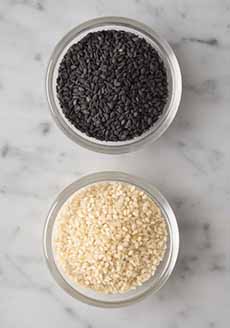
    Tahini is made by grinding hulled sesame seeds (photo #5), raw or roasted, into a smooth, creamy paste. Roasted tahini has a deeper flavor.

    Tahini is an ancient food.

    Sesame seeds are among man’s oldest-known oil-bearing crops, with evidence of cultivation dating back more than 4,000 years in the Indus Valley (primarily in what is now Pakistan and northwest India) and Mesopotamia, the Fertile Crescent (in southwest Asia, specifically within the Tigris and Euphrates river, an area that encompasses much of modern-day Iraq, parts of Syria, Turkey, and Iran).

    While wild sesame seeds were used in food preparation, the practice of grinding sesame seeds into paste likely developed soon after cultivation began, in areas that are now Iraq, Iran, and the Levant (the word tahina is Arabic, from the verb for “to grind”).

    From there, cultivation of sesame and the preparation of tahini spread throughout the Mediterranean region, North Africa, and eventually globally through trade routes.

    While tahini was traditionally made by grinding seeds with stone mills, modern tahini is produced using steel mills. Artisanal producers still use stone mills for superior flavor and texture.

    (Want to grind your own sesame paste? You can get a mill at Walmart and elsewhere.)
     
     
    STRANGE THINGS PEOPLE PUT IN COFFEE

    It’s all cultural, depending on where you grew up. In the U.S., milk and sugar is the standard.

    Warm spices such as cardamom, cinnamon, cloves, ginger, and nutmeg, are found in holiday blends (and are popular everyday additions in Morocco).

    But some Americans get quite creative with their coffee additives. Beyond tahini, here are a few of them:

  • Butterscotch instant pudding powder with cinnamon.
  • Butter. The famous “Bulletproof coffee” made with grass-fed butter creates “a creamy and frothy texture and a rich buttery flavor.”
  • Coconut oil provides “a creamy and smooth texture and a subtle coconut flavor.”
  • Honey or maple syrup. Natural sweeteners. Ever since we discovered the Drizzle brand of cinnamon honey, it’s become a favorite sweetener in our coffee.
  • Hot sauce. A tradition begun by David Pace, the founder of Pace Foods, who used his picante sauce in and on many dishes, including his morning coffee.
  • Olive oil. A fruity EVOO adds a rich and fruity flavor. Starbucks even launched a line, Oleato†, with olive oil.
  • Orange zest. Adds a citrusy brightness.
  • Protein powder. For a nutritional boost.
  • Raw cacao powder or cacao nibs. For a hint of chocolate.
  • Salt. Just a pinch can reduce bitterness and enhance the natural sweetness, with no sugar added.
  •  
    Some International Traditions

  • Lemon juice. Popular in Portugal, bright and citrussy.
  • Egg yolk. Mixed with with sweetened condensed milk, it creates the Vietnamese coffee beverage cà phê trứng.
  • Raw egg. In Sweden, äggkaffe (egg coffee) mixes raw egg with coffee grounds before brewing.
  •  
     
    BLACK VS. WHITE SESAME SEEDS: THE DIFFERENCE

    Sesame seeds have a black hull when harvested. White sesame seeds (they’re actually cream-colored) have had the black hull removed.

    Why remove the hull, which contains additional fiber, antioxidants (anthocyanin), and minerals?

    The choice often comes down to the flavor intensity and visual.

  • Black sesame seeds have a more intense, robust flavor with earthier, nuttier notes—a more complex taste than white sesame seeds.
  • White sesame seeds are milder with subtler nutty notes, and slightly sweet.
  •  

    Tahini Salted Maple Latte
    [1] The original: Salted Tahini Honeycomb Latte, a Spring 2025 creation at Maman bakery cafe in New York City (photo © Maman).

    Maple Tahini Coffee
    [2] A hot version made with plant milk. Here’s the recipe from Chef Laura (photo © Love Chef Laura) .

    Salted Tahini Honeycomb Latte
    [3] A delectable copycat recipe of Maman’s Salted Tahini Honeycomb Latte (photo © Salima’s Kitchen).

    Iced Cafe, a Tahini Slushie
    [4] The slushie version from Edith’s Sandwich Counter in Brooklyn (photo © Edith’s).

    Black & White Sesame Seeds In Glass Ramekins
    [5] Black and white sesame seeds. White sesame seeds have had the black hull removed. Either can be ground to make tahini. See more differences below (photo Nano Banana).

    A jar of Once Again tahini
    [6] We’re fans of Once Again tahini, a premium brand that’s organic, non-GMO, free from additives, and luscious (photo © Once Again).

    Tahini Dressing & Dip
    [7] Use the same tahini to make a delicious dressing or dip. Here’s a recipe (photo © Taste Of Home).

    Nespresso Home Espresso Machine
    [8] Start with fresh-brewed espresso (photo © Nespresso).

    4 Varieties Of Honey In Open Jars
    [9] Pick your sweetener. Honey can add citrusy or floral notes, depending on the variety. The Maman original used honey.You can use agave or simple syrup, but they don’t have complex flavor notes, just bland sweetness (photo © IDM Südtirol Alto Adige).

    A Jar Of Maple Syrup
    [10] Maple syrup is a common pairing with tahini because its caramelized notes complement the toasty flavor of roasted sesame seeds (photo © Maple From Canada).


  • Both varieties can be pressed to make sesame oil, with black sesame oil having a more pronounced flavor.
  • Both varieties can be toasted—in fact, it’s recommended. A few minutes in a frying pan intensifies their nutty taste and adds a deeper, more complex layers of flavor. See how in the ‡‡footnote.
  •  
    Culturally:

  • White sesame seeds are more common in Western cooking, including the Mediterranean and the Middle East: in tahini, on bread, in salads, and as garnishes.
  • Black sesame seeds are popular in Asian cuisine, particularly Chinese, Japanese, and Korean cooking. They’re used in desserts, rice dishes, and as garnishes where their dramatic color and stronger flavor are desired.
  •  
    Whichever you have on hand—black, white, or a blend—sprinkle them over rice and other grains, salads, noodles, eggs; add them to baked goods (instead of poppy seeds); and add them to stir-fries right before the end of cooking.

    And if you come across it, definitely try black sesame ice cream. Or make your own with this recipe (photo #12, below).
     
    A Bowl Of Black Sesame Ice Cream
    [12] Black sesame ice cream is one of our favorite “new” flavors (photo © Food 52).
     
    ________________
     
    *Tahini is nutrient-dense. Nutrient density is the measure of which is the amount of essential nutrients a food provides relative to its calorie content (essentially, a measure of how much nutritional bang for your buck you get from a food).

    **Hummus became somewhat widespread in the U.S. among the young in the 1960s counterculture movement and continued to gain traction with the publication of Frances Moore Lappé’s book Diet for a Small Planet in the early 1970s. But Sabra was the first big commercial brand.

    The Starbucks Oleato oil-infused coffee beverage first debuted in Italy. It came to the U.S. in February 2023, followed by Canada. But North Americans didn’t take to it and it was discontinued in North America in 2024.

    According to the Starbucks website, Oleato™ began in Sicily when Starbucks founder Howard Schultz was introduced to the daily Mediterranean custom of having a spoonful of olive oil. As he sipped his morning coffee, he was inspired to try the two together and discovered “coffee enhanced with lush, velvety flavor that lingers beautifully on the palate.”

    Bulletproof coffee is a high-fat coffee drink that’s become popular in health and wellness circles, especially in ketogenic or low-carb diets. It’s made by blending hot coffee with grass-fed butter and MCT oil (a dietary supplement made from medium-chain triglycerides (MCTs), a type of saturated fat).”

    ‡‡How to toast sesame seeds: On the stove, heat a dry skillet over medium-low heat. Add the sesame seeds in a single layer and stir frequently for 3-5 minutes until they become fragrant and start to pop slightly.They’re ready when you hear little popping sounds. In the oven, spread the seeds on a baking sheet and toast at 350°F (175°C) for 5-8 minutes, stirring once halfway through.
     

    CHECK OUT WHAT’S HAPPENING ON OUR HOME PAGE, THENIBBLE.COM.


    Comments off

    Peanut Butter Pancakes Recipe With More Protein & Fiber

    Peanut Butter Pancakes With Bananas
    [1] Peanut butter and oat pancakes, topped with peanut butter sauce (photo: The Nibble).

    Peanut Butter Pancakes With Sliced Bananas & Bacon
    [2] If you prefer, classic maple syrup—but keep those yummy bananas (photo © Esrak Ormaz | Pexels).

    Bag Of Bob's Red Mill Thick Rolled Oats
    [3] It’s our favorite oatmeal, too (photo © Bob’s Red Mill).

    Bag Of Bob's Red Mill Whole Wheat Pastry Flour
    [4] Why use pastry flour for pancakes instead of all-purpose flour? See the *footnote (photo: The Nibble).

    A Jar Of PB & Co. Peanut Butter
    [5] We’re fans of the Peanut Butter & Co. line. Check out all the flavors (photo: The Nibble).

    Peanut Butter Pancakes
    [6] Looks like fun, but how do you eat it (photo © Crazy Richard’s).


    September 26th is National Pancake Day, a food that can be served for breakfast, lunch, dinner, and dessert (a la mode with fruit or dessert sauce).

    Today’s recipe adds flavor, protein and fiber to pancakes in a yummy way: with the addition of peanut butter for protein, plus oatmeal and whole wheat flour for fiber. Thanks to Peanut Butter & Co. for the recipe.

    This was the winning recipe commissioned from noted food bloggers for the Peanut Butter & Co. and Bob’s Red Mill “Nuts About Oats Recipe Contest,” part of an initiative to “Build a Better Breakfast with Peanut Butter.”

    You can add also add PB to breakfast with yogurt and berries in a PBJ parfait, spread on a toast, or dabbed onto cold cereal or oatmeal.

    Below:

    > The peanut butter oat pancakes recipe.

    > Easy peanut butter sauce recipe.

    > The year’s 18 pancake, waffle, French toast, and crêpe holidays.

    Elsewhere on The Nibble:

    > The history of pancakes.

    > The history of peanut butter.

    > The year’s 12 peanut butter holidays.

    > The year’s 116 breakfast holidays.

    > The different types of pancakes and waffles: a glossary.

    > More pancake recipes.

    > More peanut butter recipes.
     
     
    RECIPE #1: PEANUT BUTTER OAT PANCAKES

    First, pick your peanut butter. For this recipe we have used two different Peanut Butter & Co. flavors:

    Prep time is 5 minutes and cook time is 20 minutes.

    If you want to gild the peanut butter lily, you can make an easy peanut butter sauce to use instead of maple syrup. The recipe follows.
     
    Ingredients For 12 Pancakes

  • 1 cup Bob’s Red Mill® Extra Thick Rolled Oats
  • 1 cup whole wheat pastry flour*
  • 1 teaspoon baking soda
  • 1/2 teaspoon kosher salt
  • 3 tablespoons granulated sugar
  • 2 teaspoons peanut oil (from the top of the peanut butter in the jar)
  • 1/4 cup creamy peanut butter
  • 2 large eggs
  • 1 teaspoon vanilla extract
  • 3 cups buttermilk milk
  • 4 tablespoon butter, melted and cooled, for brushing on skillet
  • Optional garnish: chopped honey roasted peanuts
  • Optional garnish: sliced bananas
  • Optional for serving: butter and warm maple syrup
  •  
    Preparation

    1. PLUS the rolled oats in a food processor or spice grinder, until coarsely ground and flour-like. Combine the ground oats in a large bowl with the whole wheat pastry flour, baking soda, baking powder, salt, and granulated sugar. Whisk together to evenly distribute. In a separate bowl…

    2. USE the back of a fork to combine the peanut oil (taken from the layer that separates off the peanut butter) and the 1/4 cup of peanut butter. Add the two eggs and vanilla extract, and continue to whisk until a smooth paste forms.

    3. ADD the egg and peanut butter mixture to the dry ingredients, and pour in the buttermilk. Use a spatula to gently mix the wet and dry ingredients just until everything is combined. Use a gentle hand and know that the remaining batter will still have a few lumps, which is desired.

    4. PREHEAT a griddle to 375°F or heat a cast iron or other heavy-bottom skillet over medium heat. Brush the griddle with some of the melted butter and pour the batter 1/4 cup at a time, making sure to keep the pancakes about 2 inches apart.

    5. COOK for one to two minutes, or until small bubbles start to form and the edges appear set and dry. Flip, and use a spatula to tuck in any batter that escapes along the sides.

    6. COOK for an additional minute or two before removing to a serving platter. Repeat with the rest of the batter. Serve topped with additional pats of butter and warm maple syrup.

    Leftover pancakes can be frozen and reheated in a toaster oven.
     
     
    RECIPE #2: EASY PEANUT BUTTER SAUCE

    Ingredient

  • ½ cup creamy peanut butter
  •  
    Preparation

    1. MICROWAVE the ½ peanut butter in a small bowl for 20 seconds.

    2. STIR until smooth and melted, and pour over the warm pancakes. If it’s too thick for you, stir in a one or more teaspon of water and re-melt.
     
     
    THE YEAR’S 9 PANCAKE & CRÊPE HOLIDAYS

  • January 28: National Blueberry Pancake Day
  • February, Last Week: National Pancake Week
  • February 2: National Crêpe Day
  • February-March: National Pancake Day: Shrove Tuesday†
  • February-March: IHOP’s National Pancake Day (falls on Shrove Tuesday)
  • March 7: National Flapjack Day
  • March 22: National Bavarian Crepes Day
  • May 6: National Crepes Suzette Day
  • September 26: National Pancake Day
  •  
    (holidays continue below photo)

     
    Breakfast Buffet: Crepes, French Toast, Pancakes, Waffles
    [7] Breakfast favorites: crêpes, French toast, pancakes, and waffles (photo: The Nibble.
     
     
    THE YEAR’S 8 WAFFLE & FRENCH TOAST HOLIDAYS

  • March 11: National Oatmeal Nut Waffles Day
  • March 25: International Waffle Day (Sweden)
  • April: National Brunch Month
  • June 29: National Waffle Iron Day
  • August 24: National Waffle Day
  • September, 1st Full Week: National Waffle Week
  • October 20: National Chicken & Waffles Day
  • November 28: National French Toast
  •  
    PLUS

  • April: National Brunch Month
  • September 22: National Ice Cream Cone Day (waffle cones)
  • December 17: National Maple Syrup Day
  •  
    ______________

    *Pastry flour is used in some pancake recipes because it has lower protein content, which results in less gluten formation, which makes the pancakes lighter, softer, and more tender. If you already have all-purpose whole wheat flour on hand and prefer to use it, it will yield denser and chewier pancakes—which is just fine with many people.

    Shrove Tuesday changes each year based on the Easter calendar, but usually falls in February. Shrove Tuesday is the day before Ash Wednesday. There’s a second National Pancake Day on September 26th. The reason for having National Pancake Day” on both days is that the February date is typically associated with the Christian tradition of Shrove Tuesday, when pancakes are eaten to use up rich ingredients before Lent. September 26th is a secular National Pancake Day, focused on simply enjoying pancakes without a religious connection.
     

    CHECK OUT WHAT’S HAPPENING ON OUR HOME PAGE, THENIBBLE.COM.


    Comments off

    National Butterbrot Day, a.k.a. German Sandwich Day: Recipes & More

    September 25th celebrates a food that may not be familiar to many Americans, yet here it is: National Butterbrot Day, also known as National German Sandwich Day. We might call it bread and butter.

    It’s a simple, open-faced German sandwich called a Butterbrot (“buttered bread”) and it’s a favorite German snack. At it’s simplest, it’s a single slice of high-quality German bread, often rye or whole grain, spread with quality butter.

    Why devote a holiday to bread and butter? Because it’s a popular German snack, similar to devoting holidays to chips, muffins, whatever.

    In Germany, it’s a touchstone.

    But there’s much more to butterbrot than meets the eye in photo #1. We’ll share all, but first:

    > The history of butterbrot is below.

    > Also below (in †footnote), the story of the trencher (photos #8 and #9).

    > The history of bread.

    > The history of sandwiches.

    > The different types of bread: a photo glossary.

    > The year’s 20+ bread holidays.

    > The year’s 27+ sandwich holidays.
     
     
    TRADITIONAL BUTTERBROT TOPPINGS

    At its simplest, butterbrot can be garnished with fresh herbs or sea salt, or with something more substantial.

    While butter and bread are the foundation, the toppings can turn butterbrot into a more substantial snack, a light meal, or part of a larger spread (photo #3).

    Popular toppings include:

  • Cheese: Sliced cheeses like Gouda, Emmental, or regional favorites.
  • Cold Cuts: Ham, salami, liverwurst (Leberwurst), or other sausages.
  • Eggs: Sliced hard-boiled eggs are a common and satisfying topping (photo #4).
  • Fish: Smoked salmon, herring, or other preserved fish.
  • Vegetables: Sliced cucumbers, pickles, radishes, tomatoes.
  • Spreads: Pâté, quark* (photo #7).
  •  
    Herbs—fresh chives, dill, or parsley—often add a finishing touch.
     
     
    THE HISTORY OF BUTTERBROT

    The concept of putting toppings on bread is ancient and universal. Bread has been a fundamental foodstuff for millennia.

    But butterbrot has become a cultural icon in Germany, beginning in medieval Europe.

  • Medieval Era: Slices of stale bread were used as trenchers† to hold food. These were thick, flat slices used as edible plates, serving both as tableware and a source of food, which was often given to the poor after the meal., which would then be eaten or given to the poor. While not butterbrot as we know it, this shows the long-standing practice of using bread as a base for other foods.
  • Availability Of Butter: Over time, with advancements in dairy farming, butter became more widely available and affordable. Spreading butter on bread to add flavor was a natural progression.
  • Industrial Revolution: In the 19th century, as people moved to cities for work, there was a need for quick, portable, and nutritious meals. Butterbrot was easy to prepare, didn’t require cooking, and could be easily.
  • Postwar Germany: In the lean times after World War I and especially after World War II, butterbrot became even more significant. It was an economical way to make a meal, stretching limited resources with simple, filling ingredients.
  •  
    Butterbrot In Modern Germany

    Over time, butterbrot became deeply ingrained in German culture. It became a symbol of home, comfort, and practicality.

  • It became a common breakfast food, a packed lunch for schoolchildren and workers, an easy snack, and a light dinner.
  • The dinner meal in Germany is often called Abendbrot (evening bread), highlighting the central role of butterbrot.
  •  
    While the essence of a simple, satisfying open-faced sandwich remains, modern culinary trends have led to more elaborate and gourmet versions of butterbrot. For example:

  • Artisanal Bread: ciabatta, focaccia, multi-seed, sourdough, spelt, and other breads have joined the traditional rye and multigrain. The bread is sometimes toasted or grilled for added texture and flavor.
  • Compound Butter: Flavored or compound butters are used, from citrus butter (with zest) to herb-infused (e.g., chives, dill, parsley), smoked butter, truffle butter, even honey butter for a sweet-savory twist.
  •  
    Toppings Expand

    Along with more sophisticated bread and butter, there are elevated toppings, both savory and sweet, which are often layered for complexity.

    Modern butterbrot is often presented as edible art, with toppings arranged in layers or patterns. Garnishes like microgreens, edible flowers, or a sprinkle of flaky or coarse colored sea salt elevate the visual appeal. They cross the line into French tartines.

    Savory Toppings

  • Artisan Cured Meats: Pancetta, prosciutto, saucisson, speck.
  • Artisan Cheeses: Brie, Camembert, chèvre, Gouda, Roquefort.
  • Eggs: Poached, soft-boiled, even scrambled, sometimes topped with caviar or shaved truffle.
  • Fish: Smoked mackerel, salmon, trout, or sturgeon, often paired with crème fraîche and/or horseradish; gravax; sardines (photo #5).
  • Vegetables: Roasted or pickled vegetables like beets, asparagus, or radishes (photo #6).
  • Spreads: Hummus, mashed avocado, chicken liver mousse, rillettes, or tapenade replacing butter as the base layer.
  •  
    Sweet Toppings

  • Chocolate: Dark chocolate shavings or spreads, paired with sea salt or chili flakes.
  • Fresh Fruits: Berries, figs, sliced apples or pears.
  • Nuts & Honey: Drizzles of honey paired almonds, pistachios, or walnuts.
  •  
    How About A Butterbrot Party?

    They go great with beer, cocktails, wine…or iced coffee or tea. Try these combinations or create your own:

  • Charcuterie: Truffle butter, prosciutto, arugula, and shaved Parmesan.
  • International/Asian: Miso butter, raw salmon, kimchi, and sesame seeds.
  • Vegetarian/Egg: Avocado, poached egg, chile flakes, and microgreens.
  • Vegetarian/Cheese: Goat cheese, fresh figs, honey and walnuts.
  • Vegetarian/Mediterranean: Feta, Kalamata olives, sundried tomatoes, shredded basil.
  • Pickled: Pickled herring, pickled beets, mustard sauce, fresh dill.
  • Smoked Fish: Dill butter, smoked salmon, capers, and lemon zest.
  • Vegan: Beet hummus, roasted vegetables, peppadew, and pomegranate seeds.
  • Sweet: Chocolate spread, sliced strawberries, and sea salt.
  •  
     
    ________________
     
    *German quark (photo #7) is a fresh dairy product that is somewhat similar to yogurt, cream cheese, or cottage cheese, but it has its own unique texture and flavor. It is a staple in German cuisine and is used in both sweet and savory dishes.
     
    What Are Trenchers: Trenchers were a common feature of dining in medieval households, especially among the upper and middle classes Made from stale or coarse bread, they were used as plates during meals (photo #8). Food was served on platters, commonly one platter to two diners, who transferred the food from the platter to their trenchers. After the meal, these bread plates, now soaked with juices and food remnants, were often given to the poor or to servants.

    Receiving trenchers was a valuable source of sustenance for the poor, as the bread would have absorbed the nutrients of the meal served on it. The distribution of trenchers to the those in need depended on the household and local customs. Back entrances: Poor individuals might have known to come to the kitchen door or back entrance of a manor, castle, or wealthy household to receive leftover food, including trenchers. This was a common practice in medieval charity. It was tied to the medieval concept of charity and the Christian duty to care for the less fortunate. Word of mouth and local custom would inform the poor about which households were likely to provide food. In some cases, the poor might line up or gather at the designated time to receive leftovers. The practice of giving trenchers to the poor was not purely altruistic. It was also a way for the wealthy to demonstrate their piety and fulfill their religious obligations.

    Almsgiving: Similarly, some religious institutions distributed food, including trenchers, as part of their charitable obligations. This could happen at specific times or on certain days. Feast leftovers: After large feasts or banquets, surplus food, including trenchers, could be gathered and distributed to the poor in the surrounding area.

    Later the trencher evolved into a small plate of metal or wood, typically circular and completely flat, without the lip or raised edge of a plate (photo #9). Trenchers of this type are still used, typically for serving food that does not involve liquid. Today’s best example is the cheeseboard. Here’s more about trenchers [some information via Chat GPT].


    Butterbrot: Bread & Butter
    [1] Plain butterbrot (photo © Joanna Stolow | Unsplash).

    Butterbrot with parsley and pink Himalayan salt
    [2] With a simple garnish: pink Himalayan salt and fresh parsley (photos #2, #3, and #5 by Nano Banana).

    Butterbrot With 5 Different Toppings
    [3] Five fancier toppings.

    Egg, Cheese, Tomato Butterbrot
    [4] A light lunch: egg, cheese, tomato on butterbrot (photo © Veldhuyzen Cheese).

    Sardine Butterbrot
    [5] Sardine butterbrot with quark* (photo © The French Farm).

    Vegetable Butterbrot With Radish & Pea Tendrils
    [6] Fancy veggie butterbrot with watermelon radish and pea tendrils (photo © Melissa’s Produce).

    A container of quark
    [7] A container of quark from Vermont Butter & Cheese (photo by Claire Freiermann © The Nibble).

    Medieval Trencher: Stale Bread Used As A Plate
    [8] A trencher: stale bread used as a plate (photo Nano Banana).

    Wood Trencher From The Mid-17th Century
    [9] The trencher evolved into a wooden plate. Today’s version is a cheeseboard: a flat wood plate or platter.


    CHECK OUT WHAT’S HAPPENING ON OUR HOME PAGE, THENIBBLE.COM.


    Comments off

    The Nibble Webzine Of Food Adventures


    © Copyright 2005-2026 Lifestyle Direct, Inc. All rights reserved. All images are copyrighted to their respective owners.