THE NIBBLE BLOG: Products, Recipes & Trends In Specialty Foods


Also visit our main website, TheNibble.com.

Food Fun: Hot & Spicy Fish “Pizza” Recipe With Sambal Oelek

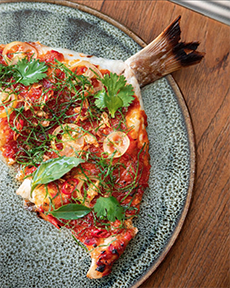
Baked Rockfish With Sambal Chili Paste
[2] Rockfish with sambal sauce (photo © Gunsmoke Restaurant | Hollywood) .

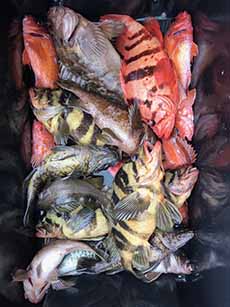
Different Species Of Rockfish In A Tray
[2] Different species of rockfish, all from California (photo © Calder Deyerle | Monterey Bay Fisheries Trust).

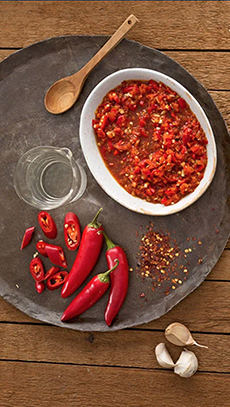
Sambal Olek, Indonesian Hot Chili Paste
[3] Sambal olek, Indonesian hot chili paste. Here’s a recipe (photo © McCormick).


Well it isn’t actually a pizza, but doesn’t this California rockfish from Gunsmoke, an Asian fusion restaurant in Hollywood, look like a slice? But indeed, it is fish, topped with sambal oelek (more about that in a minute), cherry tomatoes, and fresh herbs. A recipe is below.

(The rockfish is currently on the menu with sambal and crispy shallots.)

Chef Brandon Kida serves cuisine that blends Japanese flavor with Californian, Filipino, French, Mexican, and Spanish cuisines.

The restaurant is called Gunsmoke because it’s located in the building which once housed the CBS studio where the original “Gunsmoke” radio show was produced.
 
 
WHAT IS SAMBAL?

Sambal is a hot Indonesian chili sauce or paste, typically made from a mixture of chili peppers, vinegar, and salt.

Some recipes add fish sauce or shrimp paste, garlic, ginger, lime juice, and scallions or shallots. Some add palm sugar.

“Sambal” is an Indonesian word that designates a hot sauce or paste with a base of chili peppers. “Oelek” or olek refers to a mortar and pestle, with which the spices are ground.

Indonesian cooks will make their own sambal from scratch, but you can buy a jar such as the sambal oelek from Huy Fong Foods (the same California company that makes the popular “rooster” sriracha sauce ).

Here’s a recipe to make your own (photo #3).

You can use it to add heat to any food, including dips, dressings, grains, noodles, proteins, sauces, soups, and stews.

Here’s more about sambal olek.

If you don’t want to make it or buy it, check below for substitutions that you may already have.
 
 
WHAT IS CALIFORNIA ROCKFISH?

Rockfish live on the bottom of a body of water, often around rock outcrops—hence the name.

They are sometimes called rock cod or are mislabeled as cod, snapper, or red snapper—three species that are not even in the same family. (The binomial families are Gadidae for cod, Lutjanidae for snapper, and Sebastinae for rockfish.)

Rockfish, depending on the species, vary in shape, size, and color, as you can see in photo #2.

  • Each species has sweet, flaky white flesh.
  • The different species have distinct flavor profiles, but each is delicious. You can try different species to see if you have a favorite.
  • You can also find frozen rockfish.
  • Here’s more about them.
  •  
    Rockfish is often chosen by restaurants for fish n’ chips or battered fish tacos.

    Now: How about some food fun?

    A recipe follows.


    RECIPE: ROCKFISH SAMBAL

    You can use a whole white fish like sea bass, or a fillet such as tilapia. If you use a whole fish, the tail end looks like “fish pizza.”

    You can steam, sauté, or bake the fish, depending on your preference.

    If you don’t want a hot, spicy sauce, use a marinara sauce.

    And yes, you can get creative. For example, with marina and pepperoni, you can have surf and turf (with some grated cheese, too).
     
    Ingredients

  • Fish of choice
  • Cooking oil
  • Sambal oelek or other paste or sauce
  • Small cherry tomatoes or pear/grape tomatoes
  • Garnish: fresh herbs of choice (in the photo are basil, cilantro, and dill)
  •  
    Preparation

    1. TO STEAM: Steam according to your normal preparation, depending on what equipment you have. You can grill or sauté if you prefer. To bake…

    2. TO BAKE: Place a rack in the middle of the oven and preheat to 400°F. Line a baking sheet with parchment paper. Pat the fish dry with an absorbent paper towel. Rub the body of the fish with about 1 tsp of cooking oil on both sides. Season with salt and pepper, if desired.

    3. PLACE the baking sheet in the oven and bake for about 20 minutes or until the fish is cooked through (the flesh will flake easily when ready). While the fish is cooking…

    4. WARM the sambal and tomatoes. The tomatoes should soften and burst.

    5. PLACE the cooked fish on plates (or if a whole fish, on a serving platter) and pour the sambal sauce over it. Garnish and serve immediately with the sides of your choice (rice or other grains are good with this recipe).
     
     
    SUBSTITUTES FOR SAMBAL OELEK

    You can substitute any chili paste, but here are some guidelines.

    Gochugang paste has a similar texture but a slightly different flavor: It is fermented and sweet, with a deeper flavor (but still hot). Here’s more about it.

    Harissa is a paste, slightly thicker and less spicy than sambal oelek. It also has different spices, including cumin. Here’s more about it.

    Sriracha has a similar bright red color and a similar amount of heat, but is thinner. Here’s more about it.


    CHECK OUT WHAT’S HAPPENING ON OUR HOME PAGE, THENIBBLE.COM.


    Comments off

    Espresso Martini Recipe For National Espresso Martini Day

    May 15th is National Espresso Martini Day. Long before the first Espresso Martini, the first known recipe for a Martini, printed in 1888 and called the Martinez, lists its ingredients as gin, sweet vermouth, orange Curaçao, gum, and bitters, garnished with a lemon twist.

    That sweet profile is closer to what modern bartenders call a Martini. Only a Dry Martini, made with gin or vodka, is a classic Martini. Everything else takes the Martini back to its Martinez roots in the 19th century.

    In the decades following the Martinez, the drink dropped its sweet ingredients and evolved into the dry Martini—possibly with the emergence of London dry gin* and Martini and Rossi’s dry vermouth at the end of the 19th century.

    The first known dry Martini recipe with gin and dry vermouth appears in 1904 [source].

    Then came the Vodka Martini. We can’t pinpoint its first appearance, but in the U.S. at least, records show it being served in New York right after the appeal of Prohibition (December 5, 1933) [source].

    Then, in the 1980s, many different flavors of Martini proliferated—mostly sweet flavors with added liqueur, taking the drink back to the Martinez days.

    Check out these 50+ Martini recipes, from cinnamon to strawberry-balsamic. As you can tell from these two, most of these Martinis are sweet—back to the original Martinez.

    We’re here to celebrate National Espresso Martini Day (the history of the Espresso Martini is below. But first, an Espresso Martini recipe from Kástra Elión vodka, the first premium vodka distilled from Greek olives. There’s more about the brand below.

    > The history of the Martini.

    > The history of espresso.

    > The history of the Espresso Martini is below.

    > The history of vodka.
     
     
    RECIPE: ESPRESSO MARTINI

    Instead of two ingredients in a Dry Martini—gin or vodka and vermouth—the Espresso Martini substitutes expresso liqueur for the dry vermouth and adds two more ingredients: cold brew coffee and simple syrup.

    For a less sweet drink, eliminate the simple syrup. The liqueur has plenty of sweetness.

    Kāstra Eliōn vodka has no hint of olives; you can use any vodka.

    Most vodka is made from fermented grains such as corn, rice, rye, sorghum, or wheat; although grapes and other fruits (such as olives), as well as potatoes, are also used. You can even distill vodka from plain sugar!

    Ingredients Per Drink

  • 1.25 ounces Kāstra Eliōn vodka (or substitute)
  • .75 ounce espresso liqueur or coffee liqueur
  • .75 ounce cold brew coffee (substitute regular coffee or espresso, chilled at room temperature
  • .25 ounce simple syrup (recipe)
  • Ice
  • 3 coffee beans to garnish
  •  
    Preparation

    1. ADD the ingredients to a shaker full of ice and shake hard for 30 seconds. Strain into a Martini glass.

    2. GARNISH with coffee beans.
     
     
    THE HISTORY OF THE ESPRESSO MARTINI

    The creation of the Espresso Martini is attributed to British bartending guru Dick Bradsell, a mixologist who is credited with revolutionizing the London cocktail scene in the 1980s.

    He is said to have created the drink—originally called the Vodka Espresso and then the Pharmaceutical Stimulant—at Fred’s Club in the late 1980s.

    As the story goes, a customer asked for a drink to “wake her up” and he combined vodka, espresso, coffee liqueur, and sugar that he shook into a frothy drink [source].

    Some bartenders then added a garnish of three coffee beans, following the custom of a glass of the coffee liqueur, Sambuca. The three beans are said to represent health, wealth, and happiness [source].

    The Espresso Martini is made with vodka. Per the comment at the top of the article, no one can pinpoint when the first vodka Martinis were made (in Europe in the 1930s or earlier?). But in the 1960s, vodka got a big boost from a man named Bond, James Bond. Agent 007’s “vodka Martini, shaken not stirred” catapulted this now-classic cocktail to instant stardom.


    ABOUT KÁSTRA ELIÓN VODKA

    Kástra Elión* Vodka, made in Greece, is the first premium vodka distilled from green Greek olives.

    The vodka is distilled from wheat and a mixture of olives hand-picked in the town of Nafpaktos, a historic port town situated on the Gulf of Corinth in western Greece. The town has a castle, or kástra in Greek, which gives its name to the vodka.

    The name roughly means “castles of the olive groves.” Kástra is the plural of kástro, Greek for a castle, and eliá is the word for olive.

    The bottle is actually a reusable ceramic container, you can use for water or even as a flower vase.

    On the nose there’s a hint of both saltiness and a fruity/vanilla sweetness, and it’s undeniably clean and pure. Tasting it, this is one of the most interesting vodkas I’ve tried in a while, and I’m not saying that just because I love Greece and its food and drink.

    The flavor is clean and pure, velvety smooth. It’s a lovely sipping vodka.

    Except for a slightly salty note (other vodkas can have a pepper note), it doesn’t have any hint of olives—just as other vodkas have no hint of the grain from which they’re distilled.

    Stin ygeiá sas (“cheers,” in Greek).


    Espresso Martini
    [1] An Espresso Martini (photos #1 and #2 © Kástra Elión vodka).

    Bottle Of Kastra Elion Vodka With Olives
    [2] Kástra Elión vodka is made from green Greek olives. The bottle is reusable ceramic.

    Bottle Of Bottega Spa Espresso Liqueur
    [3] It’s hard, but not impossible, to find espresso liqueur. Most of the brands are coffee liqueur (photo © Bottega Spa).

    Mr. Black Espresso Martini Recipe
    [4] Mr. Black cold brew coffee liqueur in an Espresso Martini (photo © Mr. Black).

    Pot Of Cold Brew Coffee In The Fridge
    [5] Cold brew coffee (photo © Takeya Cold Brew Coffee Maker).

    Bottle Of Classic Simple Syrup From Sonoma Syrup
    [6] Classic simple syrup (it’s available in different flavors). You can buy it or make it with this recipe (photo © Sonoma Syrup).

    ________________
     
    *London dry gins are flavored with juniper, complemented by touches of other botanicals: citrus and other fruits, herbs, spices, and/or others (bark, roots, e.g.), depending on the brand.


    CHECK OUT WHAT’S HAPPENING ON OUR HOME PAGE, THENIBBLE.COM.


    Comments off

    100+ St. Patrick’s Day Recipes & History Of St. Patrick’s Day

    Green Goddess Dressing
    [1] Green Goddess salad dressing. Here’s the recipe (photo © Martha Stewart).

    Green Mint Chocolate Chip Cookies
    [2] Green mint chocolate chip cookies Here’s the recipe (photo © ).


    If you’re hunting for St. Patrick’s Day recipes, take a look at our collection. We have 100 delicious recipes for:

  • Breakfast
  • Lunch
  • Cocktails
  • Dinner
  • Dessert
  • Snacks
  •  
    Some are authentic Irish or Irish-American dishes, and others, like the dip in the photo, are simply a celebratory green.

    Take a look!
     
     
    THE HISTORY OF ST. PATRICK’S DAY

    St. Patrick’s Day, celebrated on March 17th, commemorates St. Patrick, the patron saint of Ireland.

    St. Patrick is believed to have brought Christianity to Ireland. He was born in Britain, around 387 C.E. When he was sixteen years old, he was captured by Irish raiders and brought to Ireland as a slave.

    During his captivity, he became a Christian and, after six years of servitude, he escaped and returned to Britain. However, he felt called to return to Ireland to spread Christianity and spent many years traveling throughout the country, preaching and converting the pagan peoples to Christianity.

    St. Patrick is said to have used the shamrock, a three-leafed clover, to explain the Christian concept of the Holy Trinity. This is why the shamrock has become a symbol of St. Patrick’s Day. (The name shamrock comes from Irish seamróg, which means “young clover.”)

    The first St. Patrick’s Day parade is believed to have taken place in New York City in 1762, when Irish soldiers serving in the British army marched through the streets. The parade became an annual event in New York City and subsequently in other cities with large Irish populations, such as Boston and Chicago.

    In Ireland, St. Patrick’s Day was originally a religious holiday, and the first official St. Patrick’s Day parade there did not take place until 1931, in Dublin.

    Today, St. Patrick’s Day is celebrated by people of all backgrounds around the world, with parades, festivals, and other events that often involve wearing green, drinking beer (which may be coored green), and enjoying Irish food and music.

     
    As an aside, corned beef and cabbage, often served in the U.S. on St. Patrick’s Day, is a dish brought to New York by Jewish immigrants in the 19th century. It is not consumed in Ireland.


    CHECK OUT WHAT’S HAPPENING ON OUR HOME PAGE, THENIBBLE.COM.


    Comments off


    © Copyright 2005-2026 Lifestyle Direct, Inc. All rights reserved. All images are copyrighted to their respective owners.