THE NIBBLE BLOG: Products, Recipes & Trends In Specialty Foods


Also visit our main website, TheNibble.com.

TIP OF THE DAY: Romanesco, Neither Broccoli Nor Cauliflower

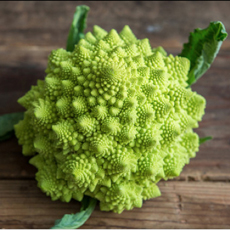
Isn’t it beautiful?

Romanesco looks like it’s been sculpted by an artist. It’s a member of the cruciferous vegetables family (Brassicaceae) that includes broccoli and cauliflower, among others. If it seems exotic, that’s because we rarely find it in U.S. markets. But romanesco grown in California is in season now.

In the U.S., it’s also called broccoflower, Roman broccoli, romanesco broccoli, romanesque cabbage and romanesque cauliflower. So is it broccoli or cauliflower? Actually, it’s neither.

Remember high school botany taxonomy: kingdom, order, family, genus, species and sometimes, subspecies?

  • The Brassica genus is unusual in that instead of individual species, it bundles its members into one species.
  • Thus, the species Brassica oleracea includes broccoli, Brussels sprouts, cabbage, cauliflower, collard greens, kale, kohlrabi, mustard, rapeseed/canola, rapini (broccoli rabe) and turnips.
  • What might be called a subspecies elsewhere are known here as cultivars, and don’t have a separate botanical name*.
  •  
    So the answer is: romanesco is neither broccoli nor cauliflower; it is its own cultivar. While you’ll see it called broccoli or cauliflower, you now know better.

    Botanists believe that Italian farmers in the 16th century developed romanesco through cross-breeding. It was initially called broccolo romanesco.

    As with cauliflower or broccoli, the pointy “florets” (often called fractals after fractal art) that comprise the head are of varying sizes. They are actually individual buds of the plant’s flower.

    Romanesco tastes more like cauliflower, with a nutty, earthy flavor nuance and a crunchier texture.

    It is about the same size of a regular head of cauliflower. There is also a smaller variety, which is about half the size. The pale green shade keeps its color through cooking.

       
    Romanesco Cauliflower
    [1] If you can’t find it locally, order romanesco online as a special treat (photo © Good Eggs).


    [2] Cooked romanesco florets (photo © Grub Market).

     
    Look in your farmers markets or specialty produce stores; the crops from California are in. You can treat yourself or send a gift from Melissas.com.


    romanesco-simplymcghie.blogspot-230r
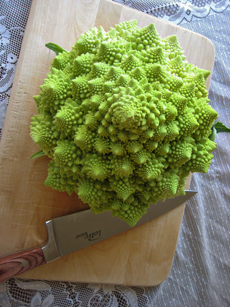
    [3] It’s almost to pretty to cut! Enjoy it as a centerpiece for a day or two. Photo courtesy SimplyMcGhie.Blogspot.com.
      HOW TO SERVE ROMANESCO

    Romanesco can be served raw, lightly cooked, or cooked through, and can be substituted in any recipe calling for cauliflower or broccoli.

    It’s a shame to destroy the architecture by dicing or puréeing.

    We wouldn’t want to turn it into soup, for example, when we could use regular cauliflower.

    Instead, consider:

  • Crudités
  • Lightly steamed (recipe)
  • Marinated
  • Mixed vegetable salads (with mixed greens or other vegetables)
  • Roasted
  • Sautéed (here’s an easy recipe with garlic, olive oil and Parmesan cheese)
  •  

    RECIPE #1: ROMANESCO SALAD

    This recipe is from Mariquita Farm of Watsonville, California (alas, now closed), which grew romanesco for many years.
    Ingredients

  • 1 head romanesco
  • 1/4 cup Kalamata or other favorite olive, pitted and sliced
  • Capers, 1 tablespoon per 4 cups of florets
  • 1/4 cup chopped onion or to taste: green onion, red onion, shallot
  • Fresh herbs, chopped (basil, cilantro and/or parsley are our favorites here)
  • Lemon juice vinaigrette (recipe below)
  • Salt and pepper to taste
  • Optional: shaved Parmesan or crumbled Gorgonzola
  • Optional garnish: toasted sunflower seeds
  •  
    Preparation

    1. LIGHTLY STEAM the florets to desired consistency. While you can use them raw, a blanching or light steaming makes the texture more uniform with the other ingredients.

    2. TOSS with the other ingredients and the vinaigrette, taking care not to damage the pointy “fractals.” Serve chilled or at room temperature.
     
     
    RECIPE #2: LEMON VINAIGRETTE

    Ingredients

  • 2 tablespoons freshly-squeezed lemon juice
  • 1/2 teaspoon lemon zest
  • 1/2 teaspoon Dijon mustard
  • 1/8 teaspoon sugar
  • 4 tablespoons extra-virgin olive oil
  • 1/4 teaspoon salt, or to taste
  • Salt and freshly ground black pepper to taste
  •  
    Preparation

    1. WHISK together the lemon juice, zest, mustard, sugar and salt in a small bowl. Add the olive oil in a slow stream, whisking constantly until the dressing is well blended.

    2. TASTE and season with additional salt and pepper as desired. Drizzle over the salad and toss to coat thoroughly.
     
     
    WHY ARE CRUCIFEROUS VEGETABLES SO GOOD FOR YOU?

    The Brassicaceae family of vegetables contains powerful antioxidants that prevent the build-up of free radicals, atoms with unpaired electrons in the body that are destructive, engendering disease.

    Along with their nutritional elements, cruciferous vegetables aid with alkalinization (making the body less acidic), bone health, cancer prevention, cholesterol reduction and detoxification (neutralization and elimination of unwanted contaminants).

    The high fiber content aids in digestion, heart health, lowering blood sugar, reducing allergy reactions and inflammation, and more.
     
    _________________
    *Other members of Brassicaceae belong to a different genus. These include arugula, bok choy, Chinese cabbage, cress, daikon, horseradish, mizuna, radish, rutabaga, tatsoi and wasabi.
      

    Comments off

    PRODUCT: WTRMLN WTR

    Back in 2006, we reviewed a wonderful product called Sundia Watermelon Juice. It was celestial, tasting like fresh-squeezed watermelon.

    Alas, the company discontinued the product, and it took until 2014 for another commercial brand to come our way.

    World Waters debuted its WTRMLN WTR (someone’s idea—not ours—of a clever way to spell “Watermelon Water”). The product was named “Best Juice” at the recent BevNET Best of 2014 Awards.

    WTRMLN WTR is an all natural cold-pressed watermelon water that is more than refreshing: It’s packed with electrolytes (the same amount as coconut water and six times the electrolytes of sports drinks) and L-citrulline, a powerful amino acid that aids in workout performance and muscle recovery. Vitamin C and lycopene contribute antioxidant and anti-inflammatory health benefits.

    There’s no added sugar. The product is certified kosher by OU.

    WTRMLN WTR is a pleasant departure from the never-ending stream of coconut waters we are pitched.

    The line debuted New York, New Jersey, Connecticut and Los Angeles, expanding to San Francisco and other areas this year.

      wtrmln-wtr-bottle-glass-arizona-230
    Drink your watermelon. Photo courtesy World Waters.
     
    A 12-ounce bottle is $4.99 at Whole Foods Markets and other fine retailers. You can buy it online at WtrmlnWtr.com, 12 bottles for $72.

    So is it as heavenly as Sundia’s version? Not to us: It tastes more “green,” which may or may not be due to the varying sweetness levels of watermelon, or the fact that watermelon rind is pressed along with the flesh.

    But it’s still grab-and-go watermelon juice. If your only other option is to juice your own, WTRMLN WTR is a great choice.

    Discover more at WTRMLNWTR.com.
      

    Comments off

    TIP OF THE DAY: How To Make Cream From Milk

    cream-cartons-wmmb-230
    [1] No cream? No problem! Make it from milk and butter (photo © Wisconsin Milk Marketing Board).

    A Dish Of Sliced Peaches and Cream
    [2] How about some dessert? Just pour cream over any sliced fruit or berries—or on cooked fruit like baked apples and compote (photo © Spache The Spatula).

    Dairy Products; milk,cheese,ricotta, yogurt and butter
    [3] Butter + Milk = Heavy Cream (photo © Siberkorn | Dreamstime).

    A Bowl Of Whipped Cream
    [4] Whip it into a dessert topping (photo © King Arthur Baking).

    Salted Caramel Hot Chocolate
    [5] Salted caramel hot chocolate with lots of whipped cream (photo © Starbucks).


    Here’s a fun kitchen trick. Say you need some heavy cream for a recipe (or even a cup of coffee), but have none.

    If you have whole milk and unsalted butter, you can combine them to make cream. The difference between milk and cream is the amount of butterfat. The butter, which is at least butterfat, supplies what the milk lacks.

    This recipe makes heavy cream, approximately 36% butterfat.

    > The butterfat content of all dairy products is below.

    > The history of cream and the different types of cream: a photo glossary.

    > The year’s 16+ milk and cream holidays.
     
     
    HOW TO MAKE HEAVY CREAM AT HOME

    Ingredients For 1 Cup

  • 1/3 cup unsalted butter
  • 3/4 cup whole milk
  •  
    Preparation

    1. MELT the butter in the microwave or on the stove top.

    2. PLACE in a mixing bowl with the milk.

    3. BLEND with electric beaters or an immersion blender.

    It’s that simple!
     
     
    BUTTERFAT CONTENT

    Butterfat, also called milkfat, is the fatty portion of milk. The components of milk include:

  • Carbohydrate, 4.9% (this is lactose, or milk sugar)
  • Fat, 3.4% (approximately 65% saturated fat, 29% monounsaturated fat and 6% polyunsaturated fat)
  • Protein, 3.3% (82% casein and 18% whey)
  • Water, 87%
  • Vitamins (cobalamin [vitamin B12], folate, niacin [vitamin B3], pantothenic acid [vitamin B5], pyridoxine [vitamin B6], thiamin [vitamin B1], riboflavin [vitamin B2, vitamins C, D, E and K)
  • Minerals (calcium, copper, iron, magnesium, manganese, phosphorus, potassium, selenium, sodium, zinc)
  • Minor biological proteins and enzymes (lactoferrin, lactoperoxidase, lipases, lactase) [Source]
  •  
    The USDA imposes federal standards for the minimum butterfat content of commercial dairy products. Here are the standards:
     
     
    BUTTERFAT CONTENT OF BUTTER

  • Butter, including whipped butter, must contain at least 80% butterfat.
  •  
    BUTTERFAT CONTENT OF CREAM

  • Half and half contains 10.5%–18% butterfat (average 12%).
  • Light cream and sour cream contain 18%–30% butterfat (average 20%).
  • Light whipping cream* (often called simply “whipping cream”) contains 30%–36% butterfat (average 35%).
  • Heavy cream* contains a minimum of 36% butterfat, up to 38%.
  •  
    BUTTERFAT CONTENT OF MILK

  • Skim milk contains less than 0.5% butterfat, typically 0.1%.
  • Lowfat milk (1% and 2% varieties) contain between .5% and 2% butterfat.
  • Whole milk contains at least 3.25% butterfat.
  •  
    BUTTERFAT CONTENT OF CHEESE

  • Dry curd and nonfat cottage cheese contain less than 0.5% butterfat.
  • Lowfat cottage cheese contains .5%–2% butterfat.
  • Cottage cheese contains at least 4% butterfat.
  • Swiss cheese contains at least 43% butterfat relative to the total solids.
  • Cheddar cheese contains at least 50% butterfat relative to the total solids.
  •  
    BUTTERFAT CONTENT OF FROZEN DESSERTS

  • Sherbet contains 1%–2% butterfat.
  • Lowfat ice cream, also called ice milk, contains no more than 2.6% butterfat.
  • Ice cream contains at least 10% butterfat.
  • Frozen custard contains at least 10% butterfat, but it also must contain at least 1.4% egg yolk solids.
  •  
     
     
    ________________

    *For whipped cream, the higher the fat content, the thicker the cream is, and the easier it is to whip into stiff peaks. Higher fat cream is also more resistant to curdling, and thus a better choice for soups and sauces.


    CHECK OUT WHAT’S HAPPENING ON OUR HOME PAGE, THENIBBLE.COM.


    Comments off


    © Copyright 2005-2026 Lifestyle Direct, Inc. All rights reserved. All images are copyrighted to their respective owners.