THE NIBBLE BLOG: Products, Recipes & Trends In Specialty Foods


Also visit our main website, TheNibble.com.

Blue Diamond Dark Chocolate Oven Roasted Almonds

We were invited by Blue Diamond to taste some new products: almonds (we love them) combined with chocolate. Need we say more?

We often eat 23 almonds a day, the ideal daily portion recommended by the Dietary Guidelines for Americans (see photo #5).

Why? We love the flavor, they’re a filling snack, and provide a big hit of protein and other good nutrition.

What happens when almonds meet up with cocoa and dark chocolate? Read on!

> The history of almonds.
 
 
BLUE DIAMOND OVEN ROASTED ALMONDS: DARK CHOCOLATE

What a treat: Crunchy nuts with deep-roasted almond flavor. The chocolate effect is created with a light coating of cocoa sweetened with evaporated cane juice.

For us, this satisfying chocolate-nut snack beats a candy bar and other less-nutritious forms of chocolate see nutrition information below).

So thank you, Blue Diamond, for this absolutely delicious snack and garnish.

It’s sold in a 14-ounce resealable pouch plus 100-calorie snack packs for portion control. (The portion control packs are highly recommended for anyone with low self control. Resistance is futile.)

A filling, satisfying 24-nut portion (one ounce) has 160 calories, 5g protein, and 6 net carbs. In addition to snacking from the bag, consider them:

  • As a side with coffee or hot chocolate.
  • In trail mix.
  • As a topping for yogurt and pudding.
  • As a garnish for cupcakes and cakes.
  •  
    These nuts are our Top Pick Of The Week for their nutritious snackability and happy chocolate fix.

    The Blue Diamond website shows Blue Diamond snack nuts in two additional flavors:Cinnamon and Maple Flavored Almonds and Dark Chocolate and Chili Pepper Flavored Almonds.

    They’re our next must-tries. We also found Toasted Coconut Oven Roasted Almonds on Amazon.

    Find a store near you and or buy them on Amazon. Check the Blue Diamond website for a store locator.

    Amazon also sells boxes of 100 Calorie Packs—great for portion control, since once we open a 14-ounce bag, anything goes.

    The almonds are certified kosher by OK.
     
     
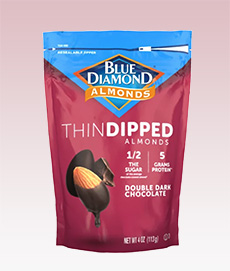
    BLUE DIAMOND THIN DIPPED ALMONDS

    We next tried the brand’s Thin Dipped Almonds:

  • Double Dark Chocolate
  • Dark Chocolate Sea Salt Caramel
  •  
    The chocolate-covered almonds have half the sugar* of average chocolate-covered almonds (and 5g protein per serving of 19 pieces).

    While we have no complaint with Thin Dipped, we far prefer the Oven Roasted.

    Try both and decide for yourself.
     
     
    ALMOND NUTRITION

    Almonds are nutrient-dense. They’re loaded with nutrients and antioxidants. The majority of their fat is monounsaturated (good fat).

    They can assist with blood pressure, blood sugar, and cholesterol (here’s more about it).

    To snack on plain almonds, just remember 1-2-3: 1 ounce of almonds equals about 23 nuts, the ideal daily portion recommended by the Dietary Guidelines for Americans.

    Instead of counting, you can also cover a 3″ x 3″ sticky note with nuts (photo #5).

    One ounce of plain almonds provides about 165 calories, 6 grams of protein, 14 grams of fat (80% monounsaturated, 15% polyunsaturated, and 5% saturated), 6 grams of carbohydrate, and 3 grams of fiber.

  • Monounsaturated and polyunsaturated fats are the “good fats,” that lower the risk of heart disease risk. Foods high in good fats include vegetable oils (such as olive, canola, sunflower, soy, and corn), nuts, seeds and fish.
  • “Bad fats”—saturated and, especially, trans fats—increase the risk of heart disease. Foods high in bad fats include red meat, butter, cheese, and ice cream, as well as processed foods made with trans fat from partially hydrogenated oil.
  •  

    Package Of Blue Diamond Dark Chocolate Almonds
    [1] Dark Chocolate Oven Roasted Almonds (photos #1, #3, and #4 © Blue Diamond).

    Blue Diamond Dark Chocolate Almonds
    [2] The almonds, up-close (photo © Stephanie Barlow | The Kitchn).

    Package Of Blue Diamond Chocolate Chili Almonds
    [3] What we want to try next: the almonds with a hit of chili heat.

    Package Of Blue Diamond Chocolate Dipped Almonds
    [4] Another new option: Thin Dipped almonds with a light coating of chocolate and half the sugar.

    Daily Portion Of Almonds
    [5] If you don’t want to count out your daily portion of 23 almonds, just cover a 3″ x 3″ Post-It note (photo © Almond Board of California).

     
    Almonds are an excellent source of vitamin E, magnesium, and manganese, and a good source of fiber, copper, phosphorous, and riboflavin.

    In fact, ounce for ounce, almonds are the tree nut highest in protein, fiber, calcium, vitamin E, riboflavin, and niacin.

    To make daily snacking easier, California Board Of Almonds has created a snack tin that holds exactly 23 almonds.

    If you’re planning an event and need a party favor, consider a healthy one. Check out the custom tins.

     
    ________________

    *Per Blue Diamond, the average chocolate-covered almond serving has 14g of sugar, whereas Blue Diamond Thin Dipped has 6g of sugar.


    CHECK OUT WHAT’S HAPPENING ON OUR HOME PAGE, THENIBBLE.COM.


    Comments off

    Pink Challah Recipe With Dragon Fruit & Pomegranate Arils

    Pink Pomegranate Challah With Honey
    [1] Challah made pink with dragon fruit purée (photos #1, #2, and #3 © Hannah Kaminsky | Bittersweet Blog).

    Round Of Pink Pomegranate Challah Dough
    [2] Pink challah dough, colored naturally with dragon fruit purée.

    Pink Pomegranate Challah Toasted Slices
    [3] Toasted for breakfast or snacking.

    Pink Dragonfruit
    [4] Dragon fruit (photo © Tanaphong Toochinda | Unsplash).

    Package Of Pitaya Frozen Dragon Fruit
    [5] Look for frozen dragon fruit smoothie packs. If you can only find frozen cubes of fruit, you can purée them yourself. With the rest of the packs, see how to make a dragon fruit smoothie bowl here (photo © Love To Be In The Kitchen).

    Cup Of Pomegranate Arils
    [6] Pomegranate arils (photo © Good Eggs).


    No, this isn’t Barbie bread. It’s a pink challah, created by our colleague Hannah Kaminsky for Rosh Hashanah, the Jewish new year, which begins at sundown on Friday, September 15th*.

    Holiday notwithstanding, any lover of delicious bread can bake a loaf or two or more (challah freezes very well) at any time of the year.

    Challah, pink or otherwise, is a soft, subtly sweet loaf that works as well with dinner as it does for breakfast.

    It also makes delicious bread pudding, breakfast casseroles, croutons, French toast, stuffing, tea sandwiches, and other sandwiches (the recipe below is especially good for PB&J and grilled cheese sandwiches with brie and strawberries).
     
    > The history of challah.
     
     
    A SWEET TRADITION

    Among the traditional Rosh Hashanah foods†, apple slices dipped in honey are served to ensure a sweet new year ahead.

    But pomegranates also hold special significance, representing abundance and fertility.

    “This year,” says Hannah, “multiply your mitzvot [blessings] with pink pomegranate challah, a brilliant-colored round loaf with crunchy pomegranate arils in every slice.”

    The round challah in this recipe is often interpreted as a representation of the cyclical nature of life and the continuity of creation.

    The circular shape is also seen as a symbol of unity and completeness, as there is no beginning or end to a circle.

    So think pink: Start a new tradition for Rosh Hashanah with pink pomegranate challah, as rich with symbolism as it is with color and flavor.

    For more on dragon fruit (pitaya), see below.
     
     
    RECIPE: PINK POMEGRANATE CHALLAH

    This challah is naturally colored pink with dragon fruit (pitaya) purée. You can find frozen dragon fruit smoothie packs (which is puréed fruit) in a well-stocked supermarket or health food store, as well as at superstores like Costco and Target.

    Prep time is 30 minutes, cook time is 30 minutes, and rising time is 1-1/2 to 2 hours. Total time is 2-1/2 to 3 hours.
     
    Ingredients

  • 1 packet (1/4 ounce) or 2-1/4 teaspoons active dry yeast
  • 3/4 cups warm water
  • 2 tablespoons granulated sugar
  • 2 tablespoons honey or agave nectar
  • 1 packet (100g) or 7 tablespoons frozen dragon fruit/pitaya purée, thawed
  • 1/3 cup olive oil
  • 3-1/2 to 4 cups bread flour
  • 1-1/2 teaspoons salt
  • 1/2 cup pomegranate arils, fresh or frozen, thawed, and patted dry
  • 1 egg yolk, beaten
  •  
    Preparation

    1. USING a stand mixer, combine the yeast with the warm water and the sugar in the bowl. Let stand for 5-10 minutes, until the mixture becomes lightly frothy. Then add the honey or agave, dragon fruit purée, and oil, stirring lightly to combine.

    2. MIX together 3 cups of flour with the salt and add it to the bowl of wet ingredients. Install the dough hook, and begin mixing on low speed. Pause to scrape down the sides of the bowl as needed to get all ingredients incorporated. It may take a few minutes, but be patient!

    3. CONTINUE mixing with the dough hook, allowing it to knead for 8-10 minutes. It should become smooth as elastic, remaining a bit tacky but not downright sticky. Incorporate additional flour as needed.

    4. TRANSFER the dough to a lightly greased bowl and cover with a kitchen towel or plastic wrap. Let it rise in a warm place for 1-1/2 to 2 hours, until roughly doubled in volume.

    5. PUNCH down the dough, cut it into four equal pieces, then roll each piece into long, smooth strands on a lightly floured work surface. It does tend to get a bit sticky, so don’t be afraid to add more flour as needed. The exact length isn’t as important as the fact that they match in size, though aim for somewhere around 1 to 1-1/2 feet long.

    6. USE a rolling pin to flatten out the logs into think ovals. Sprinkle about 2 tablespoons of the pomegranate arils down the center of each one, folding over the sides and pinching the edges to seal them within.

    7. BRAIDING: You can either simply spiral the strands together into a round, or braid them starting in the center, then fold under the ends. Hannah’s best advice for shaping is to consult a YouTube video, because “I have a very hard time describing the process and I’m certainly no master of it myself!” Once braided…

    8. GENTLY TRANSFER the loaf onto a sheet pan lined with parchment paper or a silicone baking mat. Brush generously with the beaten egg yolk to cover the entire exposed surface.

    9. PREHEAT the oven to 400°F allowing the bread to rise for at least 30 minutes while it comes up to temperature. Immediately reduce the temperature to 375°F once you slide the dough into the center of the oven. Bake for 30-35 minutes, until the top is gently golden all over.

    10. COOL on a rack until at room temperature before cutting into generous slices.
     
     
    WHAT IS DRAGON FRUIT?

    Dragon fruit (also called pitaya and pitahaya) is a the fruit of a climbing cactus, Hylocereus undatus, which is native to Central and South America and requires a warm, humid climate.

    The cactus produces large, fragrant flowers that bloom at night and are pollinated by nocturnal creatures like bats and moths.

     
    The pollinated flowers develop into the colorful, spiky-skinned dragon fruit. Different varieties have pink or yellow outer skin with pink, red, or white flesh dotted with tiny black seeds.

    Cultivated by the Mayas and Aztecs, dragon fruit was later introduced to Southeast Asia, the U.S., and other parts of the world.

    Around the 16th century, the fruit was found by European missionaries and explorers traveling in Central America. From there it was transported to all corners of the globe [source].

    The French introduced the fruit into Vietnam more than a century ago, and Vietnam is the world’s leading exporter of dragon fruit.

    Other countries such as Australia, the Caribbean, China, Israel, Malaysia, the Philippines, Taiwan, Thailand, and the U.S. (Florida and Hawaii) are some other countries that grow the fruit [source].

    Its taste is often described as a blend of kiwi, pear, and watermelon, with a mildly sweet and refreshing flavor (personally, we find it bland).

    The fruit is packed with essential nutrients, including vitamins C and E, antioxidants, and dietary fiber. It’s low in calories and high in water content.

    The fruit is commonly used in fruit salads and smoothies, but it can also be eaten raw or grilled. It became is a popular ingredient in many Asian and Latin American cuisines, both savory and sweet.

    It is also served as a juice and made into sorbet and syrup. The unopened flower buds can be cooked like vegetables.

    Its high price is due to its labor-intensive cultivation and harvesting and its delicate skin and perishable nature.
     
     
    ________________

    *The dates change every year according to the Jewish calendar. It’s the first of the Jewish High Holy Days, as specified by Leviticus 23:23–25. Here’s more about it.

    †Traditional Rosh Hashanah foods include, among others, apple cake, apples and honey, brisket, challah, gefilte fish, honey cake, kasha varnishkes, kugel, matzoh ball soup, and tzimmes.


    CHECK OUT WHAT’S HAPPENING ON OUR HOME PAGE, THENIBBLE.COM.


    Comments off

    Try A New Type Of Salami For National Salami Day

    September 7th is National Salami Day, a day to enjoy a slice or two…or more. Even better, try a new type. We live in New York City, where our diverse population leads to are lots of choices.

    Perhaps the best way to start is to define “salami.” If you’re Jewish, you might think of a kosher-style deli salami (photo #10). If you’re Italian, there are hundreds of types from which to choose, especially in Italy, where you could spend years trying each region’s specialties.

    In the absence of years to pursue the salamis of the world, here’s a brief focus on the salamis of Italy.

    Below:

    > What is salami?

    > The different types of Italian salami.

    > The history of salami.

    Elsewhere on The Nibble:

    > The different cuts of pork and pork products.

    > The different types of charcuterie: a glossary.

    > The different types of bacon.


    1. WHAT IS SALAMI

    Salami is a salted and seasoned, cured, fermented, and air-dried sausage typically made from ground pork and fat. Most salami is made from pork, although it can be made from beef, boar, venison, and other game meats.
     
    There are hundreds of types of salami, not only worldwide but in Italy alone. Different regions have their specialties.

    New recipes are created each day according to Volpi Foods, which produces several varieties.

    “That means you could spend your entire life touring the world, one salami at a time, and still never get to try them all,” says Frank Volpi.

    To Make Salami

    • The meat is ground and kneaded to achieve the desired texture: fine-grained (Milano style), medium grind (Felino and Genoa styles), firm and chewy (chorizo, pepperoni), spreadable (‘nduja, sobrasada), etc.).
    • Fat and various spices are added according to the recipe: salt, garlic, black pepper, wine, and various herbs or spices.
    • It is then packed into casings, and air-dried for weeks or months to create a shelf-stable product.
    • In general, the cuts of pork used are the thigh, shoulder, loin, filet, belly, and the succulent fat from the pig’s jowls (guanciale).
    • A good salami has to have the right balance of lean meat and fat. The tendency today, especially for industrial (mass-produced) products, is to make leaner salami, which affects the taste and texture but looks better on the package’s nutrition panel.
    • The best salami are artisanal—“fatti come una volta,” which means “made as they used to be.” The recipes can go back centuries.

     
    Salami vs. Salumi vs. Salame

    Salumi (note the “u,” not the “a” in salami) is a broad Italian term for all cured meats, while salami is just one specific type of cured sausage that falls under that larger category.

    • Salumi A large family of Italian preserved meats, mostly made from pork. It includes whole muscle cuts (like a whole leg) or ground mixtures. Examples: Prosciutto, pancetta, coppa, guanciale, and mortadella. It’s analagous to the French term charcuterie. Salame is the plural form.
    • Ham and other deli meats such as bresaola, pancetta, and prosciutto, are also salumi.
    • Salami is a specific kind of cured, fermented, and air-dried sausage. Examples: chorizo, Genoa salami, ‘nduja, soppressata, and pepperoni.
    • The rule: All salami is salumi, but not all salumi is salami

     
    Charcuterie is the French term for prepared meat products made primarily from pork, including bacon, ballotines, confits, galantines, hams, pâtés, rillettes, sausages, and terrines.
     
    Salami vs. Sausage

    Salami is actually a specific type of cured and fermented sausage, but today the popular distinction is:

    • Salami, plural salame: dry-cured Italian-style meats for slicing, usually eaten cold.
    • Sausage: fresh or smoked cooking sausages, usually eaten hot.

     
    Etymology

    Salame originally meant “all kinds of salted [meats].” Over time, the meaning narrowed to focus specifically on the popular seasoned, encased, and air-dried sausages.

    It combines the Latin word sal/sale, meaning salt, with the Italian suffix -ame, which turns a word into a collective noun. (The words salad, sausage, sauce, salsa and salary all come from the same Latin root.)

    “Salame” originally meant “all kinds of salted [meats].” Over time, the meaning narrowed to focus specifically on the popular seasoned, encased, and air-dried sausage.

    Salami Vs. Sausage

    All salami are sausages at the early stages of production.

    • Salami is then either hot smoked, fermented, or potentially dried to finish the process. It is cured* and ready to eat.
    • Fresh sausage is minced meat and fat, with salt and spices stuffed into a natural or synthetic casing. It is generally sold raw and must be cooked before eating.
    • Both are made from ground meat mixed with seasonings and stuffed into a casing. Salami is then dried until the desired hardness is achieved.
    • Preparation techniques differ.


    2. DIFFERENT TYPES OF ITALIAN SALAMI: TRY SOMETHING NEW!

    The three main components that set the different types of salami apart are:

    • The ingredients: meat, seasonings, and fat. Some salami use a blend of spices to create complex flavors, while others are simpler—just salt and garlic, for example.
    • How the meat is cut (chopped vs. ground, e.g.).
    • How it is prepared (for example, cooked by hot smoking or cold smoking, dry-cured*, or water bath.

     
    There are numerous examples of artisanal salami in every region of Italy. What follows are some of the varieties that are better known in the U.S.
     
    Calabrese Salami. Spicy Calabrese from Calabria gets its kick from cayenne pepper and paprika, making it zesty but not overpowering (photo #11). Italy’s Calabria region is known for its spicy foods.

    Cacciatore Salami. Cacciatore is Italian for “hunter” (photo #1). The story goes that hunters carried this spicy sausage as a snack on long hunting trips. It can be made with all pork, a pork/beef blend, venison, or wild boar.

    Coppa. Coppa is not a salami, but it looks like one, marbled with delicious fat. Instead, it is charcuterie, a whole cut of meat taken from a single muscle, pork shoulder that’s typically rubbed with pepper, nutmeg, and allspice. It’s then slowly aged and air-dried for at least 45 days. This brings out its full tenderness and fragrance. It can substitute for prosciutto, which is cured from the pig’s hind leg. Hot coppa (photo #12) is rubbed with crushed red pepper flakes and paprika.

    Genoa Salami. Genoa Salami is a hard, garlic-heavy, dry-cured meat from Genoa in the Liguria region of northwestern Italy (photo #9). It’s typically made of pork, salt, garlic, pepper, fennel seeds, and wine.

    Finocchiona Salami. Finocchiona Salami is a spicy Tuscan specialty that is dry-cured and made with fennel seeds and black pepper (photo #3).

    Hard Salami. A dry, smoky salami seasoned with garlic, salt, white pepper, and red wine with a characteristic fermented flavor.

    Italian Dry Salami. A rich salami, coarsely ground, flavored with Italian-style seasonings, garlic, and red wine with a characteristic fermented flavor.

    Milanese Salami. Milanese salami, also known as Milano salami, is made with a combination of pork and beef, and rice-sized grains of pork fat and is bright red in color and sweeter than Genoa salami.

    Napoli Salami. The traditional smoked salami from Naples, Napoli salami is smoked over applewood giving it a complex, hearty flavor.

    ‘Nduja. ‘Nduja is a spicy, spreadable salami from Calabria (photo #5). Here’s more about it.

    Pepperoni. Pepperoni is not Italian in origin, but an Italian-American variety of salami, seasoned with chiles and spices. A popular American pizza topping, it can be enjoyed on sandwiches, with cheese, or sliced and served on a charcuterie board.

    Salami Cotto. Salami cotto, a specialty of the Piedmont region of Italy, is a variety of salami that is cooked before or after curing and is seasoned with garlic and peppercorns.

    Soppressata.
    Soppressata, one of the most well-known types of Italian salami, is a dry-cured, pressed pork salami (photo #4). The ingredients, flavor, and texture of soppressata vary based on region, with flavors that range from sweet to savory. Seasonings can include basil, chiles, fennel, garlic, and/or oregano. Hot or spicy sopressata contain hot chile pepper, sweet sopressata contains only cayenne, and white sopressata contains only black pepper.

    Toscano Salami. This Tuscan specialty is made with wild Tuscan fennel, which, imparts a slight, licorice-like aroma and flavor (p.
     
     
    Salami Beyond Italy

    Chorizo. Chorizo is a type of pork sausage originating on the Iberian Peninsula (photo #2). It is made in many regional varieties and in several countries on different continents, most notably Mexico. Mexican chorizo is made with fresh (raw, uncooked) pork and seasoned with vinegar and chiles. Spanish chorizo is usually made with smoked pork seasoned with garlic and pimentón (Spanish smoked paprika, either sweet or hot—the pimentón gives Spanish chorizo its deep brick-red color and smoky flavor. Spanish chorizo is available in fully cooked and dry, to be sliced like salami/pepperoni;, and fully cooked and soft (semicured).

    French Salami. Saucisson sec is the French term for dry salami. It’s a thick dry cured sausage made of pork, or pork blended with other meats. Saucisson sec may also be made with additional ingredients such as dried fruits, wine, or cheese to create a distinctive flavor and aroma. There are numerous regional differences. Rosette de Lyon (photo #6), for example, is a dry sausage that consists of coarsely chopped pork, often from the shoulder, with fat, spices, and a hint of garlic.

    German Salami. German salami is traditionally made with a mixture of pork and beef and seasoned with garlic and spices. It’s typically higher in fat than other salamis.

    Hungarian Salami. Hungarian salami is made from pork meat and fatty pork bellies. The Pick Company from Szeged, founded in 1869, makes the best-known variety of winter salami. It is known for its cover of white-gray mold, a harmless mold (think Brie and Camembert) that helps to preserve the salami and keep it moist.

    Spanish Salami. Spanish salami, called salchichon, is a spicy salami made with finely ground pork and beef, and seasoned with peppercorns.


    Sliced Cacciatore Salami
    [1] Cacciatore salami (it means “hunter” in Italian) is a traditional Italian salami with a bit more spice (all photos except as noted © Columbus Craft Meats).

    Sliced Chorizo
    [2] Chorizo salami (photo © Murray’s Cheese).

    Sliced Finocchiona Salami With Garlic Cloves
    [3] Finocchiona salami, from Tuscany is seasoned with fennel seed and garlic cloves.

    Sliced Hot Sopressata Salami
    [4] Hot sopressata. Sopressata is also made in sweet and white styles.

    Nduja on Crackers
    [5] ’Nduja is a spicy, spreadable salami from Calabria. Here’s more about it (photo © Murray’s Cheese).

    Slices Of Rosette de Lyon French Salami
    [6] Rosette de Lyon, French salami.

    Slices Of Italian Dry Salami (Secchi)
    [7] Salami secchi—dry Italian salami.

    Toscano Salami Whole & Sliced
    [8] Toscano salami (photo © Olli Salumeria Americana | Facebook).

    Slices Of Genoa Salami
    [9] Genoa salami.

    Kosher Beef Salami
    [10] The familiar deli salami in New York is a kosher-style hard beef salami (photo © Liebman’s Kosher Deli | Goldbelly).

    Sliced Calabrese Salami With Hot Chile Pepper
    [11] Calabrese salami, made hot with habanero chiles.

    Slices Of Hot Coppa
    [12] Hot coppa (photo © De Laurenti).


    3. THE HISTORY OF SALAMI

    The concept of curing and preserving meat dates back thousands of years. In ancient times, people discovered that salting, drying, and fermenting meat helped to extend its shelf life, making it a valuable food source, especially during the winter months or for consumption on long journeys.

    The Romans are often credited with refining the art of meat preservation. They used a combination of salt, spices, and natural fermentation to create a variety of cured meat products.

    In Roman times, these meats belonged to a group of food called salsum, meaning “salted.”

    Even in prehistoric times, salt was known to be an indispensable way to preserve meat. Salt naturally expels water and blocks the proliferation of bacteria.

    Toward that end, some modern salume, like sopressata and sausages, belong to the category of air-cured pork meats called salumi insaccati (“encased”), which means that the meat is wrapped in natural skin, usually made from pig intestines.

    Italy is arguably the most famous producer of salami in the world. Various Italian regions have their own traditional types of salami: Calabrese salami, Genoa salami, Milano salami, Toscano salami, and others noted above.

    During the Middle Ages, the practice of making salami and other cured meats spread throughout Europe. As in Italy, different regions in different countries developed their own variations of salami. Each had its own unique combination of flavors and ingredients, which were based on available resources and local customs.

    Italian immigrants played a significant role in introducing salami to the Americas, where it became popular in countries like the United States and Argentina.
     
     
    The Industrialization Of Modern Salami

    In the 19th and 20th centuries, advances in food processing and manufacturing techniques led to the industrial (mass) production of salami. This made salami more widely available and affordable to a broader audience.

    Modern salami production involves the careful selection of meat cuts, mixing the chopped or ground meat with spices and fat, curing, and fermentation. The specific ingredients and processes can vary widely, and some artisanal producers still rely on traditional methods.
     
     
    Salami Today

    Salami has become a global food, enjoyed in various forms and dishes worldwide. It’s commonly found on charcuterie boards, in sandwiches, in pasta, and on pizza, among other culinary creations.

    One can find a wide range of salami flavors, from traditional to experimental. Some producers create unique combinations by adding ingredients like wine, cheese, herbs, nuts, or even fruits to the mix.

    How about lamb, juniper, and gin salami seasoned with orange peel and coriander, two of the botanicals in gin?

    A saucisson rouge nose-to-tail pork salami with the pig’s liver and heart in addition to its flesh?

    Blackberry duck salami with blackberries, cinnamon, orange peel, and boysenberry sour ale?

    Dodge City salami salami seasoned with lots of pepper, garlic, and fennel pollen that aims to create a porchetta-like explosion of flavors in your mouth?

    Spruce & Candy salami with spruce tips, American Pale Ale, lemon peel, clove, Calabrian pepper, and pink peppercorns?

    We could go on and on. But perhaps the next step is for you to hit the store and pick up some good salami.
     
     
    Thanks to Columbus Craft Meats, Olli Salumeria Americana, and Volpi Foods for some of the information in this article.


    *Curing is any of various food preservation and flavoring processes of foods such as meat, fish, and vegetables, by the addition of salt. Salt draws moisture out of the food. This occurs by the process of osmosis, which in turn draws out potentially harmful bacteria. With moisture removed, potential new bacteria lose a favorable environment in which to thrive, and the longevity of the food item is increased.


    CHECK OUT WHAT’S HAPPENING ON OUR HOME PAGE, THENIBBLE.COM.


    Comments off


    © Copyright 2005-2026 Lifestyle Direct, Inc. All rights reserved. All images are copyrighted to their respective owners.