|
Updated September 2026
September 7th is National Salami Day, a day to enjoy a slice or two…or more. Even better, try a new type. We live in New York City, where our diverse population leads to lots of choices.
Perhaps the best way to start is to define “salami.” If you’re Jewish, you might think of a kosher-style deli salami (photo #10). If you’re Italian, there are hundreds of types from which to choose, especially in Italy, where you could spend years trying each region’s specialties.
In the absence of years to pursue the salamis of the world, here’s a brief focus on the salamis of Italy.
Below:
> What is salami?
> The different types of Italian salami.
> America’s best artisan salami producers.
> The history of salami.
> Salami, wine, beer, and cheese pairing chart.
Elsewhere on The Nibble:
> The different cuts of pork and pork products.
> The different types of charcuterie: a glossary.
> The different types of bacon.
1. WHAT IS SALAMI
Salami is a salted and seasoned, cured, fermented, and air-dried sausage typically made from ground pork and fat. Most salami is made from pork, although it can be made from beef, boar, venison, and other game meats.
There are hundreds of types of salami, not only worldwide but in Italy alone. Different regions have their specialties.
New recipes are created each day according to Volpi Foods, which produces several varieties.
“That means you could spend your entire life touring the world, one salami at a time, and still never get to try them all,” says Frank Volpi.
To Make Salami
- The meat is ground and kneaded to achieve the desired texture: fine-grained (Milano style), medium grind (Felino and Genoa styles), firm and chewy (chorizo, pepperoni), spreadable (‘nduja, sobrasada), etc.
- Fat and various spices are added according to the recipe: salt, garlic, black pepper, wine, and various herbs or spices.
- It is then packed into casings, and air-dried for weeks or months to create a shelf-stable product.
- In general, the cuts of pork used are the thigh, shoulder, loin, filet, belly, and the succulent fat from the pig’s jowls (guanciale).
- A good salami has to have the right balance of lean meat and fat. The tendency today, especially for industrial (mass-produced) products, is to make leaner salami, which affects the taste and texture but looks better on the package’s nutrition panel.
- The best salamis are artisanal—“fatti come una volta,” which means “made as they used to be.” The recipes can go back centuries.
Salumi vs. Salami vs. Salame
- Salumi (note the “u,” not the “a” as in salami/salame) is a broad Italian term for all cured meats, a large family of preserved meats mostly made from pork.
- In addition to salami and sausages, it includes ham and other deli meats: coppa, guanciale, mortadella, pancetta, and prosciutto, for example. Salumi is analogous to the French term charcuterie†.
- Salumi is always plural. You cannot buy “a salumi.”
- Salami are just one specific type of cured sausage that falls under the larger salumi category, specifically the cured, fermented, and air-dried sausage tubes wrapped in casings. Examples include chorizo, Genoa salami, ‘nduja, pepperoni, soppressata, and everything else mentioned in this article.
- Salame is singular and salami is plural, although English speakers use “salami” as singular and “salamis” as the plural form.
- The rule: All salami is salumi, but not all salumi is salami.
Etymology
Salame combines the Latin word sal/sale, meaning salt, with the Italian suffix -ame, which turns a word into a collective noun. (The words salad, sausage, sauce, salsa, and salary all come from the same Latin root.)
“Salame” originally meant “all kinds of salted [meats].” Over time, the meaning narrowed to focus specifically on the popular seasoned, encased, and air-dried sausages.
Salami vs. Sausage
All salami are sausages at the early stages of production. Salami is actually a specific type of cured and fermented sausage, but today the popular distinction is:
- Salami (plural: salame): dry-cured Italian-style meats for slicing, usually eaten cold.
- Sausage: fresh or smoked cooking sausages, usually eaten hot.
Production
- Both are made from ground meat mixed with seasonings and stuffed into a casing.
- Salami is then dried until the desired hardness is achieved. It is then either hot smoked, fermented, or potentially dried to finish the process. It is cured* and ready to eat.
- Fresh sausage is minced meat and fat, with salt and spices stuffed into a natural or synthetic casing. It is generally sold raw and must be cooked before eating.

[16] Six types of salame from Olli, in a sampler at Williams Sonoma: Finocchiona, Holy Mole!, Il Pio, Parmigiano and Porcini, Saucisson Sec, and sSoppressata (photo © Williams Sonoma).
2. DIFFERENT TYPES OF ITALIAN SALAMI: TRY SOMETHING NEW!
The three main components that set the different types of salami apart are:
- The ingredients: meat, seasonings, and fat. Some salami use a blend of spices to create complex flavors, while others are simpler—just salt and garlic, for example.
- How the meat is cut (chopped vs. ground, e.g.).
- How it is prepared (for example, cooked by hot smoking or cold smoking, dry-cured*, or water bath).
There are numerous examples of artisanal salami in every region of Italy. What follows are some of the varieties that are better known in the U.S.
Calabrese Salami. Spicy Calabrese from Calabria gets its kick from cayenne pepper and paprika, making it zesty but not overpowering (photo #11). Italy’s Calabria region is known for its spicy foods.
Cacciatore Salami. Cacciatore is Italian for “hunter.” The story goes that hunters carried this spicy sausage as a snack on long hunting trips. It can be made with all pork, a pork/beef blend, venison, or wild boar.
Genoa Salami. Genoa Salami is a hard, garlic-heavy, dry-cured meat from Genoa in the Liguria region of northwestern Italy (photo #9). It’s typically made of pork, salt, garlic, pepper, fennel seeds, and wine.
Finocchiona Salami. Finocchiona is a spicy Tuscan specialty that is dry-cured and made with fennel seeds and black pepper (photo #3).
Hard Salami. A dry, smoky salami seasoned with garlic, salt, white pepper, and red wine with a characteristic fermented flavor.
Italian Dry Salami. A rich salami, coarsely ground, flavored with Italian-style seasonings, garlic, and red wine with a characteristic fermented flavor. It’s a generic term rather than a specific recipe (photo #7).
Milanese Salami. Milanese salami, also known as Milano salami, is made with a combination of pork and beef, and rice-sized grains of pork fat. It’s bright red in color and sweeter than Genoa salami.
Napoli Salami. The traditional smoked salami from Naples, Napoli salami is smoked over applewood, giving it a complex, hearty flavor.
‘Nduja. ‘Nduja is a spicy, spreadable salami from Calabria (photo #5). Here’s more about it.
Pepperoni. Pepperoni is not Italian in origin, but an Italian-American variety of salami, seasoned with chiles and spices. A popular American pizza topping, it can be enjoyed on sandwiches, with cheese, or sliced and served on a charcuterie board.
Salami Cotto. Salami cotto, a specialty of the Piedmont region of Italy, is a variety of salami that is cooked before or after curing and is seasoned with garlic and peppercorns.
Soppressata. Soppressata, one of the most well-known types of salami, is a dry-cured, pressed pork salami (photo #4). The ingredients, flavor, and texture of soppressata vary based on region, with flavors that range from sweet to savory. Seasonings can include basil, chiles, fennel, garlic, and/or oregano. Hot or spicy soppressata contains hot chile pepper, sweet soppressata contains only cayenne, and white soppressata contains only black pepper. (Sopressata with a single “p” is a common Anglicized variant.)
Toscano Salami. This Tuscan specialty is made with wild Tuscan fennel, which imparts a slight, licorice-like aroma and flavor (photo #8).
[17] Genoa, Napoli, Soppressata and Toscano salame from Olli, in a sampler at Williams Sonoma (photo © Williams Sonoma).
Salami Beyond Italy
Chorizo. Chorizo is a type of pork sausage originating on the Iberian Peninsula (photo #2). It is made in many regional varieties and in several countries on different continents, most notably in Mexico. Mexican chorizo is made with fresh (raw, uncooked) pork and seasoned with vinegar and chiles. Spanish chorizo is usually made with smoked pork seasoned with garlic and pimentón—Spanish smoked paprika, either sweet or hot. The pimentón gives Spanish chorizo its deep brick-red color and smoky flavor. Spanish chorizo is available in fully cooked and dry, to be sliced like salami/pepperoni, and fully cooked and soft (semicured).
French Salami. Saucisson sec is the French term for dry salami. It’s a thick dry-cured sausage made of pork, or pork blended with other meats. Saucisson sec may also be made with additional ingredients such as dried fruits, wine, or cheese to create a distinctive flavor and aroma. There are numerous regional differences. Rosette de Lyon (photo #6), for example, is a dry sausage that consists of coarsely chopped pork, often from the shoulder, with fat, spices, and a hint of garlic.
German Salami. German salami is traditionally made with a mixture of pork and beef and seasoned with garlic and spices. It’s typically higher in fat than other salamis.
Hungarian Salami. Hungarian salami is made from pork meat and fatty pork bellies. The Pick Company from Szeged, founded in 1869, makes the best-known variety of winter salami. It is known for its cover of white-gray mold, a harmless mold (think Brie and Camembert) that helps to preserve the salami and keep it moist.
Spanish Salami. Spanish salami, called salchichón, is a spicy salami made with finely ground pork and beef, and seasoned with peppercorns.
3. THE BEST AMERICAN-MADE ARTISAN SALAMI
These companies make some of America’s best hand-crafted salami. Each has different specialties; we hope you enjoy perusing the websites. All sell online; some have store locators.
- Brooklyn Cured, Brooklyn, New York
- Creminelli Fine Meats, Salt Lake City, Utah
- Foustman’s Salami, San Juan Bautista, California
- Fra’ Mani, Berkeley, California
- Olli Salumeria, Oceanside, California
- Salumeria Biellese, New York, New York
- Smoking Goose Meatery, Indianapolis, Indiana
- Tempesta Artisan Salumi, Chicago, Illinois
[18] Where to begin? (photo © The Cheesemonger Invitational and Fra’ Mani).
4. THE HISTORY OF SALAMI
The concept of curing and preserving meat dates back thousands of years. In ancient times, people discovered that salting, drying, and fermenting meat helped to extend its shelf life, making it a valuable food source, especially during the winter months or for consumption on long journeys.
The Romans are often credited with refining the art of meat preservation. They used a combination of salt, spices, and natural fermentation to create a variety of cured meat products.
In Roman times, these meats belonged to a group of food called salsum, meaning “salted.”
Even in prehistoric times, salt was known to be an indispensable way to preserve meat. Salt naturally expels water and blocks the proliferation of bacteria.
Toward that end, some modern salumi, like soppressata and sausages, belong to the category of air-cured pork meats called salumi insaccati (“encased”), which means that the meat is wrapped in natural skin, usually made from pig intestines.
Italy is arguably the most famous producer of salami in the world. Various Italian regions have their own traditional types of salami: Calabrese salami, Genoa salami, Milano salami, Toscano salami, and others noted above.
During the Middle Ages, the practice of making salami and other cured meats spread throughout Europe. As in Italy, different regions in different countries developed their own variations of salami. Each had its own unique combination of flavors and ingredients, which were based on available resources and local customs.
Italian immigrants played a significant role in introducing salami to the Americas, where it became popular in countries like the United States and Argentina.
And then, salami entered the industrial age, mass-producing an artisan product.
The Industrialization Of Modern Salami
In the 19th and 20th centuries, advances in food processing and manufacturing techniques led to the industrial (mass) production of salami. This made salami more widely available and affordable to a broader audience.
Modern salami production involves the careful selection of meat cuts, mixing the chopped or ground meat with spices and fat, curing, and fermentation. The specific ingredients and processes can vary widely, and some artisanal producers still rely on traditional methods.
|
|
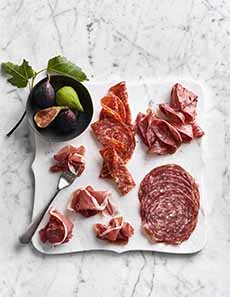
[1] Three types of salame and a friend: salame Calabrese, salame Napoli, soppressata, and prosciutto. Salame is the singular noun; salami is plural (photo © Williams Sonoma).
[2] Chorizo is a Spanish salami (photo © Murray’s Cheese).
[3] Finocchiona salami, from Tuscany, is seasoned with fennel seed and garlic cloves (photo © The Nibble).
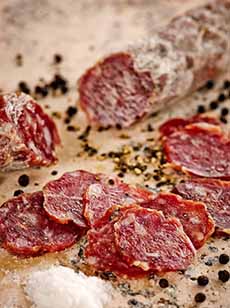
[4] Hot soppressata gets its fiery kick from crushed red pepper flakes or Calabrian chili paste, plus black pepper, paprika, and garlic. Soppressata is also made in sweet and white styles (photo © The Nibble).
[5] ’Nduja is a spicy, spreadable salami from Calabria. Here’s more about it (photo © Murray’s Cheese).
[6] Rosette de Lyon, French salami (photo © Columbus Craft Meats).
[7] Salame secco (or salami secchi)—dry Italian salami, is a generic term encompassing the others in our list (photo © Columbus Craft Meats).
[8] Toscano salami (photo © Olli Salumeria Americana | Facebook).
[9] Genoa salami is a garlic-heavy salami from the hometown of Christopher Columbus and Niccolò Paganini (photo © DeLallo).
[10] The familiar deli salami in New York is a kosher-style hard beef salami seasoned with garlic (photo © Zabar’s).
[11] Calabrese salami are made hot with Calabrian chiles or cayenne—although some U.S. craft brands use habanero for greater heat (photo © Columbus Craft Meats).
[12] A salami “Caprese” sandwich with mozzarella, roasted red pepper, and fresh basil (photo © Brooklyn Cured).
[13] A salami by any other name would be as tasty (photo © Creminelli Fine Meats).
[14] Eat your arugula and enjoy the salami and bocconcini guilt-free (photo © Brooklyn Cured).
[15] A lovely hors d’oeuvre. Here’s how to make it (photo © Amazing Grace Charcuterie).
|