THE NIBBLE BLOG: Products, Recipes & Trends In Specialty Foods


Also visit our main website, TheNibble.com.

Curry Pasta Primavera Recipe For National Curry Week

The first week in October marks the celebration of National Curry Week, a holiday begun in the U.K. 25 years ago. It was founded by a prominent journalist who had fallen in love with curry and wanted to create awareness of the burgeoning Indian restaurant industry, while also raising funds for charity [source].

Americans may not realize that curry is considered by some to be the “new” national dish of Britain*.

Number one on the list for many years has been roast beef and Yorkshire pudding, followed closely by fish and chips. Will they be ousted?

The British Raj—the ruxle of the British Crown in the Indian subcontinent between 1858 and 1947—led to the introduction of Indian cuisine to Britain. Chicken tikka masala and curry became popular dishes.

According to the organizers of National Curry Week, millions of plates of curries are consumed every week in the U.K.
 
> The history of rotini (fusilli) is below.

> The history of pasta.
 
 
WHY YELLOW PEAS?

Of course, you can use conventional wheat pasta in the recipe below. But here’s why you might want to try a box of ZENB yellow pea pasta, made in just about any shape you require.

Yellow pea pasta is gluten-free and diabetic-friendly; equally important, it’s an excellent mimic of wheat pasta. And it helps to promote digestive health.

Peas are one of the best sources of resistant starch, a form of starch that behaves like fermentable fiber, feeding beneficial bacteria.

They also stimulate the production of the short-chain fatty acids that help protect against certain cancers, mitigate inflammation, and enhance satiety [source].

Yes, yellow pea pasta helps to promote digestive health (a key aspect of immunity), but it’s also delicious.

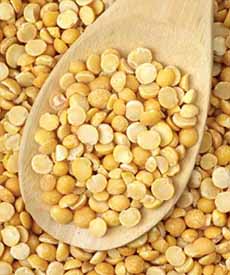
The brand is gluten-free, vegan, non-GMO, and OU Kosher. The only ingredient is yellow peas (photo #5).
 
 
RECIPE: GREEN COCONUT CURRY PRIMAVERA WITH ROTINI (FUSILLI)

This fusion dish combines pasta with vegetable curry—and it’s not just any pasta. It uses yellow pea pasta, which is gluten-free and more nutritious than conventional wheat pasta. The recipe is also vegan.

Yellow pea pasta is very tasty, and we encourage you to try it.

The recipe was created by a leader in yellow pea pasta, GENB.

However, you can use conventional wheat pasta if you like.

The pasta is mixed with vegetables in a yummy curry sauce and is ready in less than 30 minutes.

The dish is also low in calories and low in fat. Says ZENB, “It will satisfy your curry and pasta cravings all in one dish!”

In addition to the vegetables below (zucchini and bell pepper), other vegetables work well in this dish, including broccoli florets, carrots (sliced), cherry tomatoes, and sugar snap peas.

You can use as many veggies as you like (we used five).

Prep time is 10 minutes, cook time is 12 minutes.

> See the difference between rotini and fusilli below.
 
Ingredients For 2 Servings

  • 2 cups (6 ounces) ZENB rotini pasta made with 100% yellow peas, uncooked
  • 2 cups water
  • 1/2 teaspoon kosher salt
  • 1/2 cup unsweetened lite coconut milk
  • 1 tablespoon green curry paste
  • 1 small zucchini, halved lengthwise, cut into 1/4-inch slices
  • 2 cups bell pepper strips
  • 1/2 cup loosely packed fresh cilantro or basil leaves
  • 1 fresh green chili, thinly sliced
  • 1 lime, cut into wedges
  •  
    Preparation

    1. COMBINE the pasta, water, and salt in a large skillet. Bring to a boil over medium-high heat.

    2. STIR in coconut milk, curry paste, and salt. Continue cooking for 4 to 5 minutes until the sauce is thickened and the pasta is cooked through.

    3. ADD the zucchini and peppers; cook for 3 to 4 minutes or until tender yet still crisp.

    4. GARNISH with fresh herbs and chile slices, and lime wedge on the side.
     
     
    ROTINI VS. FUSILLI

    Rotini are short (two inches long), corkscrew-like shaped pasta. In Italy—actually, everywhere except the U.S. and Canada—they are called fusilli.

    Barilla sells the same product as rotini in the U.S. and fusilli in the U.K.

    It appears that the original corkscrew pasta, fusilli, was renamed rotini in North America. As to why, we were unable to find an answer.

    According to someone who has researched the subject if you ordered rotini in Italy and the rest of the world, no one would know what that was. Here’s more about it.

    Corkscrew pasta shapes are particularly popular with children but are also a great shape to catch sauces in the twists.

    Rotini work with most sauces, and in in pasta salads and baked pasta dishes.
     
     
    THE HISTORY OF FUSILLI

    The corkscrew shape was invented in the Italian region of Campania, likely in Naples.

    Before industrial production capabilities, fusilli were made by wrapping fresh spaghetti around a thin rod or thick wire to dry.

    In fact, the word fusillo is from the Neapolitan dialect and refers to a rod that’s similar to a spindle, made by the blacksmith.

    Later, according to Italia Regina, pasta makers also used knitting needles and the spokes as disused umbrellas.

    The name of the shape derives from fuso†, a spindle or a thin pin on which something turns [source]. Fusilli means “little spindles.”

    Modern, industrial production of fusilli began in 1924.

    Two Italian emigrants in New York, Guido and Aurelio Tanzi, created a machine that produced quality fusilli efficiently. They have become one of the most popular cuts of pasta.

    Here’s more about the history of fusilli.

    In addition to conventional fusilli, there are:

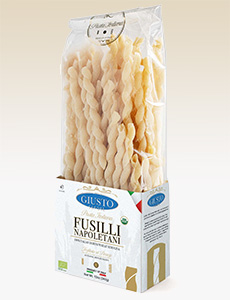
  • A longer version, called Fusilli Napoletani (photo #6), is made by coiling the dough around an actual spindle.
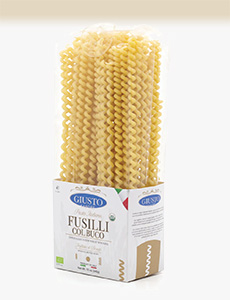
  • There is also a long “buco” version that is hollow inside like bucatini‡‡ (photo #7) source].
  •  
    Their name derives from the Italian word “fuso” or spindle. Fusilli means “little spindles.” This corkscrew pasta is famous for its’ twisty shape.

    As with many short cuts of pasta, the shapes were designed to catch and hold as much sauce as possible.


    Rotini Pasta In Curry Sauce With Vegetables
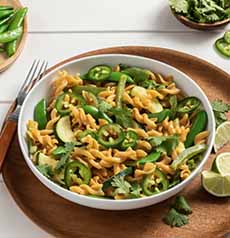
    [1] Rotini (a.k.a. fusilli) in curry sauce with string beans, sugar snap peas, zucchini, and a garnish of sliced jalapeños (photos #1 and #4 © ZENB).

    A Bowl Of Pasta Salad Made With Rotini Corkscrews
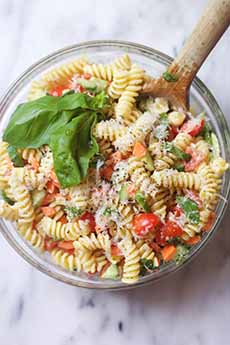
    [2] Rotini/fusilli are a great shape for pasta salad. Here’s the recipe (photo © The Baker Chick).

    A Bowl Of Corkscrew Pasta, aka Fusilli or Rotini
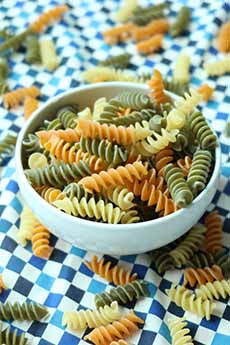
    [3] Multicolor fusilli in plain, spinach, and tomato (photo © Towfiqu Barbhuiya | Pexels).

    Boxes of ZenB Yellow Pea Pasta
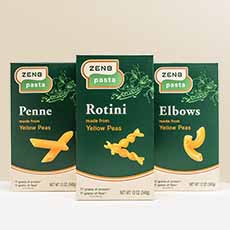
    [4] ZENB makes yellow pea pasta in all the major shapes. Here are three of them.

    A Spoon Of Dried Yellow Peas
    [5] Yellow peas used to make the pasta (photo © Just Egg).

    Package Of Fusilli Napoletani Pasta
    [6] Fusilli Napoletani are long corkscrews (photos #6 and #7 © Giusto Sapore).

    Package Of Fusilli Col Buco Pasta
    [7] Fusilli col Buco have a hole running down the interior of the center, like bucatini‡‡. Buco means hole in Italian.

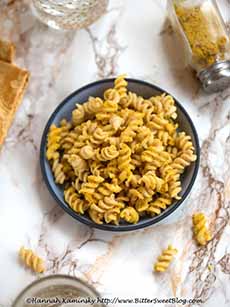
    Bowl Of Fusilli With Curry Sauce
    [8] For an even quicker curry fusilli, mix curry powder in a small bowl with just enough water to make it into a thick gravy. You can add to it with sauteed garlic and onion, and add other veggies as you like (photo © Hannah Kaminsky ! Bittersweet Blog).

     
    ________________

    *The national dish of Ireland is Irish Stew, a thick, hearty dish of mutton, potatoes, and onions. The national dish of Scotland is haggis, a sheep’s stomach stuffed with offal, suet, onions, and oatmeal into a loose sausage. The national dish of Wales is cawl, a stew made from bacon, lamb or beef, cabbage, and leeks [source]. As an aside, no particular food has been designated the national dish of the U.S., possibly because there are simply too many regional foods to choose from. If we had to pick, it would be the burger and fries—specifically, the cheeseburger, which accounts for about 70% of burger sales.

    †Note that there are numerous dialects spoken in different areas of Italy, and they are not typically noted in Italian-English dictionaries.

    ‡Chicken tikka masala is a dish created in the U.K. by British cooks of South Asian origin. Marinated chicken chunks are cooked in a spicy, creamy, bright orange or reddish sauce, the result of food coloring. The coloring—ratan jot, the root of Alkanna tinctoria—is a natural red dye that has no flavor and is used just for visual effect. It has been traditionally used as a food coloring in Indian recipes such as Kashmiri Rogan Josh and Tandoori Chicken.

    ‡‡Bucatini, also known as perciatelli, are a thick spaghetti-like pasta with a hole running through the center. The cut is common throughout Lazio, the region where Rome is located.


    CHECK OUT WHAT’S HAPPENING ON OUR HOME PAGE, THENIBBLE.COM.


    Comments off

    Yaza Labneh: A Thick, Delicious Lebanese Spread & Dip

    Container Of Yaza Labneh With Bowl Of Labneh & Fruit
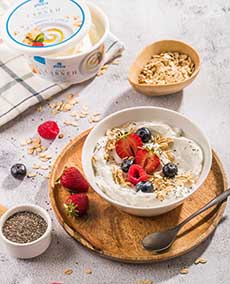
    [1] Start the day with a bowl of labneh, fruit, and granola (photos #1 through #7 © Yaza Labneh).

    Yaza Za'atar On Bagel
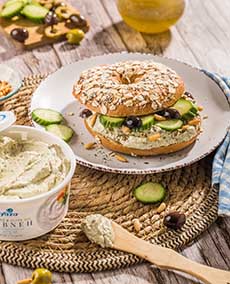
    [2] Spread labneh on your bagel. Here, it’s layered with sliced mini cucumbers and pitted olives.

    Labneh Salad Dressing On A Green Salad
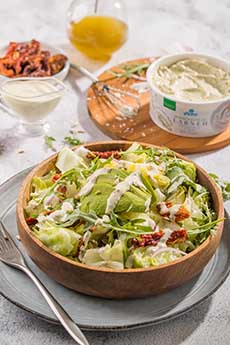
    [3] Blend labneh and olive oil for a creamy salad dressing.

    Labneh Dip With Pita Chips
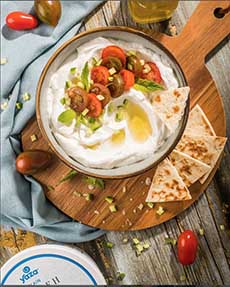
    [4] For a snack, top labneh with chopped cucumbers, onions, olives, and tomatoes, and serve with pita or pita chips.

    Containers With 3 Flavors Of Yaza Labneh
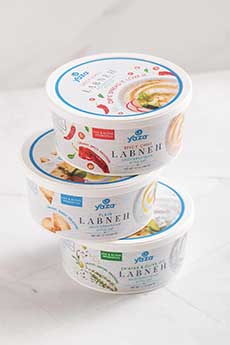
    [5] The three flavors of Yaza Labneh.

    Crudites (raw vegetables) with Spicy Chili Yaza Labneh dip.
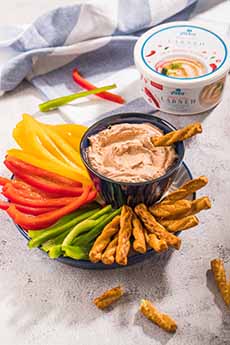
    [6] Crudités with Spicy Chili Yaza Labneh dip.

    Labneh Sandwich With Beets & Walnuts
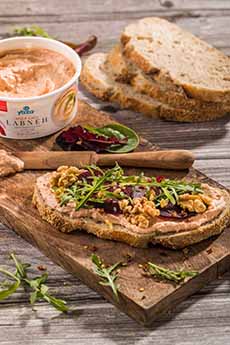
    [7] A vegan sandwich of Spicy Chili labneh, beets, walnuts, and arugula.

    Labneh Balls
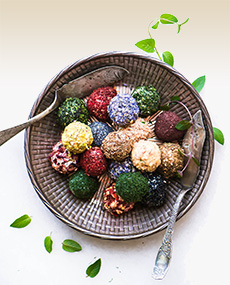
    [8] These Jewel Box Labneh Balls are a treat for the eyes and palate. Here’s the recipe (photo © A View From Great Island).


    Updated August 2026

    The Lebanese dip and spread labneh is made by straining Greek yogurt, an already strained yogurt, removing even more liquid. It’s doubly strained yogurt and a thick, creamy base for a spread or dip. It’s almost like a softer cream cheese, without the carrageenan or carob bean gum used to enable the block to be sliced.

    In the U.S. it is sometimes referred to as as a “yogurt cheese.” While there are fresh cheeses that look like labneh (fromage frais* is the best example), here’s the difference between yogurt and cheese:

  • Cheese is made by curdling milk, while yogurt is made by fermenting milk with specific bacteria strains.
  • Cheese is high in fat and cholesterol, while yogurt is lower in fat and contains live and active cultures that can improve gut health.
  •  
    Not only is labneh delicious, but it is quite healthy: high in calcium, protein, and probiotics.

    Alternate spellings are labaneh, lebnah, labne, or labni, among other spellings. The word is transliterated from Arabic. Laban is the Arabic word for yogurt. Pronunciation differs, too (see the footnote‡).

    Are you ready to take a bite?
    Below:

    > Yaza labneh, our Top Pick Of The Week.

    > The difference between Lebanese and Turkish Labneh.

    > How to enjoy labneh.

    > The history of labneh.

    > A super-simple recipe to make labneh at home.

    Elsewhere on The Nibble:
     
    > The history of yogurt.

    > The different types of yogurt: a glossary.
     
     
    YAZA LABNEH, OUR TOP PICK OF THE WEEK

    Our Top Pick Of The Week is Yaza Labneh, a new brand. It’s made in the Catskills with cow’s milk from New York State dairy farms.

    And, it’s made in three wonderful flavors: Plain, Spicy Chili, and Za’atar & Olive Oil. The latter two are currently the only flavored labneh brands in the U.S.

    You’ll see za’atar mentioned several times in this article. It’s a staple spice blend of the Middle East, combining sesame seeds (often toasted) and sumac, with dried herbs such as oregano or marjoram and thyme, plus toasted spices like coriander and cumin. Here’s more about it.

    All three flavors are great on bagels, toast, or as dips.

    Yaza† labneh is simply delightful and has become a major part of our dairy consumption.

  • The Plain variety has universal use and is great as a side with spicy foods (when you need a slight cool-down).
  • Za’atar & Olive Oil is nicely herbal and we’ve been enjoying it on bagels and grilled vegetable sandwiches.
  • Spicy Chili brings on the heat. We like it on roll-ups and other sandwiches. Check it out on the beet, walnut, and arugula sandwich in photo #8.
  •  
     
    Get Your Yaza Labneh!

    The brand plans to be a staple in every American home. Traditionally, labneh has been sold in ethnic/specialty stores but it is currently sold in 17 states** with the aim to be in every state.

    As of this writing, Yaza is sold in 17 states: CO, CT, FL, GA, IL, IN, LA, MD, MI, NC, NJ, NY, OH, PA, TN, VA, and WI. The brand is currently in discussion with upscale and mass retailers nationwide.

    > Here’s a store locator.
     
     
    THE DIFFERENCE BETWEEN LEBANESE & TURKISH LABNEH

    There are two types of labneh, Lebanese labneh and Turkish labneh. They are very different.

  • Lebanese labneh like Yaza is strained yogurt with probiotics. It is very healthy, clean, high in protein, and low in fat and calories. The labneh is manually strained using a cheesecloth and is exposed to open-air bacteria, which results in gut-healthy probiotics. The shelf life is typically shorter; in the Middle East, around 21 days.
  • Turkish labneh has more fat and doesn’t have probiotics. It is very close to American cream cheese in taste and nutrition. Because it has no probiotics, the shelf life is between 9 months and 1 year.
  •  
     
    HOW TO ENJOY LABNEH

    Labneh is tangier and creamier than yogurt, and it’s meant to be eaten with savory ingredients. That hasn’t stopped American cooks from turning it into cheesecake, desserts with berries, flan, and even whipped cream.

    But let’s start with classic uses in Lebanon and other Middle Eastern countries:

  • Breakfast: A nutritious breakfast with a drizzle of olive oil, a sprinkling of fresh za’atar, and a side of pita.
  • Appetizer and snack: A dip and spread, in a similar fashion to hummus. Any traditional mezze spread will include at least one type of labneh.
  • Mezze plates: Babaganoush, hummus, labneh, stuffed grape leaves, tabbouleh, taramasalata, tzatziki, and much more. Check out these options.
  • Sauce: With falafel and kibbeh (fried meatballs).
  •  
    To port it over to the typical American diet, labneh is quite versatile:

  • Breakfast: Instead of Greek yogurt, either Lebanese-style (see above) or in a bowl with fruit, honey, and granola (photo #1).
  • As a spread on toast and bagels, instead of cream cheese (photo #2).
  • Lunch and dinner: As a sauce, garnish, or side dish.
  • As a base for salad dressing, blended with olive oil (photo #3).
  • Snacks: Plain or with za’atar and olive oil, with breadsticks, crackers, crudites, pita, or tortilla chips (photo #4).
  • Labneh balls (photo #8), served like mini cheese balls with crackers or salad.
  •  
     
    THE HISTORY OF LABNEH

    The exact origin of yogurt is uncertain, but it is thought to have appeared in Mesopotamia around 5000 B.C.E.

    Cheeses made from strained yogurt have been eaten for thousands of years in the Levant (a large area in the Eastern Mediterranean region of West Asia that comprises modern-day Israel, Jordan, Lebanon, Palestine, Syria, and a small part of southern Turkey—see image #9, below).

    Nomadic Bedouin tribes, who inhabited the Syrian Desert since at least 6000 B.C.E., used labneh as an important source of protein and even had a dry version to carry while traveling (think of modern yogurt powder, that can be reconstituted with water).

    The Armenians are widely credited with introducing labneh throughout much of the Middle East many centuries ago.

    The popularity of labneh grew quickly and before long every culture throughout the Middle East and beyond had developed its own unique version. The main differences between varieties are:

  • The choice of milk. Everything from cow’s, goat’s, sheep’s, and water buffalo’s milk—even camel’s milk—have been used. The choice of milk significantly alters the flavor.
  • The texture. Labneh can be fresh or preserved in olive oil with herbs. It can be rolled into balls for a nice presentation. The balls can also be preserved in olive oil.
  •  
     
    RECIPE: HOMEMADE LABNEH

    Labneh is extremely easy to make, and in Lebanon, almost every family has their own special family recipe and technique. They typically make it from homemade raw milk yogurt, but you can use store-bought Greek yogurt.

    1. SPRINKLE Greek yogurt with a bit of salt.

    2. LINE a colander with cheesecloth, set it over a large bowl, and add the yogurt. Allow it to strain in the refrigerator or a cool room for 24 hours.

    That’s it! Your labneh is ready to eat and will keep, in a tightly covered container, for up to two weeks in the fridge.

     
    But you can also customize the flavor:

    3. MIX IN your favorite herbs, such as fresh or dried chiles, chives, dill, garlic, or parsley.

    We also like to add sliced scallions or blend in a bit of tomato paste.

    Finally, can also form it into balls and preserve it in olive oil, where it will keep for months. Here’s how.
     
     
    Map Of The Levant
    [9] The Levant (image via PAT, Public Domain).
     
    ________________

    *Fromage frais is a light, fresh cheese that originated in France. It looks like Greek yogurt, but it’s technically a cheese. It has a mild, slightly tangy flavor and a smooth, creamy texture. It is often used as a spread or dip, although it can also be used in recipes to substitute for cottage cheese, mascarpone, ricotta, or sour cream. Frûche (pronounced froosh) is another fresh French cheese that has a mild flavor and a smooth, creamy texture. It’s like fromage frais but has a slightly higher fat content and thus is richer.

    **In the Northeast, check Balducci’s, Caraluzzi’s Markets, D’Agostino, Gristedes, King’s Food Markets, Morton Williams, Union Market, and other independent retailers and specialty stores across the nation.

    †The brand name, Yaza, is a mashup of taza, meaning fresh in Arabic; meza, the Arabic term for small plates/appetizers; and yogurt, as labneh is strained yogurt. The swirl in our logo mimics how labneh is traditionally presented in a bowl or plate as a dip. Clever!

    ‡The pronunciation differs per country. In Lebanon, it is pronounced LAB-NEH. You may hear LAB-NAH, LOB-NEH, LEB-NAY or other pronunciations across various countries and regions.


    CHECK OUT WHAT’S HAPPENING ON OUR HOME PAGE, THENIBBLE.COM.


    Comments off

    Fall Popcorn: Maple & Pecan Popcorn Recipe

    October is National Popcorn Poppin’ Month. Make your popcorn flavor of the month Old Fashioned Bourbon Maple Popcorn with Pecans.

    Accented with warming flavors of bourbon, orange, and bitters, this maple-glazed popcorn recipe is a fun, cocktail-inspired snack perfect for sharing.

    Serve it with cocktails, or grab a bowl for movie night.

    > Check out the “matching” Maple Old Fashioned recipe below.

    > See more popcorn recipes, both every day and seasonal, including Halloween and the holidays.

    > The history of popcorn.

    > The history of Bourbon.

    > The history of maple syrup.
     
     
    RECIPE: MAPLE PECAN POPCORN

    You can substitute rye or other whiskey for the Bourbon. For a “mocktail” popcorn, substitute non-alcoholic bourbon.

    Ingredients

  • 8 cups popped popcorn
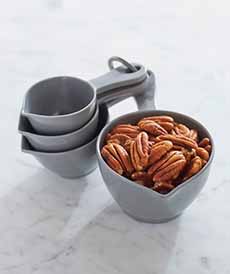
  • 1/2 cup chopped toasted pecans (how to toast nuts)
  • 1/3 cup maple syrup
  • 1 tablespoon Bourbon
  • 2 tablespoons butter
  • 1 tablespoon orange zest
  • Dash of bitters
  •  
    Preparation

    1. PLACE the popcorn and pecans in a large bowl.

    2. COMBINE the maple syrup, bourbon, and butter in a small saucepan set over medium-high heat; bring to a boil. Cook, swirling the pan for 3 to 5 minutes or until the mixture thickens to corn syrup consistency.

    3. STIR in the orange zest and bitters.

    4. DRIZZLE the maple syrup mixture over the popcorn; toss to evenly coat. Cool completely and serve.
     
     
    RECIPE: MAPLE BOURBON OLD FASHIONED
     
    Ingredients Per Drink

  • .5 ounce maple syrup
  • 2 ounces bourbon
  • 4 dashes Angostura bitters
  • Optional garnish: orange peel, brandied cherry
  • Ice
  •  
    Preparation

    1. COMBINE the first three ingredients in a mixing glass and stir to combine.

    2. POUR into a rocks glass over ice. Garnish with orange peel and cherry. The garnishes can be skewered on a cocktail pick.


    CHECK OUT WHAT’S HAPPENING ON OUR HOME PAGE, THENIBBLE.COM.


    A Bowl Of Maple Pecan Popcorn
    [1] Maple pecan popcorn (photo © The Popcorn Board).

    Bottles Of Maple Syrup
    [2] Maple syrup adds a touch of sweetness like kettle corn (photo © Nadine Primeau | Unsplash).

    A Measuring Cup Of Pecan Halves
    [3] Toast the pecans. Here’s how (photo © Williams Sonoma).

    Old Fashioned Cocktail
    [4] Have a Maple Bourbon Old Fashioned with your maple pecan popcorn (photo © Adam Jaime | Unsplash).


    Comments off


    © Copyright 2005-2026 Lifestyle Direct, Inc. All rights reserved. All images are copyrighted to their respective owners.