|
We’ve written extensively on pairing wine with desserts, from apple tart and chocolate cake to cheesecake and tiramisu. There’s a brief mention of two sweet wines that go with ice cream: Nigori saké, a sweet, milky style, and Pedro Ximénez* dessert sherry.
But the problem with those limited ice cream and wine pairings is that ice cream comes in many flavors, and you wouldn’t pair the same wine with chocolate ice cream as with strawberry.
So since then, we’ve devoted lots of time to pairing wines with ice cream. The recommendations are below, and also include pairings with sorbets.
ICE CREAM & DESSERT WINE: A NEW CONCEPT
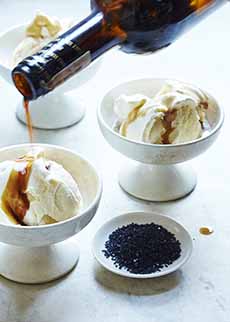
How alien is the concept of wine and ice cream? So much so that we couldn’t find a photo of a dish of ice cream together with a glass of wine “for love or money,” as the expression goes. The closest we got was a bowl of rum raisin ice cream, over which Pedro Ximénez sherry had been poured as a sauce.
It is widely thought that ice cream and wine just don’t mix. One reason given is that the butterfat from the cream dulls the palate, but foie gras is even fattier and sweet wines are splendid with it. The other reason is that the coldness of ice cream numbs the palate, and this can be true.
However, if you wait at least 10 seconds to sip the wine, following a spoonful of ice cream, your palate can be “primed” for wine. Use sorbet instead of ice cream and avoid the butterfat issue altogether.
The Tradition Of Sweet Wine For Dessert
Sweet wines date to ancient times. The finest wines in Rome were sweet white wines. Bonus: The higher the sugar content, the more a wine can withstand aging, temperature shifts and transportation; so sweet wines held up better.
Also, then as now, sweet wines pair with any course, depending on the particular dish. Today, wine connoisseurs pay big bucks to attend dinners where different vintages of Chateau d’Yquem, the priciest sweet wine (it’s a Sauternes from the Bordeaux region of France), is poured with every course.
The Tradition Of Sweet Wine For Dessert
For centuries at refined dining tables in Europe, dessert consisted of a glass of sweet wine, alone or with fresh fruit. A glass of Port with cheese is another time-honored tradition. Wherever a sweet wine is made, you can bet that it is enjoyed at the end of dinner.
We respect that tradition: A glass of Sauternes with sweet summer apricots or peaches is divine; ditto with Port and Stilton or other blue cheese. Over time, we’ve switched our guest menus away from serving a substantial dessert after a big meal (including a cheese course), to a dish of sorbet and a glass of dessert wine.
More recently, we’ve been inviting friends to an “ice cream social”† to try different wine and ice cream pairings. It’s a delightful occasion, and we highly recommend it. Consider it for adult birthday parties.
HOW TO PAIR WINE WITH ICE CREAM & SORBET
While we’ve paired specific sweet wines with specific ice cream flavors, below, you first need to seek out what your local wine stores stock. Explain the specific ice cream flavors you’d like to serve and see what they recommend from their inventory. You can bring them this list, to make the selection process easier.
France’s vintners produce a wealth of sweet wines:
Banyuls, a fortified red wine (Roussillon, France)
Champagne Sec, the sweetest style of the sparkling white wine (Champagne, northeast France)
Bonnezeaux, white wine (Anjou, Loire Valley, France)
Maury, red wine (AOC‡, Roussillon, France)
Muscat de Rivesaltes, a fortified white wine (AOC, Roussillon)
Muscat-de-Beaumes-de-Venise, white wine (AOC†, Rhone Valley, southeast France; not to be confused with the dry red AC wines labeled Beaumes-de-Venise, formerly known as Côtes du Rhone Villages)
Sauternes, white wine (Bordeaux, southwest France)
Vin de Paille, white wine (Jura, France)
Dessert wines from other countries include:
Amontillado Sherry, fortified red wine (Spain)
Brachetto d’Acqui or Lambrusco, slightly sparkling red wines (Italy)
Black Muscat, red wine (California and elsewhere)
Ice-Wine/Eiswein, red and white (Austria, Canada, Germany, New Zealand and elsewhere)
Late Harvest Wines (made the world over from Gewürztraminer, Riesling, Semillon, Viognier, Zinfandel and other red or white grapes)
Madiera, fortified red wine (Portugal)
Moscato d’Asti, sparkling white wine (Italy)
Moscatel de Setúbal, red wine (DOC, Portugal)
Muscat, red and white (grown in many locations in Europe, Australia, U.S. and elsewhere)
Nigori Saké, milky white and sweet [the name means cloudy] (Japan)
Pedro Ximénez Sherry [abbreviated PX], fortified white wine (Spain, Andalusia region)
Reciotto de Valpolicella, red wine, very raisiny (Amarone, Italy)
Ruby Port, fortified red wine (Portugal)
Sparkling Shiraz (Australia) or Lambrusco (Italy)
Sweet Madiera (Bual or Malmsey), fortified red wine (Portugal)
Tokaji (Tokay) 5 Puttonyos‡‡, white wine (Hungary)
WINE & ICE CREAM PAIRINGS
Any flavor of ice cream matches with its corresponding liqueur (e.g. raspberry with raspberry liqueur) or complementary liqueur (e.g., chocolate ice cream with coffee liqueur, peach ice cream with raspberry liqueur)
Apricot ice cream, Bonnezeaux, Sauternes, Vin de Paille
Berry ice creams match with Champagne, Muscat, Nigori Saké
Butter pecan, maple walnut or other nutty ice cream with PX Sherry, Sweet Madiera
|
|

[1] Ice cream made with Pinot Noir, which can be drunk alongside it. Here’s the recipe from Desserts With Benefits (photo © Desserts With Benefits).

[2] Kitchen Repertoire adds an extra dimension to a classic dish of vanilla ice cream with Pedro Ximénez sweet sherry: black sea salt. Leave the chocolate syrup to the kids (photo © Kitchen Repertoire).
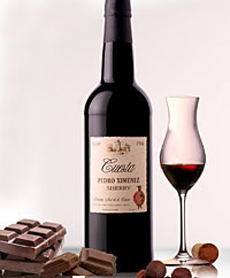
[3] Pedro Ximénez also goes well with chocolate, be it chocolate ice cream, chocolate cake, chocolate mousse, or a fine chocolate bar (photo © Bodegas José De La Cuesta Pedro | Spain).
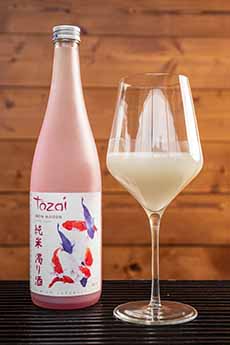
Nigori saké is unfiltered, creating a cloudy, or milky, appearance. The style is brewed to be sweet and the texture is creamy. We love to pair it with dessert. Snow Maiden, in the photo, is one of the finest (photo © Kinjo Kitchen + Cocktails | Facebook).
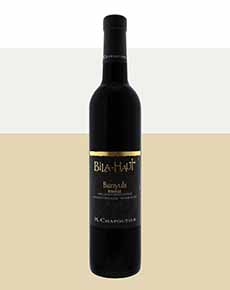
[5] Banyuls, a sweet red wine from France, is a perfect pairing with chocolate ice cream and other desserts (photo © M. Chapoutier).
|
|
Caramel or dulce de leche ice cream with PX Sherry or Sweet Madeira
Chocolate ice cream with Banyuls, Nigori Saké, PX Sherry; or Brachetto or Lambrusco with bittersweet chocolate ice cream
Chocolate chip ice cream should be matched to its base flavor: chocolate, coffee, mocha, raspberry, vanilla, etc.
Coconut ice cream with Late Harvest Semillon, Nigori Saké, Sauternes, Beerenauslese (or the pricier Trockenbeerenauslese)
Coffee or mocha ice cream with Amontillado Sherry, Nigori Saké, Madeira, Ruby Port
Floral ice cream—Earl Grey, jasmine, lavender, rose—with Ice Wine
Ginger or pumpkin ice cream with Sweet Madiera
Mint ice cream with Nigori Saké, Madiera or Late Harvest Zinfandel
Rum raisin ice cream with PX Sherry or Reciotto de Valpolicella
Stone fruit ice cream—apricot, cherry, mango, peach, plum—with Muscat-de-Beaumes-de-Venise
Vanilla ice cream with Nigori Saké, PX Sherry, Sauternes, Sweet Madiera, Vin de Paille (bonus: Scotch also works!)
HOW TO SERVE WINE & ICE CREAM
Serve the wine in a glass.
Drizzle it over over the ice cream.
Soak dried or fresh fruit in the alcohol overnight and use it as an ice cream topping, along with a glass of the wine.
WHAT ABOUT PAIRING WINE WITH SORBET?
You can use the same wines and liqueurs as with the analogous ice cream flavors; or with a sweet sparkling white wine.
For citrus sorbets (grapefruit, lemon, lime, orange—not represented in the ice cream list), pair with the sparkling wine or the matching liqueur.
________________
*Pedro Ximénez, pronounced him-AY-nez and also spelled Jiménez and various other ways, is a white Spanish wine grape used to make fortified wines like sherry. It’s also the name of the sweet dessert sherry made from it. Pedro Ximénez is often abbreviated as PX. The identity of the original Pedro Ximénez and his relationship to the grape is lost to time.
†Ice cream socials—parties where people came to eat ice cream— were popular events in the U,S. They date back to the 19th century before freezers, not to mention electric ice cream makers (i.e., they were a laborious undertaking, and thus a real treat). Some churches and communities still give them, but today it’s an easy party to throw at home. Here’s how to have an ice cream social.
‡AOC, an abbreviation for appellation d’origine contrôlée (AOC), “controlled designation of origin,” is an official designation that assures that a product was produced in the specified region according with specific ingredients, according to traditional techniques. The analogous word in Italian is denominazione di origine controllata abbreviated, DOC.
‡‡Puttonyos is the Hungarian word to denote the level of sugar in wine; the comparable word used in the U.S., France and other countries is brix.
CHECK OUT WHAT’S HAPPENING ON OUR HOME PAGE, THENIBBLE.COM.
|