THE NIBBLE BLOG: Products, Recipes & Trends In Specialty Foods


Also visit our main website, TheNibble.com.

TOP PICK OF THE WEEK: McConnell’s Ice Cream

California-based McConnell’s Ice Cream has always been a small family company. Founded in Santa Barbara in 1949, the McConnells made everything from scratch, in small batches, with milk and cream from cows who graze on Central Coast pasture. It’s still made the same way—including pasteurizing the raw milk at The Old Dairy creamery (it dates to 1934).

Happy cows give happy milk, and these California girls graze on green grass under blue skies. If you’re a cow, there’s nothing better. Add the finest local, sustainable and organic ingredients—from the cage-free eggs to strawberries grown down the road. Avoid preservatives, stabilizers, or additives of any kind.

The result: ice cream that tastes fresher, more vibrant and creamier (the ice cream now has more than 18% milk fat).

The company is under new management (also a family), the ice cream is even better than we remember. Perhaps that’s because one of the owners is an executive chef-restaurateur, and the other is a veteran of winemaking (who grew up eating McConnell’s). They used their palates to fine-tune the classic recipes and create quite a few others.

They also spent the better part of two years modernizing the equipment and production process.


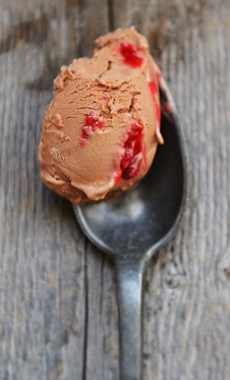
/home/content/p3pnexwpnas01_data02/07/2891007/html/wp content/uploads/chocolate raspberry jam mcconnellsicecream 230

Chocolate With Raspberry Jam.
Photo courtesy McConnell’s.


And they’re taking their updated line on the road: The brand is branching out nationwide. Look for it in specialty food stores and upscale supermarkets.

The flavors change seasonally, but a representative sample includes:


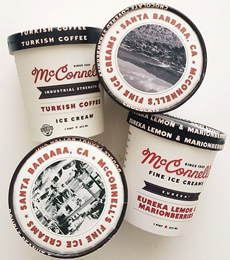
/home/content/p3pnexwpnas01_data02/07/2891007/html/wp content/uploads/mcconnells 4 pints mcconnellsicecream 230
While much is updated and improved at McConnell’s Ice Cream, the classic packaging remains. Photo courtesy McConnell’s.
 
  • Chocolate Almond Brittle
  • Chocolate Covered Strawberries
  • Churros Con Leche
  • Coconut & Cream
  • Double Peanut Butter Chip
  • Dutchman’s Chocolate
  • Eureka Lemon & Marionberries (in stores now and exquisite!)
  • Golden State Vanilla
  • Mint Chip
  • Peppermint Stick
  • Salted Caramel Chip
  • Sea Salt Cream & Cookies
  • Sweet Cream
  • Toasted Coconut Almond Chip
  • Turkish Coffee
  • Vanilla Bean
  •  
    One of this summer’s specials is Boysenberry Rose Milk Jam, an impressive combination (though we’re not one for all those boysenberry seeds). We recently tasted an upcoming fall flavor, Cardamom & Swedish Gingersnaps, that was so good, before we knew it the pint was empty (and we hadn’t gotten up from the table).

    If you can’t wait for the ice cream to show up in your local store, you can order it from the website. For the person who has everything, send it as a gift!

    For more information, visit McConnells.com.


    Comments off

    FOOD FUN: Rainbow Ice Pops

    rainbow-popsicles-theviewfromgreatisland-230sq
    Eat the rainbow! Photo courtesy Sue | The View From Great Island.
      We were charmed by these homemade ice pops from blogger Sue of The View From Great Island (the island town of New Castle, New Hampshire).

    She puréed blueberries, kiwis, mango, pineapple, strawberries and watermelon to make rainbow pops.

    When you make your own, you may choose to follow the colors of the rainbow in order: red, orange, yellow, green, blue, indigo and violet. Here are some fruit choices:

  • Red (cherry, grape, plum, raspberry, strawberry, watermelon)
  • Orange (apricot, cantaloupe, mango, orange, papaya)
  • Yellow (cherry [Queen Anne, Rainier], golden kiwi*, golden raspberry, nectarine, peache, yellow plum
  • Green (avocado, grape, honeydew, kiwi*)
  • Blue (since there are no naturally blue foods, you can skip this layer or purée white fruits—apple, banana, coconut, pear, white peach—and tint them with food color)
  • Indigo (blueberries)
  • Violet (blackberries, black grapes)
  • Preparation

    You’ll need ice pop molds. Most wide pop molds make only 6 pops. We found one that makes 10 ice pops for not much more money ($18.80 plus free shipping). For all the work you’ll put to make rainbow pops, make as many as you can, whether it’s buying two 10-pop molds or borrowing extra molds from friends.

    1. PURÉE the individual fruits and chill them. Make the darkest layer (violet) first, and work your way up to red at the top. NOTE: When you’re making separate colored layers, it’s important to freeze each layer until set so the layers won’t bleed into each other.

    2. TO REMOVE: Set the mold halfway deep in warm water for 30 seconds, or until the pops begin to release. If you want to remove only a few pops, wrap those individual molds in a kitchen towel dampened with hot water.
     
    *We recommend straining the seeds, which tend to create a “polka dot layer.”
      

    Comments off

    Fresh Peach Bellini Cocktail Recipe & The History Of The Bellini

    Peaches and Prosecco: What could be more refreshing?

    For National Bellini Day, June 23rd, we were inspired to look for the ripest peaches we could find, even though peak peach season is not yet upon us.

    In the off-season, you can buy frozen peach purée or (surprise!) baby food puréed peaches.

    Fresh or frozen, you can make the peach purée a day or two in advance of your brunch or cocktail party. Well-chilled purée from the fridge is ideal.
     
    Below:

    > Bellini cocktail recipe.

    > The history of the Bellini.

    > What is Prosecco?

    Elsewhere on The Nibble:

    > The different types of sparkling wine.

    > Why you should have a Champagne re-corker.

    > The year’s 100+ cocktail and spirit holidays.

    > The year’s 9+ Champagne and other sparkling wine holidays.

    > The history of individual cocktails, spirits, and other foods.
     
     
    RECIPE: FRESH PEACH BELLINI COCKTAIL

    Ingredients Per Drinks

  • 2 ripe peaches
  • Chilled Prosecco (substitute Cava or other sparkler)
  • Lemon wedge
  • Optional garnish: peach wedge
  •  
    Preparation

    Plan on two peaches for the cocktail. Cut a wedge from one peach, unpeeled, for the garnish. Peel and purée the remainder of the two peaches. The riper the peaches, the better they are for the purée; but you need a ripe-but-firm peach to slice and notch for the garnish.

    1. POUR 2 ounces of the purée into a flute, tulip or other stemmed glass. Increase the amount of purée for a sweeter and less alcoholic drink.

    2. ADD a squeeze of fresh lemon.

    3. TOP with chilled Prosecco. You don’t need to stir, but if you want to, do it just once, very gently, so you don’t break the bubbles.

    4. GARNISH with a peach wedge.
     
     
    THE HISTORY OF THE BELLINI COCKTAIL

    While many people use Champagne to make a Bellini, the original recipe, created in 1948 by Giuseppe Cipriani, head bartender at Harry’s Bar in Venice, is made with Prosecco. The dry, sparkling Italian wine is lighter than Champagne—and much less expensive.

    Even if money isn’t an issue, save the Champagne and its complex, yeasty, toasty and mineral-chalky flavors, for sipping straight.

    The peachy color of the cocktail reminded Cipriani of the color of the robe of St. Francis of Assisi in a painting, “St. Francis In The Desert” (sometimes called “St. Francis In Ecstasy”) by Giovanni Bellini, commissioned in 1525. Cipriani named the drink in Bellini’s honor. If you’re a Bellini lover and in New York City, the painting is in the collection of the Frick Museum.

    Some sources report that the original Bellini was made with white peach purée. White peaches were plentiful in the area and were often marinated in wine as a dessert.

    If you can’t find white peaches, don’t worry. When mixed with the Prosecco, the flavor difference between white and yellow peaches is indistinguishable. And yellow peaches provide more of the color for which the drink was named.


    Bellini Cocktails With Prosecco & Fresh Peaches
    [1] A Bellini made with fresh summer peaches (photo © Martini & Rossi).

    Mionetto Prosecco Bottle
    [2] Prosecco’s traditional bottle shape (photo © Mionetto).

    Bellini Cocktail
    [3] Use whatever glasses you have (photo © Gelson’s Markets).

    A Bottle Of Trader Joe Bellini Cocktail
    [4] Instant Bellini from Trader Joe’s, bottled and ready to quaff (photo © Trader Joe’s).

     
    Peach, Strawberry & Grapefruit Bellini Cocktails
    [5] The Bellini has been adapted to other fruits, like mango, strawberry, and grapefruit. You simply substitute the fruit purée (photo © Cutco).
     
     
    ABOUT PROSECCO & ITS HISTORY

    Prosecco is the quintessential summer sparkler: light-bodied for hot weather drinking and sufficiently affordable—most bottles are $10 to $12—to enjoy regularly.

    Hailing from the Veneto region of northeast Italy, Prosecco is the name of the village where the Prosecco grape—now known as the Glera grape—originated. Other local white grape varieties, such as Bianchetta Trevigiana, can be included in the blend.

    The wine can be frizzante—just slightly fizzy, sometimes bottled with a regular cork to be opened with a corkscrew—or spumante—very fizzy, bottled with the mushroom-shap cork and wire cage* used on Champagne bottles.

    The wine is often labeled Prosecco di Conegliano Valdobbiadene, after its appellation.

    The history of Prosecco is not well documented. Until recently, there were different theories about its origin.

    Now, it is believed that the first Prosecco was created in 1868 by Antonio Carpene, who subjected still white wine of the area to a second fermentation, which produced the bubbles.

    In general, the wine of Prosecco has been linked to a wine made at the time of Roman Empire, in a town called Pucino.

    It, like Prosecco, was located in the hills that surround the Gulf of Trieste [source]. (The town no longer exists, but the surname Pucino, indicating a person from Pucino, is still going strong.)

    Using grape DNA and archaeological evidence, it was more recently established that the grape called Prosecco was very similar to the older grape from the Pucino area, Glera. The grape called Prosecco is now called Glera.
     
    Bellini Cocktail With Raspberry Garnish
    [6] If you don’t have fresh peaches for garnish, a raspberry adds a nice pop of color (photo © Taste Of Home).
     
    _________________

    *Dom Perignon created an early version of wire caging on the cork. Manyt of bottles were lost during production because the cork on the bottle was unable to withstand the pressure of the effervescent Champagne. The added strength. In 1844, Adolphe Jacqueson made the cage (called a muselet in French) in the shape we know today. Here’s a further discussion.
     

    CHECK OUT WHAT’S HAPPENING ON OUR HOME PAGE, THENIBBLE.COM.


    Comments off


    © Copyright 2005-2026 Lifestyle Direct, Inc. All rights reserved. All images are copyrighted to their respective owners.