|
Updated July 2026
Israeli salad (salat yerakot, vegetable salad*, in Hebrew) is a chopped salad most commonly made with tomatoes, cucumbers, onion, parsley, lemon juice, olive oil, and salt. It can also include bell pepper, and onion.
Other ingredients, such as carrot and country-specific ingredients (more about that in a few paragraphs) can be added. A dash of sumac or za’atar (see below) is optional.
Israeli salad is a finely chopped mixture Despite its modern national name, it belongs to a much older family of Eastern Mediterranean salads rather than having a single, clear inventor.
In Israel, the ingredients are diced very fine, and it is a badge of honor among cooks to dice as finely and perfectly as possible. Chunkier versions appear in the U.S.
As a kibbutz tradition in Israel (and now ubiquitous at restaurants and cafés), Israeli salad is typically eaten for breakfast, along with a host of other options†. It is also served as a side dish at lunch and dinner, and added to pita along with falafel or shawarma.
Below:
> Recipe: Israeli salad.
> A breakdown of the ingredients.
> The history of Israeli salad.
Elsewhere on The Nibble:
> More cucumber recipes.
> The year’s 40+ salad holidays.
> The year’s 95+ vegetable holidays.
> The year’s 4 cucumber holidays.
> The year’s 12+ tomato holidays.
> The year’s 6 onion holidays.
RECIPE: ISRAELI SALAD
Truth be told, although an ideal Israeli salad is known for its fine, even dice, dicing is our least favorite kitchen task. So we make a medium dice, imperfect in every way, and it works just fine.
You can serve Israeli salad plain or with greens underneath; as a side dish; in a pita with hummus, falafel or both; and on a mezze plate with hummus, babaganoush, grape leaves, tabbouleh and tzatziki or labneh. Add feta and Kalamata olives for a Greek salad, and on top of that, add chickpeas for a Middle Eastern salad.
Ingredients
6 Persian‡ cucumbers or 3 peeled Kirbys, finely chopped (no need to peel the Persian cukes)
4 plum, San Marzano or other roma tomatoes, finely chopped
4 green onions (scallions), thinly sliced, or equivalent red onion, finely diced
1 cup fresh parsley leaves, chopped
Optional: 1/2 cup fresh mint leaves, chopped
1/2 cup olive oil
2 tablespoons fresh lemon juice
Salt and freshly ground black pepper
Optional seasoning: sumac or za’atar (see below)
Plus
Pita triangles, warmed or toasted
Unconventional Optional Plus
Feta or goat cheese
Preparation
1. COMBINE all ingredients together in a bowl. Season with salt and pepper to taste, along with the optional sumac and za’atar.
MEET THE INGREDIENTS
Persian Cucumbers
Persian cucumbers don’t require peeling. They were developed in 1939 on a kibbutz in northern Israeli; the local cucumbers were small and tasty but susceptible to rot and disease. The breeders hybridized them with cucumbers from China, India, Japan, Surinam and the U.S. to improve disease resistance; and crossed them with English and Dutch varieties to be seedless.
The result was a small, very flavorful cucumber with crisp, sweet, succulent flesh, a smooth, thin, edible skin and without developed seeds. [Source]
They range from four to six inches in length. In Israel, the variety was called Beit Alpha, after its birthplace. Some American growers called it a Persian cucumber or Lebanese cucumber. You can find them at farmers markets, higher-end supermarkets (we found them at Trader Joe’s). Or, buy Persian cucumber seeds,also called baby cucumbers, and grow your own.
Sumac
Sumac is ground from a red berry-like drupe that grows in clusters on bushes in subtropical and temperate regions. The dried drupes of some species are ground to produce a tangy, crimson spice. (One of the species not used is the poison sumac shrub.)
The word “sumac” comes from the old Syriac Aramaic summaq, meaning red. In Middle Eastern cuisine, the spice is used to add a tangy, lemony taste to meats and salads; and to garnish hummus and rice. The spice is also a component of the popular spice blend, za’atar, below.
Za’atar
|
|
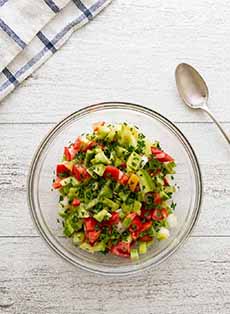
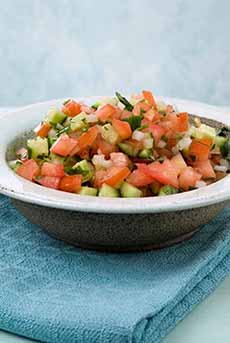
[1] Israeli salad: cucumbers, tomatoes, parsley and scallions. It’s refreshing, low in calories, and good for you (photo: Angela Khebou | Pexels).

[2] Israeli salad: refreshing, low in calories and good for you (photo © Pushlama | iStock Photo).
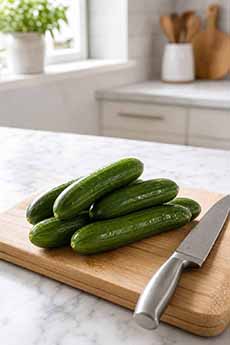
[3] Persian cucumbers (photo © The Nibble).
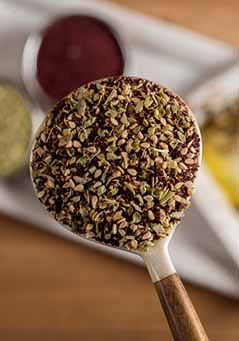
[4] Za’atar is a spice blend, that is often sold finely ground. This blend contains sumac, golden sesame, and oregano, but blends vary. Here’s more about this staple spice of the Middle East (photo © Aromatiques).
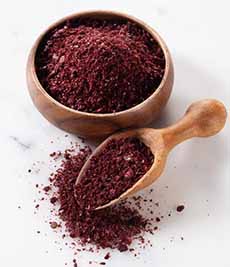
[5] Sumac is an ingredient of some za’atar blends (most people would say, the best za’atar blends, contributing citrussy tang). The wild sumac bush produces deep red berries that are ground into a spice. Most Americans have only heard of one of the many species, poison sumac—a completely different plant (photo © Taste Of Home).
|
Also spelled zahtar, za’atar is a spice blend that is very popular in Middle Eastern cuisines. It is actually the word for Lebanese oregano, a member of the mint family Lamiaceaea, and known since antiquity as hyssop. The za’atar blend includes spices well-known in European cuisines, with the unique components of Lebanese oregano and sumac berries, which impart a tart, fruity flavor that differentiates za’atar from other spice blends.
Traditional ingredients include marjoram, oregano, thyme, toasted sesame seeds, savory and sumac. Za’atar is used to season meat and vegetables, mixed with olive oil and spread on pita wedges or flatbread, added to hummus, and for a modern touch, sprinkled on pizza, especially ones with feta cheese.
ISRAELI SALAD HISTORY
Israeli salad is actually an Arab salad, adapted from a Palestinian country salad and popularized in the kibbutzes of Israel.
Despite its modern national name, it belongs to a much older family of Eastern Mediterranean salads.Its closest culinary relatives include:
Arab/Palestinian salad (salatat ‘arabiya), typically tomatoes and cucumbers with onion, herbs, olive oil, and lemon.
Turkish shepherd’s salad (çoban salatası).
Similar chopped vegetable salads from Lebanon, Syria, Jordan, and across the former Ottoman region.
The ingredients and style of preparation were already widespread in Palestine and neighboring areas long before the establishment of the State of Israel in 1948.
Tomato-and-cucumber salads became especially common in the late 19th and early 20th centuries as tomatoes became widely grown on kibbutzim (the plural of kibbutz, communal settlements in Israel traditionally centered around collective agriculture).
Jewish immigrants to Mandatory Palestine‡ adopted and adapted local food traditions, including this salad. It later became a familiar everyday dish in Israeli homes, hotels, and kibbutzim, where it acquired the label “Israeli salad.” Its signature presentation is the very small, even dice of cucumber and tomato.
Thus, the Israeli salad is best understood as an Israeli version of a shared regional Levantine and Ottoman culinary tradition. Its roots are closely connected to Palestinian, Arab, Turkish, and broader Mediterranean foodways, while the name reflects its place in contemporary Israeli cuisine.
Variations include ancestral seasonings: chopped ginger and green chili peppers show India influences. Preserved lemon peel and cayenne pepper are popular with North African Jews. Bukharan Jews, who immigrated from Central Asia, dress the salad with vinegar only. A Persian variation substitutes mint for parsley.
___________________
*Israeli salad is also called salat katzutz (Hebrew for chopped salad) and salat aravi (Hebrew for Arab salad).
†The Israeli breakfast is a dairy meal (meatless), starting with eggs in different styles, including shakshouka (recipe), eggs poached in a spicy tomato. In addition to Israeli salad, other Middle Eastern dishes may be served, such as baba ghanoush (eggplant spread), hummus and labaneh, a thick-strained yogurt. The options continue with breads, cheeses and fish, such as pickled herring, sardines and smoked salmon; olives and fresh vegetables (cucumbers, green bell peppers, onions, radishes, shredded carrots, tomatoes).
‡Mandatory Palestine was a geopolitical entity administered by the United Kingdom under the terms of a League of Nations mandate from 1920 to 1948. It covered the geographic region spanning present-day Israel, the West Bank, the Gaza Strip, and Jordan
CHECK OUT WHAT’S HAPPENING ON OUR HOME PAGE, THENIBBLE.COM.
|