THE NIBBLE BLOG: Products, Recipes & Trends In Specialty Foods


Also visit our main website, TheNibble.com.

TIP OF THE DAY: Save The Sauerkraut Juice & A Bacon Sauerkraut Recipe

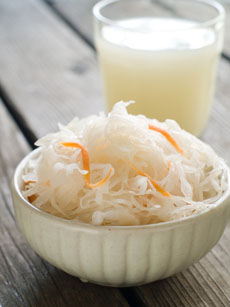
We have a delicious recipe for bacon sauerkraut below, but first a tip: Don’t toss the sauerkraut juice. Not only is it good for you*; if you like the taste of sauerkraut, the juice has the identical flavor.

Drink It

Drinking sauerkraut juice may sound strange to Americans, but it is a popular digestif and tonic in Belgium, Germany, Scandinavia and elsewhere. You can drink it:

  • As a glass of juice or a shot
  • In a vodka cocktail
  • As a sparkler mixed with club soda
  •  

    We enjoy drinking a small glass of sauerkraut juice as we eat the sauerkraut itself: with brats, franks, pork loin, etc.

    And if you have a store throat, some people swear that sauerkraut juice is the cure (and much tastier than gargling with salt water).


    Eat the sauerkraut, drink the juice. Photo © Viktorija | Fotolia.

     
    Cook With It

  • Cooking/steaming water: Steam brats in the juice.
  • Marinades: The acids in sauerkraut juice are tenderizers, and great in marinades for pork and poultry. Use it instead of vinegar.
  • Slow cooking: Add the juice to pork and apples in a slow cooker, or to soups and stews where you’d like a hint of tart and tangy.
  • Vinaigrette: Replace the vinegar with sauerkraut juice. Add a clove of crushed fresh garlic.
  •  
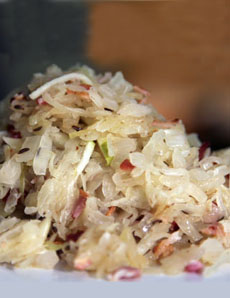
    The bacon sauerkraut recipe that follows was a hit at our July 4th festivities. The recipe is from Dietz & Watson, producers of premium deli meats. There are more recipes on the company website.

     
    *Sauerkraut, a fermented food, is an anti-carinogen, digestive aid, immune support aid and probiotic. It’s high in nutrition and very low in calories.


    Simply delish: bacon and sauerkraut. Photo
    courtesy Dietz & Watson.
      BACON SAUERKRAUT RECIPE

    Ingredients For 6 Servings

  • 9 slices bacon
  • 3 tablespoons unsalted butter
  • 2 medium onions, chopped
  • 1 garlic clove, chopped
  • 2 pounds sauerkraut, drained (save the juice!) and rinsed
  • 1-1/2 cups chicken stock
  • 1 cup sweet white wine, such as Muscat or Riesling
  • 1/2 teaspoon caraway seeds
  • 2 large Granny Smith apples, peeled, cored, and thinly sliced
  • 1 large red skinned potato (about 3 ounces, peeled and grated)
  • Salt and freshly ground white pepper
  •  

    Preparation

    1. COOK the bacon in the butter in a large saucepan over medium heat until crisp, about 3 minutes.

    2. ADD the onions and garlic; sauté until golden brown, about 5 minutes.

    3. STIR in the drained sauerkraut, chicken stock, wine and caraway seeds.Bring to a boil over high heat.

    4. REDUCE heat to medium and cook about 45 minutes, until the stock is reduced by three-fourths.

    5. STIR in the apples and potato and cook about 45 minutes more, until the apples and potato are dissolved. Season with salt and pepper to taste.


    Comments off

    FOOD FUN: A Salad Bowl Of Radicchio Leaves

    The Alcove Cafe & Bakery in Los Angeles creates a bowl from radicchio leaves, and fills it with salad. It’s not just pretty: It’s fun food!

    The Cafe serves it with their ginger shrimp, seared ginger-marinated shrimp with mixed greens, sauteed mushrooms, tomatoes and plum dressing, topped with enoki mushrooms.

    The dish is called “Ginger Shrimp Salad”—a bit of creative license, but if that makes people eat more salad greens, we’re all for it.

    So your food fun for the week is:

    Buy a large head of radicchio, remove the core, turn the leaves into a bowl and fill it with a colorful green salad.

     
    Eat the bowl (photo © Alcove Cafe | Los Angeles.
     
    WHAT IS RADICCHIO?

    Radicchio (rah-DEE-key-yo) is an Italian leaf chicory. There are different varieties, each named after the region in Italy where it is grown. The most common variety in the U.S. is radicchio di Chiogga, a round (pronounced key-YO-guh), tightly packed head of dark maroon leaves with thick white veins.

    Radicchio has a bitter taste that mellows when it is grilled or cooked. Available year-round, radicchio is quite nutritious: high in magnesium, potassium and vitamin A, with a mere 9.2 calories in a one-cup serving.

    When buying radicchio, pay attention to size. A fresh radicchio head should be about the size of a grapefruit. It you find one with a small, drier head, it likely means that it is older and the outer leaves have been pulled off to keep it looking good.

     
    CHECK OUT THESE RADICCHIO RECIPES.


    Comments off

    TIP OF THE DAY: Red, White & Blue For Breakfast, Lunch & Dinner


    Enjoy the red, white and blue all day. Photo courtesy Shiloh Farms.


    For three weeks leading up to Independence Day we’ve presented quite a few ideas for red, white and blue food.

    Here’s the last one for Independence Day 2013:

    For each meal today, use red and blue berries to create a red, white and blue dish.

  • Breakfast: Sprinkle your cottage cheese or oatmeal with red and blue berries.
  • Lunch: Garnish plain or vanilla yogurt with red and blue berries.
  • Dinner & Snack: For dessert, garnish or layer the berries with frozen yogurt, ice cream, rice pudding or tapioca.
  •  

    INDEPENDENCE DAY: HOW THE CELEBRATION BEGAN

    Independence Day, popularly known as the Fourth of July, commemorates the adoption of the Declaration of Independence on July 4, 1776. The document declared independence from the Kingdom of Great Britain.

    The day before, John Adams had written to his wife, Abigail: “I am apt to believe that it will be celebrated by succeeding generations as the great anniversary festival. It ought to be commemorated as the day of deliverance, by solemn acts of devotion to God Almighty. It ought to be solemnized with pomp and parade, with shows, games, sports, guns, bells, bonfires, and illuminations, from one end of this continent to the other, from this time forward forever more.”


    The Festivities Began Two years Later

    The first Independence Day celebration took place in 1777. Bristol, Rhode Island marked the day with a thirteen-gunshot salute in the morning and evening, honoring the 13 colonies that formed the United States of America.

    Philadelphia also celebrated that day: with 13-gun salutes, speeches and prayer sessions, music, parades, troop reviews, an official dinner and the now-indispensable fireworks. Ships in the harbor were decked with red, white, and blue bunting.

    In 1781, the Massachusetts General Court became the first state legislature to recognize July 4 as a state celebration. The first printed reference to “Independence Day” appears in 1791.

     
    Today we’d prefer these petit fours to turtle soup, an earlier favorite. Photo courtesy Dragonfly Cakes.
     

    The Federal Holiday Was Declared In 1870

    Congress established the first federal holidays in 1870, including New Year’s Day, the fourth of July and Christmas.

    Much of the 1777l Philadelphia celebration had become July 4th tradition: barbecues, baseball games, bunting, civic ceremonies, concerts, fireworks, parades, picnics and more. To add some civics to your day, read the Declaration of Independence.

    Here’s more Independence Day history.

    FOOD TRIVIA: Hot dogs and potato salad were not served on Independence Day in the 18th and 19th centuries. The popular food choice was turtle soup! (Source)
      

    Comments off

    TOP PICK OF THE WEEK: Fruttare Bars


    Peaches and milk, one of four dleightful Fruttare flavors. Photo courtesy Unilever..


    If you’re a fan of Creamsicles, you know the unique combination of creamy ice cream and fruity sorbet.

    Creamsicles debuted in California in 1923. A mere 90 years later, there’s another creamy frozen treat that combines ice pop and milk: Fruttare bars.

    Created in Europe by Unilever, they’ve arrived in the U.S., and they deserve your attention.

    A distant cousin of the Creamsicle concept—which is a vanilla ice cream bar coated with orange sherbet—Fruttare bars are a blend of fruit juice (the base of ice pops and sherbet) and fresh milk. Chunks of fruit add texture and bursts of flavor.

    The initial flavors include:

  • Banana and Milk
  • Coconut and Milk
  • Peach and Milk
  • Strawberry and Milk
  •  
    The line also includes Fruttare Fruit and Juice Bars (no dairy), conventional frozen fruit bars in Lime, Mango, Orange and Strawberry. They are also delightful, but slightly less awesome than the fruit and milk bars.

    Fruttare bars, available at retailers nationwide, are certified kosher by KOF-K.

    Read the full review.


    Comments off

    RECIPE: Gazpacho Verde

    On really hot summer days, we like to cool down with a chilled meal. A bowl of gazpacho and a large salad, accompanied by lots of iced tea, fit the bill.

    Gazpacho, a low-calorie, high-nutrition dish, is one of those recipes that afford maximum customization: Each cook can do his or her thing, and even a favorite recipe can be tweaked each time it is made.

  • The combination of vegetables and herbs is endless.
  • The soup can be made with regular or flavored olive oil and vinegar.
  • It can be served plain or topped with a broad variety of garnishes (see the list below).
  •  
    Many people think of gazpacho as tomato based. But, as this recipe for gazpacho verde (green gazpacho) shows, no tomatoes are required.

    That’s good news right now, since our stores and farmers markets stores are filled with pricey hothouse tomatoes. If there’s a bumper crop of tomatoes in August or early September and the price goes down, that’s the time to make tomato-based gazpacho.

    We love the ease of gazpacho: Toss chopped vegetables into the blender, and in a minute you’ve got soup.


    Gazpacho verde garnished with diced avocado. Photo courtesy Pink Sands Resort | Bahamas.

     
    Chef Ed Boncich of Pink Sands Resort in the Bahamas has shared his gazpacho verde recipe with us:

    GAZPACHO VERDE RECIPE

    Ingredients

  • 1 English cucumber (a nearly seedless variety)
  • ½ red onion
  • 4 green bell peppers
  • 4 tomatillos (paper-like skin peeled off)*
  • 1 avocado
  • 2-3 ounces rice wine vinegar
  • 10 ounces olive oil
  • Dash hot pepper sauce or to taste
  • Salt and pepper to taste
  •  

    *Canned tomatillos can be substituted for fresh ones, but the flavor of fresh tomatillos is far superior. Tomatillos are not “little tomatoes”; they are cousins of tomatoes. While both are members of the nightshade family, Solanaceae, they have a different genus: Physalis for tomatillos (P. philadelphica) and Solanum for tomatoes (S. lycopersicum).


    Tomatillos. Photo courtesy Burpee.com, which sells the seeds to grow your own.
      Preparation
    1. ROUGHLY chop the cucumber, onion, peppers, tomatillos and avocado and place them in a blender (you may have to add blend it in two batches).

    2. ADD the rice wine vinegar and oil and blend until smooth. Add the hot pepper sauce. If you’ve added too hot, dilute it by adding additional rice wine vinegar or some honey.

    3. CHILL. Garnish and serve.
     
    GAZPACHO GARNISHES

    Dairy Garnishes

  • Fresh herbs
  • Greek yogurt, plain or herbed (mix in finely
    chopped fresh herbs)
  • Large crouton/crostini with fresh goat cheese)
  • Fresh herbs
  • Crème fraîche or sour cream
  • Non-Dairy Garnishes

  • Baby beets or diced whole beets
  • Boiled potato, half or whole
  • Crab meat or other seafood, chilled
  • Diced avocado or cucumber
  • Croutons (small) or large garlic crouton/crostini
  • Steamed vegetables (broccoli or cauliflower florets, carrots, etc.)
  •  
     
    GAZPACHO HISTORY

    Gazpacho is a cold raw vegetable soup that originated in Andalusia, the southernmost region of Spain. The name is of Arabic origin, and literally means “soaked bread,” an ingredient of early recipes that made use of the prior day’s stale bread. The term has become generic for “cold vegetable soup.”

    The original recipe came from the Arabs who occupied much of Spain from the 8th through the 13th centuries. Early on, gazpacho was a way for field workers to make lunch from the vegetables at hand. The recipe typically included stale bread, bell pepper, garlic, olive oil, onion, tomato, wine vinegar and salt—which remains the Andalusian style. Since the tomato is a New World fruit that was not eaten in Europe until the 1800s*, the earliest gazpacho was made without it.

    There are many variations of gazpacho, depending on local ingredients and preferences. American recipes tend to leave out the bread, although some garnish the soup with a garlic crouton. White gazpacho is made with olive oil, sherry vinegar, bread, garlic and salt, and substitutes green grapes and almonds for the vegetables.
     
    _________________
    *A member of the Nightshade family of plants, the tomato was deemed poisonous until it was eaten out of desperation during a famine in the early 1800s in Italy. The original tomato, which grew wild, was the size of a cherry tomato, which made an attractive house plant.

     
    HOW MANY TYPES OF SOUP HAVE YOU HAD?

    Check out the history of soup and the most popular soups in our Soup Glossary.


    Comments off

    The Nibble Webzine Of Food Adventures
    RSS
    Follow by Email


    © Copyright 2005-2026 Lifestyle Direct, Inc. All rights reserved. All images are copyrighted to their respective owners.