THE NIBBLE BLOG: Products, Recipes & Trends In Specialty Foods


Also visit our main website, TheNibble.com.

GIFT: WellnessMats

One of the new styles—we have it in front of
our kitchen sink! Photo courtesy Wellness
Mats.


In the search for holiday gifts that will be used and treasured, we recommend WellnessMats.

Anyone who spends a lot of time standing on a hard kitchen floor will be thrilled. Every person who’s stood on our WellnessMat has expressed intent to purchase one.

The anti-fatigue floor mats are ergonomically engineered and medically proven to provide unsurpassed comfort, safety, relief and support while you stand. If only the Earth were paved with wellness mats: No more back pain, leg pain, knee pain, foot pain (at least, for those moments when standing on a WellnessMat).

Mario Batali, Todd English, Guy Fieri, Duff Goldman and Top Chef Sarah Grueneberg are all fans. Even people who are in tip-top shape and don’t spend hours in front of the stove or sink will appreciate the pillowy comfort.


WellnessMats come in just about every size, color and pattern that a decorator could desire. There are also choices for the bathroom, garage, grill, laundry room, workplace and for fitness. There are even mat covers, so you can change the look with the seasons.

Prices vary by size. Our 3’ x 2’ mat, shown in the photo, is $129.95—the best money you can spend for kitchen comfort.

See the choices on WellnessMats.com. You can buy them online for the best selection, and at fine retailers such as Williams Sonoma and Sur la Table. WellnessMats come with a seven year warranty (you can’t puncture them with stilettos), and are 100% made in USA.


Comments off

TIP OF THE DAY: Hearts Of Palm

Back in the day when we still seriously dieted, we created what we called a luxury salad—absolutely delicious and “luxurious” because the ingredients were relatively costly.

Whenever we’re feeling diet-minded—or simply want to detox from the rich foods we eat all day, we whip one up. If you can get to a club store, artichoke hearts and hearts of palm are more affordable.

Hearts of palm are best chilled or at room temperature, and thus best with cold dishes. Add chopped hearts of palm to:

  • Green salads
  • Cold grain salads, such as barley, tabbouleh or quinoa salad
  • Vegetable salads
  • On skewers with water chestnuts, olives and cherry tomatoes
  •  
    Some people serve hearts of palm on a crudités platter with dip or deep fried with dipping sauce. But that, to us, covers up the delicate flavor of the hearts of palm, which at best need only a light touch of vinaigrette.
     
     
    KAREN’S LUXURY SALAD RECIPE

    Ingredients

  • Artichoke hearts
  • Hearts of palm
  • Pimiento (roasted red pepper)
  • Sliced red onion
  • Black olives
  • Optional: marinated mushrooms
  • White wine-olive oil vinaigrette
  • Optional: frisée, radicchio or other salad greens
  •  
    Preparation

    Just combine and serve!
     
     
    WHAT ARE HEARTS OF PALM

    Hearts of palm are the edible hearts of young palm trees— the edible inner portion of the stem. Palm branches are harvested and cut; the bark and leaves are removed to expose the tender inner core.

    Hearts of palm have a smooth, firm consistency, a snap to the bite, and a delicate flavor reminiscent of artichokes (they can be used as a substitute for artichokes in a recipe).

    The hearts can be white or pale yellow, depending on whether the palms are wild or cultivated.

     
    [1] Hearts of palm (photo © Foodesto).
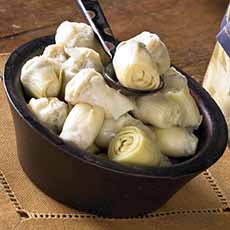
    A Bowl Of Artichoke Hearts
    [2] Artichoke hearts. These are from La Tienda (photo © La Tienda).

    A bowl of small marinated mushrooms.
    [3] Marinated mushrooms (photo © Taste Of Home).

     
    The cream-colored stalks resemble white asparagus, minus the tips. However, unlike asparagus, the palm hearts are nested layers. You can peel the layers apart (not that you’d want to).

    Hearts of palm have only 50 calories per cup, are a great source of dietary fiber, and are a good source of protein, ribolavin, potassium, vitamin C, folate, calcium, iron, magnesium, phosphorus, manganese, copper, and zinc. The only caveat: They can be packed in water with a high sodium content.
     
     
    WHERE DO HEARTS OF PALM COME FROM?

    Due to poaching in Brazil, Ecuador is now the largest producer and exporter of hearts of palm. Costa Rica is the largest exporter of to the U.S, and Hawaii also produces some palm hearts.

    They are also harvested from Florida’s official state tree, the Cabbage Palm.
      

    Comments off

    GIFT: Marina’s Cranberry Chutney


    For a party favor, stocking stuffer or a pantry
    staple, to enjoy quality cranberry sauce all
    year long. Photo by Elvira Kalviste | THE
    NIBBLE.
     

    Cranberry jelly is easy to figure out, but what is the difference between cranberry sauce and cranberry chutney? How about cranberry conserve? Cranberry relish?

  • Cranberry Conserve is a generally mixture of more than one fruit (added oranges, for example), often with added nuts and raisins, that is cooked until it becomes thick.
  • Cranberry Chutney, made with fruit or vegetables, usually includes vinegar, onion and spices. It’s of Indian origin (chatni is the Hindi word for strongly spiced). While people who only know Major Grey’s Mango Chutney (a British concoction in 19th-century India) may think of chutney as sweet, it does include vinegar, lime juice, onion and tamarind.
  • Cranberry Jelly is simply sweetened and jelled fruit juice, a clear, bright product. It is generally made by cooking fruit juice and sugar with pectin as a jelling agent and lemon juice as an acid, to maintain a consistent texture. Jelly is firm and will hold its shape.
  • Cranberry Sauce. A sauce is cooked; the fruit softens and is bound buy a syrup made from the fruit’s juices, water and sugar. Optional spices can be (and should be!) added.
  •  

  • Cranberry Relish. A relish is not cooked. In the case of cranberry relish, the cranberries are chopped, mixed with sugar and other ingredients: apples, oranges/zest, lemon juice/zest, brandy or Grand Marnier, fresh ginger, etc.
  • So there is an official difference, even though one person’s conserve may be another person’s chutney.

    There are textbook terms, and then there are mis-uses by people who inherited the misuse or weren’t likely to do culinary research. In olden times, the distinctions weren’t codified; hence, Boston Cream Pie is a layer cake, and cheesecake is a cheese custard pie.

    Sometimes, people choose names that they think have more sales appeal. We’ve received pies called crumbles (a pie has a bottom crust, a crumble does not), jams called preserves (the difference), buttercrunch called English toffee (the difference), etc., etc. So if you care about being correct, look it up.
    MARINA’S CRANBERRY CHUTNEY

    Marina’s Cranberry Chutney is made from cranberries, sugar, onion, oranges, raisins and walnuts, seasoned with cinnamon, ginger, nutmeg, salt and cayenne.

    Her prime business is raising pork, and the lovely layering of flavors in her cranberry condiment is a beautiful complement to pork or poultry.

    Given the multiple fruits, raisins, nuts and lack of vinegar, we’d call it a conserve, not a chutney. But to paraphrase Shakespeare’s Juliet: What’s in a name? That which we call a chutney by any other name would taste as good.

    The onion is a delightful touch and the cayenne is so subtle that heat-avoiders won’t even know it’s there. Sold in 16-ounce jars for $5.99, it’s available from Marina’s website, CircleBPork.com. It’s available on Amazon for $6.99.


    Comments off

    TIP: 12 Ways To Use Chocolate Liqueur

    The craze for chocolate Martinis a few years back led many people to buy a bottle of chocolate liqueur. If you still have most of it on the shelf, finish it up this holiday season.

    Beyond sipping as an after dinner drink or mixing into a cocktail, what else can you do with chocolate liqueur?

  • Add it to coffee or hot chocolate (including iced coffee and chocolate).
  • Spike a milkshake or float.
  • Drizzle over ice cream.
  • Add a tablespoon to a basic whipped cream recipe.
  • Drizzle over chocolate pound cake, to create a chocolate cousin of rum cake.
  • Replace the liquid in brownies or cake; this recipe adds 1/2 cup of chocolate liqueur to a chocolate cake recipe.
  • Add it to a trifle.
  • Add to a dessert sauce.
  • Switch out the Kahlúa in tiramisu.
  • Add to chocolate mousse.
  • Enjoy a dessert of sliced bananas.
  • Make chocolate truffles.
  •  

    Dorda is named after the owner of Chopin Vodka, Tad Dorda, who began making it for his own enjoyment. Photo courtesy Podlaska Wytwórnia Wódek Polmos.


    Godiva White Chocolate Liqueur. Photo
    courtesy Godiva.
      TYPES OF CHOCOLATE LIQUEUR

    There are three types of chocolate liqueur: liqueur, cream liqueur, and crème de cacao.

  • Chocolate liqueur is a distilled spirit flavored with chocolate and optional ingredients (fruits, nuts, spices, etc.) plus added sugar. Examples include Godiva Dark Chocolate, Royal Mint-Chocolate Liqueur and Sabra liqueur (made with Jaffa oranges).
  • Chocolate cream liqueur, which adds dairy cream to the blend. Examples include Cadbury Cream Liqueur, Godiva White Chocolate Liqueur and Vermeer Dutch Chocolate Cream Liqueur.
  • Crème de cacao, which does not include dairy cream; “crème” refers to the creamy texture of the liqueur, which is made in dark and white versions. It is made specifically with cacao beans instead of baking chocolate or cocoa powder and is less sweet than other chocolate liqueurs.
  •  

    CHOCOLATE LIQUEUR HISTORY

    Chocolate liqueur has been around for centuries. In the historical record, the earliest mention is a French reference to producing chocolate en liqueur, in 1666. In New England prior to the American Revolution, a “chocolate wine” was popular, made from chocolate, port, sherry and sugar.

    Recipes for chocolate liqueur appear in a 1789 French manual, an 1803 French pharmacy manual and an 1825 American cookbook. Recipes are prevalent throughout the 19th century and into the early 20th century.*

    Here’s a modern chocolate liqueur recipe if you want to make your own. Remember: The better the chocolate, the better the liqueur.

    Today, you can find chocolate liqueur in dark chocolate, milk chocolate, mocha, and white chocolate, as well as infused with other flavors such as mint, orange, raspberry. If you’re looking for something else: Go ahead, make it!
     
    *Source: Wikipedia.
      

    Comments off

    HOLIDAY: Challah Stuffing Recipe For Thanksgivukkah

    In case you’ve been off the grid, the hot holiday news this year is that for the first time in history, Thanksgiving coincides with Hanukkah. It’s been dubbed Thanksgivukkah. And it won’t happen again for another 70,000 years.

    So even if you’re not Jewish, think of celebrating this once-in-a-lifetime (many lifetimes, actually) double holiday by adding a Hanukkah tradition.

    Here’s an easy switch recipe: challah stuffing. This recipe is courtesy TheShiksa.com, one of our favorite recipe bloggers. It adds sausage, and uses a slow cooker, which saves oven space.

    Prep time is 35 minutes, cook time is 4 hours 30 minutes.

    RECIPE: CHALLAH STUFFING

    Ingredients For 8-10 Servings


    Challah stuffing. Recipe and photo courtesy
    TheShiksa.com.


  • Optional: 12 ounces turkey or chicken sausage, ground or removed from casing
  • 1 large challah (about 1½ lbs)
  • 2 tablespoons extra virgin olive oil (or 6 tbsp if not using sausage)
  • 1 large sweet yellow onion, chopped
  • 2 cloves garlic, minced
  • 1 pound carrots, peeled and chopped
  • 1 pound celery, peeled and chopped
  • 1/4 cup fresh parsley, chopped
  • 1 tablespoon fresh sage, chopped (or 1½ teaspoons dried sage)
  • 1 tablespoon fresh marjoram, chopped (or 1½ teaspoons dried marjoram)
  • 2 teaspoons fresh oregano, chopped (or 1 tsp dried oregano)
  • 1 quart (4 cups) chicken broth
  • 1 pound sliced white mushrooms
  • 2 eggs, beaten
  • Salt and pepper
  •  


    A plain challah is fine. If you have one with
    sesame seeds, it adds a bit more flavor.
    Photo © Lindsay Basson | Fotolia.
      Equipment

  • Large sauté pan
  • Large skillet
  • Mixing bowls (including one very large size)
  • 5 to 6 quart crock pot or slow cooker
  •  
    Preparation

    1. PREHEAT oven to 350°F. Cut the challah into ½ inch cubes. Spread the cubes out across two baking sheets. Place the trays in the oven for about 12 minutes, switching trays on racks halfway through cooking. The challah cubes should be toasted and slightly golden. Remove from oven and allow to cool.

    2. HEAT 2 tablespoons of olive oil in a large sauté pan over medium high. Add sausage to the pan and cook until browned. Transfer to a bowl using a slotted spoon and reserve for later. Variation: If you don’t want to include sausage, skip that step and begin by first sautéing the onions, carrots and celery in 6 tablespoons of olive oil, then continue the recipe as written, omitting the sausage.

     
    3. ADD the onions, carrots and celery to the same pan and sauté for 5-6 minutes until softened and fragrant. Add garlic and sauté for an additional 2 minutes.

    4. POUR 2½ cups of chicken broth into the pan along with 1 teaspoon of salt and ½ teaspoon of black pepper. Remove from heat. Reserve remaining chicken broth.

    5. HEAT the remaining 2 tablespoons of olive oil in a clean skillet over medium high heat. Add sliced mushrooms to the skillet. Sauté for 10 minutes, until the mushrooms begin to brown and shrink in size. Remove from heat. You may need to cook the mushrooms in two batches depending on the size of your skillet.

    6. COMBINE in a very large mixing bowl the challah cubes, sausage, vegetable/chicken broth mixture, mushrooms and herbs. Stir to blend all ingredients, making sure the challah cubes are evenly moistened. Add the beaten eggs to the mixture and stir until they are fully incorporated into the stuffing. The mixture may seem dry now, but wait to add more broth until it’s had a chance to cook—the liquid will slowly be absorbed by the bread.

    7. SPRAY the slow cooker with nonstick cooking spray; then pour in the challah mixture.

    8. SET slow cooker on high heat and cover the pot. Cook for 30 minutes. Remove the cover and stir to redistribute the liquid throughout the stuffing, then check the stuffing for dryness. If it still seems dry, drizzle a little more broth over the top of the stuffing and stir again. Return the lid and reduce heat to low.

    9. COOK on low for 4 hours, checking and stirring every hour to make sure the stuffing isn’t too dry. If it is, add more broth—carefully, as it can easily go from the right texture to overly wet and mushy. After 4 hours, stir, taste, and add more salt or pepper, if desired. Switch to warm setting until ready to serve.


    Comments off

    The Nibble Webzine Of Food Adventures
    RSS
    Follow by Email


    © Copyright 2005-2026 Lifestyle Direct, Inc. All rights reserved. All images are copyrighted to their respective owners.

