THE NIBBLE BLOG: Products, Recipes & Trends In Specialty Foods
Also visit our main website, TheNibble.com.
|
December 14, 2013 at 8:23 am
· Filed under Christmas, Cookies-Cake-Pastry, Giftable, Tip Of The Day
|
|
Flowers are lovely, of course. And arrangements of seasonal fruits and pine—lady apples, clove-studded oranges, pomegranates, pine cones and branches—have been our centerpiece of choice.
But how about an edible centerpiece that becomes part of dessert?
There’s nothing more charming than an old-fashioned gingerbread house as a holiday centerpiece. And if the gingerbread is top quality, it’s a joy to be part of the “demolition crew.”
You can serve it at the end of a big holiday meal with ice cream—a much lighter choice than most cakes and pies.
We have to give props to the creative bakers who’ve thought “outside the house” to produce these two gingerbread centerpieces.
|
|

To grace your table, a gingerbread train. Photo courtesy Mackenzie Ltd. |
They’re available from one of our our favorite gourmet food e-tailers, Mackenzie Ltd. If you enjoy looking at photos of luscious foods, you’ll devour every page of Mackenzie’s website.
ALL ABOARD THE GINGERBREAD EXPRESS
Destined to become a classic, this three-car gingerbread train (photo above) replaces the traditional gingerbread house with a whimsical choo choo.
Entirely edible, the train is a memorable holiday centerpiece that will delight children and adults alike. If you know model train enthusiasts, it makes a delightful gift.
It’s 21 inches long, $59.95, at MackenzieLtd.com.
|

Gingerbread fantasy: a carousel. Photo
courtesy Mackenzie Ltd. |
|
OR TAKE A SPIN ON THE GINGERBREAD
CAROUSEL
This stunning centerpiece is also 100% edible. It measures almost a foot tall and 15″ across. You can provide some optional old-fashioned carousel music during the dessert course.
With an impressive amount of hand decoration, the gingerbread carousel is $149.95 at MackenzieLtd.com.
Both the train and the carousel are made of high-quality gingerbread and arrive fully assembled to immediately grace your table.
Here’s the history of gingerbread, which evolved in 15th-century Germany. The Medieval German Lebkuchen Guild (lebkuchen is German for gingerbread) turned it into a highly-decorated art, crafting fancy shapes decorated with sugar and gold.
|
|
|
|
Permalink
|
|
December 13, 2013 at 8:44 am
· Filed under Giftable, Oil-Vinegar-Dressing
|
|
It’s truffle season, and while we love the aroma and flavor of truffles, our budget doesn’t afford them often.
So when we encountered an easily affordable spray bottle of Grand’Aroma Truffle Flavored Extra Virgin Olive Oil by Fratelli Mantova, we thought, “Why not?”
We know that most truffle oils are flavored with “truffle essence”—laboratory approximations of truffle aroma. But some of them are quite passable. In fact, truffle oil made with natural or chemical aroma and flavor—as opposed to infusion with real truffles—has a more assertive truffle flavor. The downside is that some brands, flavored with chemicals, have a hint of artificiality.
We were willing to invest $9.00 to explore the truffle oil spray. We have a couple of bottles of truffle oil, but were particularly attracted to the spray format (which uses no chemicals, additives or emulsifying agents).
And we like it—we really like it!
Eggs: Spray on the nonstick frying pan before cooking eggs.
Pizza: Spray on a white/mushroom pizza when it leaves the oven.
|
|
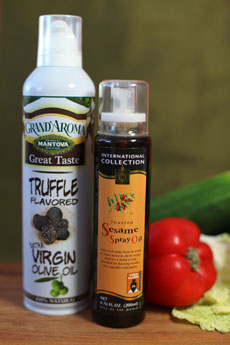
Truffle-flavored EVOO and sesame oil sprays. Photo by Elvira Kalviste | THE NIBBLE. |
|
Grilled Proteins: Spray on grilled or roasted beef, lamb, poultry and seafood.
Starches: Spray on fries and other potatoes, pasta, polenta, and risotto.
Vegetables: Spray on cooked asparagus, cauliflower, corn, mushrooms.
Vinaigrette: Replace some of the olive oil in a classic vinaigrette; use on salads and to make marinated mushrooms.
Tartare: Mix into beef, salmon or tuna tartare; on beef carpacio
Snacks: Spray on popcorn and potato chips.
Mantova Spray Truffle Flavored Extra Virgin Olive Oil in an eight-ounce spray is $9.22 on Amazon.com. It’s a welcome stocking stuffer or small gift for any cook or foodie.
We also picked up a sesame oil spray, a very good way to add just a hint of this heavy oil to stir-frys and other protein or vegetable dishes.
|
|
|
Permalink
|
|
December 13, 2013 at 7:38 am
· Filed under Christmas, Cocktails & Spirits, New Year's Eve
|
|
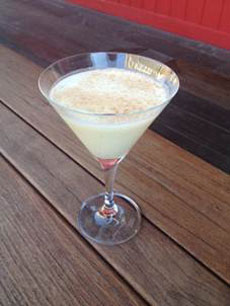
The Eggnog “Martini” in sunny Napa Valley.
Photo courtesy Boon Fly Café | Carneros Inn.
|
|
Can you call any a cocktail poured into a Martini glass a Martini?
Of course not; otherwise you’d call a Cosmopolitan a Cranberry Lime Martini with triple sec substituting for vermouth.
The Martini is a cocktail made with gin and vermouth, and garnished with an olive or a lemon twist. The first recipe for a vodka Martini appears in 1951, but didn’t gain world notice until the publication of the second James Bond novel, Live and Let Die, in 1962 (Bond’s cocktail of choice was a vodka martini, “shaken not stirred”).
Here’s more Martini history.
Why a vodka Martini? Two good guesses are that a bartender made it for a customer who didn’t like gin; or that a vodka distributor created and promoted it to move more vodka—also a clear spirit but without the aromatic gin ingredients.
If you want to make a cocktail with rum, tequila or whiskey, call it something other than a Martini.
|
|
Even if they don’t know the rules, the folks at Boon Fly Café at the The Carneros Inn (in sunny Napa Valley) are pleasing customers with Eggnog “Martinis.”
All you need is eggnog, Captain Morgan Spiced Rum and a Martini glass.
|
|
RECIPE: BOON FLY CAFE’S EGGNOG MARTINI
Ingredients For One Drink
1 ounce of Captain Morgan Spiced Rum
3 ounces eggnog
Garnish: Dash of nutmeg or cinnamon
Preparation
1. SHAKE rum and eggnog with ice and strain into a Martini glass.
2. GARNISH and serve.
MORE CHRISTMAS MARTINI RECIPES
Candy Cane Martini
Cranberry Martini
Ginger Martini
Pomegranate Martini
|
|

Captain Morgan, ready to pour rum into his eggnog. Image courtesy Diageo.
|
|
|
|
Permalink
|
|
December 12, 2013 at 2:53 pm
· Filed under Christmas, Food Fun, Recipes
|

Turn refrigerated cinnamon bun dough into
Christmas trees. Photo courtesy Immaculate
Baking Co. |
|
What’s for breakfast on Christmas? How about these Cinnamon Roll Christmas Trees—with a side of eggs or oatmeal for nutrition.
This recipe comes from Immaculate Baking Co., which makes refrigerated cookie dough, pie crusts, biscuits, scones and other doughs in natural, organic and gluten-free versions.
RECIPE: CHRISTMAS CINNAMON ROLLS
Ingredients
Aluminum foil
1 can refrigerated cinnamon rolls with icing
4 to 6 drops green food color
Green, red, white and yellow candy sprinkles or colored sugar
|
|
Immaculate Baking Co. used its gluten-free cinnamon rolls for this recipe, but you can use any refrigerated cinnamon roll dough.
|
|
Preparation
1. HEAT oven to 350°F. Cut five 18-inch pieces of foil. Crush each piece of foil into a cone shape 3-inches high with a 2 1/2- inch diameter base. Spray each cone very generously with cooking spray.
2. SEPARATE dough. Unroll each roll into long strip. Wrap dough around cone starting at base and ending at top. Press at top of cone to form point. Bake 16 to 18 minutes or until golden brown.
3. COOL 5 minutes. Gently remove foil cones; cool trees upright on cooling rack about 30 minutes.
|
|

Photo courtesy Immaculate Baking Co.
|
|
4. STIR together icing and food coloring in a small bowl. Working with one tree at a time, drizzle or frost edges of tree from top to bottom; sprinkle with candies. Repeat with remaining trees. Serve.
You can follow the recipe in photos in Immaculate Baking’s cookie blog.
|
|
|
Permalink
|
|
December 12, 2013 at 1:26 pm
· Filed under Beverages, Fair Trade, Food Holidays, Kosher Nibbles
|
|
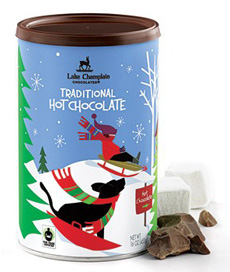
Winter Hot Chocolate is a classic cocoa mix
with a touch of vanilla. Photo courtesy Lake
Champlain Chocolates.
|
|
“Forget Christmas gifts this year,” said our friend Gerard, when he called to invite us to his annual party and gifting frenzy. “At this point in our lives, none of us needs another scarf, another basket of Kiehl’s products, another tzotchke, another random book.”
“Can we bring some gourmet cocoa?” we suggested. “Sure,” he responded.
That’s why we love food gifts. They can readily be consumed by the recipient, his guests or his family members.
And you don’t have to go far to find something good. Any upscale supermarket has gourmet chocolate bars, fine olive oil and gourmet hot chocolate.
We passed by all of them at Whole Foods yesterday, including these gifty hot chocolate canisters from Lake Champlain Chocolates (also available directly from Lake Champlain Chocolates). They’re just $10.50 for a festively-designed one-pound canister (one pound makes approximately 21 eight-ounce servings). You can package the gifts with some handmade marshmallows in the confections section.
|
Lake Champlain’s hot chocolate is certified kosher by Star-D, and is Fair Trade Certified, which means that it’s a feel-good product, right for the holiday season.
Fair trade certification allows farmers to receive higher prices than they would in the conventional market. It means that the farmers are paid a fair price for their product and are not exploited by middlemen who pay them less than their crop is worth.
Read more about Fair Trade.
|
|
25 WAYS TO GLAMORIZE A CUP OF COCOA
From adding flavors—banana, cinnamon, chai, hot spices, mint—to liqueurs, we’ve got 25 ways to make an already delicious cup of cocoa even more memorable.
Check ‘em out.
THE DIFFERENCE BETWEEN COCOA & HOT
CHOCOLATE
December 12th is National Cocoa Day. What’s the difference between cocoa and hot chocolate?
Most people use the terms interchangeably, but they’re actually different.
Cocoa is a drink made from cocoa powder.
Hot chocolate is a drink made from actual chocolate, usually ground or shaved into small bits. Chocolate has more cocoa butter than cocoa powder, so it makes a richer drink, all things being equal (the same type of milk, e.g.).
|
|
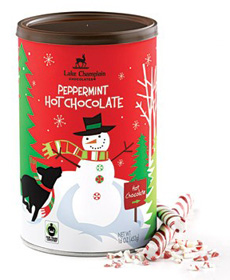
Enjoy Peppermint Hot Chocolate for the holidays, with hints of vanilla and cinnamon. Photo courtesy Lake Champlain Chocolates.
|
|
To make any cup of cocoa or hot chocolate richer, you can:
Use half and half, or half milk and half cream.
Stir in a pat of unsweetened butter—really! It’s a chef’s secret trick.
Visit our Cocoa Section for brand reviews, recipes and more about man’s favorite chocolate drink.
Or take our Cocoa Trivia Quiz.
|
|
|
Permalink
|
The Nibble Webzine Of Food Adventures
© Copyright 2005-2026 Lifestyle Direct, Inc. All rights reserved. All images are copyrighted to their respective owners.



