THE NIBBLE BLOG: Products, Recipes & Trends In Specialty Foods


Also visit our main website, TheNibble.com.

The Income Tax Cocktail: A Recipe For April 15th

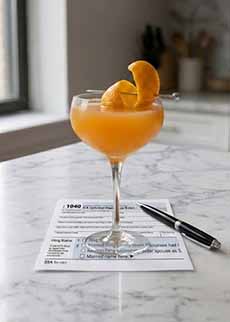
Income Tax Cocktail
[1] The Income Tax Cocktail was created when income tax went into effect in 1913 (Gemini Photo).

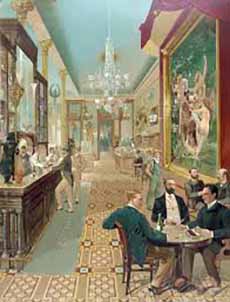
Hoffman House Bar 1890
[2] The elegant bar at the Hoffman Hotel in New York City, where the Income Tax Cocktail may have been created.


Since it is Tax Day, the most thematic choice is undoubtedly the Income Tax Cocktail. It’s a classic Pre-Prohibition drink that feels like a more sophisticated, slightly “taxing” twist on a Bronx Cocktail.

The addition of both sweet and dry vermouth—along with a healthy dose of bitters—perfectly captures that bittersweet feeling of finishing your returns—not to mention the bitter sting of the payment.

Below:

> The Income Tax Cocktail recipe.

> The history of income tax.

> The history of the Income Tax cocktail.

Elsewhere on The Nibble:

> The history of cocktails.

> The history of Happy Hour.

> The year’s 100+ cocktail and spirit holidays.
 
 
RECIPE: THE INCOME TAX COCKTAIL

Ingredients Per Drink

  • 1½ ounces gin
  • ¾ ounce fresh Orange Juice
  • ¼ ounce sweet vermouth
  • ¼ ounce dry vermouth
  • 2 dashes Angostura bitters
  • Garnish: orange twist
  •  
    Preparation
     
    1. SHAKE all ingredients with ice and strain into a chilled coupe glass.

    2. GARNISH with an orange twist.

     
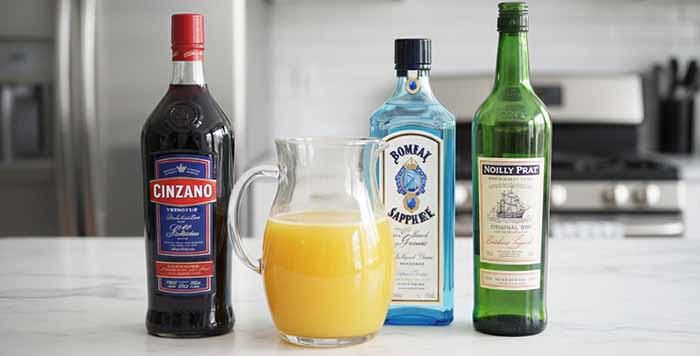
    Income Tax Cocktail Ingredients
    [3] Ingredients for the Income Tax Cocktail (Abacus Photo).
     
     
    THE HISTORY OF THE INCOME TAX COCKTAIL

    The inventor of the Income Tax Cocktail is, as with many classic cocktails, lost to time. The drink first appeared in the early 20th century, along with federal income tax (1913).

    It may have been created at the Hoffman House hotel in New York City. Located on the then-fashionable Madison Square at Broadway between 24th and 25th Streets, the bar was known for inventing cocktails.

    While there is no record anywhere of who invented the Income Tax Cocktail, Hoffman House is a good guess.

    The Hoffman House bar was a known meeting place for political figures and financiers—the exact people who would have been most stung by the new income tax and in need of liquid comfoert.

    A big promoter of the new cocktail was from Charlie Morrison, a legendary bartender at the Hoffman House.

    The bar of the Hoffman House hotel enjoyed an international reputation as the city’s finest drinking establishment between 1864 and 1911. Here’s more about it.

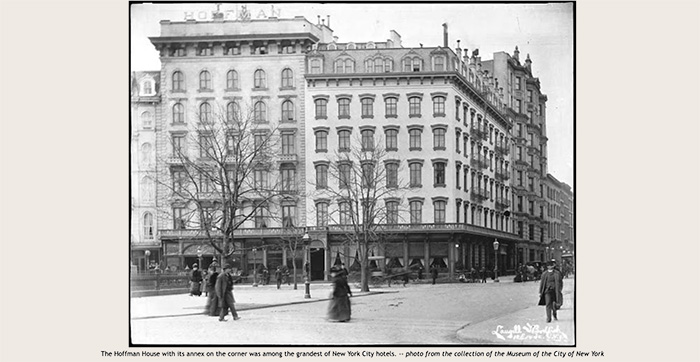
    Hoffman House Hotel
    [4] The Hoffman House Hotel in New York City closed on March 15, 1915, and was demolished shortly after to make way for a 16-story office and loft building. Here’s more about it (photo courtesy Museum Of The City Of New York).
     
     
    THE HISTORY OF INCOME TAX

    Before 1861, the U.S. government was funded primarily by customs duties on imported goods and excise taxes on products like liquor and tobacco.

    To fund the enormous cost of the Civil War, President Abraham Lincoln signed the Revenue Act of 1861, America’s first federal income tax. It was a flat 3% tax on incomes over $800 (which would be roughly $16,000 to $21,000 today).

    This first income tax was temporary and was repealed in 1872 once the war debt was manageable.

    Some 30 years later, the government under Grover Cleveland tried to institute an income tax with the Wilson-Gorman Tariff Act of 1894. The attempt was immediately challenged and led to a Supreme Court ruling that it was unconstitutional because it wasn’t apportioned among the states based on their populations, as the Constitution required.

    And then came…
     
     
    The 16th Amendment

    Realizing that they needed to formally amend the Constitution to bypass this ruling, Congress proposed the 16th Amendment. It was ratified on February 3, 1913, explicitly giving Congress the power to collect taxes on income “from whatever source derived,” regardless of a state’s population. This was the Revenue Act of 1913.

    Congress lost no time in establishing the income tax system we recognize today, including a progressive tax structure where higher earners paid higher percentages.

    The very first Form 1040 was released for the 1913 tax year. It was a single page, and a family with an income of $4,000 (a high income*) paid only about $10 in tax, around $335 in today’s money.
     
     
    How Did We Get To Today’s Hefty Taxes?

    Before 1943, taxpayers would calculate and pay their total annual tax bill directly to the IRS in one lump sum on March 1st†.

    But the enormous cost of World War II required massive spending, and the government couldn’t wait until the filing day to get the cash.

    The Current Tax Payment Act of 1943 introduced the withholding system we use today. Taxes were automatically deducted from every person’s paycheck, turning the annual income tax from a lump sum payment into a per-paycheck deduction that maximized government cash flow.
     
    And there you have it!
     
    U.S. Treasury Building
    [5] The U.S. Treasury Building in Washington, D.C. The Internal Revenue Service (IRS), a bureau within the U.S. Department of the Treasury, is the primary government body responsible for collecting federal income tax and enforcing tax laws. The statue is Albert Gallatin (1761–1849), a pivotal early American statesman who served as the longest-tenured Secretary of the Treasury (1801–1814) under Jefferson and Madison (photo CC-BY-SA-4.0 license).

    ________________
     
    *An income of $4,000 in 1913 is equivalent in purchasing power to approximately $133,000 to $136,000 in 2026. This represents a cumulative inflation increase of over 3,200% over the 113-year period. A $4,000 salary in 1913 was considered quite wealthy, often aligning with high-end corporate management or top-tier professionals.

    †The deadline has shifted over time, starting on March 1 in 1913, moving to March 15 in 1918, and finally settling on April 15 in 1955 to give taxpayers more time. If the 15th falls on a weekend or holiday, the deadline moves to the next business day.
     

    CHECK OUT WHAT’S HAPPENING ON OUR HOME PAGE, THENIBBLE.COM.


    Comments off

    Make A Mango Cobbler: A Recipe For Any Time Of The Year

    April 13th is National Peach Cobbler Day. Why would someone place a peach holiday in a month devoid of fresh peaches? We have the answer below .

    And we have a substitute recipe for today: You can find fresh mangoes year-round*, and they make a delicious cobbler.

    The year’s 4 mango holidays:

  • May 5: Cinco de Mango, promoted by The National Mango Board
  • June: National Mango Month
  • July 18: National Tropical Fruit Day
  • July 22nd: National Mango Day
  •  
    Below:

    > The recipe for mango cobbler.

    > Why National Peach Cobbler Day is held in April.

    Elsewhere on The Nibble:

    > Classic peach cobbler recipe.

    > The history of cobbler.

    > The history of mangoes.

    > The difference between cobbler, crumble, crisp, betty, buckle, grunt, pandowdy, slump, and other baked fruit dishes.

    > The different types of pies and pastries: a photo glossary.
     
     
    RECIPE: MANGO COBBLER

    Igredients

  • 4 cups chopped peeled mangoes (about 3 medium)
  • 2/3 cup sugar
  • 1/2 teaspoon ground cinnamon
  • 2 tablespoons cornstarch
  • 1 tablespoon cold water
  • 1 tablespoon butter
  •  
    For The Topping

  • 1 cup self-rising† flour
  • 1 tablespoon sugar
  • 3 tablespoons shortening
  • 1/2 cup 2% milk
  •  
    Preparation
    Optional Garnish

  • Ice cream
  • Whipped cream
  •  
    Preparation

    1. COMBINE the mangoes, sugar and cinnamon in a large saucepan. Cook and stir until the mixture comes to a boil.

    2. COMBINE the cornstarch and water until smooth; stir into the pan. Cook and stir for 2 minutes or until thickened.

    3. TRANSFER to a greased 11 x 7-inch baking dish. Dot the top with butter.

    4. MAKE the topping. In a small bowl, combine the flour and sugar. Cut in the shortening until the mixture resembles coarse crumbs. Stir in the milk; mix well.

    5. DROP by tablespoonfuls onto the hot fruit. Bake, uncovered, at 400°F for 20-25 minutes or until bubbly and golden brown. Serve warm.
     
     
    WHY IS PEACH COBBLER DAY IN APRIL?

    At first glance (and at second glance, too), it seems dumb—OK, strange—to hold a peach holiday in a month when no peaches are available in most parts of the country until the “stone fruit” months of June through August.

    When we drilled down to discover that the choice of a date in April was completely intentional, and has everything to do with industry marketing rather than the harvest cycle.


    Mango Cobbler
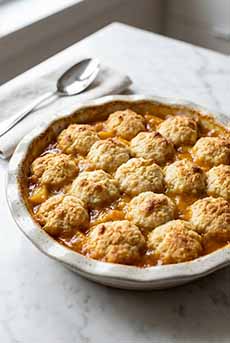
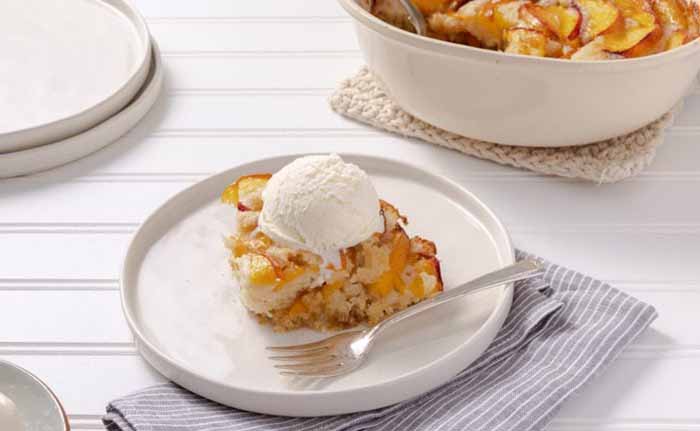
    [1] Mango cobbler, great on its own or when peaches aren’t in season (Abacus photo).

    Whole & Sliced Mangoes
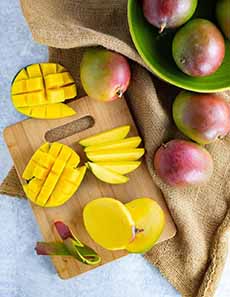
    [2] Different mango varieties reach their peak at different times of the year. See the *footnote (photo © Melissa’s Produce).

    Bag Of White Lily Self Rising Flour
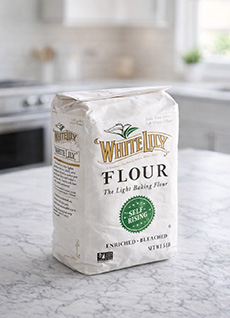
    [3] See the †footnote for why it’s important to use self-rising flour in a cobbler (Abacus Photo).
     
    Sticks Of Butter
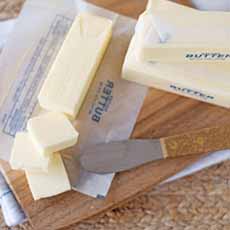
    [4] In cobblers, where a biscuit-like dough is dropped on top, the butter fries the bottom edge of the dough that is touching the fruit and crisps up the very top. The middle of the “cobblestones” remains fluffy while the exterior gets a slight, buttery crunch (photo © Go Bold With Butter).

     
    National Peach Cobbler Day was created by the Georgia Peach Council in the 1950s. Their goal was specifically to promote canned peaches.

    By placing the holiday in April, they encouraged people to buy and use inventory from the previous year’s harvest during a time when fresh fruit was unavailable.

    According to sources, “This strategy proved that a great cobbler doesn’t actually require fresh peaches; high-quality canned peaches, which are often packed at the peak of ripeness, can produce an excellent result year-round.”

    According to us, canned peaches are no substitute for fresh or even frozen peaches.

    However, this was the 1950s, when the canned crop of convenience foods had American housewives making everything with canned fruit, canned soup concentrates,

    Mango Cobbler
    [5] If you want something more interesting than vanilla ice cream, consider coconut, candied ginger, or macadamia nut. You can soften vanilla ice cream and mix in your inclusion of choice (photo © Taste of Home).

    ________________
     
    *Per The National Mango Board; Ataulfo / Honey mango late February–mid July; Tommy Atkins mango early March–mid July; Kent mango January–early February and again in December; Keitt mango August-September plus some in spring; Haden mango March–early May; Francis mango May–July.

    †The primary reason to use self-rising flour instead of all-purpose flour is for convenience and consistency, particularly in recipes like biscuits, pancakes, and cobbler toppings. Self-rising flour is essentially all-purpose flour that has already been premixed with baking powder and salt (most brands use a ratio of about 1 ½ teaspoons of baking powder and ½ teaspoon of salt for every 1 cup of flour). This saves you two steps and ensures that the leavening agent is perfectly distributed throughout the flour, which helps prevent clumping/uneven rising in the dough.

    Secondly, in the U.S., most self-rising flours (especially Southern brands like White Lily or Martha White) are made from soft winter wheat, which has a lower protein content than standard all-purpose flour. Lower protein means less gluten formation. This results in a softer, fluffier, and more tender crumb. This is why self-rising flour is the “gold standard” for Southern-style biscuits or delicate cobbler drops (all-purpose flour can sometimes make those same recipes slightly tougher/breadier.
     

    CHECK OUT WHAT’S HAPPENING ON OUR HOME PAGE, THENIBBLE.COM.


    Comments off

    Ele Chocolates Probiotic Bites: A Chocolate A Day Is Good!

    Ele Chocolates Probiotic Bites
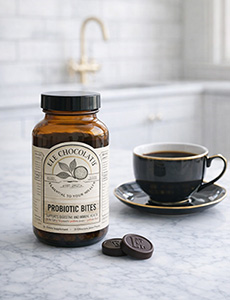
    [1] Each morning, we enjoy one Probiotic Bite with our first cup of coffee (Abacus Photo).

    Ele Chocolates Probiotic Bites
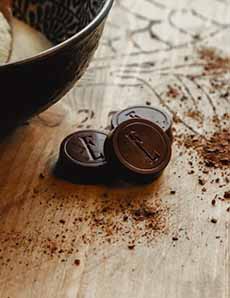
    [2] The bites are made from organic 70% cacao (dark chocolate (photos #2, #3, #5, and 6 © Ele Chocolates).

    Ele Chocolates Probiotic Bites
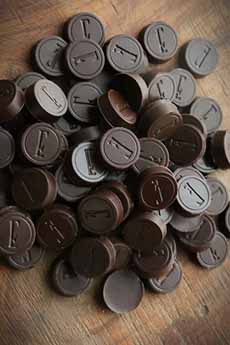
    [3] Tempting, but you can only eat one a day, the effective dose.

    Cacao Beans
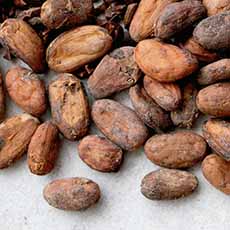
    [4] It begins with single origin, organic, Fair Trade certified cacao beans (photo © Tetiana Bykovets | Unsplash).


    The Nibble doesn’t typically cover health and wellness foods. But we were treated to a jar of Probiotic Bites from Ele Chocolates and we liked them so much, that after our initial supply ran low we became a monthly subscriber.

    After several months, they’ve become such a part of our morning ritual that they’re our Top Pick Of The Week.

    With Mother’s Day coming up, we’re gifting bottles to several of our friends.

    What if you could start the day with a piece of chocolate that’s delicious, healthful, and probiotic, yet contributes just 62 calories along with your morning cup of coffee or tea? (It can be consumed without any beverage at all.)

    Designed as a functional supplement, the delicious flavor comes from single origin, organic, Fair Trade certified, 70% cacao dark chocolate. The innovative product is made by Ele Chocolates, a partnership between of one of our favorite artisan chocolate lines, The Cordial Cherry (another Nibble Top Pick Of The Week), and Synbiotic Health, a biotech company specializing in probiotics.
     
     
    WHAT’S IN THEM?

    The ingredients are simple: cacao, coconut oil, and billions of friendly microorganisms from specific probiotic strains. The magic comes from how they’re put together.

    The Bites:

  • Are a blend of Bifidobacterium adolescentis (iVS-1®)† and Bifidobacterium longum (iVE-15®)†, totaling about 3 billion CFUs.
  • Are gluten-free with no added refined sugars, milk, soy, or wheat.
  • Contain the prebiotics Inulin and XOS†.
  • Are safe for children and adults, including women who are pregnant or breastfeeding.
  •  
    Below:

    > How do Probiotic Bites help your system?

    > Why two particular strains are used.

    > Where to buy.

    > About Ele Chocolates.

    > About Synbiotic Health.

    Elsewhere on The Nibble:

    > What is probiotic food?

    > Probiotics, prebiotics, and synbiotics.
     
     
    PROBIOTIC BITES: HOW DO THEY HELP?

    While these statements have not been evaluated by the Food and Drug Administration.

    Probiotic Bites are not intended to diagnose, treat, cure, or prevent illness or disease.

    Ele says that taking one Probiotic Bite a day can help you maintain a healthy and balanced digestive and immune system.

    Their tests have shown that the Probiotic Bites:

  • Improve digestion and overall gut health with live probiotics, friendly bacteria that are good for the digestive system by keeping the microbiome balanced. This in turn helps to promote better digestion: less bloating and easier elimination.
  • Provide better immune support. Good bacteria crowd out the bad ones so the gut can’t be taken over by less friendly bacteria and pathogens.
  • Improved lactose digestion. The probiotic IVS-1® is continously studied to prove its effectiveness in reducing symptoms and reactions to poor lactose digestion.
  •  
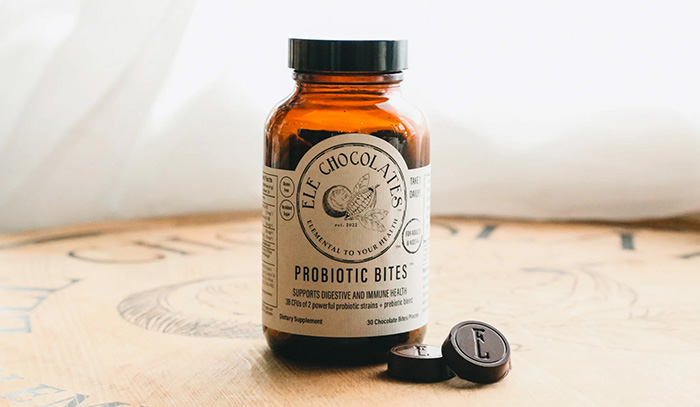
    Jar Of Ele Chocolates Probiotic Bites
    [5] We take a moment each morning to enjoy the peace and tranquility of our Probiotic Bite. Seriously!
     
     
    WHY THESE PARTICULAR PROBIOTIC STRAINS ARE USED

    Standard probiotics, like the “live” ones found in some yogurts, often die off in the stomach. These two strains were selected using in-vivo selectio” (iVS) and in-vitro enrichment (iVE), techniques used to find the “tough” bacteria that can actually reach the gut alive and perform functional tasks like producing vitamins or calming inflammation.

    These two specific strains of probiotic bacteria were developed by Synbiotic Health.

    Bifidobacterium adolescentis, iVS-1®, is naturally occurring in the human gut and is chosen for its “ecological fitness,” meaning it’s particularly good at surviving the journey through the digestive system and colonizing the gut.

  • Folate Producer: It’s a robust producer of folate (Vitamin B9), which is essential for DNA synthesis and cardiovascular health.
  • Lactose Digestion: It contains a high number of lactase genes, potentially helping those with lactose maldigestion*.
  • Intestinal Barrier: Clinical studies have suggested that it helps improve the integrity of the intestinal barrier, reducing “leaky gut.”
  • Neurotransmitter Support: It has the genetic capability to synthesize GABA, a neurotransmitter that helps regulate anxiety and stress.
  •  
    Bifidobacterium longum, iVE-15®, is one of the most well-researched probiotic species. The iVE-15 strain is specifically selected for its ability to thrive in the human microbiome.

  • Short-Chain Fatty Acid (SCFA) Production: It helps produce butyrate and acetate, which fuel the cells lining your colon and support a healthy gut environment.
  • Pathogen Defense: By lowering the pH in the colon, it creates an acidic environment that is inhospitable to harmful bacteria.
  • Immune System “Conversation”: It helps fine-tune the immune system’s response, helping it distinguish between harmless food and actual threats.
  • Longevity: While B. longum is famous for being a “founder” bacteria in infants, strains like iVE-15 are used in adults to maintain metabolic and digestive balance.
  •  
     
    GET YOUR PROBIOTIC BITES

    We don’t give healthcare advice. We also don’t use probiotic supplements—we don’t need them.

    So we can say, as an avocational user: We’re in it for the chocolate. It’s a happy and healthy way to start the day. To us, Probiotic Bites are a treat.

    If you do take probiotic supplements, consult with your healthcare provider for advice.

    One consideration might be the cost. With a 10% discount for monthly subscribers, a 30-day supply is $45 a month.

    Is it worth $1.50 a day—or is it even possible for many budgets—to enjoy a piece of good-for-you chocolate?

    We can only say that it makes us happy to wake up each morning and head to the kitchen to make coffee and enjoy our Probiotic Bite.

    > The Bites are sold on the company website as well as on Amazon.

    While there are rave reviews, i.e. “this solved my problem,” on both sites, we were surprised to see a couple of lower reviews on Amazon because the purchasers didn’t like the taste.

    Frankly, we love the taste…but as we all know, chacun à son goût, to each his own taste.
     
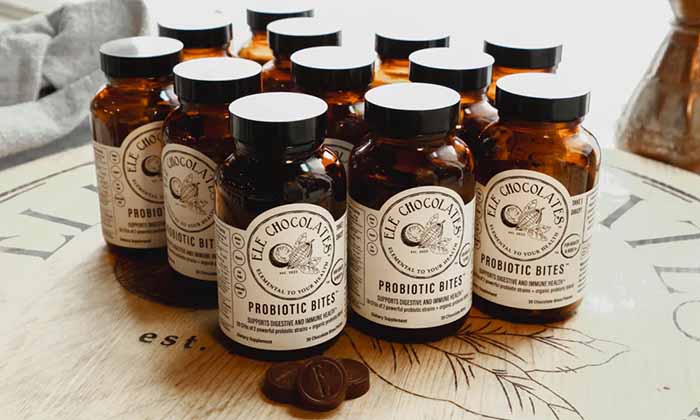
    Jars Of Ele Chocolates Probiotic Bites
    [6] A year’s supply. Actually, you can get your monthly refills in sustainable brown bags.
     
     
    ABOUT ELE CHOCOLATES

    “Ele” (pronounced EL-uh) is short for “Elemental,” a name that reflects the company’s mission to support health at its “elemental core.”

    The name signals that the product is a fundamental building block for gut health, rather than just a standard confection.

    The company was founded in 2022 as a collaboration between Melissa Stephens, the artisanal chocolatier of The Cordial Cherry, her daughter, Hannah Humeniuk, and biotech company Synbiotic Health.

    The CEO of Synbiotic, a customer of The Cordial Cherry, reached out to propose combining their chocolate-making expertise with his company’s probiotic strains.
     
     
    ABOUT SYNBIOTIC HEALTH

    Synbiotic‡ Health is a biotechnology company that specializes in the research and development of “ecologically advanced” probiotics and synbiotics. Unlike many supplement companies that simply market existing strains, Synbiotic Health is a research firm that discovers and licenses its own proprietary bacterial strains.

    The company is considered highly respected within the scientific and nutraceutical communities due to their academic pedigree and rigorous approach to clinical validation. The company was founded in 2017 by four prominent microbiome researchers, world-renowned experts in gut ecology and fermentation.

    Their lead strain, iVS-1®, is backed by peer-reviewed human clinical trials published in high-impact journals like Microbiome and Applied and Environmental Microbiology.
     
    ________________
     
    *Maldigestion is the biological process of what is happening (or not happening) in your gut. Lactose intolerance is physical symptom: how you feel because of maldigestion.

    †Inulin (FOS) (25 mg) is sourced from organic Jerusalem artichokes. Xylooligosaccharides (XOS) (15 mg) are sourced from organic cane sugar.

    ‡More terms to know:

    Synbiotic is the “1+1=3” of gut health. It’s the combination of a probiotic (the live bacteria) and a prebiotic (the fiber “food” that helps those bacteria grow).

    CFU (Colony Forming Units) is the measure of how many billions of live, active bacteria are in each chocolate bite.

    In-Vivo Selection (IVS) is is the process Synbiotic Health uses to pick bacteria that have been proven to survive inside a living body, rather than just in a petri dish.
     

    CHECK OUT WHAT’S HAPPENING ON OUR HOME PAGE, THENIBBLE.COM.


    Comments off


    © Copyright 2005-2026 Lifestyle Direct, Inc. All rights reserved. All images are copyrighted to their respective owners.