THE NIBBLE BLOG: Products, Recipes & Trends In Specialty Foods


Also visit our main website, TheNibble.com.

Easy Grasshopper Pie Recipes For St. Pat’s

Grasshopper Pie is a crème de menthe chiffon pie with a chocolate cookie crust. It was invented in the U.S. in the 1950s following the popularity of the Grasshopper Cocktail, a minty chocolate dessert cocktail made from cream, green crème de menthe and white crème de cacao. Some recipes make it a frozen pie with mint ice cream.

The cocktail’s name derived from its green color. While it reputedly originated at Tujague’s, a landmark bar and Creole restaurant in the French Quarter of New Orleans, the story is a bit more complicated, as you’ll see below.

Grasshopper Cocktail Recipe: 3/4 ounce cream, 3/4 ounce white creme de cacao and 3/4 ounce green creme de menthe. Shake with ice and pour into a Martini glass.

> September 15th is National Creme de Menthe Day.

> The year’s 6 cider and applejack holidays.

> The year’s 31 pie holidays.

> The year’s 49 cocktail holidays.

Below:

> The year’s 8 mint holidays are below.

> The year’s 7 liqueur holidays.

> The history of the Grasshopper cocktail and Grasshopper pie.

> Grasshopper pie recipe.

> Ice cream Grasshopper pie recipe.


THE HISTORY OF THE GRASSHOPPER COCKTAIL

The recipe, created by Philibert Guichet Jr., owner of Tujaque’s restaurant in New Orleans, began as an entry submitted to a cocktail contest in New York City. It won the second place prize. Of note is that the contest was held in 1928—before the end of Prohibition (1920-1933). [Source]

The cocktail gained popularity in the South during the 1950s and 1960s.

In the 1950s, liquor became much more widely available as it filled grocery store shelves across the land. With women doing most of the grocery shopping at this time, the popularity of sweeter, dessert-type drinks increased. By the 1960s, the Grasshopper had become a standard cocktail.
 
 
THE DEBUT OF GRASSHOPPER PIE

At the same time the cocktail became a national standard, the pie appeared. Chiffon pies were very popular at that time, and food historians speculate that the recipe was invented by food companies to promote their products.

In the 1997 American Century Cookbook: The Most Popular Recipes For The 20th Century, Jean Anderson writes, “I suspect—but cannot verify—that [Grasshopper Pie] recipes descend from one that appeared in High Spirited Desserts, a recipe flier published jointly by Knox Unflavored Gelatin and Heublein Cordials. [Source]

There are two easy recipes below: the standard version and a frozen version.
 
 
RECIPE #1: GRASSHOPPER PIE

Prep time is 30 minutes plus several hours to chill (or overnight).

You can play with the garnishes, using chocolate chips instead of chocolate shavings. If you want a more vivid green for St. Patrick’s day, add food color before you whip the cream.

Ingredients For 8 Servings

For The Crust

  • 1-1/2 cups plus 1 tablespoon chocolate wafer crumbs, divided (about 32 wafers)
  • 1/4 cup sugar
  • 1/2 stick (1/4 cup) unsalted butter, melted
  •  
    For The Filling

  • 1-1/2 teaspoons unflavored gelatin
  • 1-1/3 cups well-chilled heavy cream
  • 1/4 cup sugar
  • 1/4 cup green crème de menthe
  • 1/4 cup white crème de cacao
  • 4 large egg yolks
  • Garnish: grated chocolate or mint-flavored chocolate*
  •  
    Preparation

    1. MAKE the crust. Stir together the wafer crumbs, sugar and butter in a bowl to combine. Pat the mixture onto the bottom and up the side of a buttered 9-inch pie plate. Bake the crust in the middle of a preheated 450°F oven for 5 minutes. Set aside to cool.

    2. MAKE the filling. In a heat-proof bowl or the top half of a double boiler, sprinkle the gelatin over 1/3 cup of the cream; let it soften for 5 minutes. Whisk in the sugar, crème de menthe, crème de cacao and egg yolks. Set the bowl over a saucepan of simmering water and cook, whisking constantly, until the mixture registers 160°F on a candy thermometer.

    3. REMOVE the bowl to a larger bowl of ice and cold water. Stir the mixture until it is cooled and thickened.

    4. BEAT the remaining 1 cup cream in a separate bowl until it holds stiff peaks. Fold it into the crème de menthe mixture thoroughly.

    5. POUR the filling into the crust and chill the pie for 4 hours, or until set. Sprinkle the pie with the grated chocolate.

    ________________

    *Green & Black’s and Lindt are two brands of mint chocolate bar available at many supermarkets.
    ________________
     
     
    RECIPE: ICE CREAM GRASSHOPPER PIE

    This version is even easier, using store-bought mint chocolate chip ice cream (photo above left). It’s a kid-friendly recipe without the liqueurs; but feel free to add 1/8 cup of crème de menthe to the softened ice cream.

    Ingredients

  • 4 cups mint chocolate chip ice cream, softened
  • 1 chocolate crumb crust (8 inches—store-bought or made with the recipe above)
  • 5 Oreo cookies, chopped
  • 1/3 cup chocolate-covered peppermint candies (e.g. Junior Mints)
  • Chocolate hard-shell ice cream topping
  •    
    grasshopper-pie-tasteofhome-230r
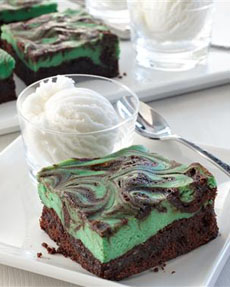
    [1] Recipe #1: Plan ahead for something green and delicious: Make a Grasshopper Pie for St. Patrick’s Day(photo and recipe © Taste Of Home).

    Grasshopper Cocktail
    [2] A Grasshopper cocktail (photo © Kuje Sakazar | Unsplash).

    A Bottle Of Bols Creme De Menthe
    [3] Crème de Menthe, a liqueur made from peppermint—often specifically Corsican mint (Gemini photo).

    ice-cream-grasshopper-pie-tasteofhome-230
    [4] Recipe #2: The easiest Grasshopper Pie is made with mint chip ice cream (recipe plus photos #3 and #5 © Taste Of Home).

    Grasshopper Cupcakes
    [5] The popular flavor combination has been ported into Grasshopper Cupcakes. Here’s the recipe (photo © King Arthur Baking).

    Grasshopper Baked Alaska
    [6] How about a Grasshopper Baked Alaska? Here’s the recipe.

    Grasshopper Cheesecake
    [7] Grasshopper Cheesecake. Here’s the recipe (photo © Betty Crocker).

     
    Preparation

    1. SPREAD the ice cream into the pie crust. Sprinkle with the cookies and candies.

    2. DRIZZLE with the ice cream topping and freeze until firm. Remove from the freezer 15 minutes before serving.

    Grasshopper Cupcakes
    [8] How about grasshopper cupcakes? Here’s the recipe (photo © King Arthur Baking).
     
     
    THE YEAR’S 9+ MINT HOLIDAYS

  • February 11: National Peppermint Patty Day
  • February 19: National Chocolate Mint Day
  • May, 1st Saturday: Kentucky Derby (Official Drink: Mint Juleps)
  • May 30: National Mint Julep Day
  • July 11: National Mojito Day
  • September 15: National Crème de Menthe Day
  • December 1: National Peppermint Bark Day
  • December 3: National Peppermint Latte Day
  • December 26: National Candy Cane Day
  •  
    Plus

  • January 23: National Pie Day is National Pie Day
  • February is Great American Pies Month
  • August 6: National Fresh Breath Day
  • August 18 is National Ice Cream Pie Day
  • September 15th is National Creme de Menthe Day
  •  
     
    THE YEAR’S 7 LIQUEUR HOLIDAYS

  • February 27: National Kahlua Day
  • March 5: National Absinthe Day
  • April 19: National Amaretto Day
  • July 2: National Anisette Day
  • July 14: National Grand Marnier Day
  • September 15: National Creme de Menthe Day
  • October 16: National Liqueur Day
  •  
    Plus

  • June 4: National Cognac Day
  •  
     

    CHECK OUT WHAT’S HAPPENING ON OUR HOME PAGE, THENIBBLE.COM.


    Comments off

    What’s A Cherimoya, And How To Serve It This Tropical Fruit

    WHAT’S A CHERIMOYA?

    When our colleague Hannah Kaminsky mentioned that cherimoya was her favorite fruit, we were curious.

    Depending on where you live, you may not come across this heart-shaped subtropical fruit often.

    We had to head to a Latin American supermarket uptown. But seek it out we did, and the trip was worth it.

    The fruit’s blend of banana, mango, passionfruit and pineapple notes is luscious. The ivory-colored flesh is creamy, similar to a ripe peach.

    Also called a custard apple in the U.S., cherimoya is believed to have originated in the Andes Mountains.

    The name originates from the Quechua (Inca) word chirimuya, meaning “cold seeds” (because the seeds germinate at high altitudes). It grows as a shrub or tree.
     
     
    HOW TO BUY & SERVE CHERIMOYA

    The pale green, shingled skin must be handled with care to avoid bruising. Choose unblemished fruit that is firm and allow it to ripen at room temperature.

    As it ripens, the skin will turn a darker green and will yield to gentle pressure. Refrigerate soft fruit and consume it as soon as possible for the best flavor.

    To serve, chill the cherimoya, cut it in half, spoon out the seeds and eat the flesh with a spoon. It can also be turned into desserts, such as crêpes, custard (hence the name “custard apple)”, dessert sauce (purée), fruit salad (as with apples, dip cut fruit in lemon or orange juice to prevent darkening), mousse, pie filling, pudding and sorbet.


    [1] A cherimoya. Now you know! (photo © specialty produce company Sid Wainer).

    cherimoya-baldorfood-230
    [2] Another perspective (photo © specialty produce company Baldor Food).


    You can freeze the cherimoya and eat it as ice cream, from the shell. Definitely try this!

    And you can drink it. Whip up a shake, smoothie, cherimoya Daiquiri or other fruity cocktail.

    To usher in spring, which began today, make Hannah Kaminsky’s tropical cocktail or smoothie, Cherimoya Lava Flow.


    cherimoya-shake-hannahkaminsky-230
    Celebrate spring with this Cherimoya Lava Flow. Photo and recipe courtesy Hannah Kaminsky.

      RECIPE: CHERIMOYA COCKTAIL OR SMOOTHIE,
    THE CHERIMOYA LAVA FLOW

    From Hawaii, where her local farmers market has plenty of cherimoyas, Hannah writes: “It’s a pricy treat to be sure,” even though grown locally. Her favorite way to enjoy the ripe, custard-like flesh is to dig in with a spoon.

    “With an overripe fruit, though,” she advises, “the only thing one one can do is blend and drink it. That’s where the idea to create a tropical shake came from, playing off the classic umbrella drink, the lava flow.

    “Fiery red rivulets of strawberry ‘lava’ flow throughout a classic coconut-pineapple rendition of this refreshing island staple, finished with a kiss of light rum. The sweet, creamy richness of cherimoya transforms the drink into an exotic new experience, which is just as luscious with or without the booze.

    “In lieu of fresh cherimoya, you can substitute either 1 medium banana or 2/3 cup young coconut meat for a different, yet still delicious, taste.”

    Of course, you can leave out the rum for a tropical smoothie. Substitute an equal amount of pineapple juice.


    RECIPE: CHERIMOYA LAVA FLOW

    Ingredients For 2 Servings

    For The Strawberry Lava Sauce

  • 1 cup strawberries, fresh or frozen/thawed
  • 2 tablespoons coconut sugar or light brown sugar, firmly packed
  • 2 tablespoons fresh lime juice
  •  
    For The Creamy Cherimoya Cocktail

  • 1 medium cherimoya
  • 1 cup diced fresh pineapple
  • 1 cup full-fat coconut milk
  • 1/4-1/2 cup light rum
  • Optional garnish: fresh pineapple wedges
  •  
    Preparation

    1. PREPARE the strawberry sauce first by combining the strawberries, sugar and lime juice in a small saucepan over low heat. Cook gently for about 10 minutes, just until the berries have softened and the sugar dissolved. Transfer to a blender and thoroughly purée so that no chunks of fruit remain. Strain out the seeds if desired and set aside.

    2. RINSE and dry the blender bowl and return it to the base. Slice the cherimoya in half and use a spoon to scoop out the flesh, discarding the black seeds as you encounter them. Add the cherimoya to the blender, along with the pineapple, coconut milk and 1/4 cup of rum. Blend on high speed until completely smooth. Add more rum to taste.

    3. DIVIDE the cocktail between two glasses and drizzle the strawberry “lava” into each one, aiming for the sides of the glass to create the greatest visual impact. Serve with a tall straw and an additional wedge of fresh pineapple for garnish.


    Comments off

    TIP: How To Microwave Artichokes

    The globe artichoke (Cynara cardunculus var. scolymus) is a species of thistle cultivated as a vegetable. It is actually a flower head, a cluster of numerous immature buds of what would be a blossom if not picked before it bloomed. The cardoon (Cynara cardunculus) is a wild variant available in spring.

    The artichoke stem is also delicious. It is an extension of the artichoke heart.

    The thistle family is a group of flowering plants that have leaves with sharp prickles. They, along with the inner choke (more about that in a bit), make eating whole artichokes a labor of love, like eating a whole lobster. But like that lobster, what’s inside is more than worth it.
     
     
    ARTICHOKE HISTORY

    Native to the Mediterranean, the artichoke was popular with the ancient Greeks and Romans. The Greeks called them kaktos and the Romans called them carduus. The English word evolved from the medieval Arabic al-khurshuf, which evolved into alcachofa in Arabic, alcachofa in Spanish, carciofo in Italian, artichaut in French and Artischocke in German.

    Artichoke cultivation spread to Italy and southern France in the late 15th and early 16th centuries. The original artichokes were small, the size of hens’ eggs. Breeding created the globe.


    thistle-Cynara-scolymus-alvesgaspar-wiki

    An artichoke in bloom in Montpellier, France. One the flower blooms, the flesh becomes coarse and barely edible. Photo by Alvesgaspar | Wikimedia.

     
    The Dutch introduced artichokes to England, and they were grown in Henry VIII’s garden by 1530. They arrived in the U.S. in the 19th century, brought to Louisiana by French immigrants and to California by Spanish immigrants. [Source]

    March 16th is National Artichoke Hearts Day.

    And now, let’s eat!
     
     
    HOW TO MICROWAVE ARTICHOKES

    Microwaving is much faster than conventional steaming on the stove top. Prep time is 3 minutes, cook time is 7 minutes.

    While freshly-harvested artichokes are sweet, some cooks add a drizzle of lemon juice before cooking to eliminate any bitterness. (We’ve never had a bitterness problem.)

    Ingredients

  • Globe artichokes, 8-12 ounces (or smaller varieties)
  • Optional: lemon juice
  • Plastic wrap
  • Optional for serving: lemon wedge, melted butter or other dip (see options in Step 6, below)
  •  

    microwave-artichoke-melissas-230ps
    Melissa’s sells artichokes ready to microwave, wrapped in plastic with a red timing device that pops up when it’s ready. Photo courtesy Melissas.com.


    Preparation

    1. RINSE the artichokes, not just to clean them but to provide moisture for microwaving. Tear off any tiny lower leaves or leaves that are blemished.

    2. TRIM any leaves from the stem. You can leave the stem on, or cut it off at the base of the globe and cook it next to it. (NOTE: Some supermarket artichokes have already been trimmed of the stem.)

    3. USING a scissors, slice off the prickly tips of the leaves. Our mother, ever the creative kitchen artist, used a pinking shears to create a decorative edge. Drizzle a tablespoon of lemon juice into the wells of the leaves.

    4. PLACE the artichoke in a microwave safe dish with 1/4 inch of water in the bottom, and over tightly with plastic wrap. Alternatively, you can cook them in a dish with a tight cover that keeps in the steam. Microwave on high for 7 minutes for one artichoke; 10 minutes for two; 15 minutes for four; 19 minutes for six.

    5. CHECK for done-ness by removing a leaf from the center of the leaves. If it pulls out easily, the artichokes are done. If not done, continue to cook at 30-second intervals. After you try this technique, you’ll know what works for your microwave.

     
    6. PLATE and serve. While we love eating them plain, perhaps with a squeeze of fresh lemon or lime juice, others like to dip the artichokes in melted butter or another dip such as aïoli (garlic mayonnaise), rouille (red pepper aïoli), romesco sauce, yogurt dip with your favorite herbs or spices (dill or cumin are popular) or vinaigrette (try this green olive vinaigrette).
     
    You can serve steamed artichokes warm/hot, at room temperature or chilled.
     
     
    HOW TO EAT AN ARTICHOKE

  • Tear off the leaves one by one, as you are ready to eat them. Place the leaf between your teeth, inside up, and use your teeth to scrape out the flesh at the base of each leaf. Discarding the remainder of the leaf on your plate or in a separate bowl.
  • The outer leaves are less tender, but it no flesh is coming off, the artichoke needs further cooking.
  • The leaves become increasingly tender as you work your way to the heart. You know you’re there when you encounter a pale, thistle-like center, the choke. It is not edible, and removing every last tiny piece is the one pain in the process. With a small spoon, scoop out and discard the choke.
  • You’ll then discover the prize, the artichoke heart: a truly delicious treat.
  •  
     
    HOW TO BUY ARTICHOKES

    We look for artichokes with the fewest blemishes and the longest stems.

    As with any produce, don’t buy more than you will use in a few days. Keep them in the fridge until you’re ready to cook them.

    How about a recipe for artichoke hearts-stuffed baked potato?


    Comments off

    PRODUCT: Marilyn’s Gluten Free Gourmet

    The gluten-free life can be a bit of a culinary safari. No sooner do you have the shy creature in sight, then it slips into the brush and you are left wistfully holding your binoculars, waiting for something else to emerge.

    This was the story of my favorite cheese crackers: They simply vanished for no good reason. I even went to the bakery’s Facebook page and tried to cajole them into bringing them back (to no avail).

    Then, in pursuit of some g-free graham crackers for Magic Bars, I stumbled across Marilyn’s Gluten Free Gourmet products in the natural foods section of an out-of-the-way Publix outside of Atlanta, Georgia.

    I grabbed the graham crackers and a pack of their cheese straws as well, ever hopeful that I might find a replacement for my late, lamented cheese crackers.

    After thanking the manager for stocking such a good variety of gluten-free products, I made haste to the car and opened the package of cheese straws. Out wafted a pungent Cheddar-y aroma that was the first hint of the Total Cheese Satisfaction that lay in store.

       
    marilyns-Cheese-Straws-230
    Marilyn’s Cheese Straws. Photo courtesy Agrafrutti.
     
    Beyond Delicious

    Can I say that they are even better than a wedge of Cheddar cheese? Because these cheese straws combine the sharp, sophisticated flavor of a fine Cheddar cheese with the crunch and texture of a delicious gluten-free cracker.

    Now, this is not a diet product. Marilyn’s is based in Georgia, so it is a rich and celebratory treat in the Southern tradition. The great part is that they are so satisfying, you don’t have to eat a whole package in one sitting—although some may choose to do so (ahem).

    But one to two straws can hold you down very well between meals. They would also make a great party snack, though one that would quickly disappear, so plan accordingly.

    As a bonus, Marilyn’s cheese straws come in several varieties: Traditional Cheddar, Jalapeño Cheddar, and a White Cheddar & Chive. Of these varieties I have to confess that the Jalapeño is my favorite; the spice of the pepper enlivens and cuts the richness of the cracker.


    marilyns-Graham-Crackers-agrafrutti-230
    Marilyn’s Graham Crackers. Photo courtesy Agrafrutti.

      Marilyn’s also makes a great graham cracker, with a hint of cinnamon, and a line of bread mixes that I am eager to try, particularly their Rosemary Sea Salt.

    All products are safe for those with gluten intolerance and Celiac disease and contain no trans fats, preservatives, artificial flavors or artificial colors. Some products do contain dairy, so please read the label; and they are produced in a facility that also uses tree and ground nuts.

    Marilyn’s products are available at Agrafrutti.com and in some Whole Foods Markets.

  • Five-ounce boxes of each variety are $5.99.
  • Eight-ounce gift boxes are $12.95.
  •  
    The brand also offers Artisan Flatbread Crackers and Cheese Buttons, not yet tried by us (but we look forward to them).
     
    — Georgi Page


    ABOUT MARILYN’S GLUTEN FREE GOURMET

    After many years of passionate baking at home, Marilyn Santulli was diagnosed with gluten intolerance. To continue enjoying gourmet baked goods and share them with other GF consumers, she decided to open a gluten-free bakery.

    Her American Gra-Frutti Bakehouse & Shop in Roswell, Georgia is open weekdays from 9 to 5 (fresh breads need to be ordered in advance). In addition to breads, muffins and cakes, the shop carries all varieties of the Marilyn’s Gluten Free Gourmet packaged line.


    Comments off

    It’s National Frozen Food Day. Who Invented Frozen Food?

    While fresh is fashionable, we can’t ignore the importance of frozen foods today, National Frozen Food Day. While March 6th is one day to celebrate, the entire month of March is National Frozen Food Month.

    Frozen food revolutionized the way Americans consume food. First came the joy of off-season fruits and vegetables (which are tastier and a fraction of the price when purchased frozen at their peak than shipped fresh from South America or elsewhere). Then the ability to buy larger quantities when on sale. Then the convenience for busy moms.

    In 1984, President Ronald Regan declared March 6th to be National Frozen Food Day, stating: “…I call upon the American people to observe such day with appropriate ceremonies and activities.”

    Our ceremony consists of frozen foods for breakfast and dinner, at least. We already had a delicious Cedarlane omelet, and cooking SeaPak frozen butterfly shrimp for lunch (thanks, SeaPak, for the samples).

    (For dinner, it’s the last day of New York Restaurant Week and we’re heading out.)

    Most supermarkets today have 2-3 aisles of frozen foods, and many Americans rely upon the convenience of frozen food for their weekly dinners and other meals.

    > Check out the best foods to buy frozen instead of fresh.

       
    seapak-jumbo_butterfly_shrimp-230
    Today, it’s jumbo butterfly shrimp for lunch at THE NIBBLE. You can bake or fry the frozen shrimp. Photo courtesy SeaPak.


    btrflyshrimp_scaloppini_seapak-230
    Butterfly shrimp “scallopini” with lemon, butter, garlic, parsley, and white wine. Here’s the recipe. Photo courtesy SeaPak.
      WHO INVENTED FROZEN FOOD: THE HISTORY OF FROZEN FOOD

    Since ancient times, foods were frozen in climates that were cold enough to freeze them (here’s more about early freezing and refrigeration). But the invention of the home refrigerator-freezer after World War II brought modern-age frozen food into every home.

    Many people think that Clarence Birdseye invented frozen food; but in fact, others preceded him.

    However, Birdseye invented good-tasting frozen food. Before Birdseye, foods were frozen at a fairly slow rate. This caused large ice crystals to form, which ruptured the cell membranes of the food. When the food was defrosted, the ice crystals melted and water would leak from the food, taking with it flavor and texture.

    What Birdseye did invent, in 1924 was the quick freezing method, which produces the type of quality frozen foods that we know today.

     
    While working as a fur trader in Labrador, Newfoundland, Birdseye discovered that the fish that he caught froze almost immediately after being pulled from the water—and that the fish was just as delicious when thawed out months later. He developed quick-freezing methods that retained the taste and texture of foods.

    Another revolution in frozen food came in 1948 when Sea Island Packing Company (SeaPak) in Georgia developed the Individual Quick Freezing (IQF) to flash freeze shrimp. This process locks in flavor at its original state of freshness. The new process forever changed the way the shrimp industry (and others) would freeze products. [Source]
     
     
    The First Home Freezer

    The first home refrigerator with a small freezing compartment that held two ice cube trays was launched in 1923 (it was a Frigidaire—Source.)

    Large “deep freezers” for retail use only became common during the 1940s. That’s why people in period novels and films went to the neighborhood drugstore to get ice cream! Big freezers did not go into mass production for home use until after World War II. Along with new refrigerator-freezer units, they enabled American homes to stock ice cream and other frozen foods.

    Prior to World War II, Americans primarily ate locally and regionally grown foods. The technology didn’t exist to pack and transport fresh foods over greater distances. Consequently, only those who lived near coastal waterways had access to shrimp, clams, oysters, and other seafood.

    Since shrimp is America’s #1 consumed seafood—a lot of that, for both home and foodservice use, is frozen—and SeaPak Shrimp & Seafood Company is the #1-selling retail brand of frozen shrimp entrees, we make them our choice for lunch. Check out all the varieties at SeaPak.com.
      

    Comments off

    The Nibble Webzine Of Food Adventures
    RSS
    Follow by Email


    © Copyright 2005-2026 Lifestyle Direct, Inc. All rights reserved. All images are copyrighted to their respective owners.