THE NIBBLE BLOG: Products, Recipes & Trends In Specialty Foods


Also visit our main website, TheNibble.com.

RECIPE: Apple Dumplings For National Apple Dumpling Day


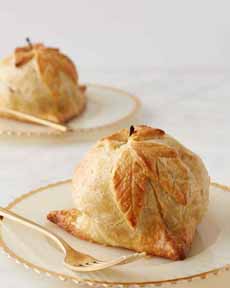
[1] A classic apple dumpling, decorated with pastry scraps to look like an apple. Here’s the recipe from Martha Stewart.


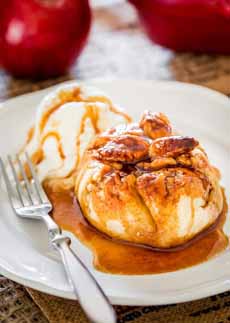
[2] Add some ice cream, pan sauce or caramel sauce, and maybe some toasted pecans. Here’s the recipe from Jo Cooks).


[3] Apple dumplings as rugelach. Rugelach was rolled with a filling, but not apple. This version uses refrigerated crescent dough. Here’s the recipe from Cincy Shopper.

  Say the word “dumpling” and most people we know would think of Chinese and Japanese dumplings, two bites of pork, shrimp or vegetable stuffing in a noodle casing, fried or steamed.

But before the rise* of Asian restaurants in the U.S., most Americans thought of a dumpling as a sweet pastry wrapped around sliced apples or other fruit (photos #1 and #2).

September 17th, National Apple Dumpling Day, celebrates that pastry, a different form for the ingredients of apple pie. If you’re in the mood, we have a recipe below.

These delicious filled pastries are made by putting cored and peeled apples on a piece of dough, along with butter, cinnamon, lemon zest and sugar. Sometimes raisins or dried cranberries are added.

  • Some people bake the whole cored apple, creating a round shape.
  • Some use half an apple, creating a domed shape.
  • Others prefer diced apples, which are easier to spoon up and eat.
  • More recently, bakers have been playing with other shapes: horns (photo #3), pyramids, squares and even crescents, like Japanese gyoza.
  •  
    The dough is then folded over the filling, and dumplings are popped into the oven.

    What’s the difference between an apple dumpling and an apple turnover, you may ask? Largely, the shape:

  • Apple dumplings are round or dome-shape and filled with whole or halved apples.
  • Turnovers are typically triangles filled with diced apples.
  •  

    APPLE DUMPLING HISTORY

    The word dumpling is first found in England around 1600, in the Norfolk dialect. It possibly derived from the Low German word for lump, dump. It described a small, usually globular, piece of boiled or steamed dough. Initially, dumplings were savory, filled with meat [source].

    But the first dumplings—bite-size packets of filling wrapped in dough—are thought to have originated in the Eastern Han Dynasty of China, some 1,800 years ago.

    They were a way to serve meat in smaller, cheaper amounts. The first dumplings were thought to be filled with mutton, chilis and herbs, followed by other meats and seafood.

    Much later, in Europe, a dumpling was a ball of dough cooked and served in soup or stew.

    In Northern Europe, the dough was usually made with suet†, and was boiled, as in today’s Chicken And Dumplings. These pastries were also fried or baked.

    Other regions used other ingredients: potatoes (like Italian gnocchi, matzoh meal (Jewish matzoh balls) and flour dumplings that were often filled (Jewish kreplach, Polish pierogis, Russian pelmeni and numerous others).

    Dumplings likely emerged as a food of the poor: a cheaper way to satisfy hunger alongside a small piece of meat. The concept evolved into pastries filled with ground meat.

    Later, the word was ported to describe larger pastry dumplings filled with fruit, which became popular in Northern Europe. Apples, pears, plums and other fruits found their way into these sweet dumplings.

    Fruit dumplings were popularized in the U.S. by the Pennsylvania Dutch, who immigrated from Germany (Dutch is an American mis-spelling of their nationality, Deutsche).


    RECIPE: EASY APPLE DUMPLINGS

    This recipe is adapted from Southern Living and uses refrigerated pie crusts as a hack.
     
    Ingredients For The Syrup

  • 1-1/2 cups sugar
  • 2 cups water
  • 1/4 teaspoon cinnamon
  • 1/4 teaspoon nutmeg
  • 1/4 cup butter
  •  
    For The Apple Filling

  • 1/2 cup brown sugar
  • 1 teaspoon cinnamon
  • 1 teaspoon lemon zest
  • 1/4 teaspoon nutmeg
  • 2 tablespoons butter, softened
  • 1/4 cup butter
  • Optional: 1/4 cup dried cranberries or raisins
  •  
    Plus

  • 8 medium Granny Smith apples, peeled and cored, whole
  • 1 package (15 ounces) refrigerated pie crusts
  •  
    Optional Garnishes

  • Vanilla ice cream or whipped cream, caramel sauce, toasted pecans or walnuts
  •   Granny Smith Apples
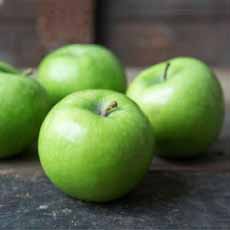
    [4] Granny Smith Apples (photo courtesy Good Eggs).

    Microplane Zesting Lemons
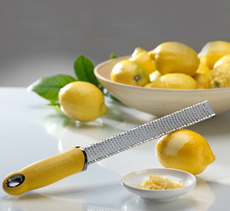
    [5] A bit of lemon zest perks up any fruit dessert (photo courtesy Microplane).


    Preparation

    1. COMBINE the sugar, water, cinnamon and nutmeg in a medium saucepan and bring to a boil over medium-high heat, stirring constantly. Reduce the heat and simmer for 10 minutes, stirring occasionally.

    2. REMOVE from the heat and add the butter. Stir to combine and set the syrup aside.

    3. COMBINE the apple filling ingredients in a small mixing bowl Mix with a fork until you have a crumb consistency. Set aside.

    4. CUT each pie crust in half. Form each half into a ball and place on a lightly floured surface. Roll into 8-inch circles.

    5. PEEL and core the apples. When you core, leave enough of a well to hold the filling.

    6. PLACE each apple onto the center of each circle and fill the empty core with the crumb filling. Fold the dough over the apples, pinching at the top to seal. Place apples in a lightly greased 13″ x 9″ baking dish. Drizzle with the syrup.

    7. BAKE at 375°F for 40-45 minutes. Serve warm with vanilla ice cream and other garnishes as desired.
    ________________

    *The 1965 Immigration & Nationality Act enabled many more Asians to immigrate to the U.S., where they established restaurants.

    † Suet is a special type of fat, the hard white mass of fat surrounding the kidneys and loins of cattle (plus sheep and other animals). It has long been used in European cooking to make puddings, pastry and mincemeat. Suet has the the cleanest and mildest taste of all the animal’s fat. Fat from grass-fed beef fat is the best (although in the suet-loving past, all beef was grassfed!).

    Read more at: https://blog.thenibble.com/2018/07/10/tip-of-the-day-beef-tallow/


    Comments off

    FOOD 101: The History Of Peanuts For National Peanut Day

    September 13th is National Peanut Day. January 24th is National Peanut Butter Day, February 21st is National Boiled Peanut Day, and PB&J lovers can look forward to April 2nd.

    A bit of history about the peanut (Arachis hypogaea), also known as an earthnut, goober, groundnut, and monkey nuts.

    But it isn’t a nut†, it’s a legume, a member of the pea and bean family, Fabaceae. If you want to sound truly knowledgeable, it’s a leguminous perennial plant.

    The difference: A legume is a pod with multiple seeds. A nut has a hard outer shell protecting a single seed, the “nut.” You can drill down here.

    The history of peanuts follows. Elsewhere on The Nibble:

    > Boiled peanuts: a delicious treat!

    > The year’s 8 peanut holidays.

    > The year’s 12 peanut butter holidays.
     
     
    THE HISTORY OF PEANUTS: A NEW WORLD CROP

    Along with the bean, cacao, cassava, chia, chile, corn, papaya, pineapple, potato and sweet potato, quinoa, squash, sunflower, tomatillo and tomatoes, peanuts originated in Latin America.

    According to the National Peanut Board, botanists believe that peanuts originated in Brazil or Peru. While there is no fossil record, we have a pottery record: Pottery in the shape of peanuts or jars decorated with peanut motifs date back as far as 3,500 years.

    The archaeological record also shows that as early as 1500 B.C.E., the Incas in Peru used peanuts as a sacrificial offering. They were entombed with mummies for the afterlife. Tribes in central Brazil made a beverage from ground peanuts and maize.

    Spanish and Portuguese explorers encountered peanuts in the 16th century; the Spanish in Mexico, the Portuguese in Brazil. They brought peanuts back to their home countries, and from there traders and explorers spread them to Asia and Africa.
     
     
    PEANUTS COME TO THE U.S.

    Peanuts came to North America in the 1700s via Africa, where they had been introduced by Portuguese traders. But it wasn’t until the early 1800s that peanuts were grown in the U.S. as a commercial crop, first in Virginia, where they were used mainly for oil and as a food for livestock and the poor.

    Peanuts were eaten by Civil War soldiers as a protein-rich subsistence food. The Southern folk song “Goober Peas” was sung by Confederate soldiers (here’s a version sung by Burl Ives and Johnny Cash). After the war, Union soldiers brought them north.

    Peanut popularity grew in the late 1800s thanks to P.T. Barnum, whose circus wagons traveled across the country selling “hot roasted peanuts” to the crowds. Soon street vendors and then ballpark vendors began selling them.

    Around 1900, labor-saving equipment was invented for planting, cultivating, harvesting and picking the peanuts, then shelling and cleaning the kernels. With an abundance of supply, demand grew and their use expanded, especially for oil, roasted and salted nuts, peanut butter and candy (source).

    And you get to enjoy them!

      Bowl Of Peanuts
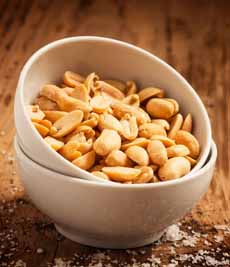
    [1] Ready for snacking and garnishing (photo © PB Crave).

    Boiled Peanuts
    [2] Boiled peanuts are a popular Southern food, boiled in salted water that gives them a fresh, legume flavor. Here’s a recipe (photo © Bittersweet Blog).

    Peanut Seedlings Growing In A Field
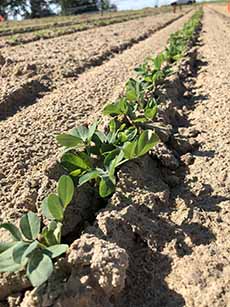
    [3] Peanut seedlings. The peanuts grow underground with the roots (photo © University Of Georgia).

     
    Peanuts Pulled From The Ground
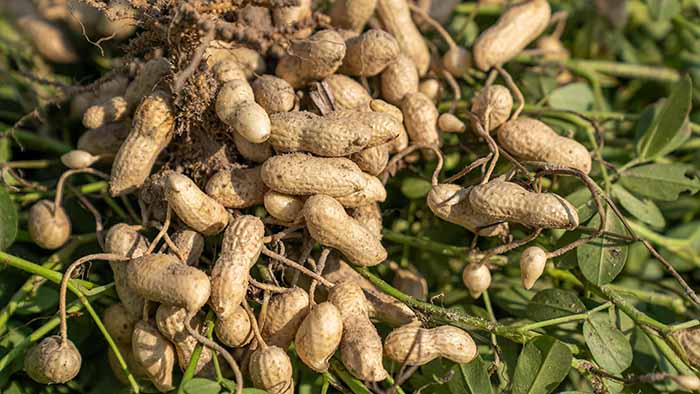
    [4] Just pulled from the ground (photo © Mark Stebnucjki | North Carolina Farm Bureau).
     
    ________________
     
    *Tree nuts do not belong to a single botanical familyy but are diverse seeds from several distinct plant families. Major families include Juglandaceae (walnuts, pecans), Anacardiaceae (cashews, pistachios), Proteaceae (macadamias), Lecythidaceae (Brazil nuts), Rosaceae (almonds), and Betulaceae (hazelnuts).

    Because “tree nut” is a culinary and allergy-related classification rather than a strict botanical one, the various nuts come from entirely different botanical orders and families. These plants last shared a common ancestor roughly 300 million years ago, making them very distant relatives, according to an evolutionary analysis. While they share a Domain (Eukarya), a Kingdom (Plantae) and a Clade (Angiosperms), they are highly diverse in their specific taxonomic placement.

    Botanically, all tree nuts (as well as peanuts, which are legumes) converge at the Clade level, right below the Domain (Eukarya) and Kingdom (Plantae) levels. More specifically, they all belong to the Clade of Angiosperms (all plants producing flowers and seeds enclosed within a fruit), which is generally classified as the phylum/division Tracheophyta (vascular plants). Here’s the breakdown of why they don’t share a closer, common rank:

    > Different Orders/Families: Tree nuts belong to at least five different orders: Ericales (Brazil nuts), Fagales (chestnuts, hazelnuts, pecans, walnuts), Proteales (macadamia), Rosales (almonds), and Sapindales (cashews, pistachios).

    > Diverse Botanical Structures: They are not all true nuts; they are a mix of true nuts (hard shell, dry fruit), drupes (seed inside a stony pit, like almonds), and seeds.

    The Taxonomic Hierarchy, using as an example the common apple tree, Malus domestica:
    > Domain (highest rank): Eukarya.
    > Kingdom (broad groups): Plantae
    > Phylum or Division* (groups within a kingdom): Angiosperms (or Magnoliophyta); this group consists of multicellular organisms that typically produce their own food through photosynthesis. In botany, the term Division is often used instead of Phylum.
    > Class (groups within a phylum): Eudicots (or Magnoliopsida); this group represents flowering plants that produce seeds within a fruit.
    > Order (groups within a class): Rosales; these are flowering plants that have two embryonic leaves (cotyledons) when they sprout.
    > Family (groups within an order): Rosaceae; this order includes a wide variety of plants, including roses, berries, and many orchard fruits.
    > Genus (closely related species): Malus; Ccommonly known as the rose family, this group includes many economically important crops like pears, plums, and cherries.
    > Species (most specific group/individual): domestica; this genus specifically refers to the group of trees and shrubs known as apples and crabapples. This is the specific identifier for the orchard apple or common apple that we eat.
    > Cultivar: While not part of taxonomy, this refers to the different varieties of apple: Delicious, Gala, Granny Smith, Honeycrisp, etc.

    Taxonomy mnemonic: “King Philip Can Only Find Green Socks”: Kingdom, Phylum, Class, Order, Family, Genus, Species
     

    CHECK OUT WHAT’S HAPPENING ON OUR HOME PAGE, THENIBBLE.COM.


    Comments off

    TIP OF THE DAY: Frozen Herb & Olive Oil Cubes


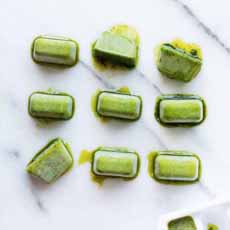
    Freeze leftover fresh herbs in olive oil (photo courtesy Pre Brands).
     

    What do you do when you have leftover chopped herbs and minced garlic?

    Some people place them in a small container, to be used the next day in eggs, on salads, or to garnish other foods.

    Some people freeze them, but they become soggy and lose flavor.

    Some people toss them.

    Here’s another solution: Freeze the chopped herbs in olive oil (or cooking oil of choice).

    More specifically, place the herbs in ice cube compartments and fill with olive oil.

    Then, just pop a cube to.

  • Cook eggs.
  • Sauté anything, from cutlets to seafood to vegetables.
  • Add them to the roasting pan, the sauce pot or the soup pot.
  •  
    The olive oil will quickly melt when you turn on the heat.

    You can also let the cube melt at room temperature and use it to flavor a vinaigrette.

    It’s a great trick for a big hit of flavor without having to buy fresh herbs.
      

    Comments off


    © Copyright 2005-2026 Lifestyle Direct, Inc. All rights reserved. All images are copyrighted to their respective owners.