|
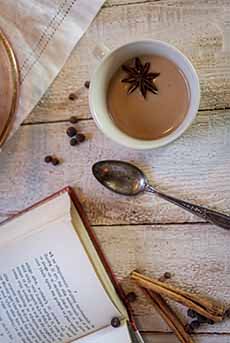
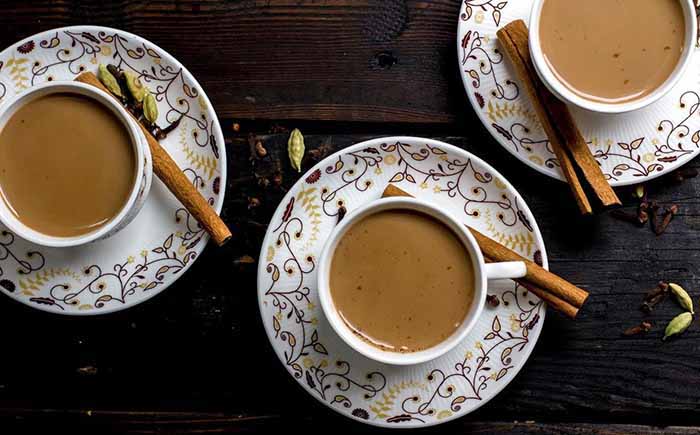
[1] Relax with a cup of chai. This one is garnished with star anise. You can re-use one of the star anise pieces you used to brew the concentrate (photo © The Prairie Homestead).

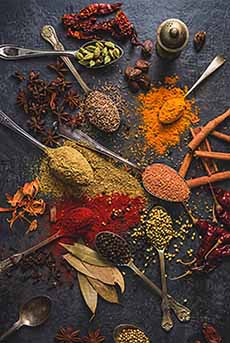
[2] Masala chai is a symphony of spices (photo © Shantanu Pal | Pexels).
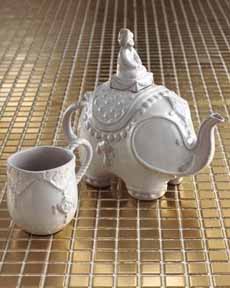
[3] Enjoy your Indian tea in an elephant tea pot (alas, this one from Houzz is no longer available, but other designs are).
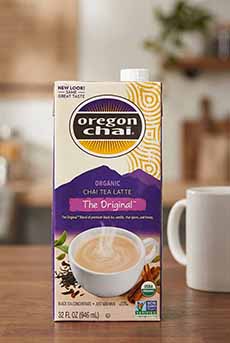
[4] The brand that started the chai craze in the U.S. The original variety has expanded into six varieties, including sugar free and caffeine free (photo © The Nibble).
|
|
Updated September 2026
The fall season ushers in traditional autumnal foods and beverages.
In the latter department, there’s apple cider, hot chocolate, mulled wine/mulled cider/hot buttered rum, spiced tea (like Constant Comment), flavor twists on cocktails (like a maple Old Fashioned), and the infamous Pumpkin Spice Latte (infamous for its 50g of sugar).
And then, there’s masala chai, which translates to “spiced tea” in English: masala means “spice blend” or “mixture of spices” in Hindi/Urdu*, and chai is the word for tea.
Note that when someone asks for “chai tea,” in English, they’re asking for “tea tea,” since “chai” already means tea! This is called redundant translation, and if you enjoy learning the quirks of language, check out the ‡footnote.
“Masala chai” specifically refers to tea brewed with a blend of aromatic spices like cardamom, cinnamon, cloves, ginger, and black pepper, along with milk and sugar.
There are numerous brands of chai on the market, each with its own blend of spices.
If you’re a fan of chai but want to customize your recipe, try the chai blend recipe below.
Then, invite everyone for a tea party.
Tea trivia: After water, tea is the most widely consumed beverage in the world. Coffee takes third place.
Below:
> Make your own chai blend concentrate.
> Snack time or tea party: foods to pair with chai.
> Pairing cheese and chai.
> The history of masala chai.
> Chai comes to the U.S.
Elsewhere on The Nibble:
> The different types of tea: a photo glossary.
> The history of tea.
> The year’s 23 tea holidays.
> The year’s 5 Indian food holidays.
1. RECIPE: CHAI CONCENTRATE
The recipe that follows is pleasantly sweet and spicy, but not too sweet or too spicy. After you try the first batch, you can tweak the ingredients if you like.
You can make the recipe without a sweetener at all so that people (dieters, the sugar-averse) can have their drink as they prefer.
Ingredients For 1 Quart Of Concentrate
- 6 cups water
- 1/4 to 1/3 cup sweetener of choice
- 2″ to 3″ piece fresh ginger root, sliced
- 5 cinnamon sticks
- 1 teaspoon peppercorns
- 3 star anise
- 15 cloves
- 5 allspice berries
- 2 teaspoons cardamom seeds
- 5 black tea bags
- Milk of choice
Preparation
1. BRING the water and sweetener to a boil in a medium pot, and simmer until the sweetener is fully dissolved.
2. ADD all of the spices, and continue to simmer on low heat for 20 minutes.
3. REMOVE the mixture from the heat, add the tea bags, and let them steep for 10 minutes.
4. STRAIN out the spices and tea bags and store the concentrate in the fridge (it will last for several weeks).
5. SERVE: Mix the chai concentrate 1:1 with milk. Gently heat in a small saucepan until it reaches the desired temperature (we heated it for 2 minutes 45 seconds in our microwave; yours may take less or more time). Pour into a mug and enjoy…perhaps with some cinnamon graham crackers or any of the foods below.
See our recipe tips after the photo.
|
[5] This photo is from Charles Chocolates, which recommends a piece of chocolate with your chai. We agree (photo © Charles Chocolates).
Recipe Tips
- If you have ground spices instead of whole, look online for the equivalent amount for substitution. If you don’t have one of the ingredients and don’t want to purchase it, just leave it out.
- Use a muslin bag or cheesecloth to hold the spices; then you don’t have to strain them out.
- For extra richness, trade some of the milk for cream or half-and-half.
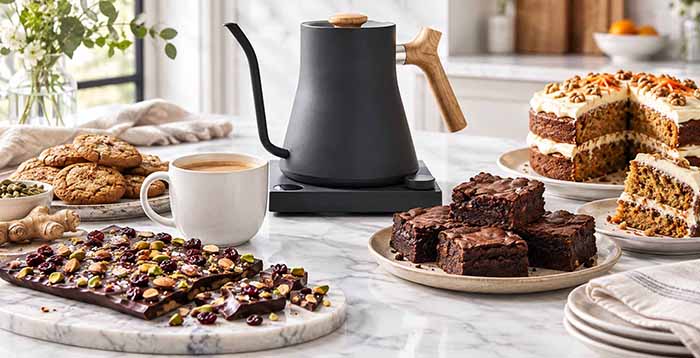
[6] How about a chai tea party with brownies, carrot cake, chocolate bark, cookies, or any of the other choices below (photo © The Nibble).
2. SNACK TIME: FOODS TO PAIR WITH A CUP OF CHAI
Chai pairs especially well with something lightly sweet and warmly spiced:
One of our colleagues recommends ginger-cardamom cookies with a piece of dark chocolate. The spice echoes the chai while the chocolate adds a pleasantly bitter contrast.
But there are others for your consideration:
- Cake: banana bread, carrot cake, coffee cake, spice cake or chocolate spice cake, chocolate-orange cake, chocolate-cardamom cake, or chocolate cake with a bit of cinnamon in the batter.
- Cookies: brownies† (a bar cookie), cardamom shortbread, chocolate biscotti, ginger cookies, LU cookies topped with a piece of chocolate, or snickerdoodles.
- Chocolate bars: chocolate with caramel, chiles, ginger, orange, Mexican spices, pistachio, toffee, or white chocolate with chai spices; dark chocolate with sea salt; milk chocolate with toasted almonds or hazelnuts.
- Chocolate bark: dark or semisweet chocolate with almonds, cranberries, pistachios, topped with some little flaky salt; milk chocolate with pretzels, toffee, and roasted hazelnuts; white chocolate with pistachios, dried apricots, and cinnamon.
- Chocolate bonbons (sometimes called truffles††): cardamom ganache, espresso, ginger ganache, hazelnut praline, orange cream, or salted caramel.
- Savory: cheese and crackers, pakoras, samosas, spiced nuts.
Chai Tea Party Idea
Get the gang together for a chai potluck. When people ask what they can bring, you have plenty of “assignments” above.
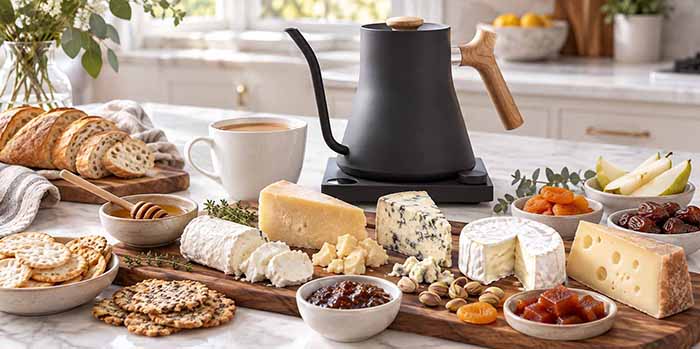
[7] If you prefer cheese to sweets, check out the selection below (photo © The Nibble).
3. PAIRING CHAI WITH CHEESE
Chai pairs with a wide variety of cheeses. You can put together a plate with mild, medium, and sharper profiles.
Serve them with baguette slices, oat biscuits, seeded crackers, thin crispbreads, or plain water crackers.
Good accompaniments are dates, candied ginger, dried apricots, fig jam, honey, pear or apple slices, and pistachios.
In alphabetical order, consider:
- Blue cheese: A mild, creamy blue such as Gorgonzola dolce or Cambozola, a creamy, mild blue from Germany that combines the rich, soft texture of Brie with the savory bite of Gorgonzola. Serve with honey or pear. Steer clear of pungent blues, which will overpower the tea.
- Brie or Camembert: Soft, buttery, and mild; especially good with a chai that has prominent cinnamon and vanilla notes. Brie and Camembert are the same recipe, made in different locations and different formats (Brie is a small wheel, Camembert a large one).
- Cheddar, aged: Sharp Cheddar provides a savory contrast to sweet chai. Try an earthy or clothbound Cheddar rather than an extremely sharp one. Our favorite U.S. clothbound Cheddar is Cabot Clothbound Cheddar. The U.K. has several greats, including Keen’s Farmhouse Cheddar, Montgomery’s Cheddar (matured by Neal’s Yard Dairy), and Quicke’s Mature Clothbound Cheddar.
- Goat cheese, fresh: Mild, tangy, and creamy, serve it with honey, pistachios, or dried apricots.
- Goat cheese, aged: Firmer and nuttier, with enough character to stand up to strong masala chai.
- Gouda: Young Gouda is creamy and mellow; aged Gouda adds caramel and butterscotch notes that echo chai.
- Gruyère or Comté: Nutty and gently sweet, with enough complexity for a robust chai.
- Manchego: Nutty, slightly salty, and firm, it pairs well with almonds, dates, or quince paste (membrillo).
- Paneer: Mild and fresh, it’s particularly appropriate if the chai is served alongside other Indian-inspired foods like the pakoras and samosas mentioned above.
4. THE HISTORY OF CHAI (MASALA CHAI)
The original masala chai (masala means spice, chai means tea) is very different from the contemporary recipe. The first version was an ancient Indian ayurvedic beverage—a cleansing spice tonic that did not include any tea.
When the British began to establish tea plantations in Assam, in 1835, they added milk and sweetener to their tea, as they did at home. At the time, tea was too expensive for most Indians and was largely grown for export (this is unfortunately true of other third-world crops, including coffee and quinoa).
In the early 1900s, the British-owned Indian Tea Association began to promote tea consumption to Indian consumers. Because black tea was still an expensive ingredient, vendors used milk, sugar and spices—the ingredients of today’s masala chai—to create a flavorful drink while keeping costs down.
The drink’s popularity spread throughout India and became even more popular in the 1960s, when mechanized tea production made black tea affordable for the common man.
5. CHAI COMES TO THE U.S.
While everything else on the fall beverage list has been on American menus for centuries, chai has only become nationally popular since the end of the 20th century, when artisan tea companies began to add it to their line
The 1990s was the decade when chai exploded into the American mainstream.
While traditional masala chai had been enjoyed in Indian households for generations and served in Indian restaurants in the U.S., it transformed into a ubiquitous coffeehouse staple during the mid-to-late ‘90s as a result of two major catalysts:
- The Rise of Oregon Chai: In the mid-1990s, a small company called Oregon Chai started distributing a concentrated, spiced tea blend to coffee shops and grocery stores, making it simple for cafes to steam it with milk.
- The Starbucks Effect: Shortly after, Starbucks officially added the Chai Tea Latte to its nationwide menus, instantly introducing millions of Americans to the sweet, spiced flavor profile and cementing it as a permanent fixture of the American cafe scene.
Chai Today
The state of chai in the U.S. has evolved from a trendy 1990s coffeehouse novelty into a multi-billion-dollar, deeply entrenched fixture of American beverage culture. Sales have steadily expanded, driven by a massive shift toward specialty variations, health consciousness, and a cultural appreciation for more authentic preparations.
Chai is experiencing steady, robust growth. The North American market commands a massive share of the global chai sector. It has firmly established itself as a permanent alternative to coffee rather than a passing fad. While standard coffeehouse chains built their business on ultra-sweet, syrup-based chai lattes, retail and grocery channels now feature everything from bottled ready-to-drink (RTD) iced chais to loose-leaf authentic spice blends and concentrated home-brewing kits.
The contemporary chai landscape looks quite different from the sweet, one-note powder or liquid concentrates of the ‘90s.
Several distinct trends shape today’s market:
- The Push for Authenticity (“Real” Masala Chai): A major counter-trend to the overly sweet coffee-shop style has been the rise of traditional, stovetop-style masala chai. Driven by specialty tea houses, South Asian cafés, and independent artisan brands, consumers increasingly seek out brews made by actively simmering loose-leaf black tea with real crushed whole spices (cardamom, ginger, cinnamon, cloves, black pepper) and fresh milk rather than relying on artificial flavorings.
- Plant-Based and Functional Integrations: Because of dietary shifts, plant-based variations are ubiquitous. Oat milk and almond milk chais dominate menu boards, accounting for a large percentage of new café orders. Additionally, “wellness” chais infused with functional ingredients like adaptogens, turmeric (golden milk crossovers), ashwagandha, and medicinal mushrooms have carved out a solid niche.
- Alternative Bases and Flavor Profiles: Innovation has expanded past standard black tea. Cafes now frequently feature variations like green tea chais, rooibos-based caffeine-free options, floral notes (such as Kashmiri rose), and nutty fusions like cardamom-pistachio.
- Texture and Formatting: Following broader modern beverage trends, iced chais topped with cold foam, blended chai frappés, and even “boba chai” (chai paired with tapioca pearls) have become popular menu items, particularly among younger consumers looking for customizable, dessert-like experiences.
What was once introduced to America as a single, uniform spiced-tea latte has matured into a diverse category that spans everything from hyper-traditional, slow-simmered street styles to modern, health-conscious functional beverages.
Oregon Chai, the brand that started it all, has expanded its line beyond Original to Caffeine Free, Salted Caramel, Slightly Sweet, Spiced, Sugar Free, and Vanilla.
Check out dozens of recipes for hot and iced chai, chai cocktails, and chai-based desserts.
*“Chai” in different languages: All related forms of the word chai—Turkish çay, Russian/Persian/Hindi/Urdu chay, etc.—derive from the original Mandarin, cha. Cha became the Cantonese, Mandarin and Japanese word for tea. Other Chinese dialects have different words; e.g. the Wu dialect spoken around Shanghai uses the word zu and the Hokkien dialect spoken around the port of Xiamen in the Fujian province uses the word tay. The word “cha” traveled to the Middle East and Eastern countries, while “tay” traveled to Europe and became our word for tea.
Xiamen was the port of trade first used by Europeans (mainly the Portuguese) in 1541. Near the end of the Ming Dynasty, in 1644, British merchants set up trading posts there; in the 19th century, it was China’s main port for exporting tea. As a result, the Hokkien dialect spoken there, not Mandarin which traveled west via overland trade routes, influenced what Europeans called the beverage. What the Xiamenese people call tay, the British spell tea, the French spell thé, the Spanish té, the Italians tè and the Germans, tee. The pronunciation varies from “tay” to “tee.”
Other words from the Hokkien language that entered English: ketchup (kiô-chap), Pekoe (pekh-hô), kowtow (khàu-thâu) and Japan (Jit-pún).
†Brownies are not classified as cake, although they may seem similar to a sheet cake. In fact, brownies are bar cookies—finger food which separates them from the cake category, the latter requiring a fork.
††Bonbons vs. pralines vs truffles vs filled chocolates: This is one of the more confusing group of names for a chocolate shell filled with a variety of centers—caramel, chocolate ganache, creams, nougats, etc. Bonbon (French for “good, good”) is the French term. In 1912, Brussels chocolatier Jean Neuhaus II, who developed a process that created hard, hollow shells (instead of hand-dipping the centers), chose to call his filled chocolates pralines. The original French truffle was a ball of ganache, rolled in cocoa powder; later chopped nuts and confectioners’ sugar were used as coatings, and ultimately, a hard chocolate shell was used as coating. Because of this latter coating, Americans began calling any filled chocolate shell a truffle. The Nibble sticks with the original French, or the term filled chocolates. In addition to Belgian pralines are two other confections that use the word “praline.”
‡Hindi and Urdu are very closely related languages that share the same grammatical structure and much of their vocabulary, but they differ in several key ways. Briefly, Hindi is the official language of India (along with English). Urdu is more associated with Islamic culture and was historically the court language of Muslim rulers in the Indian subcontinent. Urdu is the national language of Pakistan and also spoken by Muslims in India.
In everyday conversation, Hindi and Urdu speakers can easily understand each other: The spoken forms are essentially the same language. In writing, however, Hindi uses the Devanagari script (the same used for Sanskrit) while Urdu uses a modified Arabic script, written right to left.
Linguistically, many scholars consider them to be two standardized forms of the same language, sometimes called Hindustani.
‡“Redundant translation” or “RAS syndrome” (Redundant Acronym Syndrome) occurs when English speakers combine a foreign word with its English equivalent. This happens because as foreign words enter English, speakers often lose awareness of the original meaning and treat them as proper nouns or specific terms rather than translations. The redundancy helps clarify meaning for English speakers who might not know the foreign word’s literal translation. Examples:
Food Terms:
> Chai tea (chai = tea)
> Gyro sandwich (gyro = a type of sandwich/wrap)
> Naan bread (naan = bread)
> Panini sandwich (panini = sandwiches, plural of panino)
> Queso cheese (queso = cheese in Spanish)
> Salsa sauce (salsa = sauce)
> Shrimp scampi (scampi = shrimp in Italian) [Note: Scampi is the plural of the Italian scampo, meaning a langoustine or Norway lobster—not an American shrimp. In the U.S., however, “shrimp scampi” usually refers to American shrimp prepared in the style traditionally associated with scampi: sautéed with garlic, butter, lemon, and white wine.]
Geographic Terms:
> Sahara Desert (Sahara = desert in Arabic)
> Rio Grande River (Rio = river in Spanish)
> Mount Fujiyama (yama = mountain in Japanese; it’s just “Mount Fuji” or “Fujisan”)
> La Brea Tar Pits (la brea = the tar in Spanish)
Other Examples:
> PIN number (PIN = Personal Identification Number)
> ATM machine (ATM = Automated Teller Machine)
> HIV virus (HIV = Human Immunodeficiency Virus)
> LCD display (LCD = Liquid Crystal Display)
Most English speakers use redundant terms unconsciously and without any intent to be redundant: They’ve simply learned the phrases that way. However, in academic or professional contexts precision matters. Even in social situations, should you correct someone? Yes, if you perceive that the person would welcome the knowledge.
CHECK OUT WHAT’S HAPPENING ON OUR HOME PAGE, THENIBBLE.COM.
|