|
While many delightful fruits have gone “on hiatus” until next summer, winter is not without its comforts: citrus fruits. Get your fill of the winter citrus bounty, and especially seek out varieties you haven’t had before.
All of the following are different species in the Citrus genus: order Sapindales, family Rutaceae.
BLOOD ORANGES
A good blood orange is our favorite citrus. Named for their deep pink or red-streaked flesh, blood oranges are smaller than other oranges and have slightly rougher skin. The skin often has a red blush.
Once a rare European import, blood oranges from California are now in abundant supply in the U.S. from December through March. If you keep trying them, you may find the simply celestial ones with luscious, raspberry-orange-flavored flesh*. They are a variety of conventional orange, Citrus × sinensis. Here’s more about blood oranges.
________________
*Today, too much fruit is grown to look great on the shelf, to be durable for transport, to eliminate bothersome seeds, and just about every reason other than natural sweetness and deep flavor. The terroir—soil and microclimate—of the orchard also has a big impact on flavor.
________________
CARA CARA ORANGES
Another citrus delight (when you get a good one), Cara Cara oranges are worth seeking out. A variety of navel orange, it has rosy pink, juicy, sweet flesh and low acidity. The taste is sweet with undertones of cherry.
The variety was discovered in 1976 as a mutation at the Hacienda de Cara Cara in Valencia, Venezuela. They are also a variety of conventional orange, Citrus × sinensis. Here’s more about Cara Cara Oranges.
GRAPEFRUITS
Grapefruits, Citrus × paradisi, have been a seasonal staple in the East since the 1920s, when winter visitors to sunny Florida drove back with carloads of them for friends and family, along with oranges and jars of orange and grapefruit marmalade. Eventually, growers began shipping commercially to the north and then nationwide.
While is was most commonly served at breakfast, halved and usually topped with honey or sugar, it is now used in many recipes, including our favorite, grapefruit sorbet.
Pommelos/pummelos are a different fruit, Citrus maxima, also known Citrus grandis. They have a much thicker peel. a green-tinged skin and a slightly drier texture. They can be substituted for grapefruit in any recipe.
KUMQUATS
These wee fruits, looking like teeny oval oranges, are C. japonica, although the name comes from the Chinese gam gwat, meaning golden tangerine. (C. is the abbreviation for Citrus; in taxonomy, to shorten the genus and species, the genus is usually designated by the first letter of its name.)
You eat them skin and all (except for the seeds), but some varieties can be tart. Halve them and toss them into green salads and fruit salads, chicken and shrimp salads.
MANDARINS
First note that it’s “mandarin,” not a “mandarin orange” or “satsuma orange”; the two are separate genuses (more about that below).
There are many varieties of mandarins, Citrus reticulata, bred the world over. In the U.S. it’s easy to find clementines, satsumas, tangerines and tangelos. They are relatively similar size and appearance (as well as calories—50—and nutrition), and the lay person can confuse them.
Clementines are seedless and sweeter than tangerines and tangelos. They’re the most commonly grown mandarin in the world, with a thinner skin and a hint of apricot flavor. They are named after Father Clément, a priest who began cultivating them in Algeria around 1900, crossing a mandarin with an orange. Spain and Morocco are the biggest exporters.
Satsumas are mostly seedless, and tend to have more juice and less pulp between their membranes. This makes them the softest and most prone to shipping damage, which is why they can be less available than other varieties. They are usually the variety sold in cans as mandarin oranges. Satsuma was a former province of Japan.
Tangerines have seeds and are less sweet than the others. Tangerines came to Europe by way of North Africa in the 1800s. They were exported through the port of Tangier in Morocco, hence the name. Different varieties were exported, generically called tangerines. In earlier times, all mandarins in the U.S. were “tangerines.”
Tangelos are a cross between a grapefruit and a tangerine. They’re especially juicy and lack grapefruit’s acidity. Minneolas and Orlandos are types of tangelos. The Minneola, which has a distinctive knob at one end, are also marketed under the brand name Honeybells.
Ugli Fruit (C. reticulata × paradisi) is a type of tangelo cross between a tangerine, a grapefruit and an orange. It looks like a lumpy, ugly grapefruit. Here’s more about it, also sold as Uniq Fruit.
YUZU
Yuzu is a unique hybrid of Ichang papeda (a primitive citrus) and a sour mandarin. It originated in China and is widely cultivated in Japan. The fresh fruit cannot be imported into the U.S., but bottled juice is available.
California farmers have begun to grow yuzu, so it may arrive in your grocery store at some point. Or, head to Melissa’s Product.
The golf ball-size yuzu has an intoxicating fragrance and zesty flavor juice.
The lemon-lime flavor is fruity but less sharp and more subtle than lemon.
Like lemons, the fruit is green when it first begins to grow (photo #7). As it ripens it becomes yellow, like a lemon (photo #8).
MANDARINS & ORANGES: THE DIFFERENCE
There are three basic citrus types—citron, mandarin and pomelo/pummelo—from which all other modern citrus varieties derive via hybrids or backcrosses.
While they look like small oranges and are often called “mandarin oranges,” mandarins are a separate species that includes the clementine, mineola (red tangelo), murcott (also called honey tangerine), tangelo, temple and satsuma, among others.
Oranges are from the order Sapindales, family Rutaceae, genus Citrus and species C. × sinensis The orange is a hybrid cross between a pomelo (Citrus maxima) and a mandarin (Citrus reticulata), with genes that are about 25% pomelo and 75% mandarin.
Mandarins are from the order Sapindales, family Rutaceae, genus Citrus and seven different sub-groups (clementines are C. clementina). “Cuties” and “Sweeties” are brand names for clementines.
|
|
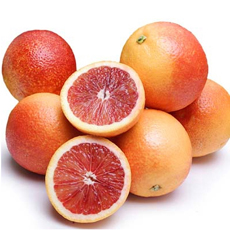
[1] These three photos show flesh of similar colors, but the flavors are very different. Here, Blood Oranges from Melissa’s.
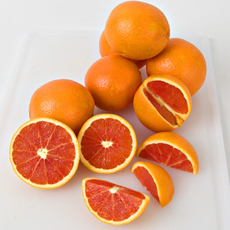
[2] Cara Cara Oranges from Whiteflower Farm.

[3] Ruby Red Grapefruit from Good Eggs (photo © Good Eggs | San Francisco).

[4] Kumquats from Good Eggs, a premier produce provider in the San Francisco Bay area (photo © Good Eggs).

[5] Tangerines ready to be juiced, from Noble Juice (photo © Noble Juice).
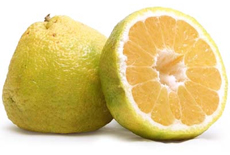
[6] Ugli Fruit from Melissa’s. Following careful breeding, these are less ugly, less lumpy and less green than earlier ugli fruits.
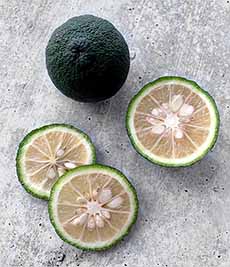
[7] Green yuzu is not yet ripe. But you can see here how large the seeds are, compared to the amount of flesh (photo © Regalis Foods).
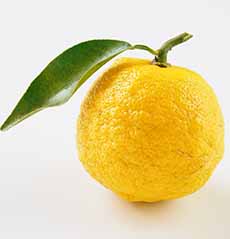
[8] A ripe yuzu is yellow, like a lemon (photo © Flavor And The Menu).
|