THE NIBBLE BLOG: Products, Recipes & Trends In Specialty Foods


Also visit our main website, TheNibble.com.

TIP OF THE DAY: Easy Cake Art

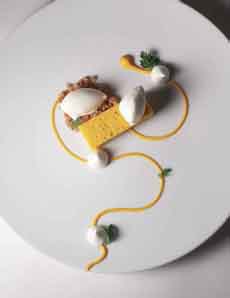
We were admiring this dessert from Caviar Russe in New York City. It’s art on a plate.

Then we realized: This is relatively easy to put together.

We love artistic food, so we set out to make our version of this cake-and-ice cream dessert.

If you buy the loaf cake instead of baking it, the only time-consuming parts are making mini meringues and cream cheese frosting.

You can combine any flavors, use fruit purée instead of frosting, and add your own signature garnishes.

Here’s what we did.
 
 
RECIPE: CAKE ART

1. Cake

To save time, we purchased a dense carrot cake—the same type used by Caviar Russe.

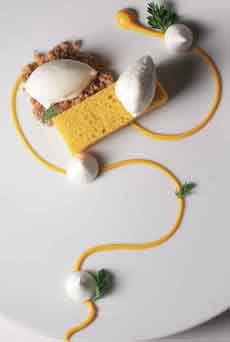
Instead of cutting a square-ish slice, cut something more stylish, like the slim rectangle in photo #1.

Don’t worry about “wasted” cake trimmings. In our book, cake is never wasted. At the least, you can toss it into the freezer to serve later, with a bowl of ice cream or an ad hoc trifle.

2. Meringues

It’s easier to pipe meringue cookies, especially the mini meringues used in this recipe. There are three on the plate.

You can buy them from Miss Meringue, although homemade meringues, without preservatives, taste better.

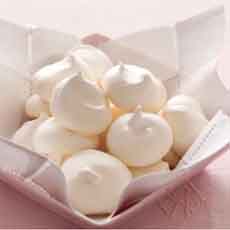
Here’s the recipe for the mini meringues in photo #3.

You may also know a local bakery that sells them.

Or, if you can only find large or jumbo meringues, cut them and serve the rough pieces—“rustic art.”

Whatever you choose, make them all one color. Different colors are distracting on an already-diverse plate.

You’ll note that there’s a dab of something white on the top right of the carrot cake. That’s crème fraîche, not a meringue.

While we love it, we omitted it. There’s enough going on.

3. Cookie Crumbles

These serve as a bed for the scoop of ice cream (top left of cake), and are a crunchy textural addition.

We bought, instead of baked, the cookies; and chose oatmeal cookies for their homey flavor pairing with carrot cake (we bought cookies without raisins, for ease in crumbling).

Use the cookies of your choice, from chocolate wafers to shortbread. It’s all about flavor pairing.

4. Ice Cream


Fancy Cake Garnish
[1] Simple ingredients like carrot cake are put together to look spectacular: a work of art from Caviar Russe.

Fancy Carrot Cake
[2] A close-up.

Meringue Cookies
[3] Mini meringues colored in pastels. Here’s the recipe from Taste | Australia.

 
Vanilla goes best with carrot cake (or rum raisin, if you can find it). But expand your horizons with other pairings: coffee or strawberry ice cream with chocolate cake, for example.

5. Swirl

You can create your swirl from fruit purée or frosting. Since we chose carrot cake, we used cream cheese frosting, which also holds its shape better then purée.

We added lemon zest and yellow food color, and copied the swirl pattern in the photo.

If you like canned frosting, you can buy it and add the zest and color.

6. Garnish

Lastly, a color counterpoint to perk up the plate.

Caviar Russe used herb fronds (the spots of green), but we didn’t want anything on the plate that people wouldn’t eat. We like mint with chocolate and other flavors, for example, but we didn’t want it as an edible with carrot cake.

So we bought pomegranate arils, and they looked great. We could have used raspberries (or pastel candy lentils), but wanted a more delicate touch.
 
 
That’s our version of this artistic dessert. Now it’s your turn!


Comments off

FOOD FUN: PB&J Burger With Ice Cream (Really!)

PB&J Burger
[1] A PB&J Burger with vanilla ice cream. It’s a popular menu item with both children and adults (photo courtesy Slater’s 50/50).


If you’re a burger person and an adventurous eater, here’s an idea from Slater’s 50/50, a burger gastropub with locations in Southern California, Honolulu, Las Vegas and Dallas.

The restaurant is known for its signature burger, a 50/50 burger patty with equal parts of ground beef and ground bacon. To us, that sounds good enough to book a trip to the nearest location.

The chefs continue to push the boundaries with “inconceivable” flavors. They certainly have done so with the “PB & Jealousy.”

It’s an Angus beef burger on a honey wheat bun, layered with:

  • Thick-cut bacon
  • Natural peanut butter
  • Strawberry jelly…
  •  
    and the pièce de resistance

  • A scoop of vanilla ice cream!
  •  
    “All of this doesn’t make sense at first,” says Chef James Bailey, who is Culinary Director for Elite Restaurant Group, which operates Slater’s 50/50. “But when you break it down to the core principle of pairing ingredients and flavors, it all comes together in this most bizarre and perfect combination.”

    He advises to “gently scoop on [the ice cream] before you take each bite.”

    To us, most of it makes sense.

  • Bacon—no question.
  • Peanut butter is the main ingredient in Thai peanut sauce, a condiment served with meat.
  • Strawberry jelly’s sweetness is not too unlike a sweet BBQ sauce.
  •  
    But the vanilla ice cream?

    Well, we do enjoy an ice cream sandwich made of vanilla ice cream on raisin bread toast, and we’ve also made it on chocolate chip bread and a brioche bun.

    PB & Jealousy’s honey wheat buns have a similar sweetness.

    As the sage says, “Don’t knock it until you’ve tried it.”

    We look forward to trying it at home—perhaps a taste-off with a beef burger, a turkey burger and a veggie burger.

    And how about blue cheese ice cream or cheddar ice cream instead of the vanilla?

    Thanks to Flavor & The Menu for this story.


    Comments off

    TIP OF THE DAY: Serve A Main Dish With Four Sides

    If you’re accustomed to serving your dinner protein with one vegetable and a starch (potato, noodles, rice)—or veg and a side salad—here’s a tip on “diversification.”

    It was inspired by this dish from Bluewater Grill, with several locations in California and one in Phoenix.

    Their chefs know that serving multiple items generates more excitement. That’s why buffets are so popular.
     
     
    YOU CAN DO THE SAME

    Just a bit of planning enables you to easily pair your protein with two cooked vegetables, a raw vegetable, and a grain or legume/pulse (the difference is below).

    Put together your plate with:

  • Cooked vegetables (in the photo, Brussels sprouts and cipollini onions; or anything you like, including baby potatoes)
  • Grains red quinoa in the photo (or rice, especially whole grain; (wheatberries, etc.; vary with other starches like noodles and potatoes).
  • Legumes or pulses (see the list below).
  • Raw vegetables as garnish (shaved fennel with fresh dill [photo #1], carrot curls, diced tomato, radicchio julienne, red bell pepper dice, etc.). Or, add a fourth item on the side, such as halved/marinated cherry tomatoes or crudités. Whatever you choose, try to add color.
  •  
    No sauce is needed, but you can swirl balsamic glaze [photo #1], or dot the plate with pesto, flavored olive oil (basil oil in photo #2) or red bell pepper purée.

    Voilá, a healthful, colorful dinner.

    Serve with an optional salad:

  • On a side plate.
  • As a first course.
  • After the main course, as the French do. You can add an ounce of cheese to the plate, as the French do, too.
  •  
     
    THE DIFFERENCE BETWEEN LEGUMES & PULSES

    Both legumes and pulses are the edible seeds of plants in the pea family (Leguminosae), a class of vegetables that includes beans, peas and lentils.

    Pulses are a subcategory of legumes. The difference is that legumes are sold fresh, and pulses are grown and harvested to be sold dried. The same product can be sold fresh (legume) or dried (pulse).

  • The term “legume” refers to any plant whose fruit is enclosed in a pod.
  • Legumes are a vast family of plants: more than 600 genera and 13,000 species (including chickpeas, peanuts and soybeans.
  •  

    Roast Salmon
    [1]Salmon with red quinoa, Brussels sprouts and cipollini onions, topped with shaved fennel and dill.

    Pan-Fried Salmon
    [2] Salmon with a different set of garnishes: purple asparagus, spring peas, cipollini onions, topped with lightly dressed pea leaves and shoots, plus droplets of basil olive oil (photos #1 and #2 courtesy Bluewater Grill).

    Salmon With Red Quinoa
    [3] Salmon on a bed of grains (here, red quinoa) with baby carrots, green peas and baby artichokes, topped with pea shoots (it’s fresh pea season) (photo courtesy Charlie Palmer Steak).

  • Pulses refer specifically to the dried seed of legumes. Examples are dried beans (including chickpeas), lentils, split peas and other dried peas.
  • Both legumes and pulses are very nutritious: low in fat, high in fiber, cholesterol-free and high in folate, iron, magnesium and potassium. They’re also a good source of protein and can be a fat- and cholesterol-free substitute for meat.
  •   

    Comments off


    © Copyright 2005-2026 Lifestyle Direct, Inc. All rights reserved. All images are copyrighted to their respective owners.