|

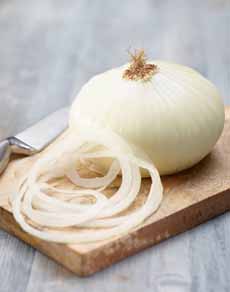
[1] On the outside, Vidalia onions look like conventional onions. On the inside, they are snow white (all photos courtesy Vidalia Onions | Facebook.
[2] Cut Vidalias without worrying about burning eyes. They’re grown in soil that is low in sulfur, which produces the burn and the bite.
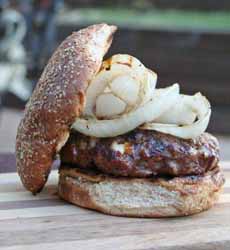
[3] The perfect onion for a burger.
[4] Toss on a pizza, before baking or after it comes out of the oven.
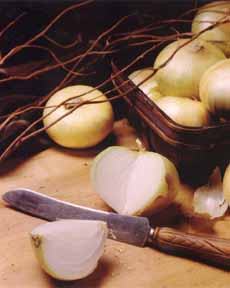
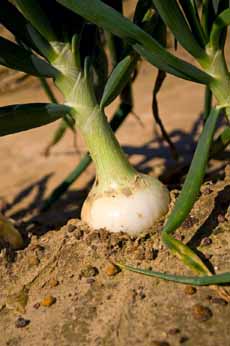
[4] Ready to harvest.
|
|
We love Vidalia® onions—the perfect onion to eat raw.
The 2019 Vidalia Onion season began on Monday, and we can all now celebrate “The Sweet Life.”
They’re available only from April through August, when the 200-million-pound harvest is distributed across the U.S. and Canada.
Vidalia onions get their name from the town of Vidalia, Georgia, where they were first cultivated. They are renowned for their sweet flavor and crisp texture. They are one of the world’s mildest onions.
Vidalia onions were an accidental discovery in the 1930s, when a crop of onions was planted in South Georgia. When harvested, the farmers were amazed at their sweetness and lack of acrid flavor and eye irritation
The distinctive taste is derived from a combination of weather, water and soil. This unique terroir† is found within 20 South Georgia counties.
The soil has much less sulfur than other soils, eliminating the eye burn and the bite of raw onions, and allowing the natural sweetness of the onions to shine through.
(When you cook onions, the heat burns off the acridity and gives you sweet, cooked onions).
Vidalias are cultivated by 50 registered growers* in the area around Vidalia, and are available for a limited time each year, from April to August.
WAYS TO USE VIDALIA ONIONS
You can use Vidalia onions as you would any onion, although their sweetness provides much more versatility.
But because of its sweetness and crispness, we prefer to use them raw, where they remain crunchy and juicy.
We like to chop or slice them as a garnish for chili, deviled eggs, fish, fried or scrambled eggs, pasta, pizza, soups, steaks and chops, etc. etc. etc.
We also use them in and on:
Burgers and sandwiches
Cornbread and scones
Crudités plate
Dips and spreads
Egg salad, chicken salad, cucumber salad, macaroni salad, potato salad, etc.
Green salads
Guacamole
Salsa (especially fruit salsa)
Relish
VIDALIA ONION HISTORY
Onions have been eaten since early man first pulled wild varieties from the ground—many thousands of years ago.
As civilization progressed, they took on greater importance, in culinary and medicinal uses. In ancient Egypt, onions were worshiped and used in burial rituals.
Onions are low in calories and good for you, high in vitamins, minerals, and antioxidants. They have many health benefits including reducing the risk of heart disease and some cancers.
Fast forward to the birth of Vidalia onions:
1930s: During the Great Depression, farmers sought new cash crops. In Vidalia, they planted onions. But when harvested, what they had was not an instant money-maker, but a strange new sweet- tasting onion.
1940s: A new farmers’ market was built, central to Macon, Augusta and Savannah. Word of “those sweet onions from Vidalia” began to spread, and a name was born as recognition grew.
1960s: A Piggly Wiggly grocery store in Vidalia saw the potential of the onions, and helped farmers from all over the Vidalia area get their new-style onions on store shelves.
1976-1977: As the onion began its ascent to national fame, local support soared. An annual Vidalia onion festival was established in Glennville, Georgia, by 1977 and in Vidalia, Georgia, by 1978.
1986: The Vidalia Onion Act of 1986 was passed by the Georgia state legislature, trademarking the name “Vidalia onions” and defining the growing region.
2018: Vidalias are now sold in 50 states and most of Canada.
MORE ABOUT VIDALIA ONIONS
Head to VidaliaOnion.org.
From there, you can also connect to Vidalia’s Facebook, Instagram, Pinterest, Twitter and YouTube accounts.
|
________________
*Because Vidalia® onions are sweetly unique, farmers united to seek legal protection for their crop and its name. Federal Marketing Order No. 955 was established in 1989, to stipulate where the crop can be grown and help with research and promotion of Vidalia onions. The Vidalia Onion Committee administers FMO No. 955 and authorizes production research, marketing research and development and marketing promotion programs. This federal program along with Georgia state laws that protect the Vidalia trademark have provided a legal framework for the industry. So, you can try to grow a sweet onion elsewhere, but you cannot call it a “Vidalia,” unless it is from Georgia! For more information, visit VidaliaOnion.org.
†Pronounced tuhr-WAH, terroir is the French expression for sense of place, the unique environment in which something grows—its specific soil composition and microclimate. Microclimate includes temperature, amount of sunshine and rain. The flavor nuances of agricultural products, from grapes to olives to milk to cacao, is a function of its terroir.
|