THE NIBBLE BLOG: Products, Recipes & Trends In Specialty Foods


Also visit our main website, TheNibble.com.

TIP: Asian Dumplings & Italian Ravioli, The Difference

While the historical record is scant, it is believed that the pasta Marco Polo brought back from China in 1295 was pillow pasta: stuffed and crimped sheets of pasta dough, a.k.a. dumplings.

And a.k.a. ravioli, too. The difference is largely local ingredients.
 
ASIAN DUMPLINGS & STUFFED PASTA: FRATERNAL TWINS

Noodles (spaghetti or other “long cut” pasta) had been introduced to the West centuries* before Marco Polo.

Arab traders brought the long noodles back home over the Silk Road, and then to Sicily during the Arab invasions of the 8th century.

In addition to being an everyday food, dried pasta was a boon for travelers, including soldiers. It was lightweight and required only boiling water to turn it into a hot meal. As in Asia, pasta was also added to soups.

In Italy, Chinese dumplings evolved into agnolotti, cannelloni, mezzalune (crescents), ravioli (plus the smaller raviolini and larger ravioloni), sacchette (beggar’s purses) and tortellini.

Instead Asian sauces made from soy sauce, vinegar, garlic, ginger, rice wine and/or hot sauce, among other ingredients, Italian pasta was accented with sauces made from local ingredients: cream, olive oil, Parmesan and tomatoes.
 
Pillow Pasta/Stuffed Pasta

Pillow pasta is stuffed pasta (pasta ripiena in Italian), but not all stuffed pasta is pillow pasta. In addition to the stuffed “pillows,” the other stuffed category includes large tubes and other shapes that are stuffed and baked, like cannelloni and jumbo shells. Other tube pasta, such as penne, rigatoni and ziti, are too small to be stuffed.

Pillow pasta can be stuffed with almost any kind of filling, either a single seasoned ingredient or combinations of different meats, cheeses, vegetables, seafood and herbs.

Here’s a brief history of pasta.

 
RECIPE: PORK & GINGER RAVIOLI…OR ARE THEY DUMPLINGS?

This recipe, from Chef Eric B LeVine could be ravioli. But because of the dough used (wonton wrappers) and the Asian ingredients—soy sauce, fresh ginger, lime, scallions—it could be a dumpling.

But wait: There’s also basil and Parmesan cheese, two Italian specialties.

This recipe, a fusion of Asian and Italian, illustrates how close Italian and Chinese (and other Asian) pastas can be; and not just in stuffed pasta, but in long cuts as well (mai fun = angel hair, chow fun = pappardelle, etc.).

Check out Chef Eric’s book, Small Bites, Big Flavor.
 
Ingredients

  • 1 lime, zested and juiced
  • 2 teaspoons soy sauce
  • 1 teaspoon honey
  • 1 tablespoon canola oil
  • 1 teaspoon dark sesame oil
  • 1/4 teaspoon hot red pepper flakes
  • 1/2 pound ground pork
  • 1/2 cup Parmesan cheese, grated
  • 1 tablespoon fresh basil, finely chopped
  • 2 teaspoons fresh ginger, peeled and grated
  • 3 garlic cloves, minced
  • 2 scallions, finely chopped
  • 1/8 teaspoon fresh nutmeg, grated
  • 1 egg
  • 32 wonton wrappers
  •  
    Preparation

    1. MAKE the dipping sauce: Combine the lime zest, juice, honey, soy sauce, canola oil, sesame oil and pepper flakes. Whisk or shake well to combine and set aside.

    2. WHISK together the Parmesan, basil, ginger, garlic, scallions, nutmeg and egg in a large bowl. Add the pork and mix very gently with your finger tips until just blended. Place the pork mixture in the fridge for 30 minutes to firm.

    3. MAKE the dumplings, one at a time. Brush the flour side of the wrapper with water. Place a heaping tablespoon of the pork mixture in the center of the wrapper. Place another wrapper on top and press the edges together to seal. Use a pastry cutter† or ravioli stamp otherwise trim the edges with a zigzag pastry wheel. Repeat with the remaining filling and wraps.

    4. COOK: Bring a large pot of water to a boil, add salt and cook the ravioli for 6 minutes.


    Ravioli With Cherry Tomatoes

    Edamame Ravioli

    Pork Ravioli Recipe

    /home/content/p3pnexwpnas01 data02/07/2891007/html/wp content/uploads/tortellini mezzaluna eatalychicago 230 1

    Chinese Potsticker Dumplings
    Top: classic ravioli (photo courtesy Delfino Restaurant). Second: round ravioli (photo courtesy Ristorante Morini. Third: The recipe below: Pork-Ginger Ravioli…or are they dumplings? (photo courtesy Chef Eric LeVine. Fourth: Italian mezzalune pasta (half moons or crescents) plus tortellini. Photo courtesy Eataly Chicago). Bottom: Chinese potstickers (photo courtesy Mackenzie Ltd).

     
    ________________________

    *The oldest written reference to noodles is in a Chinese dictionary from the third century C.E. However, these noodles were not made from what we know as noodle dough, but from bread dough. The dough was shaped into little bits and cooked in a wok of boiling water. Called mian pian, they are still eaten in China. [Source]

    †If you need to buy a pastry cutter, consider the double-wheel type that cuts both straight and zigzag edges.
      

    Comments off

    Strawberry Rhubarb Galette Recipe, A Spring Favorite Pie

    Rhubarb
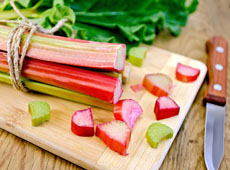
    [1] Rhubarb with its leaves. Don’t eat the leaves—they’re mildly toxic (photo © OurOhio.org).

    Trimmed Rhubarb
    [2] Trimmed rhubarb, as it is most often seen in stores (photo © Good Eggs | San Francisco).

    A Strawberry Rhubarb Pie with a lattice crust.
    [3] A beautiful strawberry-rhubarb pie. Here’s the recipe (photo © The Baker Chick).

      To many foodies, the beginning of spring means asparagus, fava beans, morels, ramps, scapes, and shad roe.

    We add rhubarb to that list. In North America it grows between April and June, paralleling the asparagus season.

    Nana was so fond of stewed rhubarb, she made it once or twice a week during rhubarb season. She served it in a dish, like pudding, with or without heavy cream; in a compote; in a parfait; on pound cream (with whipped cream); and as a topping on ice cream.

    Her daughter, Mom, was an inveterate pie baker, turning out Rhubarb Pie, Raspberry Rhubarb Pie, and Strawberry Rhubarb Pie.

    There’s a delicious Strawberry Rhubarb Galette (a rustic pie) recipe below.

    > The history of rhubarb.

    > The history of strawberries.

    > The history of pie.

    > National Rhubarb Day is January 23rd.

    > National Strawberry Rhubarb Pie Day is June 9th.
     
     
    RHUBARB: A VEGETABLE, NOT A FRUIT

    Technically, rhubarb is a vegetable, a member of the sorrel family. Fruits are not necessarily sweet. Tomatoes are fruits, avocados are fruits, hot chiles are fruits, and cucumbers and squash are fruits.

    By botanical definition, fruits have their seeds/pits, on the inside, contained in the fruit’s ovary sac*.

    Fruits carry their seeds inside; vegetable seeds scatter in the wind. You see seeds in an apple, avocado, cucumber, and tomato, but not in broccoli, carrots, or lettuce. Lacking sweetness doesn’t make it a vegetable.

    Rhubarb, Rheum rhabarbarum, is a vegetable in the Polygonaceae family. The leaf stalks (petioles) are crisp like celery with a strong, tart taste. Rhubarb looks like rosy-pink celery but is no relation (celery is a member of the Apiaceae family).

    Even for a vegetable, rhubarb is very tart. Before it was served sweetened, it was added to soups (try it in lentil soup) and sauces: in the Himalayas, in Moroccan tagines, and in Middle Eastern stews. Be sure to cook only the stems; the leaves are mildly toxic (they contain oxalic acid).

    But for most of us, rhubarb needs a sweetener. It’s absolutely delicious as stewed rhubarb, rhubarb ice cream, rhubarb pie, and its variation in this recipe, strawberry rhubarb pie. Some people eat the stems raw by dipping them into sugar.

     
    Rhubarb grew wild in northwest China and was cultivated about 5,000 years ago for medicinal purposes. It made its way west via Turkey and Russia and was first planted in England by an apothecary in 1777. Once sweetened, it became popular for jams, sauces and crumbles.

    The thinner and darker pink the fresh rhubarb stalks are, the less tart they will be. Look for stalks that are crisp, bright pink, thin, and unblemished.
     
    _______________________

    *The only exception is the strawberry, which is not a botanical berry but an accessory fruit. True vegetables have no pit or seed sac.
    _______________________
     

    RECIPE: STRAWBERRY-RHUBARB GALETTE

    This French-inspired pastry (photo #3) is the perfect balance of tart and sweet, prepared with fresh strawberries and peak season rhubarb enveloped inside a buttery, hand-formed crust and garnished with a touch of sparkling sugar.

    It’s a spring specialty at Hewn, an artisanal bakery in Evanston, Illinois, which advises that this pastry makes a brief appearance only during the late months of spring when rhubarb season is at its peak.
     
    What’s A Galette?

    In the pastry world, a galette is a rustic, open-face fruit pie. It is flat, with a flaky, turned-up crust that wraps around the filling to create a “bowl.” The Italian word is crostata.

    A galette is a pie instead of a tart because it uses a pâte brisée crust, instead of the dense, crumbly, and sweet pâte sablée used for sweet tarts.


    Ingredients For A 6-Inch Galette

    For The Filling

  • 1 pint ripe strawberries, cut in quarters
  • 2 stalks of rhubarb, skin removed (use a knife to peel off the dark outside layer)
  • ¼ cup sugar
  • ½ vanilla bean (the other is used in the dough)
  • 1 tablespoon all-purpose flour
  • 1/16 teaspoon sea salt
  •  
    For The Dough

  • 1¼ teaspoons salt
  • 3 cups all-purpose flour
  • 4 sticks chilled butter, cut into tiny cubes
  • ¾ cup chilled cold water
  • ½ vanilla bean
  • Optional: fresh thyme or tarragon, chopped, to taste
  • 1 egg (whisked and used to brush the dough before baking)
  •  
    Preparation

    Make the Filling

    1. CHOP the rhubarb into ¼ inch strips. Toss the rhubarb with the quartered strawberries.

    2. ADD the sugar, vanilla bean and sea salt to the rhubarb and strawberries. Toss until it is coated.

    3. ADD the flour and mix the filling.
     
    Make the Dough


    Rhubarb Tart
    [4] Rhubarb Galette from Hewn; recipe included

    Stewed Rhubarb
    [5] Our Nana’s favorite use of rhubarb is stewed rhubarb. Here’s a recipe (photo © Fast Ed.com.au).

    The easiest way to make the dough is to use a food processor—but you have to make sure to not overwork the dough.

    1. USING a food processor add the salt and flour and pulse for 5 seconds. With the food processor on…

    2. SLOWLY DROP butter in, in a continuous stream. You should be able to have all the butter added within a minute. Once all the butter is added, let the processor run for 10 more seconds. The dough should look very shaggy and the butter should still be visible. Add the optional herbs.

    3. TURN to the the pulse setting and slowly pour the cold water. This is where the dough can get overworked. Once the water is added, the dough will still be shaggy and should NOT form a ball. The shaggier it is, the flakier the dough will be.

    4. SCOOP out the dough and form into a flat disk. Wrap with plastic wrap and let the dough chill for 2 hours before rolling it out.
     
    Assemble And Bake

    1. PREHEAT the oven to 350°F (325° for a convection oven).

    2. ROLL the dough out and use a ring or bowl to trace a round. The size should be about 6 inches. Cover a sheet pan with parchment paper, lay the dough ring on it sheet pan and spoon ¼ cup of the filling in the center. Fold the edges of the dough up, so it creates a pocket to contain the filling. Add the rest of the filling.

    3. BRUSH the edge of the dough with the egg wash and bake the galette for 12 minutes. After 12 minutes check: The crust should be deep golden and the filling should not be runny.
     
     
    ABOUT HEWN ARTISANAL BAKERY

    Founded by partners Ellen King and Julie Matthei in 2013, Hewn is a cozy neighborhood spot in a historic space. Ellen is a classically trained chef, Julie is the business director.

    Hewn sources local and seasonal ingredients from small, local farmers. The bakery’s name refers to the craftsmanship associated with making something by hand For more information, visit HewnBread.com.


    Comments off

    TIP OF THE DAY: Cider Tasting For Mother’s Day

    Hard Cider & Food
    Drier ciders work better with meats. Photo courtesy Angry Orchard.
      Skip the Pinot Grigio and taste some cider for Mother’s Day. It’s more novel than wine, and will suit any guest:

    Cider is equally popular among men and women, whereas beer is significantly more popular among men*. Cider is also gluten-free and less filling than beer.

    While many people think “autumn” when they hear “cider,” that is true for non-alcoholic cider, which is fresh-pressed.

    Hard cider is fermented for eight weeks after the juice is pressed. The cider then matures for several months, is blended, filtered and carbonated. So the “freshest” hard cider is on the market now, not in the fall.

    Another note: In the U.S., alcoholic cider is called hard cider and apple cider/apple juice (the terms are interchangeable in the U.S.) is simply called cider.

    In the U.K. it’s the reverse: “Cider” is hard cider.

    While most cider is made from apples, you’ll also find pear cider, known in the U.K. as perry.

     
    CIDER & FOOD PAIRINGS

    Hard ciders pairs with the same foods as beer and white wine. Styles range from very dry to sweet “hard apple juice.”

  • The sweetness of cider allows you to serve desserts with it, too, especially apple desserts (pie, crumble, bread pudding).
  • For nibbles, serve hearty cheeses and charcuterie.
  • For main courses, consider barbecue, chicken, pork and sausages (beer and brats, meet cider and brats); plus soups, stews and one of our favorite pairings, cheese fondue.
  •  
    TIPS

  • In recipes, you can substitute hard cider for wine.
  • Hard cider is best served chilled or over ice.
  •  

    CIDER TASTING PARTY: WHERE TO START

    1. Gather up a dozen brands or so, and invite friends over for a hard cider tasting. You’ll find hard ciders from the U.S. and England†. Get apple cider for the kids.

    2. For serious foodies, conduct a blind tasting. Serve them in order of alcohol content, lowest to highest. Either cover up the labels with paper (we used a removable glue stick) or place each one in a paper sandwich sack (the size of a take-out coffee bag, which you can get at the nearest deli [offer to pay for them and you’ll likely get them for free]).

    3. Mark each label or bag with a number, and provide each person with a tasting notes sheet. If your group is accustomed to evaluating beer and wine, you can adapt this professional scoring sheet. We put all the descriptors in the left column of that sheet onto one piece of paper, with one for each guest. For notes, we made up a simple sheet with designated areas for rating ciders 1 through 12 (or however many ciders you’re serving) on a second sheet.

    You can also print out this Cider Tasting Wheel.

      Cider Goblet
    You can use any glass you like for cider; this one is popular in Europe. Photo courtesy Crispin Cider.
     
    4. Decide on the food and how many bottles of each cider you’ll need for your size crowd.

    5. Start with small pours: An ounce each of 12 cider becomes 12 ounces in relatively short order. At the end of the comparison tasting, people can go back for more.

    6. Provide “dump buckets” so participants can toss what they don’t like. These can be large tumblers or other vessels (we’ve used short vases!).

    7. Have a great time.
     
    _____________________________
    *Beer is preferred by men in terms of market penetration (+10% for men), frequency (+35% for men), and servings consumed (+33% for men).
     
    †Magners Irish Cider is the only hard cider imported from Ireland.
      

    Comments off

    PASSOVER: Matzoh Strawberry “Shortcake” Recipe

    Matzoh Strawberry Shortcake Recipe
    Substitute matzoh for the biscuits or cake in this Passover Strawberry Shortcake recipe. Photo and recipe courtesy Good Eggs | San Francisco.
     

    In addition to Chocolate Matzoh Crunch and chocolate-dipped coconut macaroons, we’ve added anther Passover treat to our recommendations. It’s courtesy of Good Eggs in San Francisco.

    “Shortcake“ is a stretch as a substitute for biscuits or sponge cake, but this no-cook, no-bake Passover dessert is delicious and oh-so-easy to make.

    Speaking of sponge cake, our standard family Passover dessert is Strawberry Shortcake with sponge cake, strawberries and whipped cream. Since sponge cakes are not leavened with yeast, they can be eaten during Passover when made with matzoh meal instead of wheat flour.

    RECIPE: MATZOH STRAWBERRY “SHORTCAKES”

    Prep time is 15 minutes.

    Ingredients For 3 Servings

  • 1 pint strawberries
  • 1 orange, juiced and zested
  • 8 ounces mascarpone
  • 3 tablespoons powdered sugar
  • 2-3 tablespoons unsalted butter
  • 2 boards matzoh
  • Optional garnish: mint sprigs
  •  
    Preparation

    1. SLICE the strawberries and let them macerate in the orange juice, reserving one tablespoon. Mix the mascarpone with the powdered sugar, half of the zest and the reserved tablespoon of orange juice.

    2. MELT the butter in a large frying pan over medium-high heat. When the butter is melted, add the matzoh and fry until crispy and golden-brown, about 1 minute on each side.

    3. ASSEMBLE the shortcakes: spread a generous layer of mascarpone on each piece of fried matzo, then top with sliced strawberries and mint. Dust powdered sugar over the top for an extra touch of sweetness!
      

    Comments off

    TIP OF THE DAY: The Best Oven Mitts

    When you’re working with hot oven pans, stove pot handles, steaming pasta pots and the like, you need more protection than a cloth oven mitt. Otherwise, be prepared to say “Ouch!”

    We tossed our cloth oven mitts 15 years ago when the first Orka silicone oven mitts debuted. No matter pleasing the design—or the ability to wear a matching apron—cloth mitts didn’t provide enough burn protection.

    Beyond protection against burns, cloth mitts are neither waterproof nor oil-proof—and get pretty stained pretty fast.

    If you haven’t yet heeded the call, it’s time to toss your cloth oven mitts and bring in the heavy hitter: silicone.
     
    THE SOLUTION: SUPERFLEX GLOVES FROM THE TRIUMPHANT CHEF

    While there are numerous silicone mitts on they market, we recently gave our older ones away in favor of what we think is the new best: the Silicone Flex Mitt from The Triumphant Chef.

    They’re the latest generation of silicone: super-flexible, yet still heat resistant up to 450°F.

  • The no-slip silicone grips better than cloth—and even better grip from the circle-and-spoke pattern.
  • You can flip chops, steaks, hot dogs on the grill without tools.
  • You can easily hold down a turkey or roast while you carve it.
  • You can fully clean them in the sink with soap and hot water—or in the dishwasher.
  •  
    A couple of decades ago, Playtex Living Gloves promoted themselves as “so flexible, you can pick up a dime. We didn’t easily pick up a dime with Flex Mitts, but it was a cinch to pick up a quarter.

    Like those Living Gloves, they have a soft cloth liner, here quilted. They’re currently on sale at Amazon.com for $13.83 a pair, plus a bonus silicone basting brush. The gloves are available in:

  • Black
  • Canary Yellow
  • Dark Red
  • Lime Green
  • Royal Blue
  • Royal Purple
  •  
    Get them for your favorite cooks for Mother’s Day, Father’s Day, summer grilling weekends…and think ahead to Christmas season.

     
    THE HISTORY OF OVEN MITTS

    For much of man’s history, hot pots and pans were handled with cloth. One source notes that mittens have been in use for more 1,000 years for a wide range of protective purposes, including protecting hands from hot ovens.

    If so, they were abandoned somewhere along the line for the presumably more effective potholders.

    Apparently, a Texan named Earl Mitt (seriously?) came up with the idea in the early 1870s, after a bad burn while baking. In an effort to prevent getting burned again, he invented the first oven mitt from shoe leather and wool. After experimenting with different materials and designs, he finally came up with the oven mitt style of cooking glove. [Source]

    Today, the outer layers are typically made of cotton or polyester, while the inner layer is filled with an insulator fabric.

    Thanks, Earl; but they’re old technology now. Along with potholders, they provide incomplete protection against high heat, steam and oil splattering. A user can be scalded by boiling water and burned hot pans and steam.

    What are you waiting for?


    All Clad pot from Williams-Sonoma. It can be monogrammed!All-Clad Pasta Pot

    Tramontana Deep Fryer

    Super Flex Silicone Oven Gloves

    Super Flex Oven Mitts
    Do you really want to touch a hot pot with kitchen towels or cloth oven mitts? (All-Clad Pasta Pot and Tramontino Deep Fryer from Williams-Sonoma). Bottom: Our favorite protection, Super Flex Oven Mitts from The Triumphant Chef, with a soft quilted liner and a bonus matching basting brush.


    Comments off

    The Nibble Webzine Of Food Adventures
    RSS
    Follow by Email


    © Copyright 2005-2026 Lifestyle Direct, Inc. All rights reserved. All images are copyrighted to their respective owners.