THE NIBBLE BLOG: Products, Recipes & Trends In Specialty Foods


Also visit our main website, TheNibble.com.

TIP OF THE DAY: Steak With Three Sauces

Our friend Andy welcomes the opportunity to visit Denver, so he can pop in at Vesta Dipping Grill, known for the variety of creative sauces it offers with its entrées (here’s the current menu).

For Father’s Day, forget the Worcestershire or A-1 and treat Dad to a choice of three homemade steak sauces. It’s like “steak three ways.” Here are a Baker’s Dozen of suggestions.
 
HERB SAUCES FOR STEAK

These quick herb sauces require no cooking: Toss everything into a food processor and pulse (purists can get out the mortar and pestle).

  • Chimichurri Sauce. The steak sauce in Argentina, chimichurri is made from parsley, garlic, green or red chile, olive oil, red wine vinegar. You can add other herbs. Mario likes cilantro, Emeril likes oregano and basil. Recipe and more.
  • Gremolata. If you want bright herb flavors without heat or tang, make gremolata. This simple condiment from Italy consists of fresh chopped parsley, lemon zest and garlic—zingy without being spicy. Recipe and more.
  • Pesto. The “original” is made from basil, olive oil, pine nuts and Parmesan cheese, but there are many variations that switch out the herb, nut and cheese. Recipe and more information.
  • Salsa Verde. Layers of flavor without heat, this Italian herb sauce is made from chopped chives, mint and parsley with capers, chopped anchovies, garlic and lemon juice. Some recipes add tomatillos. Recipe and more information.
  •    
    Ribeye Steak With Sauces

    This 32-ounce steak is served with three sauces and a head of roasted garlic at The Fillmore Room in New York City.

  • Shallot Vinaigrette. Use your best vinegar and olive oil, minced shallots and parsley or other herb of choice. As a bonus, serve it warm. Recipe.
  •  

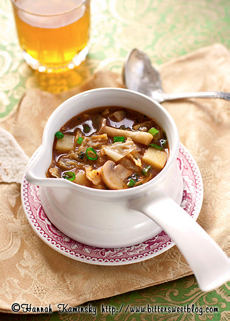
    Mushroom Sauce
    Mushroom sauce with red wine is a classic steak sauce (photo Hannah Kaminsky | Bittersweet Blog).
     

    CLASSIC FRENCH SAUCES

  • Aïoli. Aïoli is a Provençal garlic mayonnaise that is typically served with seafood. But it’s delicious with steak, too, and is also a yummy dip for French fries. Recipe.
  • Béarnaise Sauce. Thick and creamy like aioli but laced with tarragon and shallot instead of garlic, this pairing has been revered by French steak lovers for centuries. Recipe.
  • Compound Butter. Another innovation of French cooks, compound butter has been flavored with anything the cook likes, from anchovies to Cognac to Roquefort cheese. The butter is rolled into a log, and a slice is cut to top a steak. The heat from the just-cooked steak turns it into a flavored butter sauce. Recipes.
  • Mustard Sauce. Mix Dijon mustard with crème fraîche and gently heat this creamy, tangy steak sauce. Recipe.
  • Mushroom Sauce. Different interpretations include mushrooms with beef stock and brandy or wine, to a cream sauce with a Dijon accent. Recipe.
  • Peppercorn Sauce. Another creamy classic, this steak sauce is made with heavy cream, chicken stock, red wine vinegar and green peppercorns, simmered briefly.
  •  
    MORE STEAK SAUCES

    There are many more options, but we’ll conclude today with global influences:

  • Try Asian-style sauces, such as Black Bean Sauce with Five Spice Powder and Teriyaki Sauce from BBC Good Food, and Green Sriracha Sauce from Food and Wine.
  • Go South-of-the-Border with Poblano Sauce (add puréed poblanos into garlic mayonnaise (aioli), Mole Sauce or Smoky Ancho Chile-Almond Sauce from FoodAndWine.com.
  • You can also make Piri-Piri Sauce with this recipe from Emeril. Piri-Piri is from Africa; Peri-Peri is the version brought back home by Portuguese sailors, and became the Peruvian version of Chimichurri. Both get their heat from fresh chiles.
  •  
    Happy grilling, happy saucing!


    Comments off

    Make Biscuits & Gravy…Plus Types Of Gravy

    If you’re from the South, or have friends and family who hale from there, you know the pleasures of biscuits and gravy, a popular breakfast dish.

    Soft biscuits are smothered in:

  • Sausage gravy, made from the drippings of cooked pork sausage, white flour, milk, black pepper, and in the best recipes, bits of sausage, bacon, or ground beef. The gravy is often flavored with black pepper.
  • Sawmill gravy (a.k.a. country gravy, cream gravy, milk gravy, sausage gravy and white gravy) a carnivore version of béchamel sauce with meat drippings added to the roux, and black pepper plus bits of breakfast sausage or chicken livers (our fave!) added to the finished sauce.
  •  
    It’s loaded with with carbs and fat, but on a special day like Father’s Day, it’s a treat. While Biscuits & Gravy are a standalone main dish, you can serve smaller portions with eggs or other favorite breakfast foods.

    > The recipe follows.

    > The different types of gravy.

    > National Biscuits & Gravy Day is December 14th.

    > The year’s 9 biscuit holidays.
     
     
    THE HISTORY OF BISCUITS & GRAVY

    Early European settlers to America had to rely on basic, simple cooking. During the best times they had meat, and every part of the animal that could be eaten was eaten.

    Biscuits and Gravy emerged as a Southern regional dish after the Revolutionary War (1775–1783), when foodstuffs and money were in short supply. Breakfast was necessarily the most substantial meal to fuel people for the workday. Biscuits covered in gravy made from meat drippings, and possibly bits of meat, fit the bill.

    This recipe, adapted from one in Breakfast: Recipes To Wake Up For by George Weld and Evan Hanczor.
     
     
    RECIPE: BISCUITS & GRAVY

    You can make the biscuits from scratch or buy refrigerated buttermilk biscuits. The biscuits are served warm.

    While some people make the gravy with cream, whole milk is rich enough.
     
    Ingredients Per Main Serving

  • 2 biscuits
  • 4 ounces fresh pork sausage (2 sausage patties or 1-2 large links)
  • 1 teaspoon flour
  • 2 cups whole milk
  • Kosher salt
  • Black pepper
  • Cayenne pepper
  • Optional topper: cooked bacon, ham, sausage patties or other meat
  • Optional topper: fried egg or side of scrambled eggs
  • Optional garnish: chopped fresh parsley, chives or other herb
  •  
    Preparation

    1. SLICE sausage links in half, remove the meat and discard the casings.

    2. HEAT a small or medium stainless steel saucepan (do not use nonstick) over medium-high heat.

    When the pan is hot (we use the water test*—see footnote below), add the sausage and use a spatula or wooden spoon to break it into chunks; then press down on the meat.

    As you brown the sausage, some brown bits will stick to the pan. This is the fond.

      Biscuits & Gravy

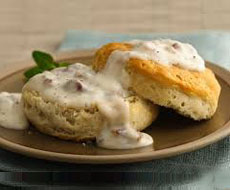
    [1] Biscuits smothered in gravy from Chef George Weld (photo © Rizzoli).
    Biscuits & Gravy

    [2] You can go lighter on the gravy, with this recipe from Pillsbury (photo © Pillsbury).
    Biscuits & Gravy Recipe

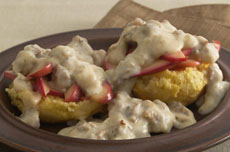
    [3] Make more of a meal by topping the biscuits with sausage patties, ham, bacon or other meat (photo © Pillsbury).
    Fried Egg, Biscuits & Gravy
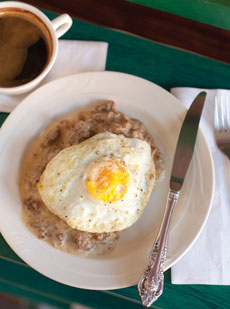
    [4] Top with a fried egg or serve scrambled eggs on the side (photo © St. Louis Magazine).

     
    3. REDUCE the heat to medium and sprinkle the flour into the pan, stirring for 1 minute. Pour in the milk and scrape up the fond from the bottom of the pan. Bring the gravy to a boil. Reduce the heat to medium and cook, stirring occasionally, until the gravy thickens, 8 to 10 minutes. It should look velvety and have the thickness of heavy cream. Season the gravy with salt, black pepper and cayenne.

    4. COOK the optional eggs and bacon or other meat.

    5. Split the biscuits and arrange on plates or in shallow bowls. Top with the optional meat and eggs, pour the gravy over the biscuits and serve immediately. While fresh herbs are not a Southern tradition, we always sprinkle them as a garnish for flavor and color.
     
    _____________________

    *THE WATER TEST: Drop 1/8 teaspoon water into the hot pan. If it forms into multiple balls that sizzle, the pan is not hot enough. Keep heating, and when the water forms a single ball that rolls around the pan, it’s ready.
     
     
    DIFFERENT TYPES OF GRAVY

    Gravy is a sauce made in its simplest form from flour (a thickener), fat, and seasonings (salt and pepper). Vegetables can be added, as well as wine and additional thickeners such as cornstarch.

    The word originally referred to a sauce made from the drippings (fat and uses) from cooked meat and poultry, there are now vegetarian and vegan gravies.

    Gravy has long used meat drippings (or in current times, a vegetarian substitute), as opposed to:

  • Sauces, which are made from fruits, vegetables and/or their juices.
  • Jus (pronounced ZHOO), the French term for a meat gravy that has been refined and condensed into a clear liquid.
  • Coulis, a thin fruit or vegetable purée used as a sauce.
  •  
    In American cooking, gravies are white or brown. Popular gravies include:

  • Brown gravy, made with the drippings from roasted meat or poultry.
  • Cream gravy is the white gravy used in Biscuits and Gravy and Chicken Fried Steak. It is a béchamel sauce made with meat drippings and optionally, bits of mild sausage or chicken liver. Other names include country gravy, milk gravy, sawmill gravy, sausage gravy, and white gravy.
  • Egg gravy is a béchamel sauce that is served over biscuits, essentially cream gravy with a beaten egg whisked in. The egg creates small pieces in the gravy.
  • Giblet gravy is a brown gravy that includes the giblets of turkey or chicken, and is served with those fowl. It is the traditional Thanksgiving gravy.
  • Mushroom gravy is a brown or white gravy made with mushrooms.
  • Onion gravy is made from large quantities of slowly sweated, chopped onions mixed with stock or wine. Commonly served with bangers and mash, eggs, chops, or other grilled or fried meat which by way of the cooking method would not produce their own gravy.
  • Red-eye gravy is a gravy made from the drippings of ham fried in a skillet, a Southern specialty served over biscuits, grits or ham. The pan is deglazed with coffee, and the gravy has no thickening agent.
  • Sausage gravy, made from the drippings of cooked pork sausage, white flour, milk, black pepper, and in the best recipes, bits of sausage, bacon, or ground beef.
  • Sawmill gravy (a.k.a. country gravy, cream gravy, milk gravy, sausage gravy and white gravy) a carnivore version of béchamel sauce with meat drippings added to the roux, and black pepper plus bits of breakfast sausage or chicken livers added to the finished sauce.
  • Vegetable gravy is a vegetarian gravy made with boiled or roasted vegetables plus vegetable stock, flour and fat. Wine and/or vegetable juice can be added.
  •  
    And let’s not forget our favorite dessert gravy: chocolate sauce, made with fat (butter), flour, cocoa powder, and sugar.


    CHECK OUT WHAT’S HAPPENING ON OUR HOME PAGE, THENIBBLE.COM.


    Comments off

    TIP OF THE DAY: Make Homemade Pork Rinds

    Homemade Pork Rinds
    [1] Don’t these homemade pork rinds look so much better than store-bought (photo and recipe © PaleoLeap.com)?

    Pork Rind Garnish
    [2] Pork rinds are also a delicious garnish for soups and salads (photo © Culinary Vegetable Institute).

    Pork Cracklings
    [3] Pork cracklings are made from the skin and fat; pork rinds are the skin (rind) only (photo © Padaek.com. Check out the recipe).


    As we think ahead to Father’s Day, we’re mulling over some homemade versions of popular snack foods from potato chips to pork rinds.

    Pork Rind Appreciation Day, established by Rudolph Foods (which sells pork rinds), is held on Super Bowl Sunday. But we like the idea of homemade pork rinds and a cold beer on Father’s Day.
     
     
    PORK RINDS VS. PORK CRACKLINGS

    Pork rinds (chicharrónes) are made from pork skin, with the attached fat removed.

    That’s the difference between pork rinds and pork cracklings. Cracklings (called grattons in Cajun cuisine) include the fat that adheres to the skin.

    Scrunchions, popular in Newfoundland, are pieces of fried fat (no skin).

    Because of the extra fat, cracklings are greasier, denser and a bit chewy. Pork rinds are airy like cheese puffs, and they dissolve in your mouth.

    Here’s an idea: Buy pork belly to make grilled pork belly or pork belly skewers, and turn the skin into pork rinds. You can also buy the skin only from butchers (it’s quite inexpensive).

    Be sure to use skin within three days of purchase, as its high moisture content means it can spoil quickly. The finished pork rinds will keep for a long time if cooked long enough for all the fat to be rendered out.

    Check out this video.
     
     
    RECIPE: HOMEMADE PORK RINDS

    Here’s a recipe for homemade pork rinds from Paleo Leap, which serves it as a crispy Paleo Diet snack with dilled mayonnaise or tartar sauce.

    Some pork rinds are deep-fried. Others, like this recipe, are roasted (the difference between roasting and baking).

    With homemade pork rinds, you control the salt. You don’t need to use any salt at all; the pork rinds will still be delicious. You can supply a salt shaker for those who must have it.

    Or, you can choose another seasoning. Garlic? Pepper? Curry?

    Ingredients

  • Pork skin
  • Optional: salt
  •  
    Preparation

    1. PREHEAT the oven to 325°F. Line a baking sheet or roasting pan with parchment paper to make clean-up easier.

    2. SLICE the skin into 1″ x 2″ strips—longer if you like—and place the strips on the baking sheet. Roast for 1-1/2 hours, then taste a piece. Many recipes call for 3 hours, but Sébastien Noël of Paleo Leap advises: “…most of the time they’re ready after 1.5 hours. You want them to be crispy but you don’t want them to be hard as a rock.”

    3. REMOVE from the oven and cool until they’re warm to the touch; enjoy them warm.


    Comments off

    FOOD FUN: Bacon Clothesline

    The innovative chef David Burke has 11 restaurants, stretching from Manhattan to Aspen.

    His playful yet polished cuisine has long featured memorable dishes, from Angry Lobster to Chocolate Burke’In Bag (a molded chocolate bag filled with mousse) to our latest fancy, Bacon On A Clothesline.

    Unlike many of his dishes, you can make your own Bacon On A Clothesline. It was all the rage at one of our recent parties, hanging on a string stretched between poles next to the bar. Get your drink, unpin a crisp slice of bacon and enjoy!

    If you’re entertaining outside for Father’s Day, rig up your own bacon clothesline for memorable “bar food.”

    Bacon On A Clothesline was created for Chef Burke’s latest restaurant, Fabrick. The menu also features a revolving choice of dishes such as Octopus Tacos, Baked Pork Shoulder with “Angry” Garlic, Skate “Chop,” Avocado Panna Cotta, Chicken Mousse with Crisped Chicken Skin and “Sticks On A Salt Brick”—skewers of duck parts on a slab of pink Himalayan salt.

    David Burke Fabrick is on the ground floor of the newly renovated garment district hotel, the Archer Hotel, a boutique hotel that also houses a Burke Group rooftop lounge, Spyglass, with skyline views.


    Bacon On A Clothesline
    Bacon, three strips of candied bacon with clothespins to a wood framed “clothesline.”

     
    There’s also and a California-style aerie at the entrance to the hotel, where you can have a cocktail and people watch.

    Fabrick is located between Fifth and Sixth Avenues, at 47 West 38th Street, Manhattan; 212-302-3838. The website: DavidBurkeFabrick.com.
      

    Comments off

    TIP OF THE DAY: DIY Bruschetta Bar

    Bruschetta

    Cherry Tomato Bruschetta

    DIY Bruschetta Bar
    Top: Grab a slice and pick your toppings. We love this selection from WhatsGabyCooking.com. Center: The classic bruschetta topping: tomatoes, olive oil and basil. The tomatoes can be halved cherry or grape tomatoes or diced beefsteak or roma tomatoes (photo courtesy Williams-Sonoma.com). Bottom: As a bonus for guests, grill the bread as you need it, so it will be warm. Photo courtesy Brit.co (see their other fun DIY bars).


    Oh, how we love bruschetta and crostini. Take slices of good crusty bread and grill (bruschetta) or toast (crostini—see the differences below) and add your favorite toppings. Crunchy and savory, it’s our idea of what to have with beer, wine or a Martini.

    It’s easy to toast bruschetta on the grill, and to take it one step further by setting up a DIY bruschetta bar for guests. If you’re grilling for Father’s Day, it’s a memorable way to start the event, with any beverage from iced tea and soft drinks to alcohol.

    By the way, that’s broo-SKETT-uh, not broo-SHETT-uh). The word is not only mispronounced in the U.S., but also misued. Bruschetta is the grilled bread, not the topping: bruscare means “to roast over coals.”

    We’ve seen jars of marinated tomatoes and basil sold as “bruschetta.” It should be labeled bruschetta topping.
     
    RECIPE: DIY BRUSCHETTA BAR

    All you need are bread, olive oil and toppings. For a DIY bar, offer at least three different toppings. Our favorites are below.
     
    Ingredients

  • Baguette loaves
  • Olive oil, salt, pepper and peeled, halved (horizontally) garlic cloves
  •  
    For The Toppings

  • Avocado, mashed and seasoned (garlic, salt, pepper, lemon juice, etc.)
  • Fresh basil, julienned/shredded
  • Greens: baby arugula or watercress
  • Marinated artichoke hearts (chopped)
  • Mushrooms, marinated
  • Onions or green onions (scallions), chopped
  • Peppadews, sliced
  • Pimento, chopped or sliced
  • Tomatoes, diced and marinated in oil and vinegar
  •  
    More options: shredded mozzarella or other cheese (ricotta, spreadable goat cheese, thinly-sliced Brie), fish (we have a passion for anchovies and herring salad on bruschetta), other marinated vegetables, prosciutto or sliced salame with mustard or mostarda.
     
    Preparation

    1. SET out the toppings and teaspoons for serving. We use ramekins; you can use any bowls you have.

    2. SLICE the bread from 1/2″ to 3/4″ thick. Rub each side with cut garlic clove and brush each side with olive oil. Add a pinch of salt and pepper. Grill to your desired toastiness.

    3. PLACE the bread on a platter next to the toppings and watch people create their appetizers.
     
     
    BRUSCHETTA VS. CROSTINI: WHAT’S THE DIFFERENCE?

    Bruschetta and crostini are popular hors d’oeuvres/snacks that are easy to make. They’re a perfect pairing to wine and beer, and also can be served as a first course or a light meal, with a salad and/or soup, or with cheese.

    The differences between the two are the size of the slice and the cooking technique.

  • Bruschetta are cut from baguette-style loaves that are three or four inches in diameter, then grilled and topped. Bruschetta originated in the Tuscany region of Italy, where they are commonly served as a snack or appetizer. Rubbed with a garlic clove and brushed with oil before grilling, they may have been the original garlic bread.
  • Crostini cruh-STEE-nee) are cut from a narrower loaf like a ficelle, about two inches in diameter, and toasted, then topped.
  • Crostini (are croutons: not in the American sense of small cubes tossed into soup or salad, but slices of toasted bread (it’s the same with French croutons). They are often topped with spreadable cheese or pâté. Plain crostini are served with soups and salads, like melba toast, or set out with cheese.
  • Both can be served plain as toast to accompany another food. But with toppings, they are transformed.
  • The toppings for both can be as simple as extra-virgin olive oil, salt and pepper or diced tomatoes and basil, to almost any spread, vegetable, cured meat or cheese—even fruit, such as sliced strawberries with olive oil, balsamic vinegar and tarragon or other sweet herb*.
  •  
    ____________
    *Sweet herbs include chamomile, lavender, lemon verbena licorice, mint, rose geranium and tarragon.
      

    Comments off

    The Nibble Webzine Of Food Adventures
    RSS
    Follow by Email


    © Copyright 2005-2026 Lifestyle Direct, Inc. All rights reserved. All images are copyrighted to their respective owners.