|
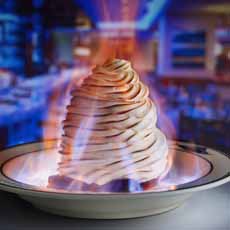
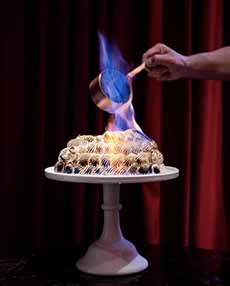
[1] A dramatic beauty (photo © The Ocean Aire).

[2] Brandy, rum, or other alcohol is lit in a small cup or spoon and poured over the Baked Alaska (photo © J F Restaurants).
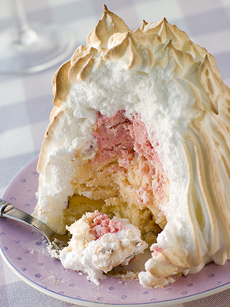
[3] The dessert is just as beautiful without flames (photo © Monkey Business | Dreamstime).
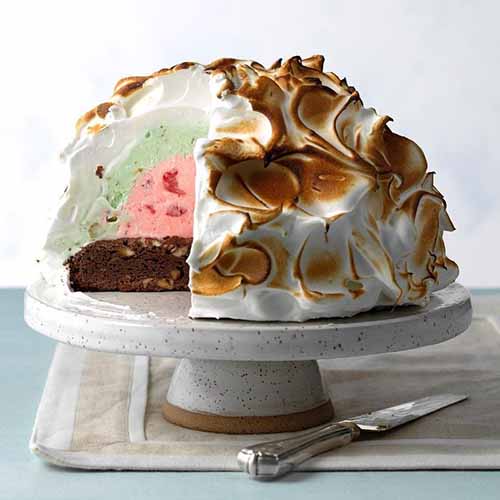
[4] You can use any flavors of ice cream and sherbet you like. For this Spumoni Baked Alaska, here’s the recipe (photo © Taste of Home).
[5] Mint lovers: Try Grasshopper Baked Alaska. Here’s the recipe (photo © Taste of Home).
[6] For home, we prefer a large Baked Alaska for everyone. But restaurants make individual sizes. However, these individual Mocha Baked Alaskas were made at home. Here’s the recipe (photo © Taste of Home).
[7] Delmonico’s, home to the first dessert called Baked Alaska, still follows the original recipe, which included apricot compote. Here it’s used as a garnish, with a side of apricot liqueur (photos #7, #8, #9, and #12 © Delmonico’s).
[8] A close-up on Delmonico’s Baked Alaska.
[9] You can style the meringue as you wish. Before Delmonico’s used the smooth, modern style above, the Baked Alaska had other designs, including this one.
[10] This is the prettiest presentation we’ve come across, from Charlie Palmer Steak.
[11] Pastry chef Franciscoz Migoya eliminated the cake base and made Baked Alaska in a glass bowl. Here are some of his other beautiful creations (photo © Franciscoz Migoya).
[12] Fun with food: Delmonico’s made Baked Alaska ice cream cones for a special event (photo CY Eats for Delmonico’s | Facebook).
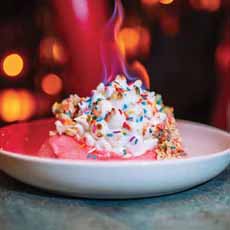
[13] This is “deconstructed” Baked Alaska: a slice of cake topped with ice cream and meringue, no baking required. Here’s the recipe (photo © Komodo Restaurant | Miami).
|
|
While February 1st is National Baked Alaska Day, it’s relatively easy to make this dazzling dessert anytime you want to impress. Just use store-bought ice cream and pound cake.
(Over-achievers: churn your own ice cream and bake your own cake.)
Make a Baked Alaska with this recipe. It’s easy when you use store-bought ice cream and pound cake instead of making/baking your own from scratch.
> The original Delmonico’s Baked Alaska recipe is below.
> Here’s the classic Baked Alaska recipe we use (it’s much simpler).
> A recipe for deconstructed Baked Alaska (photo #13).
> The history of Baked Alaska is below.
> The different types of ice cream and frozen desserts: a photo glossary.
> The history of ice cream.
> The different types of cakes.
But first:
WHAT IS BAKED ALASKA?
Baked Alaska is a masterpiece of chemistry: an ice cream cake topped with meringue and baked in the oven until the meringue browns.
The concept (and execution) is simple. Ice cream, mounded on a pie plate or in a rectangle, is covered on all sides with slices of sponge cake or pound cake; this is then covered with meringue.
The entire dessert is then placed in a 500°F oven just long enough to firm the meringue—three or four minutes.
The meringue is an effective insulator, and in the short cooking time needed to finish the dessert, it prevents the frozen ice cream from melting in the hot oven.
Various browning methods evolved over time. The propane or butane kitchen torch as we know it today became more common in professional and home kitchens during the 1960s-1970s, alongside the rise of French-influenced cooking in America. However, since this is quite specific historical culinary information, I want to note that I may not be entirely accurate about these dates and you may want to verify them.
THE HISTORY OF BAKED ALASKA
The concept of baked ice cream was developed by the Chinese, who used pastry as the insulator; a Chinese delegation introduced it to Paris in the 19th century.
In 1804, an American-born military officer, physicist, and inventor Benjamin Thompson Rumford (1753-1814), created the first incarnation of the dessert.
A loyalist, he had moved to England during the American Revolution and became a British subject.
The dessert was the by-product of his study of the resistance of stiffly beaten egg whites to the induction of heat. He named the dessert Omelette Surprise. Later versions added sponge cake underneath the ice cream, the recipe that is common today.
who, as a loyalist during the War of Independence moved to London at the end of the war. Considered a hero for Britain, moved to London, he received a knighthood (and subsequently became Count Rumford).
In his scientific pursuits, he investigated the heat resistance of beaten egg whites, and demonstrated that beaten egg whites were a better insulator. The trapped air bubbles in the meringue that covers the ice cream create an excellent insulating layer that protects the ice cream from melting when exposed to high heat for a short time.
Thompson’s dish was named Omelette à la Norvégienne, the Norwegian attribution owing to the “arctic” appearance (the meringue looks like snow) and the frozen ice cream center.
According to Wikipedia, Omelette Norvégienne, also called Omelette Surprise, was created by a Chef Balzac at the Grand Hôtel in Paris, in 1867—the same year as Delmonico’s version debuted (we could find nothing about Chef Balzac except this entry, so if he did work at the hotel, he was not a famous chef).
The flambéed version became popular later. The technique ignites brandy/Cognac or other high-proof liquor in a spoon or sauce boat and pours the flaming liquor over the Baked Alaska.
Some sources suggest this technique gained popularity in the mid-20th century, as tableside flambé became a dramatic trend in fine dining restaurants. While it’s difficult to pinpoint the exact first instance, variations of flambéed desserts were set in flame at tableside.
Among the first, the spectacle of flaming Crêpes Suzette was already in vogue by the early 1900s, which likely influenced the practice of flambéeing other dishes to engender oohs and aahs.
Both desserts and savory main courses were flambéed (sometimes, but not always, depending on the restaurant).
Flambéed main courses: Beef Stroganoff, Duck à l’Orange (flambéed with Grand Marnier to enhance the orange flavor), Lobster Thermidor, Steak au Poivre, Steak Diane.
Flambéed desserts: Baked Alaska, Bananas Foster, Cherries Jubilee, Crêpes Suzette – Thin French pancakes with a sauce of butter, sugar, orange zest, and Grand Marnier, flambéed tableside.
BAKED ALASKA AT DELMONICO’S
Delmonico’s Restaurant in New York City took pages from both the Chinese and Benjamin Thompson playbooks, tweaked the recipe, and renamed it named Baked Alaska in honor of the newly-acquired Alaska territory, and the name stuck.
Delmonico’s is credited as creating the iconic dish called Baked Alaska, although the restaurant’s original recipe was called “Alaska Florida” for its extremes of cold and heat [source].
Hot and cold elements in a single dish were a “first” in the U.S.
While the concept existed before, Ranhofer is credited with naming it in 1867 to celebrate the U.S. purchase of Alaska. The new name popularized the dessert.
His original Baked Alaska consisted of a base of walnut spice cake topped with apricot marmalade, banana ice cream in the center, and a meringue shell that was toasted in the oven.
Since its inception, Baked Alaska has been one of the bestselling desserts at Delmonico’s, made in individual portions. The restaurant estimates that approximately 7 out of 10 guests choose Baked Alaska for dessert.
Since its reopening in September 2023, Delmonico’s has also been offering seasonal twists on the dessert.
In December, a festive holiday version featured mint ice cream atop chocolate cake with a peppermint meringue.
This past fall, the restaurant served a bourbon pecan version.
This year on Valentine’s Day, the dessert will turn pink but keep its original flavors of banana gelato, walnut cake, and apricot jam.
BAKED ALASKA RECIPE: THE OLD VERSUS THE NEW
The original Omelette Norvégienne (the 19th-century French version of Baked Alaska) differs from modern versions in several ways:
Cake base: The original used sponge cake (génoise) as the base. Modern recipes still use sponge cake, but variations may include pound cake or other denser cakes for a firmer structure.
Ice cream: The original had a single flavor of ice cream, often vanilla. Many modern versions layer multiple flavors of ice cream or ice cream and sorbet.
Browning: Originally, meringue was applied thickly and then either baked briefly in a very hot oven or torched to create a top with golden accents. Today, the use of a kitchen torch is preferred for precision browning.
Flambé: The original did not involve flambéing. The focus was on the insulating properties of the meringue. Flambéing began in the early 20th century. While not all restaurants take this step, those that do use alcohol (brandy/Cognac, Grand Marnier, rum) for drama. While most of the alcohol burns off, some flavor remains.
Presentation: The original was served simply, without extra enhancements. Today, the plates are often decorated with fruit, fruit sauces, caramel), or elements for artistic presentation.
DELMONICO’S ORIGINAL BAKED ALASKA RECIPE
Today’s executive chef at Delmonico’s, Bill Oliva, shared his recipe for Baked Alaska, patterned after the original. This recipe makes 8 individual portions, as opposed to one large cake.
Ingredients For The Walnut Sponge Layer
8 ounces egg yolks
5 ounces sugar
8 ounces egg whites
6 ounces sifted all purpose flour
5 ounces chopped walnuts
Preparation For The Walnut Sponge
1. COMBINE the egg yolks with 2 ounces of sugar in the bowl of an electric mixer. Beat at medium speed until thick and light in color. In another bowl…
2. BEAT the egg whites with the remaining sugar to medium peaks. Gently fold the egg whites into the egg yolk mixture.
3. FOLD the sifted flour and chopped walnuts into the egg mixture. Spread the batter on a parchment-lined sheet pan and bake at 425°F for 10-15 minutes.
4. COOL completely cut into 3-inch rounds. Set aside.
Ingredients For The Apricot Compote
Editor’s note: We purchased a brand of top-quality apricot preserves.
1 pound dried apricots, roughly chopped
2 tablespoons sugar
2 star anise
2 whole cloves
1 vanilla pod split lengthwise
1 ½ cups orange juice
1 ½ cups water
Zest of 1 orange
Preparation For The Apricot Compote
Put all compote ingredients into heavy bottom pan and bring mixture to boil. Reduce heat and simmer till apricots are cooked and liquid forms a syrup.
Ingredients For The Banana Ice Cream
1.5 pints milk
1.5 pints heavy cream
12 ounces sugar
10 egg yolks
6 ounces puréed banana
Preparation For The Banana Ice Cream
1. PLACE the milk, cream, half the sugar, and the vanilla bean in a saucepan and bring the mixture to the boiling point.
2. BLEND the egg yolks with the remaining sugar. Temper the egg yolk mixture into the hot milk mixture.
3. ADD the banana purée and heat slowly until the mixture thickens to coat the back of a spoon. Strain the mixture and allow it to cool in ice bath. Refrigerate overnight.
4. PROCESS the mixture according to the instructions of your ice cream machine. Store the ice cream in the freezer until assembly.
Ingredients For The Italian Meringue
1 pound sugar
4 ounces water
8 ounces egg whites
Preparation For The Italian Meringue
1. COMBINE the sugar and water in saucepan and bring the mixture to 240°F on a candy thermometer.
2. PLACE the egg whites in the bowl of mixer and, when the sugar in the saucepan reaches 230 degrees, start to whip the egg whites into soft peaks.
3. BEGIN adding the sugar syrup to the egg whites in steady stream, continue to beat until all the sugar syrup has been incorporated into the mixture. Continue to beat until the mixture has smooth consistency and firm peaks.
|
To Assemble
1. PREHEAT the oven to 425°F. Place the walnut cake rounds on serving plates and top them with apricot compote.
2. SCOOP a generous portion of banana ice cream onto the apricot compote.
3. PLACE the Italian meringue in pastry bag and completely cover the ice cream, walnut cake and compote with meringue.
4. BAKE for 4 minutes or until the meringue is slightly browned and crispy.
5. GARNISH if desired and serve. The recipe doesn’t indicate garnishes, but you can see from photos # __ and #__ that edible flowers, swaths of apricot compote, and candied walnuts are used.
________________
*Charles Ranhofer (1836–1899) was a French chef who came to New York and became at Delmonico’s Restaurant in New York City, where he helped shape fine dining in America and joined Delmonico’s in 1862. He worked there for creating famous dishes, including Eggs Benedict, refining what became Lobster Newburg, and Pommes de Terre à la Delmonico.
†Pommes de Terre à la Delmonico is a rich, creamy, and crispy potato preparation, sometimes compared to modern potatoes au gratin or Dauphinoise potatoes, but with its own distinct style. Peeled potatoes are cut into uniform small cubes, parboiled, and sautéed in butter. A rich sauce (cream-based or stock and butter) is added.
The mixture is transferred to a baking dish, topped with grated Gruyère or Parmesan, and baked until golden and bubbly. Some versions finish with a light dusting of breadcrumbs for extra crispness.
‡The U.S. acquired Alaska from Russia in 1867, paying $7.2 million for the territory (less than 2 cents per acre). Despite the initial skepticism and ridicule, the Alaska Purchase would prove to be a wise investment; its vast natural resources, including oil, gold, and minerals, would make it worth well over $500 billion today. Alaska became the 49th state on January 3, 1959 [source].
‡‡The history of Delmonico’s: In 1827, at the beginning of New York City’s evolution as the financial center of the world, a small pastry shop at 23 William Street in lower Manhattan was opened by the Delmonico brothers. It sold classic French pastries, fine coffee, chocolates and bonbons, wines and liquors, as well as Havana cigars, was operated by two brothers from Switzerland: Giovanni (John) and Pietro (Peter) Delmonico. Its success led them to purchase a triangular plot of land at the intersection of Beaver, William, and South William Streets where, in 1837, they opened the first fine dining restaurant in the country.
A third member, nephew Lorenzo Delmonico, joined the business in 1831 at age 19. Lorenzo became instrumental in transforming Delmonico’s from a cafe into America’s first true fine dining restaurant. He was particularly known for his business acumen and for introducing French cuisine and fine dining customs to American restaurant culture.
Delmonico’s restaurant offered what was then an unheard-of luxury in America: the European custom of private dining rooms, where afforded discriminate entertaining. This made Delmonico’s the place where New York’s elite conducted their business dealings.
The basement held the restaurant’s treasure, the largest private wine cellar in the city, with an impressive 1,000 bottles of the world’s finest wines. It was said to be the first wine cellar in an American restaurant.
Other innovations: They were the first American restaurant to allow guests to order from an à la carte menu, rather than eating whatever set meal was being served that day. This was revolutionary at the time. They hired French chefs, most notably Charles Ranhofer, who became one of America’s first celebrity chefs.
Lorenzo was particularly clever about cultivating an exclusive atmosphere. He maintained a strict dress code and was known to turn away people who weren’t “suitable,” even if they could afford to pay (including refusing admission to Jews and people of color). This exclusivity made Delmonico’s even more desirable to New York’s upper class, and the policy continued after Lorenzo’s death in 1881. The practice remained common at many upscale establishments into the 20th century [source: Claude.ai 2025-02-01].
CHECK OUT WHAT’S HAPPENING ON OUR HOME PAGE, THENIBBLE.COM.
|