THE NIBBLE BLOG: Products, Recipes & Trends In Specialty Foods


Also visit our main website, TheNibble.com.

FOOD FUN & FOOD ART: New Boursin Fig & Balsamic Spreadable Cheese


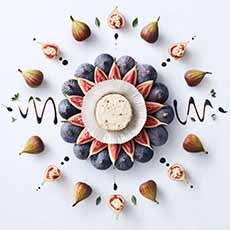
[1] Boursin’s fall flavor, Fig Balsamic, makes a beautiful center for a snack plate with black mission figs and brown turkey figs (both photos © Gournay Cheese).


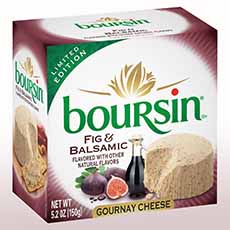
[2] There’s a lot of flavor in each little carton.


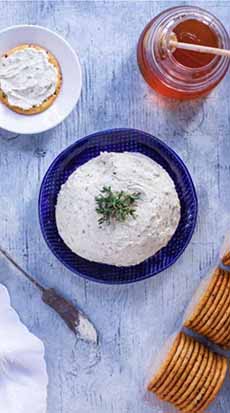
[3] You can make a Boursin-like spread from cream cheese. Here’s the recipe from Food.com (photo © Diana | Eating Richly). Also check out this recipe from The View From Great Island.


One of the nice parts of food reporting comes in the fall, when a number of brands release limited-edition fall flavors: chestnut, cinnamon, cranberry, eggnog, fig, gingerbread, peppermint and pumpkin, to name the more popular ones.

So it is with French cheese brand Boursin, with the launch of their newest seasonal flavor, Fig & Balsamic—available for a limited time only.

Boursin is a soft creamy cheese made in a variety of flavors, each as delicious as the next. Its flavor and recall a more sophisticated whipped cream cheese.

Fig and Balsamic joins Cranberry & Spice, also a seasonal flavor, and the line’s mainstays:

Fig & Balsamic (seasonal flavor, available starting this month)

  • Basil & Chive
  • Garlic & Fine Herbs
  • Pepper
  • Shallot & Chive
  •  
    The cheeses can be elevated from a toast or bagel spread to an hors d’oeuvre with fine crackers or baguette slices, or stuffed dates.

    Check out Boursin’s recipes for more ideas.
     
     
    WHERE TO FIND IT

    Boursin Fig & Balsamic is now available in the deli section of major retailers nationwide, including AHOLD (Food Lion, Giant Food, Giant/Martin’s, Hannaford, Peapod, Stop & Shop), Albertsons, Kroger, Meijer and Publix. The suggested retail price of $5.99-$6.99.
     
     
    BOURSIN CHEESE HISTORY

    Boursin Garlic and Fine Herbs, sold in a little foil cup, was created in 1957 by François Boursin, a cheesemaker in the commune of Croisy-sur-Eure commune in Normandy, northern France.

    The cheese was inspired by a traditional Normandy party dish of garnished fromage frais (French for “fresh cheese”); a fresh, unaged cheese intended to be eaten within days of its production.

    In the case of Boursin, guests would take their portion of cheese and top it with herbs to add herbs for flavor.

    Boursin thought: Why not sell the cheese with the herbs already blended in?

    Voilà: Boursin Garlic and Fine Herbs, the first flavored cheese product to be sold nationally in France.

    In 1990, the brand was acquired by Unilever, who sold it to Groupe Bel 2007 [source].

    The original cheese, fromage frais, is simply drained, lactic set curd, lightly salted, that does not undergo a ripening period. It has a creamy, soft texture and fresh and a fresh, milky flavor.

    Fromage frais differs from fromage blanc, another fresh, white French cheese, in that by law, fromage frais must contain live cultures when sold, whereas with fromage blanc, the fermentation has been halted [source].

    It is often eaten for breakfast (we love it with toast), with fruit for dessert, or in cooking.
     
     
    > Check Out The Different Types Of Cheeses In Our Cheese Glossary


    Comments off

    TIP OF THE DAY: Make A Frappe, A Recipe For A New England-Style Milkshake

    October 7th is National Frappe Day.

    Frappe (pronounced frap) is a New England term for a milkshake, from the French frapper (frap-PAY), “to beat.”

    It’s an iced beverage that is made in a blender or a shaker, to produce a foamy drink. Ice is added to increase the foaminess. Milk, sugar, and flavorings can be added. Caramel or chocolate sauce can be used as garnishes, along with whipped cream and a host of others.

    A frappe is not a milkshake, and it has its own holiday (National Milkshake Day is September 12th).

    “When is a milkshake not a milkshake?” asks New England Magazine.

    “In New England, of course, when it’s a frappe (or a cabinet).”

    > The recipe is below.

    > The differences between a float, ice cream soda and shake.

    > The year’s 8 ice cream drink holidays.

    > The history of the milkshake.

    > The history of the frappe is below.
     
     
    WHAT’S DIFFERENT ABOUT A FRAPPÉ?

    New England Magazine goes on to explain that:

  • Milk. In New England, a milkshake never includes ice cream. It’s more like chocolate (or vanilla, or whatever) milk.
  • Frappe. A frappe has lots of ice cream—what most of us in other regions would call a thick shake. But there’s also ice, to make the drink extra-frosty.
  • Cabinet. If you’re from certain parts of Rhode Island and southeastern Massachusetts, you order a cabinet. Why? Because the blender was kept in a cabinet.
  • France. For reference, in France, a frappé is a cold blender drink, like a shake. It originally described frozen fruit juice and even liquor served over shaved ice [source].
  • Greece. In 1957 in Greece, a Nestlé representative invented the coffee frappe by blending instant coffee, cold water, and ice in a shaker (Frappuccino**, anyone?). Since then, the frappe has been one of the most popular drinks in Greece—sometimes referred to as “the national coffee drink [ibid.].
  •  
    New Englanders also refer to sprinkles as jimmies. Why ask why? (There are conflicting stories, none of them satisfactory.)
     
     
    FINALLY, THE É IS RESTORED TO FRAPPÉ

    We hadn’t thought about frappes and jimmies for decades; we lived in Boston long ago. When we moved back to the land of milkshakes and sprinkles, frappes and jimmies faded into the deepest recesses of memory.

    But when we did live in the land of frappes, no one could tell us, a student of French and an editorial stickler, why the accent mark was left off.

    Maybe the area’s menu typesetters didn’t have an aigu, the é with the accent mark? Certainly, it couldn’t be that nobody knew French.

    Etymology notwithstanding, it seems that “frappé” (with the accent) has finally come to New England thanks to L.A. Burdick, one of New England’s finest chocolatiers.

    Burdick has café-chocolate shops in Walpole, New Hampshire (the original), Boston, and Cambridge, with a more recent expansion to Chicago and New York City.

    If you’re in the neighborhood, here are the addresses.
     
     
    LARRY BURDICK’S FRAPPÉS

    Burdick Chocolate is one of our favorite artisan chocolatiers. His chocolate shoppe cafes are located in the Boston area plus in Chicago, D.C., and New York City.

    Burdick’s frappés combine a chocolate drink (milk and chocolate syrup) with crushed ice and fruit pureé (photo #1). His offerings:

  • Dark chocolate with raspberries
  • Milk chocolate with bananas
  • White chocolate with strawberries
  •  
    Here’s how we adapted the concept.

    1. PURÉE your fruit of choice. Sweeten lightly to taste.

    2. MAKE a thick milkshake in the blender. Crush a couple of ice cubes with an ice tapper or a mallet.

    3. PLACE the purée in the bottom of a tall glass, and top with the shake (photo #1).

    4. GARNISH with whipped cream and a piece of fruit.

    If you’re near a store that sells Magnum ice cream, you can buy dark, milk or white chocolate ice cream.

    Otherwise, punt, with regular vanilla or chocolate ice cream. We used Ghirardelli white chocolate syrup and Talenti Double Dark Chocolate Ice Cream.
     
     
    EASY FRAPPÉ RECIPE

    Ingredients For 1 Drink

  • 2 cups ice
  • 1 cup ice cream
  • ¼ cup premium chocolate syrup
  • Optional garnishes: whipped cream, grated chocolate, mini chocolate chips, jimmies, chocolate syrup
  •  
    Preparation

    1. ADD the ingredients to a blender and blend until smooth. Pour into a tall glass (or mason jar, or whatever) and garnish as desired.
     
     
    THE HISTORY OF THE FRAPPÉ

    The frappe (pronounced frap) is a classic New England ice cream drink that’s similar to a milkshake but with a key difference: it always includes ice cream.

    In the late 19th and early 20th centuries, soda fountains became popular gathering spots in the U.S., and regions developed their own variations of creamy drinks.

    In most of the U.S., “milkshake” came to mean a drink that included ice cream, but not on New England. They the drink called a milkshake does not have ice cream; just milk and flavored syrup, shaken until frothy.


    Chocolate Raspberry Frappe
    [1] A chocolate-raspberry frappe (with the accent mark) from chocolatier Larry Burdick (photo © L.A. Burdick Chocolates).

    Chocolate Thick Shake
    [2] A couple of chocolate cookies were tossed into the blender for this version (photo © American Heritage Chocolate).


    [3] Add some spice to your chocolate: cinnamon, nutmeg, chili powder (photo © American Heritage Chocolate).


    [4] A full-on frappe. Find the recipe for this and others at Koobie’s Coffee (photo © Koobie’s Coffee).


    [5] A frappe can be any flavor you like (photo © The Milkshake Factory).

    Homemade Chocolate Chip Mint Ice Cream
    [6] Ready, set, scoop (photo © American Heritage Chocolate).


    New England distinguished their frappe from their milkshake by including ice cream in the former, creating a thicker and richer drink than their milkshake.

    Let’s add to the confusion by pointing out that in Rhode Island, part of New England, a frappe (a milkshake made without ice cream) is called a cabinet. The name is believed to derive from the cabinet where the blender was kept.

    Back to the frappe:

    By the early 1900s, the frappe became a staple at soda fountains and ice cream parlors in the region, blending milk, flavored syrup, and a generous scoop of ice cream. It became a beloved part of New England’s food culture, served at ice cream parlors and local diners.

    Today, the frappe remains a regional specialty in New England, though the lines between milkshakes and frappes have blurred in some places. But its history remains a testament to the area’s culinary traditions and its ability to preserve regional distinctions in our world of increasingly homogenized food culture.

    (Some information via Abacus.ai.)
    ________________

    *Nonpareils, the precursors of sprinkles/jimmies, date to at least the late 18th-century, if not earlier. They were used as decoration for pièces montées† and desserts.

    The candy company Just Born (maker of Peeps, Mike & Ike, Peanut Chews, and other favorites), then in Brooklyn, New York, claims that its founder, Sam Born, invented the chocolate-flavored sprinkles he called jimmies. However, advertisements for chocolate sprinkles as a confection exist as far back as 1921, predating Just Born’s, established in 1923, by two years.

    But head over to Holland: Dutch hagelslag (sprinkles) were invented in 1913 by Erven H. de Jong in Wormerveer. Here’s more of the story.

    A pièce montée (mounted piece) is a decorative confectionery centerpiece, created in an architectural or sculptural form. They are made for formal banquets and weddings, of ingredients such as confectioner’s paste, nougat, marzipan, and spun sugar.

    The great French Marie-Antoine Carême, a student of architecture, is reported to have said about pièces montées, that architecture is the most noble of the arts, and pastry the highest form of architecture [source].

    Don’t know ibid?

    **Fun fact: The original Frappuccino was made and trademarked by The Coffee Connection, a coffee shop in Massachusetts. They were bought out in 1994 by Starbucks, which tweaked the recipe a bit and popularized the sweet coffee drink that everyone knows today [source].


    CHECK OUT WHAT’S HAPPENING ON OUR HOME PAGE, THENIBBLE.COM.


    Comments off

    PASTA RECIPE: Spicy Pumpkin Carbonara With Calabrian Chiles


    [1] Bucatini: like spaghetti, but thicker and with a hole down the center (photo by Alicia LaLocanda | CC-BY-NC-ND-2.0 License).


    [2] Spicy Pumpkin Carbonara—recipe below (photo © Delallo).


    [3] Bucatini Ai Frutti Di Mari (mixed seafood). Here’s the recipe (photo © Delallo).


    [4] Bucatini, homemade by The Baker Chick. Here’s her recipe (photo © The Baker Chick).


    [5] Delallo Calabrian chiles in olive oil. You can buy them online (photo © Delallo).


    [6] Just-picked Calabrian chiles, hanging to dry. Learn more about them below. Depending on the subspecies, they can be rounder or longer and narrow (photo © Toldio74 | Dreamstime).


    [7] Bucatini Con Le Sarde: with sardines. Here’s the recipe (photo © Delallo).


    [8] Bucatini With Green Olives, made with our favorite olive, the castelvetrano. Here’s the recipe (photo © Delallo).


    [8] Artichoke, Bacon & Spinach Bucatini. Here’s the recipe ((photo © Delallo).


    Our friend Penny, who does not like mushrooms, felt “left out” when she saw our Creamy Mushroom Fettuccine recipe last week.

    So here’s one for Penny, for all mushroom-eschewers, for the pumpkin-happy fall, and for for National Pasta Month, October.

    In this recipe, “spicy” means hot, from the Calabrian chiles (photos #5 and #6). If you don’t want the heat, just omit them.

    Or, check out the bucatini recipes in photos #7, #8 and #9. Thanks to Delallo for the recipe.
     
     
    RECIPE NOTES

    This recipe uses bucatini, a cut we love.

    Bucatini is a long, thick spaghetti-like pasta with a hole running through the center. It’s a tubular pasta, kin to cannelloni, elbows, penne, rigatoni and ziti.

    The name comes from the Italian buco (BOO-koe), meaning hole.

    The Neapolitans* call it perciato, which means pierced. Either way, it’s a fun cut.

    Why is it fun? Because you can suck the sauce through the straw. It’s messy, but you don’t have to be a kid to try it (at least once).

    Why the hole?

    One reason for the hole is that, in the days when all pasta was made by hand, it enabled a thicker version of spaghetti to cook more evenly, so the inside would not still be hard when the outside was al dente.

  • The hole was made with a rush, a thick, stiff straw; or a thin rod known as a ferretto.
  • Pasta dough was rolled and stretched around the ferretto and the ferretto was then, removed, leaving the hole.
  •  
    Bucatini is common throughout the region of Lazio, particularly Rome†, its capital.

    Popular preparations there use:

  • Buttery sauces with guanciale or pancetta, vegetables, cheese, eggs, and anchovies or sardines.
  • Bucatini carbonara (instead of spaghetti), as well as amatriciana and arrabbiata.
  • Cacio e pepe.
  • Anything with a sauce thin enough to suck through a straw!
  •  
    If you can’t get hold of it bucatini, substitute spaghetti, linguine or fettuccine—or spaghettoni, thick spaghetti without the hole, which is also a fun pasta to serve.
     
     
    RECIPE: SPICY PUMPKIN CARBONARA FOR NATIONAL PASTA MONTH

    Ingredients For 4 Servings

  • 1 tablespoon extra virgin olive oil
  • 1 egg, plus 2 additional egg yolks
  • 1/2 cup pumpkin purée (not pie filling!)
  • 1/4 teaspoon nutmeg
  • 1-1/2 cups grated parmesan cheese plus more for garnish
  • 3 cloves garlic, smashed
  • 4 ounces pancetta, diced
  • 2 tablespoons DeLallo Chopped Calabrian Chili Peppers
  • 1 (1-pound) package bucatini
  • Coarse sea salt
  • 1 cup pepitas (pumpkin seeds), toasted
  • Freshly ground black pepper
  •  
    Preparation

    1. BEAT the eggs, cheese, pumpkin and nutmeg in a large serving bowl, until combined. Add the salt and pepper. Set aside, and bring 5 quarts of salted water to a boil.

    2. HEAT the olive oil and garlic in a large saucepan. Once the garlic begins to turn golden, remove from the oil and discard. Add the pancetta to the pan. Sauté the pancetta until it becomes golden brown, about 6 minutes. Then add chiles to the pan and cook until fragrant, about 2 minutes.

    3. COOK the pasta according to package instructions. Drain, reserving 2 cups of the pasta water to finish the sauce.

    4. COMBINE the hot pasta and pancetta mixture with oil in the serving bowl with the egg and cheese. Toss to coat and to gently cook the eggs, which is done with the heat of the pasta. Once combined, add about 1/4 cup of the reserved hot pasta water and toss. If the pasta appears too dry, add another splash of pasta water.

    5. SERVE immediately, with additional parmesan cheese to garnish.
     

    WHAT ARE CALABRIAN CHILES

    Calabrian chiles (or chili peppers) are a variety of native to the Calabria region of Italy (the toe of the “shoe”—the heel is in Apulia).

    They are also called the small red cherry pepper, devil’s kiss and peperone picante Calabrese, which means “spicy pepper of Calabria.”

    The typical harvesting season is late summer through fall.

    Their genus and species, Capsicum annuum, is the same one for bell peppers, sweet/Italian peppers, serrano, cayenne, paprika, and jalapeños. (There are five different Capsicum cultivars.)

    Depending on your personal definition of “hot,” Calabrian chiles are moderately hot or hot, ranging from 25,000 to 40,000 SHU on the Scoville Scale.

    Hot peppers are in the 30,000 to 50,000 SHU range. By comparison, a jalapeño ranges from 2,500–8,000 SHU.

    The chiles are blood-red and small but very flavorful, soaking up more than 300 days of sunshine annually.

    This means that in addition to heat, they have a flavor unique to their terroir: fruity, salty and smoky.

    These popular chiles—a staple in southern Italy—are sold fresh, but also dried, pickled, or stuffed and sold in olive oil.

    DeLallo Foods, an importer of fine Italian foods, sells them that way, ready to use in a recipe or as part of an antipasto.

    Diamante, a coastal town at the top of Calabria (above the “ankle” of the foot, close to the border with Basilicata), holds an annual Peperoncino Festival. The weeklong event takes place every September (in a non-pandemic year) and lasts a week. It attracts visitors from all over the world.
     
     
    HOW TO USE CALABRIAN CHILES

    Calabrian chiles can be served both raw and cooked: baked, roasted and sautéed.

    They pair well with just about anything: cheeses, fish and shellfish, herbs (basil, cilantro, mint, parsley, ), meats (beef, poultry, pork), and vegetables (cucumbers, mushrooms, tomatoes, zucchini). You can also use them to stuff olives.

    Fresh chiles will keep up to one week when stored whole and unwashed in the fridge, in a paper or plastic bag.

    The fresh chiles are:

  • Chopped and added to hummus, marinades, salsas and sauces.
  • Mixed into mayonnaise, sour cream or yogurt dips.
  • Pickled.
  • Sliced and served over pieces of dark chocolate and onto sandwiches (yes, really—and they’re served this way at the Peperoncino Festival).
  • Tossed into salads.
  •  
    In recipes, the chiles can be:

  • Added to sauces (they are the “arrabiatta”—the heat—in pasta arrabiata [the word means “angry”]).
  • Baked with cheesy dishes such as potatoes au gratin and casseroles.
  • Mixed into pasta and pizza dough.
  • Sautéed with garlic.
  • Stirred into stews and soups.
  • Stuffed with meats, anchovies, capers, or cheeses.
  •  
    They can also be dried and used to:

  • Crush into red pepper flakes (which is typically made from the milder cayenne chile).
  • Flavor honey, oils, vinegar.
  •  

    THE HISTORY OF CALABRIAN CHILES

    Chiles were first introduced to Italy by Spanish traders, likely in the early 16th century. Columbus had brought seeds back to Spain from the Caribbean in 1493.

    These members of the Nightshade** family, were initially met with suspicion, and were mainly used for decoration until they were deemed safe to consume (the same happened with tomatoes, also brought back from the New World, and also Nightshades**).

    Then, chiles were quickly adopted into Italian cuisine, and many new varieties were cultivated in Italy. As mentioned earlier, terroir‡‡ had a big influence on the diverse flavors, sizes, etc.

    Today, outside of Italy, Calabrian chiles are predominantly grown by small growers in Asia, Australia, Europe and the U.S. If you’d like to grow them at home, you can find seeds online [source].

     
    ________________

    *Neapolitans are residents of Naples, Italy. Neapolitan is the language of Naples, and also the name of a species of dog and horse bred in the region, among other references.

    †Rome is not only the capital of the country of Italy, but the capital of the Province of Rome, and the capital of the region of Lazio.

    ‡In the U.S., you can find fresh Calabrian chiles from California; but also dried or jarred versions and Calabrian chile oil. Some stores refer to them as peperoncini, the generic Italian word for hot chiles (singular peperoncino, both cases often spelled with a double “p” in the U.S.). The generic name for sweet chile peppers in Italian is peperoni (singular peperone). If you can’t find Calabrian chiles, you can substitute serrano chiles, crushed red pepper flakes or a hot chile paste like aji amarillo, harissa or sambal olek.

    ‡‡Terroir, pronounced tur-WAH, is a French agricultural term referring to the unique set of environmental factors in a specific habitat that affect a crop’s qualities. It includes climate, elevation, proximity to a body of water, slant of the land, soil type and amount of sun. These environmental characteristics gives a fruit or vegetable its unique character.

    **The Nightshade family, Solanaceae, is a family of flowering plants. Many of their fruits, pods or roots are edible, while others contain the alkaloid solanine, which is toxic in high concentrations (as in the deadly nightshade, or belladonna, and the tobacco plant). Edible members include the cape gooseberry, capsicum (chile), eggplant, goji berry, potato, tamarillo and tomatillo and tomato, among others.


    Comments off


    © Copyright 2005-2026 Lifestyle Direct, Inc. All rights reserved. All images are copyrighted to their respective owners.