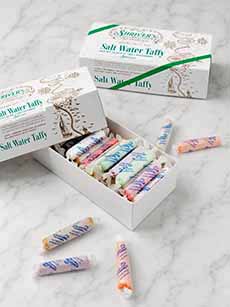
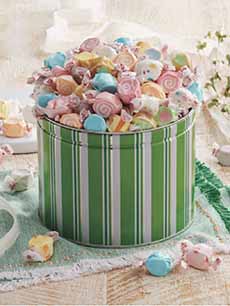
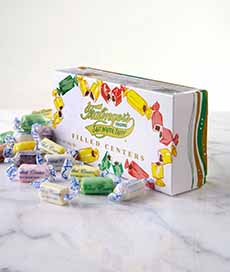
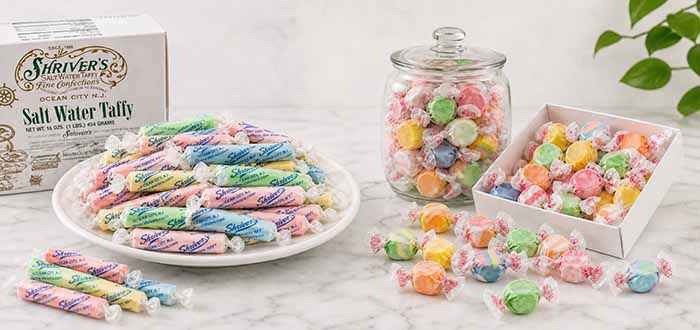
As mentioned earlier, there is no salt water in salt water taffy, although regular tap water is required to make the product.
From whence came the name salt water taffy? Here’s what we do know about how the “salt water taffy” appeared.
Around 1880, the Ritchie Brothers and Windle W. Hollis both had taffy stands on the Atlantic City Boardwalk. Taffy was the candy sensation of the day, a must-have vacation treat for children and adults alike.
At the end of the summer of 1884, Captain John L. Young, a prominent Atlantic City entrepreneur, approached Joseph Fralinger, a local vendor whose various stands sold cider, fruit, lemonade, mineral water and a storefront with cigars.
Young owned or controlled boardwalk property and concessions. After a dispute with the concessionaire, he asked Fralinger to take over the taffy stand on Applegate Pier.
Fralinger agreed and in the winter of 1885, he read books on confections, selling his first batch of taffy that spring. His first flavors were molasses, chocolate, and vanilla. More flavors followed, culminating in 25 different choices and color variations.
Now, back to the “salt water” story.
According to an account in Wikipedia, Fralinger was standing at the booth of another taffy maker, David Bradley, who had been selling taffy since 1883 and to whom the anecdotes credit with the “storm” story.
The “storm” tale created by Bradley told of a Nor’Easter that sprayed the ocean water over Mr. Bradley’s stock of taffy.
Fralinger heard one young girl ask for “salt water taffy,” another ask for “ocean wave taffy” and a third ask for “sea foam taffy.”
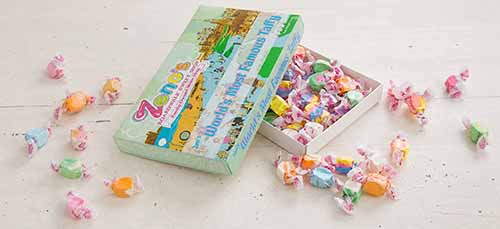
Fralinger recognized a concept when he heard it. He had already been selling boxes of taffy. He took the next step and popularized the name “salt water taffy,” printing boxes with that name and selling it as a souvenir of Atlantic City.
Here’s an account from his great-grandson, including many more details and how taffy was pulled.
According to the account, in 1923 another vendor obtained a trademark for the name “Salt Water Taffy” and attempted to get fees from anyone else using the name. The case went all the way to the U.S. Supreme Court, which ruled against him on the grounds that the name had been used by too many people for too long for any one person to claim any exclusive rights to it.
Fralinger produced taffy in small oblongs. His first major competitor, Enoch James, made his taffy into bite-size rounds. Both shops still operate on the Atlantic City Boardwalk.
The first mention of “salt water taffy” in an Atlantic City business directory dates to 1889.
James Candy Company, an Atlantic City taffy maker established in 1880, markets the Fralinger brand today.
Oblong or round, the older the taffy, the harder it gets. If you value your fillings, pinch a piece before you chew it. It should yield to pressure, like a ripe pear.
Otherwise, you might want to remove the wax paper and nuke it for 3 seconds in the microwave.

[10] Stick taffy and round taffy, also called kisses (photo: The Nibble).
STICK VS. ROUND TAFFY: DOES THE SHAPE MATTER?
It’s more than a design preference: The shape of taffy changes its thickness, surface area, and how the piece is handled/wrapped.
Sticks
Stick taffy is usually extruded, pulled into a rope, and cut to length. Sticks are easier to wrap tightly and seal; a tight wrap reduces moisture and sticking.
Sticks provide a more consistent chew and are often perceived as softer because it warms in the mouth faster.
Rounds a.k.a. Kisses
Rounds were created for ease in bulk handling: tumbling, counting, and bagging.
Because they are thicker than sticks, they can feel chewier.
And because the wrapping of a round isn’t as tight as that on an stick, moisture can get in over time and the taffy can get stickier.
The bottom line is that neither shape is universally “better.” You might want to make your choice based on chewier (round) or softer (stick).
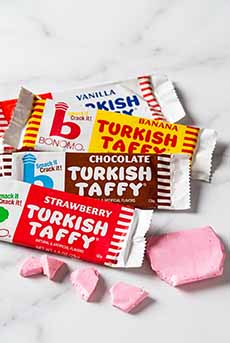
[11] Bonomo’s Turkish Taffy. Is it really “taffy?” No, it’s a different confection, and the answer is below (photo: The Nibble).
THE INVENTION OF TURKISH TAFFY
In the early 20th century, Turkish Taffy bars, the size of chocolate bars, appeared (and later, a jumbo bar was made for souvenir shops).
Many citations state that Turkish Taffy was invented by Victor Bonomo shortly after World War II.
But according to the Bonomo Turkish Taffy Museum, Turkish Taffy was invented in 1912 by an Austrian immigrant, Herman “Pop” Herer. In 1901 he started his own wholesale candy-making business.
While making a batch of marshmallow candy for M. Schwarz & Sons of Newark, New Jersey, Pop accidentally added too many egg whites to the batch. He recognized that the result had potential; and after much experimentation, he created, “Turkish Taffy.”
Why he chose that name is not recorded; however, our guess is that he may have been inspired by the Turkish confection known as Turkish Delight.
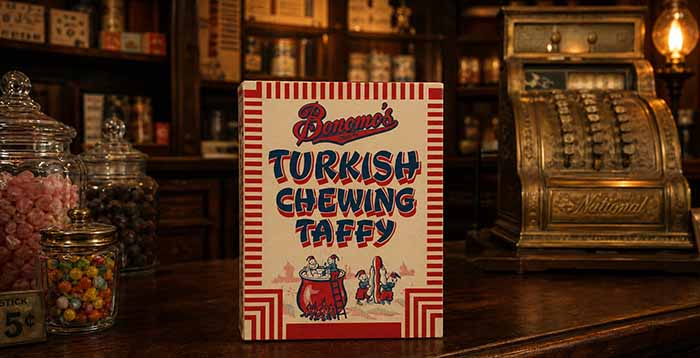
Later, Pop’s business was purchased by M. Schwarz & Sons, and Pop went to work for them perfecting his Turkish Taffy. M. Schwarz & Sons renamed the product Turkish Chewing Taffy (photo #12 below).
In 1936 the Bonomo family of Coney Island in Brooklyn, New York purchased M. Schwarz & Sons’ Turkish Chewing Taffy. They dropped the word “Chewing” and the treat returned to its original name, Turkish Taffy—a name trademarked by Bonomo.
Coincidentally, the Bonomo family was of Turkish ancestry.
But Is Turkish Taffy Actually Taffy?
What Bonomo and its taffy bar imitators make is technically not taffy, but short nougat*. The bars are made from a batter of corn syrup and egg whites that is cooked and then baked. Taffy bars are harder and tougher to chew than salt water taffy.
The way to eat Bonomo’s was to smack the wrapped bar against a hard surface to crack it into individual pieces (photo #8). The pieces were chewed over a period of time, so the bar lasted longer than an individual piece of salt water taffy.
In 1972, the Bonomo brand was purchased by Tootsie Roll Industries, which changed the 60-year-old smack-it crack-it formula to a soft taffy, eventually named Soft and Chewy Tootsie Taffy. It did not do so well, and by the mid-1980’s the product was discontinued.
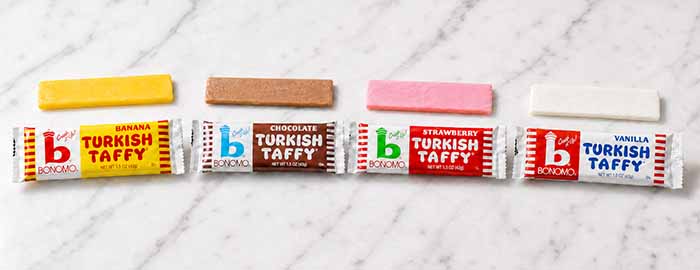
After petitions by fans, the original Bonomo Turkish Taffy was relaunched in 2010—in the original flavors, vanilla, chocolate, strawberry, and banana.
So…should you go for salt water taffy or Turkish Taffy?
Personally, we opt for the softer, chewier, salt water taffy. And on National Taffy Day, we’re going to dig into a box of it.
[12] An old Bonomo Taffy box from the 1940s. Before individual bars appeared in the 1950s (photo #11 above), the taffy arrived in large sheets that were broken with a hammer at the store counter (photo: The Nibble, taffy box CC-BY-SA 2.0).
________________
*What is short nougat? In confectionery terms, the word “short“ refers to a texture that is crumb and tender rather than stretchy and elastic. Standard (chewy) nougat is the familiar, elastic texture found in many modern candy bars like Milky Way or Snickers. It is “long,” meaning it can be stretched or pulled significantly before it breaks. It contains a higher proportion of corn syrup, which prevents the sugar from crystallizing and keeps the candy flexible and chewy.
Short nougat has a grained, soft, “brief” texture. When you bite into it, it breaks cleanly rather than stretching. This is due to a higher ratio of sucrose (table sugar) and less corn syrup. Because sucrose is prone to crystallization, it creates a grained structure that makes the nougat tender and melt-in-the-mouth, similar to the difference between a chewy caramel and a crumbly fudge.
CHECK OUT WHAT’S HAPPENING ON OUR HOME PAGE, THENIBBLE.COM.
|