THE NIBBLE BLOG: Products, Recipes & Trends In Specialty Foods


Also visit our main website, TheNibble.com.

Butterfly Cannon Tequila: Super-Premium Tequila Of A Different Color

As you relax with a cocktail on warm summer days, the eye-catching colors of the handsome bottles of The Butterfly Cannon Tequila promise more than other Tequilas.

The naturally colored and flavored contents are not just exciting on the palate; they’re a striking gift for any lover of tequila.

The Butterfly Cannon is a new approach to Tequila*: a super-premium Tequila made from 100% blue agave and produced at Mexico’s most awarded distillery, Destiladora del Valle de Tequila.

The brand also has a mission: to conserve the Monarch butterfly (photo #5), which is in peril. You can read more about it below.

Now, take a sip with us!
 
 
THE EXPRESSIONS OF BUTTERFLY CANNON TEQUILA

The Butterfly Cannon Tequila, made in three expressions, takes its name from the migration of butterflies from the U.S. to Mexico. The tequilas are:

  • Cristalino, a fresh, crisp silver Tequila aged for up to 30 days in barrels before being charcoal filtered. Like conventional silver Tequilas, it is clear.
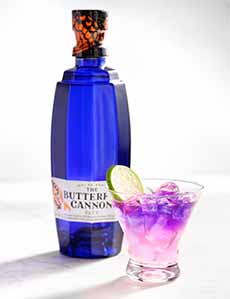
  • The Butterfly Cannon Blue, infused with prickly pear and clementine plus a natural blue color extracted from beets. The vivid blue color of the bottle is actually the color of the Tequila. And surprise: It turns pink when combined with mixers like soda, tonic, or a squeeze of citrus juice.
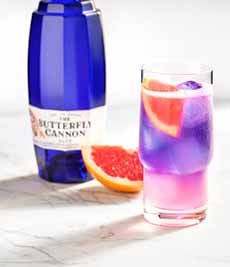
  • The Butterfly Cannon Rosa, made by infusing Mexican pink grapefruit peel into the Cristalino Tequila.
  • All are made from 7- to 8-year-old blue agave plants, harvested by hand and baked in traditional steam ovens before being mashed, fermented, and distilled.
  • All are 40% A.B.V. / 80 proof.
     
    So sip them on the rocks, mix them with soda or tonic, and enjoy them in your favorite Tequila cocktails.

    Both the Margarita and the Paloma cocktails in the photos contain citrus juice that will turn the Blue Tequila shades of violet and pink.

    > Two recipes, for Blue and Rosa Tequilas, are below.
     
     
    BEAUTIFUL PACKAGING

    The Butterfly Cannon Tequila is packaged to please, in distinctive 750ml bottles, sealed with a cork. The capsules are decorated with butterflies.

    There’s also a sampler set of 50ml bottles, one of each expression.
     
     
    GET YOURS!

    All three expressions are available at Sidewalk Spirits, Blackwell Wines, and elsewhere online.

    > National Tequila Day is July 24th.

    > The different types (expressions) of Tequila.

    > The history of Tequila.
     
     
    RECIPE #1: BLUE MARGARITA

    Yes, the Tequila really is as blue as the bottle.
     
    Ingredients Per Drink

  • 2 ounces The Butterfly Cannon Tequila Blue
  • 1 ounce orange liqueur (Grand Marnier, Triple Sec, etc.)
  • 2 ouncees fresh-squeezed lime juice
  • Club soda
  • Ice
  • Garnish: orange slice
  •  
    Preparation

    1. COMBINE the tequila, orange liqueur, and fresh lime juice in a shaker. Shake and pour over ice in a rocks glass.

    2. TOP off with a splash of soda and serve with an orange slice.
     
     
    RECIPE #2: BUTTERFLY ROSA & TONIC

    Butterfly Rosa, infused with Mexican pink grapefruit peel, begins with a hint of grapefruit flavor in addition to the lovely rosy color.
     
    Ingredients Per Drink

  • 1 ounce The Butterfly Cannon Rosa Tequila
  • 3 ounces tonic water
  • Ice
  • Garnish: grapefruit slice, rosemary sprig
  •  
    Preparation

    1. COMBINE the tequila and tonic water over ice in a stemmed glass. Stir lightly.

    2. GARNISH with a sprig of rosemary and a slice of grapefruit.


    The Butterfly Cannon Blue Tequila Bottle & Margarita
    [1] The Butterfly Cannon Blue Tequila and a Blue Margarita. The recipe is below (photos #1, #2, #3, and #4 © The Butterfly Cannon).

    The Butterfly Cannon Rosa Tequila Bottle & Cocktail
    [2] The Butterfly Cannon Rosa Tequila with tonic water. The recipe is below.

    The Butterfly Cannon Blue Tequila Paloma Cocktail
    [3] The Butterfly Cannon Blue Tequila and a Paloma cocktail. Just add grapefruit juice!

    The Butterfly Cannon Tequila Expressions
    [4] The expressions of The Butterfly Cannon Tequila.

    Monarch Butterfly On A Flower
    [5] A Monarch butterfly hovering over a flower (photo © Suzanne D. Williams | Unsplash).

     
    TEQUILA WITH A MISSION: BUTTERFLY CONSERVATION

    The Butterfly Cannon tells us that Eastern migratory Monarch butterflies have a unique lifestyle. American Monarchs go through three regenerations, laying their eggs in milkweeds.

    They then migrate all through the U.S., and then via Texas into Northern Mexico, where they overwinter in trees for around five months.

    But the butterfly has declined in recent decades, partly because the widespread adoption of herbicide-resistant corn and soybean has nearly eliminated common milkweed from crop fields in the Midwest.

    Sadly, more and more of their habitat in Mexico is being destroyed by intensive farming as well (here’s more about it).

    Butterfly Cannon Tequila donates to the Monarch Butterfly Conservation Fund, which aims to conserve the magic of the Monarch migration.
     
     
    ________________

    *Tequila is capitalized because it is the name of a town. The capitalization of proper names continues with products named after them: Bourbon, Burgundy, Champagne, Belgian waffles, and French fries.


    CHECK OUT WHAT’S HAPPENING ON OUR HOME PAGE, THENIBBLE.COM.


    Comments off

    Barbecue For Breakfast!

    Barbecue for breakfast is trending at restaurants, so why not at your house?

    Flavor & The Menu, a trendspotting website for chefs, reports:

    “While barbecue remains a popular choice at lunch and dinner, it is actually the fastest-growing breakfast flavor today” [source].

    Dishes spotted on menus:

  • Rise ’N Shine Benny: Buttermilk biscuit, a sunny-side-up egg on top of our smoked pulled pork, smothered in barbecue-hollandaise sauce, chive garnish, at Vicious Biscuit, based in Mount Pleasant, S.C.
  • Barbacoa Breakfast Tacos: Three tortillas with seasoned braised beef barbacoa, scrambled cage-free eggs, scallions, melted cheddar, and Monterey Jack, lime crema, Cotija cheese, pico de gallo, and fresh avocado with a side of black beans, at First Watch, based in Bradenton, Fla.
  • BBQ Pulled Pork Waffle: Slow-roasted pulled pork, “pig roast” barbecue sauce, and cole slaw, at Dan’s Waffles, Merchantville, N.J.
  •  

    Brisket For Breakfast
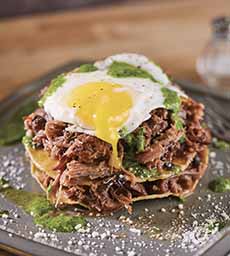
    A loaded Breakfast Brisket Tostada (photo © Compass Group).

  • Breakfast Brisket Tostada (in photo), a crunchy breakfast/brunch dish that spreads a seasoned black bean purée over tostadas, then bakes them and layers the tostadas with pulled brisket and chimichurri, topped with a fried egg and a sprinkle of Cotija cheese and fresh cilantro, at Compass Group.
  •  
    Now you have more ideas about how to serve leftover barbecue!
     
    > The history of barbecue.


    CHECK OUT WHAT’S HAPPENING ON OUR HOME PAGE, THENIBBLE.COM.


    Comments off

    Grilled Belgian Endive Recipe & The History Of Belgian Endive

    You may have grilled romaine, but how about grilled endive?

    Thanks to modern farming techniques, endive is available year-round.

    It can be grilled, added to salads, or used as “boats” to hold finger foods at parties—the latter an easy-to-make, no-cooking dish that looks impressive. Appetizers, salads, mains, sides, soups—even for dessert, you can make a type of Tarte Tatin using endive instead of apples.

    Here are dozens of endive recipes from California endive growers.

    If you’re grilling this weekend, here’s a simple side with big flavor.

    Grilled endives also provide the base for a great summer salad. See the variation below.

    A leaf of endive has just one calorie! It’s a good source of potassium, vitamins, and minerals, high in complex fiber, and promotes digestive health.
     
     
    RECIPE: GRILLED BELGIAN ENDIVE

    Ingredients

  • 3-4 heads endive, sliced lengthwise
  • 1 tablespoon olive oil
  • Salt and pepper to taste
  • Optional: chopped fresh rosemary
  •  
    Preparation

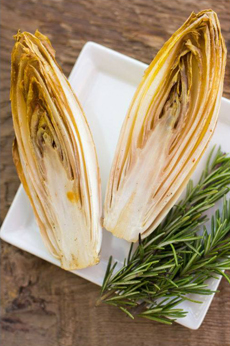
    1. PREHEAT the grill over a medium flame. Brush each endive half with olive oil and place on the grill, cut side down to start. Let cook for 8–10 minutes.

    2. TURN over and cook the endives for another 12-15 minutes, turning occasionally and lowering the flame if needed until the endives soften.

    3. SEASON with salt and pepper, garnish with chopped rosemary. Serve hot or allow to cool and serve at room temperature

    Variation

    For a salad, cut the grilled and cooled endives crosswise into one-inch slices. Mix with crumbled feta or goat chevre, roasted nuts, and baby arugula, dressed with additional olive oil and a squeeze of lemon or lime as desired.
     
     
    THE HISTORY OF BELGIAN ENDIVE

    Belgian endive (Cichorium intybus var. foliosum) is a member of the chicory family, Asteraceae, which includes Belgian endive, curly endive, escarole, frisée, puntarelle, and radicchio.

    They are part of the chicory family of leafy greens (Asteraceae, the daisy family). They can be enjoyed raw or cooked.

    Belgian endive and curly endive are both in the chicory genus. Belgian endive is botanically known as part of Chichorium intybus. It’s grown from chicory roots in a dark environment.

    Shaped like a torpedo, Belgian endive grows to about six inches in length. It has tender white leaves with either yellow or red-colored leaf edges.

    Belgian endive is a pleasantly bitter, nutty, and refreshingly crisp vegetable with a delicate crunch. Once considered a luxury imported from Europe, it is now grown in California year-round).

    The ancestral plant is native to western Asia, North Africa, and Europe [source]. The plant has a history reaching back to ancient Egypt.

    In ancient Rome, a dish called puntarelle was made with chicory sprouts. It was mentioned by the Roman poet Horace (65 B.C.E. to 8 B.C.E.) in reference to his own diet, which he describes as very simple:


    Grilled Endive
    [1] Grilled Belgian endive tastes even better with a sprinkling of rosemary leaves (all photos © Endive.com).

    Endive With Root
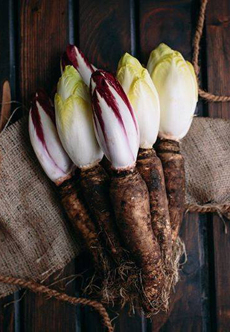
    [2] This is what endive looks like when it’s pulled from the ground. The long roots of the chicory family of plants can be dried and ground for a coffee substitute.

    Belgian Endive For Grilled Belgian Endive Recipe
    [3] Belgian endive has two subspecies: green tips and red tips.

     
    “Me pascunt olivae, me cichorea, me malvae” (“As for me, olives, endives, and mallows provide sustenance”).
    The wild plant has been cultivated in Europe since the 16th century.

    But the variety known as Belgian endive was first discovered by accident in the 1830s by Jan Lammers, a Belgian chicory farmer. After harvesting the greens, he decided to store the roots in his cellar to dry and use as a coffee substitute.

    Lammers had to leave his farm for several months to serve in the Belgian War of Independence. When he returned he discovered that the chicory roots had sprouted small, white leaves. He tasted them and found them to be tender, moist, and pleasingly bitter.

    It took another few decades to commercially cultivate what he called witloof chicory. Witloof is Flemish for “white leaf.”

    A Belgian botanist named Brézier then went on to refine a cultivation method to the point where it could be grown commercially. Markets in Brussels began carrying endive in 1846, and then in 1872 it was introduced in Paris and it became so popular (and pricey) that it was nicknamed “white gold” [source].

    Endive is pricey because it’s one of the most difficult vegetables in the world to grow. There’s a two-step growing process:

  • The first growth takes about 150 days in the field, where the chicory grows from seed into a leafy green plant with a deep tap root.
  • At harvest, the tops of the leafy plant are cut off, and the roots are dug up and placed in cold storage, where they enter a dormancy period.
  • Based on marketplace demand, these roots are removed from cold storage for their second growth, which takes 28 days in dark, cool, humid forcing rooms (similar to a mushroom growing facility).
  • This labor-intensive growing technique is called blanching. The control over the initiation of this second growing process allows for the year-round production of endive.
  •  
    In contrast, curly endive, Cichorium endivia, which includes batavia lettuce, escarole, and frisée, is simply grown in the fields as green curly lettuce.

    Commercially grown Belgian endive is exported mainly from western Europe with Belgium contributing the largest share [source].


    CHECK OUT WHAT’S HAPPENING ON OUR HOME PAGE, THENIBBLE.COM.


    Comments off


    © Copyright 2005-2026 Lifestyle Direct, Inc. All rights reserved. All images are copyrighted to their respective owners.