THE NIBBLE BLOG: Products, Recipes & Trends In Specialty Foods


Also visit our main website, TheNibble.com.

A Dark ‘n Stormy Recipe For International Dark ‘n’ Stormy Day

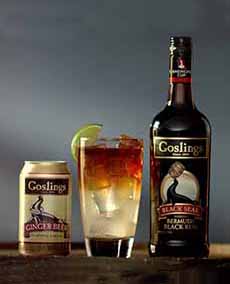
June 9th is International Dark ‘n’ Stormy® Day, honoring one of the few cocktails (photo #1) whose name is actually trademarked*—in this case, by Goslings Rum’s Rum. And it’s such a simple recipe: just two ingredients, Black Seal Rum and Stormy Ginger Beer.

It’s the national drink of Bermuda.

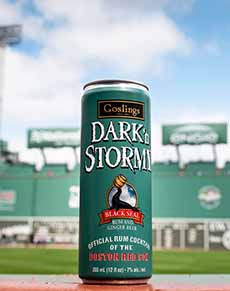
The drink is so popular that Goslings has a ready-to-drink canned Dark ‘n’ Stormy (7% ABV; $9.99 SRP, photo #4), and even a Dark ‘n’ Stormy Happy Hour Gift Box.

Stormy, by the way, is the name of the seal on the label of Goslings† Black Seal Rum, and the ginger beer was named for him. It’s the best-selling ginger beer brand in the U.S., and it’s our favorite brand, too. It has just the right amount of spiciness.

Goslings Stormy Ginger Beer also is made zero-calorie diet version, which is so delicious that we no longer buy bland diet ginger ale. Diet Goslings Stormy Diet Ginger Beer is a zero-calorie miracle.

Below:

> Recipe: The Dark ‘n’ Stormy.

> The history of the Dark ‘n’ Stormy.

> The history of ginger beer.

Elsewhere on The Nibble:

> The 5 most popular cocktails with ginger beer.

> The history of the cocktail.

> The history of rum.

> The different types of rum.

> Ginger beer vs. ginger ale: the difference.

> The history of ginger ale.

> Cooking with ginger beer.

> The history of ginger.

> The year’s 11 ginger-related holidays.

> The year’s 50+ cocktail and spirits holidays.

> The year’s 40+ beer holidays.

> The year’s 24 non-alcoholic beverage holidays (including juice and soft drinks).
 
 
RECIPE: THE DARK ‘N’ STORMY

Ingredients Per Drink

  • 6 ounces Goslings Stormy Ginger Beer (or substitute brand, or Diet Stormy Ginger Beer)
  • 2 ounces Goslings Black Seal Rum
  • Optional: Lime wedge
  •  
    Preparation

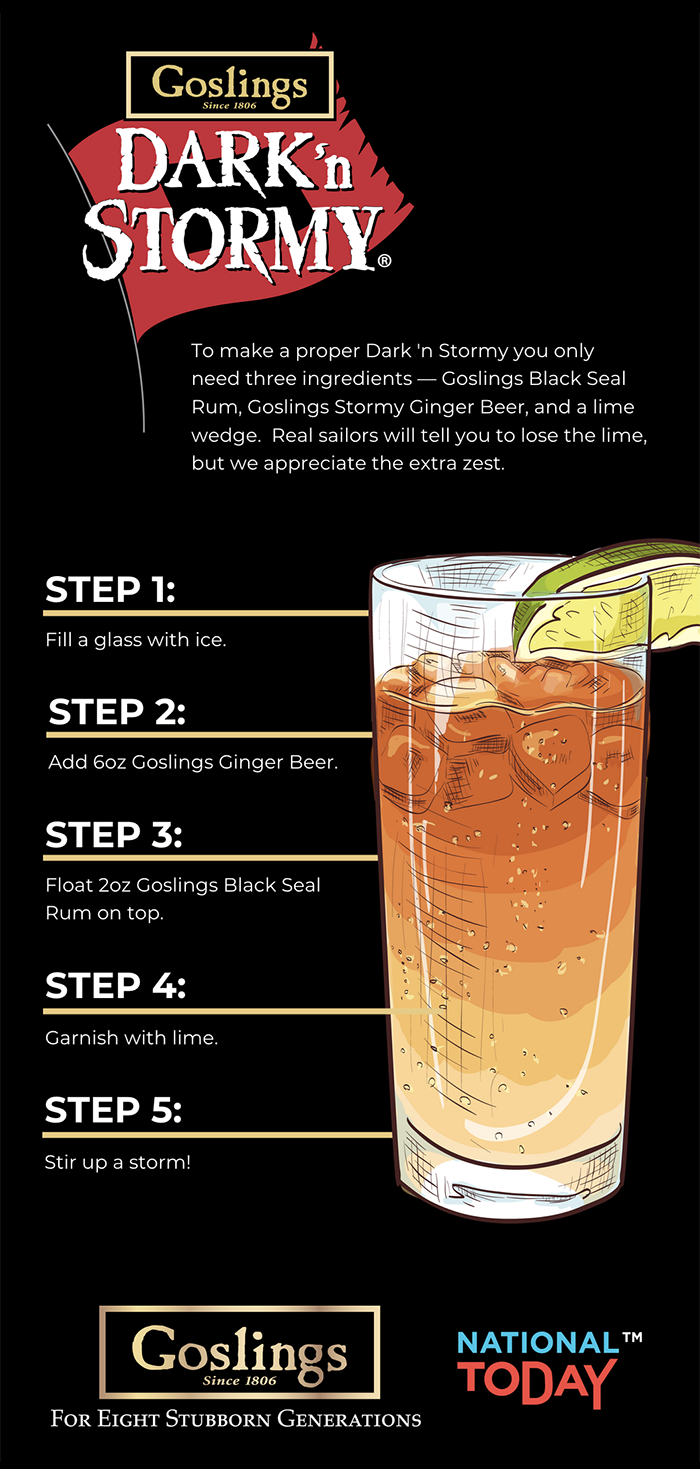
    1. FILL a tall glass with ice. Pour the ginger beer into the glass and float the rum on top.

    2. STIR until it looks like a storm cloud. Garnish with the lime wedge.

    See an illustration of the preparation below.
     
     
    THE DARK ‘N’ STORMY HISTORY

    According to the company website, the Dark ‘n’ Stormy was invented in the 1920s, when more adventurous members of the British Navy stationed on Bermuda started adding Goslings Black Seal Rum to the ginger beer they brewed to combat seasickness (ginger beer is very low in alcohol).

    It turned out that Gosling’s Black Seal Rum, with its molasses flavor notes, was the perfect complement to the sizzling ginger beer.

    The Dark ‘n’ Stormy allegedly got its name from an old sailor who compared the drink’s murky hue to the color of a storm. It’s just a legend, but everything needs an origin story, even if you have to make one up.

    And the drink does look like a storm cloud in a glass.
     
    The Journey Begins

    Who created Gosling’s Black Seal dark rum?
     
    In the spring of 1806 James Gosling, the oldest son of William Gosling, a wine and spirits merchant, set out from Gravesend, Kent, England on the ship Mercury, with £10,000 sterling worth of merchandise, bound to set up shop in America.

    After 91 days on calm seas—unable to move because there was no wind—the ship’s charter (the period of time for which the ship was hired to transport goods from the vessel’s owner) ran out.

    The ship put in at the nearest port, St. George’s, Bermuda. James liked it enough to stay and open shop there, instead of re-chartering a boat and heading to America.

    Brother Ambrose Gosling arrived to join the business in 1824, and the shop was moved to Hamilton. The brothers entered the rum production business in 1857.

    The firm, first known as Gosling and Son, was later renamed Gosling Brothers.

    In 1860, after much experimentation in the blending process, the distinctive black rum that would later be named Black Seal was ready for sale [source].

    After much experimentation in the blending process, the distinctive black rum destined to be Black Seal was formulated and offered for sale [source].

    Up until the First World War the rum was sold from the barrel, and folks brought in bottles to be filled (note that many products were scooped from the barrel, from sugar and flour to coffee and crackers—hence the brand Cracker Barrel).


    Dark n Stormy Recipe Rum Cocktail
    [1] Dark ‘n’ Stormy is one of four cocktails with a U.S. Patent Office trademark on their name and recipe. The other three are in the *footnote below (photos #1, #4, and #5 © Goslings Rum).

    Dark 'n Stormy Recipe Cocktail
    [2] There are just two ingredients in a Dark ‘n’ Stormy cocktail: Goslings Black Seal Rum and ginger beer. Plus an optional lime wedge for garnish (photo © Reserve Bar).

    Dark n Stormy Cocktail With A Bottle Of Goslings Black Seal Rum
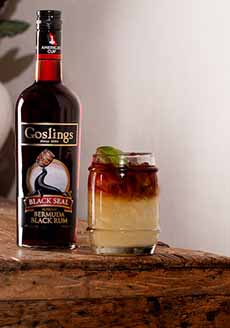
    [3] The seal, who is balancing a rum barrel on its nose, is called Stormy (photo © Love Drinks).

    Dark n Stormy Canned Cocktail
    [4] Available in cans, the Dark ‘n’ Story is the official rum cocktail of the Boston Red Socks.

    Poached Pears With Goslings Run Recipe
    [5] You can use Goslings Black Seal Rum in many other drinks, and in recipes like these poached pears. Here’s the recipe.

     
    Eventually, the black rum was sold in Champagne bottles, reclaimed empties from the British Officer’s Mess. The corks were sealed with black sealing wax. People began asking for the “Black Seal,” and it became the name of the rum.

    Many years later, a play on words and images gave birth to the little, barrel juggling black seal logo. The seal subsequently was named Stormy, and gave its name to Goslings Stormy Ginger Beer.

    Today, Goslings Black Seal Rum is made in 80 proof and 151 proof.

    The business is run by Malcolm Gosling, the 8th generation rum maker.
     
     
    THE HISTORY OF GINGER BEER

    Originating in the tropics of Southeast Asia, ginger root was introduced to the Caribbean and Africa in the 15th century.

    The Brits first fermented it into an alcoholic beverage (just ginger root, sugar, and water).

    Ginger beer became another favorite drink of the British, and was exported worldwide in strong, earthenware bottles [source].

    Among other places in England that produced ginger beer, there was a ginger beer factory that was operated as a subsidiary of the Royal Naval Officer’s Club [source]!

    Ginger beer’s spicy-and-sweet flavor makes it an excellent mixer for cocktails and mocktails.

    Because of varying jurisdictional laws, check to see if the bottle of ginger beer you pick up is alcoholic or the equivalent of a soft drink.

  • Most modern ginger beers contain either no alcohol or less than .5%, although some are over 4% (check these out).
  • Even non-alcoholic ginger beer is spicier with more intense flavor than commercial ginger ale.
  • Ginger beer is carbonated naturally via fermentation. Soft drinks are artificially carbonated.
  •  
    Our favorite easy-to-find, non-alcoholic ginger beer, Goslings, is also available in a sugar-free, non-caloric version (using sucralose and acesulfame potassium).
     
    ________________

    *Three other cocktails are protected by trademark. In addition to Dark ‘n’ Stormy, they are the Hand Grenade, the Painkiller, and the Sazerac.

    †What’s the deal with Gosling’s versus Goslings? While the family is named Gosling, when they called their brand Goslings, they decided to eliminate the apostrophe. As editors, we don’t approve—but no one consulted us. We also disagree with the trademarked spelling of Dark ‘n Stormy. Since ‘n is used as a contraction of “and,” it should be ‘n.’
     
    Dark & Stormy Recipe
    [6] How to mark a Dark ‘n’ Story (infographic © National Today).


    CHECK OUT WHAT’S HAPPENING ON OUR HOME PAGE, THENIBBLE.COM.


    Comments off

    Portillo’s Garden Dog: A Plant-Based Hot Dog, Dressed To Kill

    Portillo's Garden Dog Plant Based Hot Dog
    [1] Portillo’s new plant-based Garden Dog tastes just like a regular hot dog—delish! (photos #1, #2, and #3 © Portillo’s).

    Portillo's Garden Dog Plant Based Hot Dog
    [2] Time for lunch!

    Portillo's Garden Dog Plant Based Hot Dog
    [3] Close-up on the toppings: mustard, relish, chopped onions, tomatoes, celery salt, pickle spear, and sport peppers, on a steamed poppy seed bun.

    Plant Based Hot Dog
    [4] You can actually buy the dogs wherever Field Roast products are sold (photos #4, #5, and #6 © Field Roast)…

    Field Roast Plant Based Hot Dog
    [5] …and create your own garnishes. Take a look at some topping options.


    [6] Classic garnishes on Field Roast’s Stadium Dogs.


    It seems that every burger chain now has a plant-based burger, but what about the hog dogs? Hot dog lovers are finally getting a plant-based version of the iconic Chicago-style dog at Chicago-based fast-casual chain Portillo’s.

    According to the National Hot Dog and Sausage Council, Americans eat more than 7 billion hot dogs every year during ‘peak hot dog season,’ between Memorial Day and Labor Day.

    Portillo’s wants vegetarians, vegans, and others who don’t eat meat that its first-ever plant-based hot dog is ready to roll—or is that, ready in a roll?

    The chain has 70 outposts across nine states and is expanding, bringing their new meatless dog nationwide (see the locations).
     
     
    MEET THE GARDEN DOG

    The meatless dog, made by quality vegan meat pioneer Field Roast (long a NIBBLE favorite), is the best plant-based dog on the market, and was chosen by Portillo’s after tasting dozens of contenders.

    Called the Garden Dog, the plant-based hotdog is now available at Portillo’s restaurants nationwide.

    The “dog” in question is the Field Roast Signature Stadium Dog which we wrote about last year.

    It’s been custom-crafted for Portillo’s and topped with the same classic Chicago-style hot dog toppings as Portillo’s regular dog: mustard, relish, chopped onions, tomatoes, celery salt, pickle spear, and sport peppers, on a steamed poppy seed bun.

    Take a bite: You won’t even know that it isn’t a conventional hot dog, that’s how good it is. It is dee-licious!

    The dog, made for Portillo’s by Field Roast, a leader in premium grain-based meat alternatives, is a pea protein-based hot dog inspired by the flavors of premium, kosher-style beef hot dogs.

    Unlike other products that use liquid smoke, the dogs are double smoked using maple hardwood chips and a combination of steam and dry heat.

    The plant-based hot dog also offers the same amount of protein per serving as most traditional hot dogs, but contains less sodium and is made without nitrites or GMOs. Already available at retail stores nationwide, the Stadium Dog has been transformed into a Chicago-style Garden Dog at Portillo’s, with those great Chicago-dog toppings.

    Portillo’s established its reputation in Chicago as a hot dog stand in the 1960s, and today is known for its hot dogs, Italian beef sandwiches and chocolate cake at its more than 70 locations across nine states.
     
     
    HOT DOG VS. FRANKFURTER VS. WIENER VS. BRAT:
    THE DIFFERENCE

    In the beginning, there was the frankfurter, or Frankfort-style sausage, a slender pork sausage popularized in Frankfurt, Germany. But first, there were Viennese sausages.

    The hot dog traces its lineage to the 15th-century Viennese sausage, or Wienerwurst in German.

    In the 17th century, Johann Georghehner, a butcher from the German city of Coburg, in Bavaria, is credited with inventing the “dachshund” or “little dog” sausage and bringing it with him to Frankfort—hence, a Frankfort sausage, which became frankfurter in the U.S.; and the word wiener was also used.

    Both names still referred to a sausage eaten with a knife and fork like other German sausages—no bun.

    The hot dog, a slender sausage in a bun, was undeniably an American invention. The attribution is given to a German immigrant named Charles Feltman, who began selling grab-and-go sausages in rolls at a stand in Coney Island in 1871.

    The 1893 World Exposition in Chicago marked the debut of the hot dog vendor. According to National Hot Dog and Sausage Council, it was around this time that the hot dog made its first appearance at a ballpark, at a St. Louis Browns game.

    The first published mention of the term “hot dog” as a food (as opposed to a canine) first appeared in print in a September 1893 issue of The Knoxville Journal. Here’s more history of the hot dog.

    What about brats? Brat is short for bratwurst, a type of German sausage that’s wider than a hot dog. Here’s more about the difference between bratwurst and hot dogs.
     
     
    Frankfurter-Hot Dog Difference

    The main differences between a frankfurter and a hot dog are the ingredients and flavors.

    German sausages are pork- and veal-based. Lamb-producing countries make lamb sausage, countries with seashores make seafood sausages.

    While the U.S. offers every kind of hot dog, from beef to pork, to beef-pork blends, to poultry, the majority of hot dogs tend to be all beef or a mixture of meat trimmings from beef and/or pork.

    There are also “gourmet” hot dogs made from high-end pork like Berkshire and Kurobuta, and beef versions made from Kobe and Wagyu.

    The main differences between a hot dog and a sausage are the production process and seasonings. Here’s what’s in the typical beef hot dog.

    The most common spices used in hit digs include allspice, cinnamon, coriander, cumin, garlic, nutmeg, paprika, and pepper (black, red, and white) [source].
     
     
    HOT DOG TRIVIA

  • Los Angeles residents consume more hot dogs than any other city (about 30 million pounds), beating out New York and Dallas.
  • During peak hot dog season, from Memorial Day to Labor Day, Americans typically consume 7 billion hot dogs. That’s 818 hot dogs consumed every second during that period!
  • Chicago’s O’Hare International Airport consumes SIX times more hot dogs, 725,000 more than Los Angeles International Airport and LaGuardia Airport combined.
  • On Independence Day, Americans will enjoy 150 million hot dogs, enough to stretch from D.C. to L.A. more than five times [source].
  •  


    CHECK OUT WHAT’S HAPPENING ON OUR HOME PAGE, THENIBBLE.COM.


    Comments off

    What Is A Tamarillo & Tamarillo Recipes

    In a specialty grocer near you, you may find a colorful stack of New Zealand tamarillos (Cyphomandra betacea)—a relative of tomatoes that looks like a plum tomato, hence its original name, “tree tomato.”

    Tamarillo, a fruit resembling an oversized plum or a plum tomato, is native to South America, where it has long been used in sweet and savory dishes.

    While it is an everyday food south of the border, in the U.S., beyond Latino supermarkets, it is sold as an exotic fruits.

    A member of the Nightshade family (Solanaceae), it’s a relative of the chile, eggplant, potato, and tomato, the tamarillo is native to Central and South America.

    They can be found in various shades of amber, purple, red, and yellow, all with a green stem.

    If you live in UDSA Zones 10-11, the winter-hardy trees will be a beautiful addition to your garden, with fragrant blossoms greeting you in springtime before the fruits arrive.

    > The history of tamarillos is below.
     
     
    HOW TO TAMARILLOS TASTE?

    They are naturally tangy, but still can be eaten fresh (once the glossy but bitter skin is removed) or cooked. Like grapefruit, fresh tamarillos can be sprinkled with sugar.

    The apricot-colored, meaty flesh is soft and juicy. Like pears and stone fruits, they yield to slight pressure when ripe.

    Some call the flavor a cross between a tomato and a tart strawberry.

    Melissa’s Produce, which sells fruits from all over the world, calls the flavor of tamarillo “habit-forming.”

    One tamarillo has just 30 calories and is packed with vitamins A (more than 100% DV) and C (50% DV). It is also rich in beta carotene and vitamin E.

    Choose fragrant, heavy fruits. Once ripened at room temperature, they can be refrigerated for up to 10 days, tightly wrapped in plastic.

    Tamarillo season runs from now through the fall.

    If you can’t find tamarillos locally you can purchase them online from specialty produce companies like Melissa’s.
     
     
    WAYS TO USE TAMARILLOS

    Tamarillos can be enjoyed in sweet or savory recipes, Tamarillos can be used in recipes for breakfast, lunch, dinner, and dessert.

    It can be used in anything from chutneys, salsa, and other condiments to mains, beverages, and desserts: cakes, pies, puddings, and more.

    It’s easy to peel and slice one into a green salad. We just made one with mixed greens, fennel, sweet onion, basil, and a honey balsamic vinaigrette.

    Chef Shawn McClain of Chicago’s Spring restaurant serves a salad of tamarillo and fennel dressed with aged balsamic vinegar and Manuka honey.

  • Grilled Tamarillo À La Mode
  • Red Tamarillo Caprese Salad
  • Roast Tamarillo Soup with Greek Yoghurt & Crispy Chickpea Croutons (photo #7)
  • Tamarillo & Apricot Crumble
  • Tamarillo & Apricot Jam
  • Tamarillo Cooler
  • Tamarillo, Gorgonzola, Butternut & Mozzarella Tart (photo #2)
  • Tamarillo Pudding Parfait
  • Tamarillo Salad Dressing
  • Tamarillo Salsa (photo #5)
  • Tamarillo Smoothie
  • Tamarillo Tiramisu
  • Walnut Crust Cheesecake with Macerated Tamarillos (photo #6)
  •  
    There are many more recipes on Tamarillo.com.
     
     
    RECIPE: EASY TAMARILLO SALSA

    This simple recipe is delicious chicken, fish, or meats. Try on a burger, sandwich, with cold cuts, or a cheese plate; and of course, with tortilla chips.

    Ingredients

  • 4 tamarillos
  • 1 onion
  • 1 tbsp brown sugar
  •  
    Preparation

    1. PEEL and chop the tamarillos and onion finely.

    2. ADD the brown sugar and mix well.

    3. REFRIGERATE to let the flavors meld.

    Recipe by Glenda Gourley for the New Zealand Tamarillo Growers Association.
     
     
    TAMARILLO HISTORY

    Tamarillos are ancient food. The tree tomato (tomate de arbol) is listed among the “lost crops of the Incas†” because the as tomate de arbol (tree tomato) has all but disappeared from their native Peruvian habitat. They are still grown, commercially, elsewhere in South America.

    A shrub or semi-woody tree that reaches heights between 10 and 18 feet, tamarillo trees bloom in early spring, producing fragrant pink flowers.

    Tamarillos spread west from South America to Asia, and then south to Australia and New Zealand. They were first introduced into New Zealand from Asia in the late 1800s.
     
    Tamarillos Find A Home In New Zealand

    Originally only yellow and purple-fruited strains that originated in South America were produced. The red tamarillo was developed in the 1920s by an Auckland nurseryman, using the seeds from the South American varieties.

    Other red strains appeared soon afterward and were bred into the large, quality varieties grown in New Zealand today.

    The commercial production of tamarillos began on a small scale in the 1930s. During World War II, demand for tamarillos grew, when the supply of other fruits high in vitamin C was restricted and sent to the troops.
     
    From Tree Tomato To Tamarillo

    Although tamarillos are from South America, the name is not Spanish, but a New Zealand invention.

    The fruit was originally known as tree tomato. But to avoid confusion with the garden tomato, and to increase appeal to export customers, in 1967 the New Zealand Tree Tomato Promotions Council decided to rename it.

    A council member came up with ‘“tamarillo,” feeling that it sounded both Māori (honoring its New Zealand roots) and Spanish (South American roots).

    In the horticultural boom of the 1970s fruit production increased markedly which led to increasing professionalism among growers with an emphasis on pest control and quality management systems.

    The fruit is popular in New Zealand thanks to its unique, attractive flavor and nutritional qualities.

    Tamarillos are grown on a commercial scale in Colombia and Ecuador, with smaller plantings in Africa, Asia, Australia, and California [New Zealand Tamarillo Growers Association].


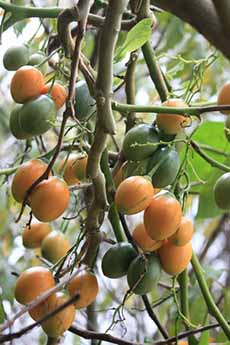
    [1] They may look like exotic grapes, but tamarillos are the size of plums (photos #1, #2, #5, #6, and #7 © New Zealand Tamarillo Growers Association).


    [2] Tamarillos can be used in savory or sweet recipes. This savory tart recipe combines tamarillo with Gorgonzola and mozzarella cheeses and butternut squash.

    Purple Tamarillos
    [3] A purple tamarillo. No matter the color, all tamarillos have green stems (photo courtesy Free Images).

    Tamarillos On Tree
    [4] Tamarillos on the tree (photo © Melodi2 | Morguefile).

    Tamarillo Salsa Recipe
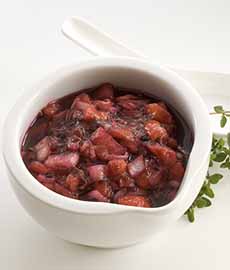
    [5] Tamarillo salsa, for chicken, fish, meats and more. Here’s the recipe.

    Tamarillo Recipes
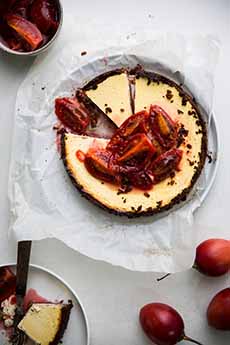
    [6] Cheesecake with a walnut crust and a topping of sweet macerated tamarillos. Here’s the recipe.

    Tamarillo Recipes
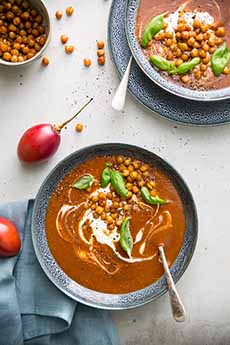
    [7] Roast Tamarillo Soup with Greek Yoghurt & Crispy Chickpea Croutons. Here’s the recipe.


    ________________

    *The Nightshade family, Solanaceae, is a family of flowering plants. Many of their fruits, pods, or roots are edible, while others contain the alkaloid solanine, which is toxic in high concentrations (as in the deadly nightshade, or belladonna, and the tobacco plant). Edible members include the cape gooseberry, capsicum (chile), eggplant, goji berry, potato, tamarillo and tomatillo, and tomato, among others.

    †Crops cultivated across the Inca Empire included avocado, beans, carob, cashews, chiles, chirimoya, coca, cotton, cucumber, gourd, grains, guayabo, lúcuma, maize, mashwa, oca, peanuts, potatoes, quinoa, squash, sweet potatoes, tomatoes, talwi, and ulluco. Here’s more about Inca farming. Here’s a book, Lost Crops Of The Incas, that you can read free online or download. An excerpt follows:

    …Pizarro and most of the later Spaniards who conquered Peru repressed the Indians, suppressed their traditions, and destroyed much of the intricate agricultural system. …Crops that had held honored positions in Indian society for thousands of years were deliberately replaced by European species (notably wheat, barley, carrots, and broad beans) that the conquerors demanded be grown.

    Forced into obscurity were at least a dozen native root crops, three grains, three legumes, and more than a dozen fruits. Domesticated plants such as oca, maca, tarwi, nuñas, and lucuma have remained in the highlands for the almost 500 years or so since Pizarro’s conquest (1533). Lacking a modern constituency, they have received little scientific respect, research, or commercial advancement. Yet they include some widely adaptable, extremely nutritious, and remarkably tasty foods” [from “Lost Crops of the Incas: Little-Known Plants of the Andes with Promise for Worldwide Cultivation,” National Research Council, 1989, Washington, DC: The National Academies Press, Introduction, p. 1].


    CHECK OUT WHAT’S HAPPENING ON OUR HOME PAGE, THENIBBLE.COM.


    Comments off


    © Copyright 2005-2026 Lifestyle Direct, Inc. All rights reserved. All images are copyrighted to their respective owners.