|
It’s time to celebrate National Pigs In Blankets Day, April 24th.
Ask for some pigs in blankets in the U.K., and you’ll get a cocktail sausage wrapped in bacon (more like a pig in a pig, we think).
At IHOP, the International House Of Pancakes, you can chow down on pork sausage links rolled in a pancake “blankets.”
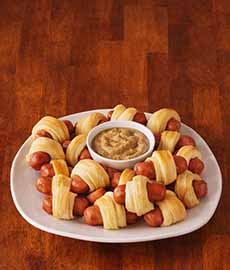
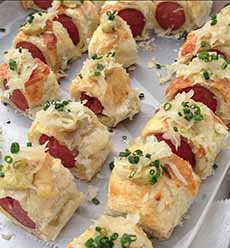
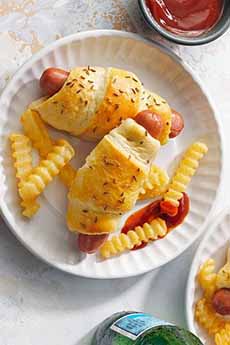
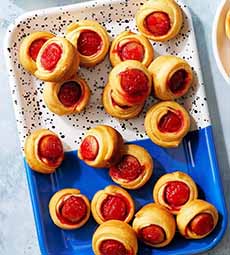
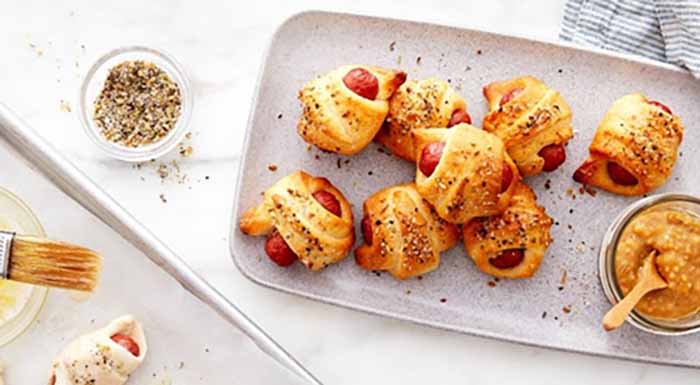
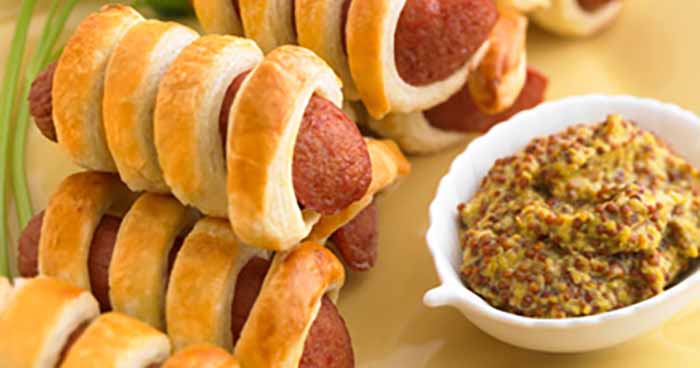
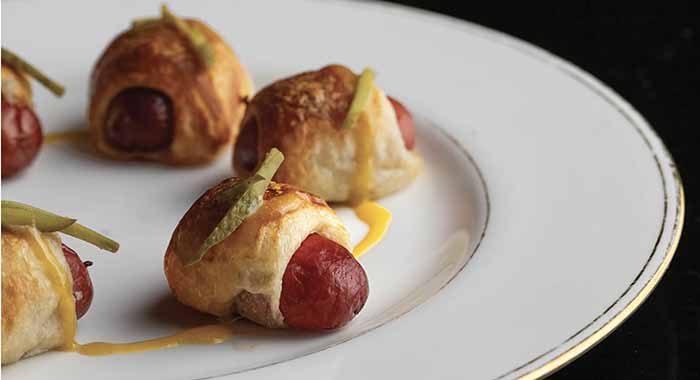
But across the U.S., what caterers declare to be the most popular hors d’oeuvre is a cocktail frankfurter in a pastry blanket. And don’t forget the mustard.
Below:
> Is it Pigs In A Blanket or Pigs In Blankets?
> The history of Pigs In Blankets.
> An easy recipe.
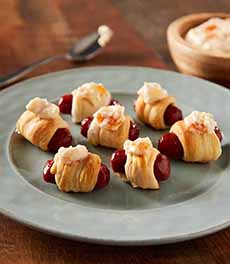
> Different dips for the piggies.
> Different names for Pigs In A Blanket.
Elsewhere on The Nibble:
> The history of hot dogs.
> The different types of mustard: a photo glossary.
> The history of mustard.
> The year’s 16 sausage and hot dog holidays.
> The year’s 90 snack holidays.
> The year’s 75+ meat holidays.
IS IT PIGS IN BLANKETS OR PIGS IN A BLANKET?
If you look at it strictly through the lens of grammar, both can be argued as correct:
While “Pigs in a Blanket” is the name almost always uses the singular “blanket” even though multiple franks require multiple blankets,
The distributive singular follows the logic that each pig has its own blanket. It’s similar to saying “The students wear a uniform.” Even though there are numerous students, each one is wearing only one uniform.
The full plural follows the logic that if there are multiple pigs, there must necessarily be multiple blankets. This is often the more logical choice to people outside of the U.S.
The collective concept holds that the term is sometimes treated as a compound noun—the name of the dish itself—rather than a literal description of the contents.
And then, there’s the “recipe effect.”
When the modern recipe was popularized in the mid-20th century (often linked to Betty Crocker recipes in the 1950s), it was presented as a singular concept.
Once a name is printed on a millions of cans of crescent roll dough, that specific phrasing becomes sticks in the public consciousness, regardless of whether it perfectly follows pluralization rules.
So, while “Pigs in Blankets” sound more grammatically correct to our editorial ears, “Pigs in a Blanket” remains the dominant Americanism.
And since the name of whoever in the Betty Crocker Test Kitchen made the decision is lost to history, we have no finger to point.
PIB “Aliases”
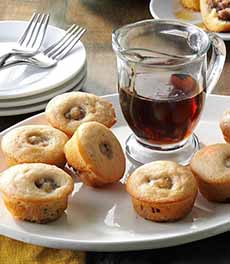
We’ve also come across Blanket Weiners, Dough Dogs, Franks Under Wraps, Hogs In A Blanket, Hogs in a Quilt, Little Pigs In A Hammock, Pastry Pups, Pigs In A Pool (when tucked inside a mini muffin), Pigs in a Sleeping Bag, Pigs In A Wreath (for Christmas), Pups in a Blanket, Sows in a Shroud (a bit macabre—perhaps for Halloween?) and Tuxedo Dogs.
Among the Czech-American community in Texas, kolaches or klobasneks are sausages wrapped in a soft, yeasty dough (not to be confused with traditional kolaches, actually sweet fruit pastries.
PIGS IN BLANKETS HISTORY
The “wrapped sausage” concept independently popped appeared across many cultures—wrapping other foods in pastry has been around since the invention of pastry and are represented all over Europe.
The pastry-wrapped piggies are likely direct descendants of Victorian-era canapés.
Long before the hot dog took center stage, the term actually referred to fried oysters wrapped in bacon.
In the late 1800s, this was a popular appetizer in the U.S. and U.K., often appearing in cookbooks along with Angels on Horseback, oysters wrapped in bacon instead of pastry and grilled or broiled.
While the specific term “Pigs in a Blanket” wasn’t yet the standard for dough-wrapped meat, F. Scott Fitzgerald famously referenced “pastry pigs” in “The Great Gatsby” (published in 1925).
This suggests that the concept of wrapping meat in dough for parties was already a high-society staple in the Roaring Twenties.
In the U.S., The earliest recipe found in American cookbooks that was called “pigs in blankets” was published in the 1930s, but comprised the aforementioned oysters wrapped with bacon.
“The Joy of Cooking,” published in 1936, contained a recipe for “Sausages in Pastry or Biscuit Dough.”
A 1940 Army cookery manual contains a recipe for “Pork Sausages Links (Pigs) in Blankets” made with pork sausage links and biscuit dough. (We’re sure the troops loved them!)
Pigs Take Center Stage
Many food historians credit Betty Crocker’s 1957 cookbook “Cooking For Kids” for a big boost in mainstream popularity.
It featured a recipe for hot dogs wrapped in Bisquick biscuit dough. This solidified the name “Pigs in a Blanket” in the American lexicon and turned it into the quintessential 1960s cocktail party appetizer.
While the party food faded over the decades in favor over newer concepts—crudités, guacamole, fine cheeses—by the early 2000s, Pigs In A Blanket had made a retro comeback on the catering scene, and they’ve never really left.
The salty bite pairs wonderfully with beer, wine, and cocktails. Adults love them as much as kids do.
So preheat the oven, head to the market, grab some cocktail franks and a roll of croissant dough, and pour your favorite libation.
|