|
January 4th is National Spaghetti Day, but mark your calendar to celebrate a year of pasta holidays below.
Trivia: The word “spaghetti” derives from the Italian word “spago,” which means “twine” or “string.”
The name for a single spaghetti noodle is “spaghetto” (it’s the singular form of the plural “spaghetti”).
Other beloved Italian foods share this same grammatical distinction—one cannoli is actually a “cannolo,” and it’s a single cheese-filled “raviolo” or “panino” sandwich.
> The history of spaghetti follows.
> The history of pasta.
> The different types of pasta: a glossary.
> Check out the year of pasta and noodle holidays, below.
THE HISTORY OF SPAGHETTI
As you’ll discover in our History Of Pasta, all pastas are not an Italian invention.
Pasta in Italy was known well before 1295, the year Marco Polo returned from China. The popular myth that he brought pasta from China to Italy may have some truth—i.e., that he did bring back pasta—but it isn’t the whole truth.
What he brought may have been Chinese stuffed pasta like Chinese jiaozi (dumplings). The truth is lost to history but we do know that stuffed pasta like ravioli aren’t mentioned in written records until the 12th century, and agnolotti and tortelli by the 14th century.
Pasta dough originated in China, in the form of dumplings and thin noodles (i.e., the thin pasta that is called linguine in Italy).
Spaghetti itself originated in Sicily. Most historians believed that Arab traders introduced pasta to Sicily sometime in the eighth or ninth centuries. The Arabs likely brought the concept of dried pasta (called itriyya) from the Middle East, where it would have arrived via the Silk Road.
Around 1154, the geographer Muhammad al-Idrisi, writing about Sicily, mentioned a place near Palermo (Trabia) where a pasta called itriya (from the Arabic itriyya, meaning “thin focaccia cut into strips” or “string-like shapes”) was being made in long strands and exported.
Pasta might even be traced back as far as the 4th century B.C.E., where an Etruscan tomb art shows people making what appears to be pasta.
Even without that reference, we know that the Romans were making an early form of lasagna** in the fifth century C.E.
Dried pasta, which was ideal for long storage and travel (just hot water was needed to make a meal), first appeared in western Sicily during the Arab domination†. By the 12th century, pasta was being worked into long, thin forms in Sicily, and Genoese merchants to the area began to spread it to their other ports of call.
So while pasta-making may have evolved through cultural exchanges across the Mediterranean, spaghetti is genuinely Italian, with Sicily as its birthplace.

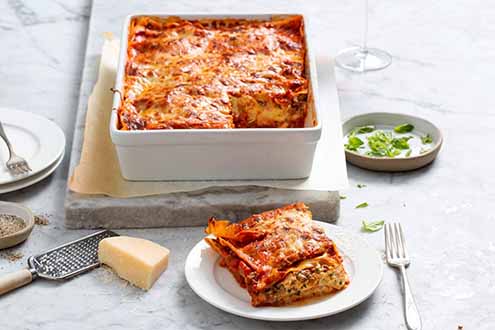
[4] Lasagna’s ancestor dates to the first century in ancient Rome (the scoop). Here’s the recipe for this classic modern version (photo © DeLallo).
|
|
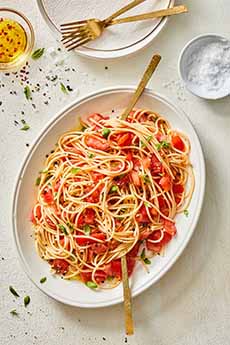
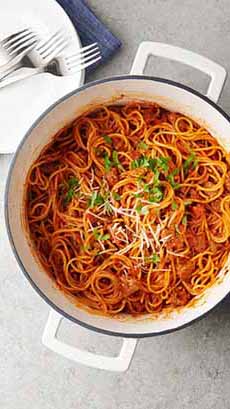
[1] One of our favorites: spaghetti with a no-cook tomato sauce made with olive oil and crushed canned tomatoes. Here’s the recipe (photo © DeLallo).
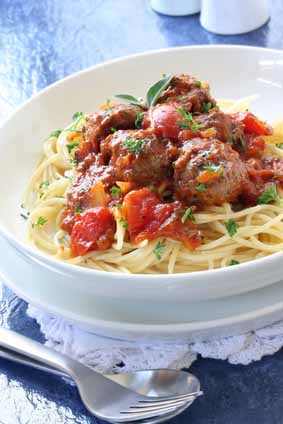
[2] Spaghetti and meatballs, one of the most popular spaghetti dishes (photo © Robyn Mac | iStock).
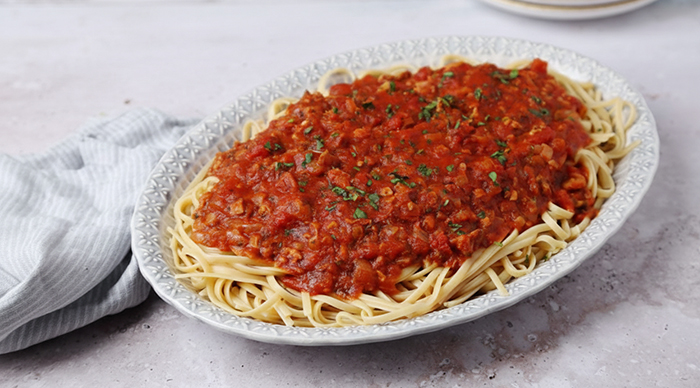
[3] Spaghetti Bolognese, the most popular spaghetti dish, is spaghetti in marinara* sauce. It originated in Imola, a northern Italian city west of Bologna sometime in the late 1800s, when the first reference to the dish’s ragu sauce appeared in print (photo © Pillsbury).
|
WHAT ABOUT THE WORD “SPAGHETTI?”
The term “spaghetti” first appears in the early 1800s in Naples, the work of Neapolitan poet Antonio Viviani (it was a new and popular food in Naples at the time. The name may have remained regional dish until shortly after Italian unification‡ when communications between the disparate areas improved.
The word “spaghetti” is the plural form of the Italian “spaghetto,” which itself derives from “spago,” which means cord, string, or twine.
The suffix “-etto” is a diminutive suffix meaning “little one.” Thus, spaghetto literally translates to “little string.”
Spaghetti, “little strings,” is a fitting description for this long, thin pasta.
The first known use of the English word “spaghetti” was later, around 1874-1885.
[5] While spaghetti existed in Italy since at least the 12th century, tomatoes from Mesoamerica did not reach Italy for another four centuries. Thus, no tomato sauce (photo © Taste Of Home).
THE ORIGIN OF TOMATO SAUCE FOR PASTA
While olive oil-based sauces and gravies predated the arrival of pasta, tomatoes didn’t arrive in Europe until the 16th century, brought by explorers from Mesoamerica where the tomato originated.
The Mayans, Aztecs, and other Central American peoples were the first to make sauces (“salsas”) with tomatoes (the history of the tomato).
The first tomato sauce recipe appears in a 1692 Italian cookbook, “The Modern Steward, or The Art of Preparing Banquets Well,” by Chef Antonio Latini.
You can find an English translation on Amazon.
More than 300 years later, spaghetti with tomato sauce is a perennially popular dish in Italy and the U.S. [source].
PASTA TRIVIA
Italy is still the country with the highest consumption of pasta, but more than half (62%) of Italian pasta production ends up abroad. The top importing countries, in order, are Germany, the U.S. France, the U.K., and Japan.
The fastest-growing markets are China, Canada, Spain, and Saudi Arabia.
In terms of pasta consumption per capita, Italy (23.5 kg per capita), Tunisia (17 kg), Venezuela (15 kg), Greece (12 kg), Chile (9.4 kg), the U.S. (8.8 kg), Argentina (8.7 kg), and Turkey (8.7 kg) [source]. Note that not every country makes Italian-style pasta dishes.
THE YEAR’S 20+ PASTA HOLIDAYS
Ready, set, get your forks!
January 4: National Spaghetti Day
February 7: National Fettuccine Alfredo Day
February 13: National Tortellini Day
March: National Noodle Month
March 11: National Eat Your Noodles Day
March 13: National Chicken Noodle Soup Day
March 20: National Ravioli Day
April 4: National Ramen Day
April 6: National Carbonara Day
July: Lasagna Awareness Month
July 7: National Macaroni Day
July 14: National Mac and Cheese Day
July 29: National Lasagna Day
September 15: National Linguine Day
October: National Pasta Month
October 6: National Noodle Day
October 17: National Pasta Day
October 25: World Pasta Day
November 7: National Pad Thai Day Day
November 14: Cacio e Pepe Day
December 11: National Noodle Ring Day
The 29th of every month: Gnocchi Day (“Ñoquis del 29” [loosely, “Gnocchi on the 29th”] in Argentina)
And how could we leave out:
March: National Sauce Month
October 27: National Parmigiano Reggiano Day (without which a dish of spaghetti and much other pasta, would be bereft)
________________
*Marinara sauce (marinara is Italian for sailor) is a tomato sauce made with tomatoes, garlic, herbs, and onions. Variations can include capers, olives, spices, and a dash of wine.
**Roman lagana is the true ancestor of many Italian dough (pasta)-based dishes, including stuffed pasta. By the fifth century C.E., per Apicius, thin sheets of dough were layered with a meat stuffing and baked. Apicius is the purported author of the oldest surviving cookbook “De Re Coquinaria” (“The Art of Cooking,” also “De Re Culinaria,” “On The Subject Of Cooking). It’s thought to be be compiled in the 1st century C.E., as the recipes appear to draw heavily from the extravagant culinary culture of the 1st century Roman elite, and include ingredients like silphium, a plant that became extinct around the 1st century.
While its author is given as Apicius, likely it was compiled by different writers and named in honor of a well-known Roman gourmet, Marcus Gavius Apicius, who lived in the 1st century. The surviving copy dates from the late 4th or early 5th century, as the style of the Latin is inconsistent and closer to Vulgar Latin (the common, everyday language) of Late Antiquity, rather than the Classical Latin of the 1st century.
†The Arab conquest and domination of Sicily spanned a significant period, approximately 264 years. While Arab raids began in the 7th century, the actual conquest and sustained Arab rule began The conquest began in June 827 (the 9th century) and lasted until 902, when the last major Byzantine stronghold on the island, Taormina, fell. Most of Sicily was under Muslim control, but small Byzantine pockets continued to resist. The Emirate of Sicily was an Islamic empire that ruled the island from 965-1091; the capital was Palermo (called Bal’harm in Arabic). It remained under Arab Muslim rule until the Norman Conquest in the 11th century, 1061-1091 C.E. Following Norman rule, through 1194, Sicily didn’t achieve independence until it became part of unified Italy in 1860-1861—nearly 800 years after the Norman conquest.
‡The Italian state was born when Victor Emanuel II assembled the deputies of the first Italian Parliament in Turin on March 17, 1861. This ultimately united into one nation the Kingdom of the Two Sicilies in the south, the Kingdom of Piedmont-Sardinia in the northwest, the Duchies of Modena, Parma, and Tuscany in north-central Italy, the Papal States of central Italy, the Austrian-controlled territories including the Kingdom of Lombardy-Venetia, and the former city-states/republics of Genoa and Venice.
CHECK OUT WHAT’S HAPPENING ON OUR HOME PAGE, THENIBBLE.COM.
|