|
Today’s tip comes from Cordon Bleu Cooking School. The famed school in Paris, attended by Americans from Julia Child to Giada De Laurentiis, Cordon Bleu now has Bleu Ribbon Kitchen cooking classes in 17 U.S. cities from coast to coast.
Check out the company website to find classes near you.
No matter how you prepare it, eggplant works well with just about everything. Its ability to balance multiple flavors makes it an excellent component in any dish involving several ingredients.
It is a delight in a simple sauté with with mushrooms, onions and tomatoes (delicious as a side or a main course over rice with some added protein such as chicken or tofu).
Hot or cold, roasted or grilled, stuffed, marinated or fried, eggplant’s slightly bitter taste and spongy texture make it a go-to ingredient for casseroles, stews and brochettes (skewers).
It works well with spices including basil, garlic, oregano, parsley, sage and thyme.
It can be curried or spiced with hot chiles. It is a key ingredient in the famous Greek dish moussaka and the French ratatouille.
|
|

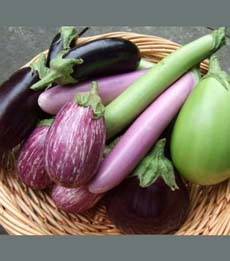
Different types of eggplant: Italian eggplant, Sicilian eggplant (variegated), Chinese eggplant (long), Thai long green eggplant, Black Beauty eggplant (purple globe) and applegreen eggplant (photo © Cordon Bleu Kitchen). |
And it’s very low in calories: just 20 calories per cup. Eggplant is fat free, high in potassium and an excellent source of dietary fiber. Some varieties are high in chlorogenic acid, a polyphenol and potent antioxidant. (Look for the Black Magic variety, which has nearly three times the amount of polyphenols as other cultivars that were studied.)
In America, eggplants are known as oblong with deep purple color (an Italian cultivar), but they can also be lavender, green, orange and yellow-white. They come in a variety of sizes and shapes, from round to oblong. Take a look at these unusual types of eggplant—some the size of strawberries!
EGGPLANT COOKING TIPS
Eggplant flesh will start to turn brown once peeled. As with apples and bananas, wait to cut the eggplant until just before cooking.
To reduce the bitter* taste of eggplant, try salting it. Once it’s cut to the desired shape and size, sprinkle the eggplant with salt and let it rest for about 30 minutes. The eggplant will lose some of its water content and will be less porous. This not only minimizes bitterness, but helps to minimize soaking up fats used in cooking. After the 30 minute period, rinse the salt off the eggplant.
For frying, coat each slice with breadcrumbs or batter so the spongy eggplant won’t absorb too much oil.
Avoid cooking eggplant in an aluminum pan, as the aluminum will discolor the flesh.
|
Now you know how the fruit got its name (photo of white eggplant © Burpee Home Gardens). |
|
From eggplant parmigiana to kabobs to caponata and ratatouille, the latter two of which can be used to top hot pasta. You can even make eggplant french fries. Or, try it in:
Pasta salads or with rice and other grains
Eggplant Lasagne
Eggplant Rollatini, strips of eggplant filled with ricotta and topped with tomato sauce and mozzarella
Stir-frys or grilled
Eggplant Caviar, one of our grandmother’s favorite appetizers
EGGPLANT TRIVIA
The name “eggplant” derives from some 18th-century European cultivars, which were white or yellow and resembled hen and goose eggs, as you can see in the photo above.
|
|
In France and the U.K., eggplant is known as aubergine.
Although eggplants are prepared like vegetables, they are botanically a fruit—a type of berry—and a member of the Nightshade family, which includes potatoes, tomatoes and peppers.
_________________
*The bitterness comes from the chlorogenic acid in the seeds—the same chemical that gives bitterness to coffee. The seeds also contain nicotinoid alkaloids. Nicotine? Yes, botanically, eggplant is a close relative of tobacco, which is also a member of the Nightshade family.
|
|