|
October 13th is National Yorkshire Pudding Day. Yorkshire Pudding is neither sweet, a dessert, or what Americans think of as pudding. In fact, it’s very much like a popover, an Americanized version of Yorkshire Pudding. (The history of Yorkshire pudding is below.) The difference:
Popovers are baked in individual molds (like muffins), usually coated with butter.
Yorkshire pudding uses the same batter as popovers, but the individual puddings are traditionally baked in the pan in which a piece of beef has been roasted. Thus, they get basted in the beef drippings instead of butter.
WHY IS IT CALLED A PUDDING?
In many Commonwealth countries, a pudding most often refers to a sweet, cake-like dessert.
These older-style puddings are baked, boiled or steamed into a cake-like consistency.
In the U.K., newer-style creamy puddings—those that Americans think of as puddings—are called:
Custards, if they are egg-thickened.
Blanc-mange, the French term, if they starch-thickened (these are our soft chocolate, vanilla and butterscotch puddings).
SAVORY PUDDINGS
“Pudding” can also be a savory dish: a side or a main dish.
Some of the better-known savory puddings include:
Black pudding or blood pudding, i.e. a blood sausage
Cheese pudding, similar to a cheese soufflé
Corn pudding, a recipe with many variations (one of our favorites is like a baked custard with corn kernels, cheese and herbs)
Kugel, a baked dish with many variations, including noodles, potatoes or cottage cheese
Kishke, an Eastern European sausage or pudding
Scrapple, a loaf of pork scraps and trimmings, sliced and fried
Steak and kidney pudding (or pie), diced steak and beef, lamb or pig kidney, onions, and gravy baked in a suet pastry
Yorkshire pudding, a baked batter
THE HISTORY OF “PUDDING”
The word “pudding” evolved from the French boudin (originally from the Latin botellus), meaning “small sausage.”
In Medieval times, sausages were an ingredient in savory puddings. According to FoodTimeline.org, 17th century English puddings were either savory (meat-based) or sweet (made from flour, nuts and sugar), and were typically boiled in special pudding bags.
Far from the creamy dessert puddings popular in the U.S., these puddings were a solid mass formed by mixing various ingredients with a grain product or another binder (batter, blood, cereal, eggs, flour or suet, for example) and cooked by baking, boiling or steaming. The “pease porridge” of the old nursery rhyme was likely a simple boiled pudding made from pease meal (pease is a legume). They were—and still are—served as a main dish; sweet puddings evolved and were served as dessert.
By the latter half of the 18th century, traditional English puddings no longer included meat. In the 19th century, the boiled pudding evolved into the U.K.’s cake-like concept, such as the Christmas pudding that remains popular to this day.
THE HISTORY OF YORKSHIRE PUDDING
Here’s the history of Yorkshire Pudding, courtesy of Wikipedia:
When wheat flour began to come into common use for making cakes and puddings, cooks in the north of England (where Yorkshire is located) devised a way to use the fat that dropped into the dripping pan of roasting meats. They used it to cook a batter pudding while the meat roasted in the oven.
There is a printed recipe for “Dripping Pudding,” which had been cooked in England for centuries to accompany meat dishes, in 1737 cookbook:
Make a good batter as for pancakes; put in a hot toss-pan over the fire with a bit of butter to fry the bottom a little then put the pan and butter under a shoulder of mutton, instead of a dripping pan, keeping frequently shaking it by the handle and it will be light and savoury, and fit to take up when your mutton is enough; then turn it in a dish and serve it hot.
Similar instructions were published in 1747 in “The Art of Cookery Made Plain and Easy,” by Hannah Glasse. It was called Yorkshire Pudding, and Ms. Glasse is credited with renaming Dripping Pudding.
The Yorkshire Pudding is a staple of the British Sunday lunch. While today it is served alongside the meat and vegetables, some people in parts of Yorkshire still eat it the old-fashioned way, as a separate course prior to the main meat dish.
Why? The story has it that the purpose of the dish was to provide a cheap way to fill the diners, thus stretching a lesser amount of the more expensive ingredients.
Yorkshire Pudding is quick and easy to make. Here’s a recipe.
|
|

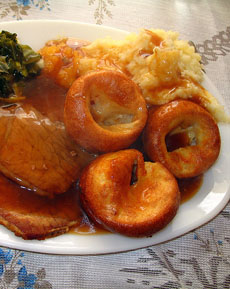
[1] Yorkshire Pudding and Roast Beef (photo © Gordon Ramsay Group).

[2] Yorkshire Pudding with the traditional fixings (photo © Robbie Jim | Wikipedia).
[3] It’s not just for roast beef (photo © Brett Jordan | Unsplash).
[4] Food fun: Instead of serving Yorkshire pudding on the side of the roast beef, serve the roast beef inside a Yorkshire pudding (photo © Salt & Honey Caterering | Bay Area).
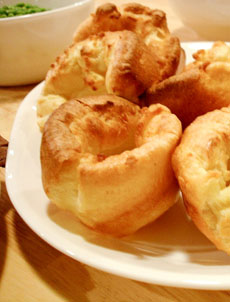
[5] Yorkshire puddings, hot from the pan (photo © Stef Yau | Wikipedia).
|