THE NIBBLE BLOG: Products, Recipes & Trends In Specialty Foods


Also visit our main website, TheNibble.com.

Grilled Flatbread Pizza Recipe With Avocado, Fig, & Prosciutto

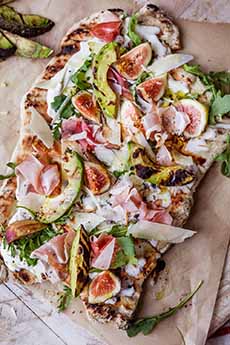
Grilled Pizza Topped With Avocado, Fig, & Prosciutto
[1] A flatbread pizza with avocado, fig, and optional prosciutto (photo © California Avocados).

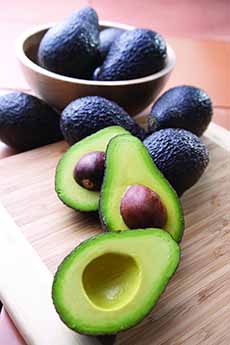
Avocados, Whole & Cut In Half
[2] You know the avocado is ripe when the stem end is soft (photo © Love One Today).

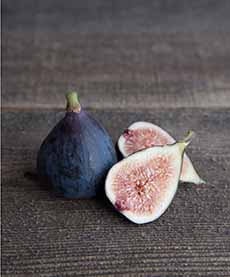
Black Mission Fig, Whole & Halved
[3] You can use any fresh figs, but black or brown figs like these black Mission figs provide appealing color contrast (photo © California Figs).

Prosciutto Slices
[4] Sliced prosciutto di Parma (photo © Di Bruno Bros.).


We made this grilled flatbread recipe for Sunday brunch, and can’t wait to make it again. It’s a flatbread pizza. Thanks to California Avocados for the recipe.

Wait, you say: Is it a flatbread or is it a pizza?
 
 
THE DIFFERENCE BETWEEN FLATBREAD & PIZZA

Flatbread and pizza can share the same toppings and the same pizza oven or grill. So how is flatbread different from pizza?

The main difference is the dough that is used.

  • Flatbread uses unleavened dough—just flour, water, and salt. Be it matzo, naan, pita, tortilla, or another type of flatbread, there is no yeast to cause the dough to rise (check out the history of flatbread).
  • Pizza dough, on the other hand, is made with yeast. While they may start with the same flour, water, and salt, all yeasted doughs need to rise for a certain amount of time (which is why we always reach for the ready-to-use refrigerated pizza dough).
  •  
    Here’s where it gets confusing:

    Many restaurants use pizza dough for their flatbreads. How can you tell?

    A true flatbread will be thin, flat, and crisp. The crust of a flatbread made with pizza dough will, well, look like a pizza crust—even though it may be a rectangle or other shape.

    Both are delicious.
     
     
    RECIPE: GRILLED CALIFORNIA AVOCADO & FIG FLATBREAD PIZZA

    Large Hass avocados are recommended for this recipe. A large avocado weighs about 8 ounces. If using smaller or larger size avocados, adjust the quantity accordingly.

    While some people enjoy a beer with flatbread, a glass of Prosecco is a sparkling option.

    Prep time is 15 min and cook time is 15 minutes.
     
    Ingredients For 8 Servings

  • 16 ounces pre-made pizza dough
  • 1 ripe avocado, seeded, peeled, and sliced
  • 1/4 cup crème fraîche or sour cream
  • Optional: 6 slices prosciutto or Serrano ham*
  • 1 cup arugula
  • 3 ripe figs, sliced
  • 1/4 cup Parmesan cheese
  • 1 teaspoon olive oil
  • 2 tablespoons balsamic vinegar
  • 1/8 teaspoon each, or to taste, salt and pepper
  •  
    Preparation

    1. PREHEAT the grill to 350°F. Stretch the pizza dough by hand into a 12″ x 14″ oval or rectangular shape.

    2. LAY the crust on the grill for 2-3 minutes, or until cooked enough to flip. Continue cooking and flipping for about 7 more minutes. Watch for burning and move the crust to a cooler area of the grill to cook the center. When the crust is about 3 minutes from finished…

    3. SLICE the avocado in half and remove the pit. Cut each half into 4 slices, leaving the skin on. Place the avocado slices on the grill, cooking 1-2 minutes per side. Set aside. Once the grilled crust is completed…

    4. TRANSFER the crust to a large platter. Assemble the pizza by spreading crème fraîche over the crust, followed by the optional prosciutto. Remove the skin from the avocado slices, placing the slices atop the crème fraîche or prosciutto. Sprinkle with the arugula, and top with the sliced figs, Parmesan cheese, drizzled olive oil, and balsamic vinegar.

    5. CUT into squares and serve.
     
     
    ________________
     
    *If you have leftover lamb or roast pork, you can use them instead.


    CHECK OUT WHAT’S HAPPENING ON OUR HOME PAGE, THENIBBLE.COM.


    Comments off

    Simply Cutrer: Sonoma-Cutrer Chardonnay, Now In Cans!

    Our first California Chardonnay obsession was Sonoma-Cutrer. We had “discovered” the wine, made in Sonoma’s Russian River growing region, on the opposite coast, in our hometown of New York City.

    When we took our first trip to Sonoma County, we were treated to a tour of the winery and an hour of relaxation in the tasting room.

    We loved the buttery, oaky, fruit-forward, full-bodied wine, made in the tradition of the great white wines of Burgundy (with a tip of the hat to Californian style), aged in barrels of French oak (the source of “buttery” and “oaky”).

    Since the first 1981 Cutrer Vineyard Chardonnay, the winery has grown exponentially, producing Chardonnay from six different vineyards that express different terroir* qualities, plus reserve wines and blends. It’s a cornucopia of Chardonnay happiness. (Not to mention, the winery also makes delicious Pinot Noirs.)

    And now, the award-winning vintner has launched Simply Cutrer, the brand’s first canned wine: ideal for one person, easy to transport, convenient to recycle—and, in our own lifestyle, great for party favors (with a ribbon) and stocking stuffers.
     
     
    SIMPLY CUTRER: THE BEST WINE IN A CAN?

    With Simply Cutrer, the venerable brand is breaking tradition by offering wine lovers a fine wine in a can. (While Sonoma-Cutrer is perhaps the most prestigious brand in the market, here’s more about premium wine in a can.)

    As a winery that has ranked at the top of the Most Requested Chardonnay list in Wine & Spirits magazine’s annual restaurant poll, Sonoma-Cutrer hopes that Simply Cutrer will change the way consumers perceive wine in a can.

    While the wine is ready for summer sipping at the pool or a barbecue, cookout‡, or picnic, it is versatile to pair with anything from a Salade Niçoise to chicken, fish, and shellfish.

    Most bottles of Sonoma-Cutrer are made from grapes grown in specific vineyards (see *terroir, below). The winery does make wine from a blend of grapes from different vineyards, and the Chardonnay grapes for Simply Cutrer are a blend sourced from different vineyards.

    In Simply Cutrer, aromas of peach, nectarine, and melon mingle with hints of vanilla, toasted nuts, and light caramel. On the palate, Simply Cutrer features notes of ripe pear and peach, and a long, lush finish.

    Simply Cutrer has an ABV‡‡ of 13.9%. It retails for an SRP‡‡ of $19.99 for a four-pack of 250ml cans. It is available for purchase in select states‡‡‡ and on the Sonoma-Cutrer website.

    Stock up for home and for gifting.
     
     
    THE HISTORY OF CHARDONNAY

    A white wine grape originating in the Burgundy wine region of eastern France, Chardonnay is now grown wherever wine is produced. It’s the most-consumed white wine in the world [source].

    While many ampelographers (botanists who specialize in the identification and classification of grape vines) had theories as to the origins of the Chardonnay grape, modern DNA fingerprinting suggests that Chardonnay is a cross between the Pinot Noir and Gouais Blanc grape varieties. The Romans are thought to have brought Gouais Blanc from Croatia to Gaul, and it was widely cultivated by peasants in eastern France [source].

    The Pinot Noir grapes in Burgundy grew in close proximity to the Gouais Blanc, providing ample opportunity to interbreed. Since the two parent grapes were genetically distant, the hybrids were vigorous and were selected for further propagation.

    A highly vigorous vine, the Chardonnay grape is easy to cultivate and adapts to different growing conditions. It takes on the attributes of its terroir and winemaker.

    In France, Chardonnay is the second-most widely planted white grape variety just behind Ugni Blanc and ahead of Sémillon and Sauvignon Blanc. (Ugni Blanc is grown extensively in the Cognac and Armagnac regions, and is distilled into brandy.)


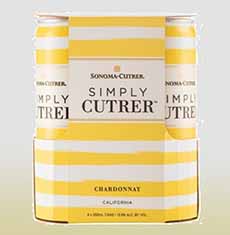
    Simply Cutrer, Sonoma-Cutrer Chardonnay In Cans
    [1] Simply Cutrer is the latest wine from Sonoma-Cutrer, a fine wine in trending 250 ml cans (photos #1 and #2 © Sonoma-Cutrer).

    Simply Cutrer, Sonoma-Cutrer Chardonnay In Cans
    [2] You can use the individual cans as party favors and placeholders. Just tie a piece of twine (or a yellow ribbon) around the can.

    Glass & Carafe Of White Wine
    [3] If you’re enjoying a nice meal at home, drinking out of a wine glass is perfectly acceptable—or empty the entire four-pack into a carafe (photo © Zwiesel Glas | Facebook).

    Cluster of Chardonnay Grapes On The Vine
    [4] Chardonnay grapes. You can buy vines and grow your own (photo © Double A Vineyards | Pixie Gardens).

     
    In addition to being the grape used in White Burgundy, Chardonnay is one of the two main grapes used to make Champagne (the other is Pinot Noir).

    In the U.S., it is the number one white wine grape in California, predominantly in the Napa and Sonoma Valleys.

    It is also an important grape in the Willamette Valley of Oregon; in the Alto-Aldige and Puglia regions of Italy; in the Marlborough region of New Zealand; and in the Thracian Valley of Bulgaria; and in Argentina, Australia, and Chile, among other regions.
     
     
    ________________
     
    *Terroir, pronounced tur-WAH, *is a French agricultural term referring to the unique set of environmental factors in a specific habitat that affects a crop’s qualities. It includes climate, elevation, proximity to a body of water, slant of the land, soil type, and amount of sun. These environmental characteristics give a fruit or vegetable its unique character.

    ‡Barbecue is meat cooked “low and slow” inside direct heat. A cookout is when foods—burgers, hot dogs, fish, corn on the cob, etc.—are cooked over an open flame.

    ‡‡ABV is alcohol by volume. SRP is standard retail price.

    ‡‡‡Select states include Alabama, Colorado, Connecticut, Florida, Georgia, Illinois, Louisiana, Massachusetts, Minnesota, New Jersey, New York, North Carolina, South Carolina, Tennessee, Texas, Virginia, and Wisconsin. Additional markets expected in 2023 include Arizona, California, Maryland, Michigan, Nevada, Rhode Island, Oregon, Utah, and Washington (availability is subject to change).


    CHECK OUT WHAT’S HAPPENING ON OUR HOME PAGE, THENIBBLE.COM.


    Comments off

    Mango Halibut Tacos Recipe For Cinco De Mayo

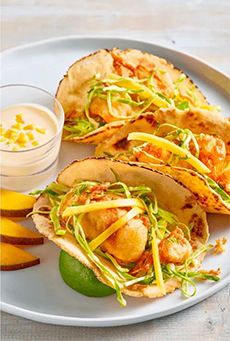
    Mango & Halibut Tacos
    [1] Mango adds pizzazz to already-popular halibut tacos (photos #1 and #4 by Carlos Garcia © Flavor And The Menu).

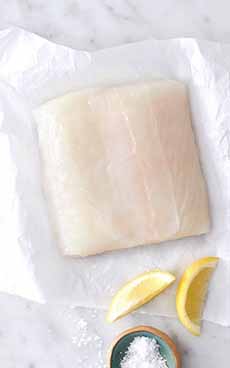
    Raw Halibut Fillet
    [2] While this recipe was made with halibut, you could substitute cod, haddock, mahi mahi, tilapia, or grouper (photo © Good Eggs).

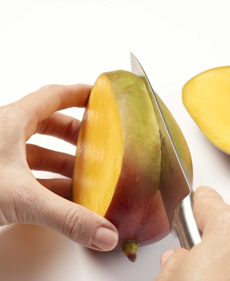
    Slicing A Mango
    [3] Slicing a mango. Here’s how to slice a mango (photo © National Mango Board).

    Mango Aioli
    [4] Mango aïoli can also be used with many other dishes. See the footnote* below.

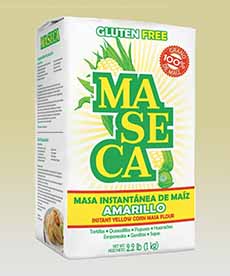
    Package Of Maseca Brand Corn Flour
    [5] Maseca brand corn flour is the most popular Mexican corn flour. Founded in 1949 in Mexico, it was the first “nixtamal” corn flour facility in the world. The name Maseca derives from “masa seca” (dry dough), dehydrated corn flour (photo © Gruma).

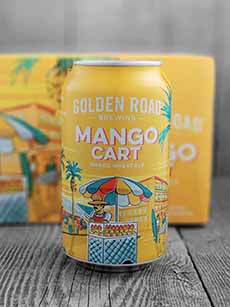
    Can Of Mango Cart Mango Wheat Ale
    [6] You can substitute Mango Cart, a mango-flavored wheat ale, for the regular beer. The different types of beer (photo © Craft Beer Kings).


    Cinco de Mayo is creeping up on us. We hasten to share this Mango Halibut Tacos recipe from John Baez, Executive Chef of Border Grill. We also have many more Cinco de Mayo recipes.

    Thanks to the National Mango Board for sponsoring this recipe. They have a wonderful trove of mango recipes for every meal of the day. We’ve just made the Mango Baked Brie and this Mango Jalapeño Cornbread Stuffing, which we made in a muffin pan to create individual cups that can be served with anything.
     
     
    RECIPE: MANGO & HALIBUT TACOS

    You can save time by purchasing corn tortillas, instead of making them from scratch (Step 5).

    You will need two squeeze bottles, for the Mango-Lime Vinaigrette and the Mango Aïoli.
     
    Ingredients For 1 Serving (3 Tacos)

    For The Mango-Lime Vinaigrette (Yields 24 Ounces)

  • 2 fresh ripe mangos
  • ½ cup fresh lime juice
  • ½ cup extra-virgin olive oil
  • Salt and pepper, as needed
  •  
    For The Mango-Pineapple Slaw (Yield 24 Ounces)

  • 2 fresh ripe, firm mangos, peeled, julienned
  • ¼ pineapple, peeled, cored, julienned
  • ½ green cabbage, cored, thinly sliced
  • ½ cup fresh mint, chiffonade
  • Salt and pepper, as needed
  •  
    For The Mango Aïoli (Yield 50 Portions)

  • 1 ½ cup fresh mango purée
  • 3 cups mayonnaise
  • ¼ cup fresh ginger juice
  •  
    For The Mango-Corn Tortillas (Yield 16)

  • 8 ounces fresh mango purée
  • 8 ounces water
  • 1 pound/16 ounces Maseca (photo #5) or other corn flour
  • 1 teaspoon kosher salt
  •  
    For The Mango Beer Batter

  • 2 cups fresh mango purée
  • 4 cups all-purpose flour
  • 2 cups beer‡
  • 4 eggs
  •  
    To Assemble The Tacos (Per Serving)

  • 6 ounces fresh halibut (cut into 2-oz pieces, preferably 3 x 1-in rectangles)
  • 6 ounces Mango Beer Batter
  • 2 ounces Mango-Pineapple Slaw
  • 1 ounce Mango-Lime Vinaigrette
  • Salt and pepper, as needed
  • 3 Mango-Corn Tortillas
  • 1-1/2 ounces Mango Aïoli
  • 2 lime wedges
  •  
    Preparation

    1. MAKE the Mango-Lime Vinaigrette. Peel and core the mangos, then purée the flesh in a blender on high speed until completely smooth. Add lime juice and purée together until thoroughly combined. Reduce the blender speed to low and slowly drizzle in olive oil to create an emulsion. Season to taste with salt and pepper. Place in a squeeze bottle; reserve.

    2. MAKE the Mango-Pineapple Slaw. Combine all the salsa ingredients in a mixing bowl and toss/mix gently by hand. Season to taste with salt and pepper. Do not add the vinaigrette until ready to serve (see Step 7).

    3. MAKE the Mango Aïoli. Combine fresh mango purée, mayonnaise, and ginger juice in a mixing bowl and whisk together by hand until completely combined. Place in a squeeze bottle and refrigerate until ready to use. (Note: If you are making a large enough batch, fresh ginger can be placed in a food processor and puréed to speed up the juice extraction process. A few drops of lemon or lime juice can also brighten up the aïoli.

    4. MAKE the Mango Beer Batter. Combine the puréed fresh mangos, flour, beer, and eggs in a mixing bowl and whisk by hand until completely combined. Refrigerate until ready to use. The consistency may be adjusted by adding more flour for a thicker batter or more purée for a thinner batter.

    5. MAKE the Mango-Corn Tortillas. In a stand mixer, combine all ingredients. Using a paddle attachment, mix ingredients at medium speed until a smooth dough is formed. Do not overmix the dough or it will alter the texture of the tortillas. Remove dough from mixer bowl and, using gloved hands, form into 1.5- to 2-oz balls. Using a tortilla press, place each dough ball in the center and press firmly to flatten the dough ball into a flat circle of dough/masa about 1/8 in thick (line the tortilla press surface with plastic wrap to ensure that the dough doesn’t stick). Place the dough circle onto a hot flattop or saute pan (350°F+) and cook on the initial side for 45 seconds to 1 minute. Then flip over and cook for an additional 30 seconds or until the tortilla begins to puff up. Remove the tortilla from the heat and reserve. Repeat with the remaining dough, holding the tortillas warm until ready to use.

    6. COOK the halibut. Toss halibut in the Mango Beer Batter, ensuring that it is completely coated, then drop into a deep fryer at 325°F for 3 to 5 minutes, or until golden brown and floating. Remove the halibut from the fryer and transfer it to a paper towel-lined plate or other surface and allow excess oil to drain off; season with salt and pepper. While the halibut is cooking…

    7. TOSS the slaw with the vinaigrette.
    (Note: Keep all ingredients/components separate until just prior to serving. Allowing ingredients to sit together for too long may result in the liquids over-saturating the fruits, causing them to be mushy.)

    8. ASSEMBLE the Mango Halibut Tacos. Briefly heat† the tortillas to make them more pliable, then add a small amount of slaw in a line down the center of each tortilla. Place a piece of fried halibut in each tortilla directly on top of the slaw. Using a squeeze bottle, drizzle the Mango Aïoli in a zig-zag pattern over the top of the fish, then top with the remaining slaw.

    9. PLATE. Gently fold the tortillas up and around the taco ingredients, place them on a plate, and prop them up with lime wedges on either end of the tortillas. Or check out these disposable taco holders, if you don’t serve tacos often enough to buy these colorful, reusable taco holders.

     
    ________________
     
    *The original aïoli is garlic-flavored mayonnaise from Provence, France (here’s the recipe). Whether garlic-flavored or mango-enhanced, as in this recipe, it has universal uses: as a condiment/spread for burgers and sandwiches, as a dipping sauce for crudités and fries, as a drizzle over meat, poultry, seafood (crab cakes!), and Tex Mex (quesadillas, tacos, etc.). Here are more uses for aïoli, the history of aïoli, and a quick recipe using store-bought mayonnaise.

    †Heat the tortillas in a dry hot pan for 20-30 seconds per side, or in the microwave covered with a damp paper towel. To microwave more than one, alternate the tortillas with damp paper towels, 30 seconds for one tortilla, and 1 minute for multiple tortillas. The goal in a microwave is to steam them.

    ‡Mango Cart wheat ale (photo #6) may be substituted for regular beer for even more mango flavor.


    CHECK OUT WHAT’S HAPPENING ON OUR HOME PAGE, THENIBBLE.COM.


    Comments off


    © Copyright 2005-2026 Lifestyle Direct, Inc. All rights reserved. All images are copyrighted to their respective owners.