THE NIBBLE BLOG: Products, Recipes & Trends In Specialty Foods


Also visit our main website, TheNibble.com.

TIP OF THE DAY: Ways To Serve Fish

Did you give up meat for Lent? Are you looking for different ways to add fish to your diet?

Here are recommendations from Chef Charlie Baggs, of Charlie Baggs Culinary Innovations in Chicago, to which we’ve added some of our own suggestions.

The original article was written for Flavor & The Menu, a magazine and website for chefs that made these suggestions for their menu during the six weeks of Lent when seafood sales soar.

Chef Baggs offers different techniques for cooking seafood in both traditional and more modern preparations. You can try a different one every day!

  • Baked: clams/oysters/clambake, en papillote; quiche; Salmon Wellington, smoked cod flan, wrapped in phyllo dough with dill and lemon sauce.
  • Boiled/steamed: crab, fish boil, gefilte fish, lobster, mussels, quenelles, shrimp cocktail, whole fish/fillets.
  • Cured/raw: carpaccio, ceviche, clams/oysters on the half shell, gravlax, sashimi/sushi, tartare.
  • Deep-fried: battered (calamari, clams, fish & chips, fish sticks, nuggets, poppers, tempura), breaded, fritters.
  • Dips and spreads: crab dip, smoked trout or whitefish, taramasalata.
  •    

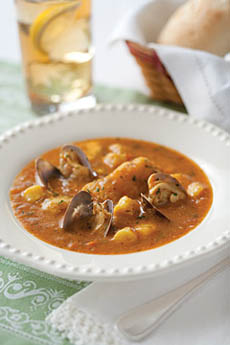
    bouillabaisse-mackenzie-230
    Make a hearty bouillabaisse. Photo courtesy MackenzieLtd.com.


    shrimp-fondue-230
    How about shrimp fondue? Photo courtesy The Melting Pot.
     
  • Grilled/broiled: fillets or whole fish—cod, mixed grill, octopus, salmon, sardines, skate, shrimp, snapper, squid, whitefish or other favorite; skewers/kebabs.
  • International: curry, fish tacos, seafood paella, stir-fried, Szechuan Fish, many more.
  • Pan-fried/sautéed: blackened, croquettes, frogs’ legs, trout, soft-shell crab, sablefish (black cod), salmon or trout patties.
  • Pickled: herring or salmon.
  • Poached: Salmon and whitefish; using shallow and deep poaching techniques.
  • Roasted: Whole fish, fillets or steaks
  • Roe/caviar: lumpfish, salmon roe, tobiko and whitefish caviars.
  • Smoked: halibut, kippered haddock (finnan haddie), herring, mackerel, salmon, scallops, smoked fish platter with bagels and cream cheese; sturgeon, trout, turbot, whitefish.
  • Soups: bouillabaisse; fish or seafood bisque or chowder.
  • Stews/casseroles: bouillabaisse, cioppino, etouffee, gumbo, New Orleans barbecued shrimp.
  • Stir-fried: Asian-style stir fry.
  • With starch: blini (buckwheat pancakes), crêpes/pancakes, jambalaya, pasta, pizza with clams, pot pie, risotto, shrimp and grits.
  • Other: Caesar salad with anchovies, escargots, lobster roll, crab/lobster/shrimp salad, seafood mousse, shrimp fondue.
  •  
    We’re sure we’ve left out other favorites. Don’t hesitate to let us know.
     
    Read the full article about Lenten dishes on Flavor & The Menu.


    Comments off

    TIP OF THE DAY: Food In A Cone

    Perhaps eight years ago, we saw an article in a trade magazine about a pilot pizza chain in California. All the pizza varieties were served in cones made of pizza dough. The founder’s concept was to make it easy to walk down the street eating from a cone instead of a drippy slice.

    We loved the idea, but to our knowledge, the business never went anywhere.*

    Recently, we discovered a pizza cone kit from Pizzacraft that enables you to turn out pizza cones at home. The kit is less than $19, is easy to use and includes everything you need to make two pizza cones at a time (you supply the food items).

    You can eat most any food in a cone, and as an alternative to pizza dough, can make waffle cones on a round waffle maker or a pizzelle maker. (Leave the sugar out of the recipe unless you’re using them for dessert.)

    Then, fill with any of your favorite fixings, including:

  • Scrambled eggs, cheese and pico de gallo
  • Chicken salad, egg salad, tuna salad, etc.
  •   pizza-cones-pizzacraft-amz-230

    Pizza in a cone. Photo courtesy Pizzacraft.

  • Chopped salad (a way to get kids to east more salad?)
  • Reverse chicken and waffles, with diced crispy chicken, Granny Smith apples and maple syrup
  • Taco fillings
  • Meatballs
  • Any diced or sliced protein and veggies
  •  
    Can’t wait? Neither can we!
     
    *UPDATE

    Right after we published this, we read today’s newsletter from Nation’s Restaurant News and learned, by pure coincidence, about Kono Pizza. The franchise chain has breakfast, lunch/dinner and dessert cones. The concept was created in Italy and is “popular around the world,” with 140 locations. The first franchise just opened in Edison, NJ, with Orlando and Iowa scheduled next.
      

    Comments off

    TIP OF THE DAY: Prosciutto Salad, The Sophisticated Ham Salad

    prosciutto-salad-olionyc-230
    Slices of prosciutto topped with a salad of
    baby arugula and watercress, topped with
    Parmigiano-Reggiano. Photo courtesy Olio e
    Piú | NYC.
      When you hear the words “ham salad,” you think of diced ham, possibly the leftovers from a holiday ham or Sunday dinner.

    Diced or minced ham is mixed with diced bell pepper, celery and onion or other favorite raw vegetables; perhaps with some hard-boiled eggs, boiled potatoes, pickle relish or green peas; and bound with mayonnaise (we use a mayo-Dijon blend).

    It’s one of those traditional Anglo-American sandwich salads, along with chicken salad, egg salad and tuna salad.

    It’s also served sans bread on a bed of green salad ingredients, perhaps with a scoop of another protein salad or a starch-based salad such as potato salad, macaroni salad or chopped vegetable salad.

    But there’s another, more sophisticated way to serve ham salad: as a first course with prosciutto or Serrano ham.

    Prosciutto, or Parma ham, is classically served as a first course with melon in Italian cuisine.

    At Olio e Piú in New York’s Greenwich Village, the chef takes a different direction, adding a salad of vinaigrette-dressed bitter greens (we like baby arugula, watercress or a mix) atop the prosciutto and topping it with some fresh-shaved Parmigiano-Reggiano cheese.


    WHAT ARE BITTER GREENS

    Bitter greens are part of the larger family of leafy greens, which include the lettuces, known as “sweet greens.” The bitterness can be mild or strong. Greens harvested earlier in the season tend to be less bitter than more mature plants harvested later.

    Many bitter greens are dark green in color, although some are pale (endive, frisée) and some are red or have red accents (amaranth, chard, radicchio). If you like your veggies, you’ve likely had more than a few of these:


  • Amaranth
  • Arugula
  • Belgian endive
  • Beet greens
  • Broccoli rabe/rapini
  • Chard
  • Chicory
  • Cress
  • Collard greens
  • Curly endive
  • Dandelion greens
  • Escarole
  • Frisée
  • Kale
  • Mizuna
  • Mustard greens
  • Nettles
  • Radicchio
  • Spinach
  • Tatsoi
  • Turnip greens
  •   red-white-belgian-230
    Not all “bitter greens” are green. Above, white endive and red endive, the latter also known as radicchio. Photo courtesy Endive.com.

     
    PROSCIUTTO & SERRANO HAMS: THE DIFFERENCES

    Both prosciutto and Serrano hams are dry-cured: salted and hung in sheds to cure in the air. Both are served in very thin slices. Country ham, preferred in the U.S., is smoked, and a very different stye from dry-cured hams.

    While prosciutto and Serrano hams can be used interchangeably, they are different.

  • Prosciutto, from Italy, is cured for 10-12 months with a coating of lard. Serrano, from Spain, can be cured for up to 18 months (and at the high end, for 24 months). The differing times and microclimates affect the amount of wind that dries the hams, and thus the character of the final products.
  • They are made from different breeds of pigs: Prosciutto can be made from pig or wild boar, whereas Serrano is typically made from a breed of white pig.
  • The diet of the pigs differs. Parma pigs eat the local chestnuts, and are also fed the whey by-product of Parmigiano-Reggiano.
  • Italian-made prosciutto is never made with nitrates. American made prosciutto, as well as both domestic and Spanish Serrano-style hams, can have added nitrates.
  • Prosciutto is considered more salty and fatty. Serrano is considered more flavorful and less fatty.
  •  
    MORE HAM

  • The different types of ham
  • American hams
  • Serrano ham vs. jamón ibérico
  •   

    Comments off


    © Copyright 2005-2026 Lifestyle Direct, Inc. All rights reserved. All images are copyrighted to their respective owners.